
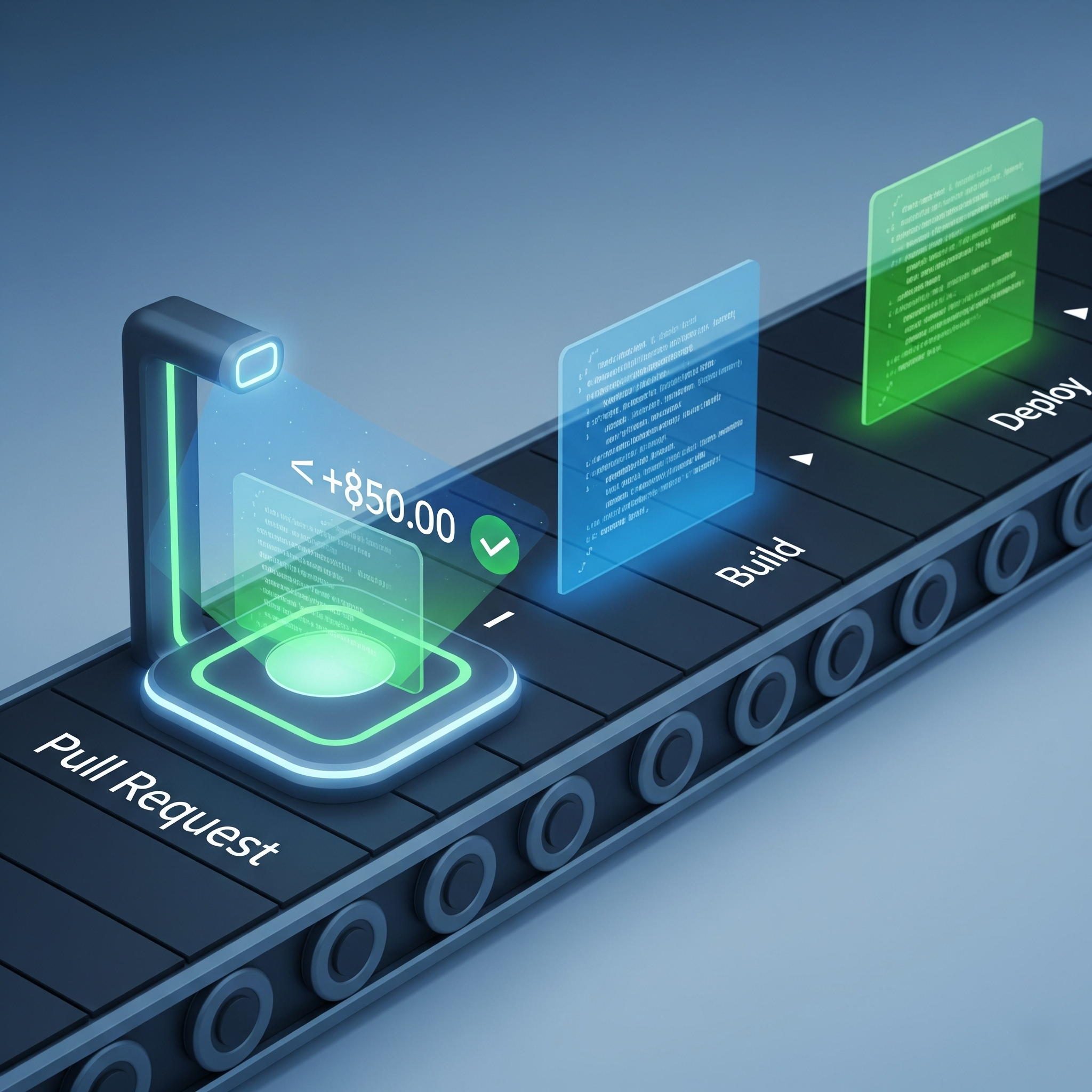
For years, cloud cost management has been a reactive exercise. An engineering team deploys a new feature, and a month later, the finance team sees a spike in the cloud bill and asks, "What happened?" This backward-looking process creates friction and fails to prevent overspending in the first place.
A modern, developer-first approach to FinOps flips this model on its head by "shifting left"—embedding cost visibility directly into the engineering workflow. The ultimate expression of this philosophy is implementing cost estimation directly within the CI/CD pipeline. This transforms cost from a financial metric into an engineering metric, providing immediate feedback on the financial impact of a code change before it ever reaches production.
Why Cost Estimation in CI/CD is a Game-Changer
Integrating cost awareness into the pull request (PR) process is a powerful mechanism for cultural change. The benefits are transformative:
Prevents Costly Mistakes: A simple typo in an Infrastructure as Code (IaC) file could accidentally provision a fleet of expensive GPU instances. A CI/CD cost check catches this before the merge button is ever clicked.
Empowers Developer Autonomy: When developers can see the cost impact of their changes instantly, they are empowered to make more cost-conscious architectural decisions.
Makes Cost Part of the Conversation: A cost estimate in a pull request makes the financial trade-offs of a new feature explicit.
Reduces Friction: It eliminates the month-end surprise and the blame game, fostering a more collaborative relationship between engineering and finance.
The Mechanics: How Does CI/CD Cost Estimation Work?
The implementation of cost estimation varies depending on what is being changed.
For Infrastructure as Code (IaC)
This is the most common and mature use case. For teams using tools like Terraform, OpenTofu, or CloudFormation, the process is relatively straightforward.
When a developer opens a pull request with changes to an IaC file, a CI/CD job is triggered.
A specialized tool, such as Infracost, analyzes the
terraform plan.The tool queries cloud provider pricing APIs to calculate the projected monthly cost of the resources being changed.
It then posts a comment back to the pull request with a clear summary of the cost delta.
For Application Code Changes
Estimating the cost impact of application code changes is more complex but is the holy grail of "shift left" FinOps. It requires a sophisticated cost intelligence platform that can model the relationship between application behavior and infrastructure consumption. For example, a change that introduces an N+1 query pattern in an API might not change the infrastructure directly, but it will dramatically increase database load and RDS costs.
A Step-by-Step Guide to Implementation
Implementing cost estimation in your pipeline can be done incrementally.
Start with IaC: This is the lowest-hanging fruit. Integrate a tool like Infracost into your version control system (e.g., GitHub Actions, GitLab CI).
Establish Baselines: The tool needs a baseline cost from your production environment to accurately calculate the delta of a proposed change.
Configure Pull Request Comments: Make the feedback visible and easy to understand by configuring the tool to post clear, automated comments on every relevant PR.
Introduce Governance Guardrails: Once the team is accustomed to the data, you can introduce automated policies. For example, a PR that increases monthly costs by more than $1,000 could require additional approval.
Conclusion
Integrating cost estimation into the CI/CD pipeline is more than just a technical enhancement; it is a profound cultural catalyst. When a cost report appears next to unit test results and security scans in a pull request, it fundamentally redefines what it means for code to be "production-ready." This shift empowers engineers to own their cloud spend within the tools and processes they use every day. It makes FinOps a proactive, bottom-up practice driven by engineering excellence, not a reactive, top-down mandate from finance.
All in One Place
Atler Pilot decodes your cloud spend story by bringing monitoring, automation, and intelligent insights together for faster and better cloud operations.