
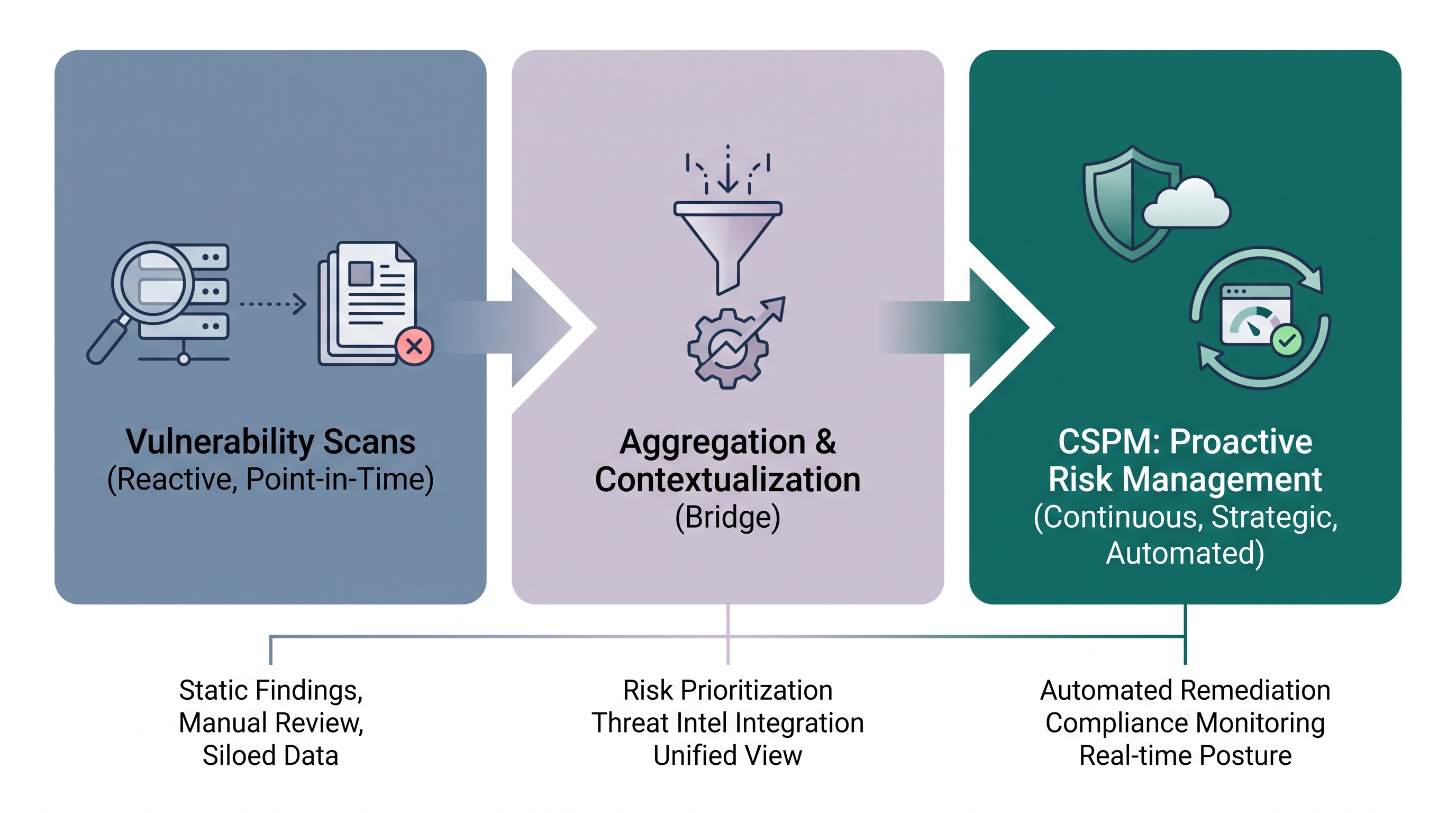
In the dynamic landscape of enterprise cloud operations, the distinction between merely reacting to threats and proactively mitigating risks is paramount. For years, vulnerability scanning has been the bedrock of security programs, diligently identifying known weaknesses in systems and applications. While indispensable, this approach often falls short in the face of rapidly evolving cloud infrastructures, ephemeral resources, and the intricate web of interdependencies that define modern multi-cloud environments. The sheer volume of alerts, the constant race against new CVEs, and the lack of contextual understanding often lead to "alert fatigue" and a reactive security posture.
Enter Cloud Security Posture Management (CSPM) – a transformative shift from a reactive, scan-and-patch mentality to a proactive, continuous, and intelligent risk management strategy. CSPM moves beyond simply identifying vulnerabilities to understanding the broader security context, enforcing compliance, detecting misconfigurations, and integrating deeply with the financial and operational aspects of cloud management. For enterprises grappling with AWS, Azure, GCP, and Oracle clouds, CSPM is not just a tool; it's a strategic imperative for unifying FinOps, cloud security, and automated operations.
The Limitations of Traditional Vulnerability Scanning in the Cloud Era
Traditional vulnerability scanning, whether network-based, host-based, or application-based, primarily focuses on detecting known vulnerabilities (CVEs - Common Vulnerabilities and Exposures) within specific components. These scanners typically operate by comparing software versions, configurations, and network services against a database of known security flaws. While crucial for identifying patch requirements and common misconfigurations, their inherent limitations become glaringly apparent when applied to the scale and complexity of cloud environments:
Point-in-Time Snapshots: Scans provide a snapshot of security posture at a given moment. In cloud environments where resources are provisioned, de-provisioned, and reconfigured continuously, a scan from yesterday might be irrelevant today. An ephemeral server spun up for a few hours might host a critical vulnerability and vanish before the next scheduled scan.
Lack of Contextual Intelligence: A vulnerability scanner might flag CVE-2023-XXXX on an EC2 instance. However, it cannot tell you if that instance is part of a critical production application, if it's internet-facing, if it holds sensitive customer data, or if it's isolated within a private subnet. Without this context, prioritization becomes a guessing game, leading to inefficient resource allocation for remediation.
Reactive Nature: Vulnerability scanning is inherently reactive. It identifies issues after they exist. While necessary for remediation, it doesn't prevent misconfigurations or policy violations from occurring in the first place.
Scan Fatigue and Alert Overload: The sheer volume of findings from traditional scans in large cloud estates can overwhelm security teams. Many findings might be low-risk, or on non-critical assets, making it difficult to identify the truly critical issues that require immediate attention.
Siloed Visibility: Traditional scanners often operate within specific domains (e.g., network, application). They typically lack a holistic view across an entire multi-cloud infrastructure, failing to correlate risks arising from interdependent services, misconfigured IAM policies, or network segmentation issues that span different cloud providers.
Limited Cloud-Native Understanding: They often struggle with cloud-native services (e.g., serverless functions, managed databases, container orchestration platforms) whose security models differ significantly from traditional VMs. Misconfigurations in S3 bucket policies, Azure Key Vault access, or GCP service account permissions are often outside their purview.
Consider an enterprise scenario: A legacy vulnerability scanner reports a high-severity CVE on an unpatched Linux kernel running on an AWS EC2 instance. While important, this information alone is insufficient for a FinOps-aware security team. What's missing is: Is this instance part of a critical application handling sensitive financial data, or is it a development sandbox? Is it publicly accessible? What is the blast radius if exploited? What is the cost impact of patching this instance during business hours versus after hours? These are questions that traditional scanning struggles to answer, leading to security decisions made in a financial and operational vacuum.
The Paradigm Shift: Introducing Cloud Security Posture Management (CSPM)
CSPM represents a fundamental evolution in cloud security, moving beyond simple vulnerability detection to a comprehensive, continuous, and context-aware approach to managing security posture across multi-cloud environments. At its core, CSPM continuously monitors and assesses cloud resources for misconfigurations, compliance deviations, and policy violations against predefined security benchmarks and organizational policies.
Unlike traditional scanners, CSPM operates at a higher level, understanding the intricate relationships between cloud resources, identity and access management (IAM) policies, network configurations, and data storage. It provides:
Continuous Monitoring: Real-time assessment of cloud configurations, ensuring that security policies are consistently enforced, not just at scheduled intervals.
Policy-Driven Enforcement: The ability to define and enforce security policies based on industry standards (e.g., NIST, PCI DSS, HIPAA, ISO 27001) and internal organizational requirements.
Misconfiguration Detection: Proactively identifying common misconfigurations that lead to vulnerabilities, such as publicly exposed S3 buckets, overly permissive IAM roles, unencrypted databases, or open network ports.
Identity and Access Management (IAM) Posture Analysis: Deep analysis of IAM policies to identify excessive permissions, privilege escalation paths, stale user accounts, and deviations from the principle of least privilege.
Network Security Visibility: Monitoring security groups, network ACLs, firewall rules, and VPC/VNet configurations to identify risky network exposures.
Data Security and Encryption Enforcement: Ensuring data at rest and in transit is encrypted according to policy.
Multi-Cloud Unification: A single pane of glass for managing security posture across disparate cloud providers like AWS, Azure, GCP, and Oracle, providing consistent policy application and consolidated reporting. CloudAtler offers a unified dashboard designed for this exact purpose, offering comprehensive visibility and control across your entire cloud estate.
The core philosophy of CSPM is proactive prevention and continuous assurance. Instead of waiting for a vulnerability to be exploited or a compliance audit to reveal issues, CSPM identifies and flags potential problems as soon as they arise, often before they can be exploited, transforming a reactive security team into a proactive risk management powerhouse.
Key Pillars of Proactive Risk Management with CSPM
Implementing a robust CSPM solution involves focusing on several critical areas that collectively contribute to a strong, proactive security posture:
1. Continuous Configuration Compliance and Governance
At the heart of CSPM is the ability to continuously assess and enforce configuration compliance. This goes beyond simple checks; it involves defining a baseline of secure configurations based on regulatory requirements (e.g., PCI DSS for financial services, HIPAA for healthcare) and industry best practices (e.g., CIS Benchmarks). A CSPM solution will:
Real-time Deviation Detection: Continuously monitor cloud resource configurations for any drift from the defined baseline. For example, if an S3 bucket's public access block is disabled, or an Azure Storage Account's encryption settings are changed, the CSPM immediately flags it.
Policy Enforcement: Translate compliance frameworks into actionable policies that can be automatically checked. This includes ensuring all EC2 instances have associated security groups, all Azure SQL Databases are encrypted with customer-managed keys (CMK), or all GCP Cloud Storage buckets enforce uniform bucket-level access.
Automated Remediation Workflows: For non-critical issues or clearly defined policy violations, CSPM can initiate automated remediation. This might involve re-enabling S3 public access blocks, detaching overly permissive IAM policies, or even triggering a serverless function to rotate credentials.
Architectural Example: An enterprise operating under PCI DSS requires all production databases to be encrypted at rest and in transit. A CSPM solution would integrate with AWS RDS, Azure SQL Database, and GCP Cloud SQL to continuously verify encryption status. If a new database instance is provisioned without encryption enabled (a common developer oversight), the CSPM would immediately detect this policy violation, alert the security team, and potentially initiate an automated workflow to either enable encryption or quarantine the resource, preventing it from entering production until compliant. This proactive enforcement prevents costly remediation efforts and potential compliance fines down the line, directly impacting FinOps through reduced risk and operational overhead.
2. Intelligent Identity and Access Management (IAM) Posture Management
IAM misconfigurations are a leading cause of cloud breaches. CSPM provides deep visibility and control over IAM, moving beyond basic user management to intelligent posture analysis:
Least Privilege Enforcement: Analyzing effective permissions for users, roles, and service accounts across clouds. This identifies instances where an IAM role has permissions far exceeding what it actually needs (e.g.,
s3:*on all resources when onlys3:GetObjecton a specific bucket is required).Privilege Escalation Path Detection: Identifying complex chains of permissions that could allow a low-privilege user to gain high-level access. This involves graph-based analysis of IAM policies and resource-based policies.
Stale Account Identification: Detecting dormant user accounts, access keys, or service principals that pose an unnecessary attack surface.
Cross-Account and Cross-Service Trust Analysis: Understanding trust relationships between accounts and services to ensure they are legitimate and not overly permissive.
Example: In a multi-account AWS environment, a developer's IAM role in a development account might inadvertently have iam:PassRole permissions that, when combined with other permissions, could allow them to assume a highly privileged role in a production account. A CSPM would detect this potential privilege escalation path, highlighting a critical risk that traditional auditing might miss. By addressing such issues proactively, enterprises reduce their attack surface and strengthen their overall security posture, a key component of robust security management.
3. Comprehensive Network Security and Segmentation Visibility
Network misconfigurations can expose critical assets to the internet or allow lateral movement within the cloud environment. CSPM provides continuous monitoring and analysis of network security controls:
Security Group/NACL/Firewall Rule Analysis: Identifying overly permissive rules (e.g., 0.0.0.0/0 to SSH/RDP ports), unused rules, or conflicting rules.
Public IP Address Exposure: Detecting instances, load balancers, or databases directly exposed to the internet when they should be private.
VPC/VNet Peering and Routing Analysis: Assessing the security implications of inter-VPC/VNet connections and routing tables to prevent unintended access.
Service Endpoint Misconfigurations: Ensuring private endpoints are correctly configured and not inadvertently exposing services.
Architectural Example: An enterprise uses an Azure Virtual Network (VNet) peered with another VNet in a different subscription. A developer accidentally configures a Network Security Group (NSG) rule allowing RDP (Port 3389) from "Any" source to a production VM within their VNet. A CSPM would immediately flag this critical exposure, identifying not just the open port but also the path of potential exploitation through the peered VNet, providing context that helps prioritize remediation and prevent unauthorized access.
4. Data Security and Encryption Enforcement
Protecting sensitive data is paramount. CSPM ensures that data security best practices are consistently applied across all cloud data stores:
Encryption at Rest and In Transit: Verifying that all storage services (S3, Azure Blob, GCP Cloud Storage), databases (RDS, Azure SQL, Cloud SQL), and message queues (SQS, Azure Service Bus, Pub/Sub) are encrypted using appropriate keys (KMS, Key Vault, Cloud KMS).
Public Data Exposure: Detecting publicly accessible data buckets or databases that contain sensitive information.
Data Residency Compliance: Ensuring data is stored in the correct geographical regions to meet regulatory requirements.
Sensitive Data Discovery (Integration): While not a core CSPM function, advanced CSPM platforms integrate with data classification tools to add context to findings, prioritizing risks associated with sensitive data.
5. Supply Chain Security and Image Vulnerability Integration
Modern cloud applications heavily rely on container images and third-party libraries. While traditional vulnerability scanning might cover OS-level CVEs, CSPM extends this by integrating with container image scanning and software supply chain security tools to provide a holistic view:
Container Image Vulnerability Scanning: Automatically scanning container images in registries (ECR, ACR, GCR) for known vulnerabilities before deployment.
Runtime Configuration Drift: Monitoring running containers for configuration changes that deviate from their secure baseline.
Dependency Analysis: Identifying vulnerabilities in third-party libraries and packages used within applications.
This "shift-left" approach ensures that security issues are identified and remediated earlier in the development lifecycle, significantly reducing the cost and effort of fixing them later.
CSPM for FinOps: Bridging Security and Cost Optimization
For enterprise FinOps teams, the integration of security and cost management is no longer optional; it's essential for sustainable cloud growth. CSPM plays a pivotal role in this convergence, providing tangible financial benefits through enhanced security:
Quantifying the Cost of Insecurity: Data breaches, compliance fines, and reputational damage carry enormous financial costs. CSPM helps prevent these by proactively identifying and mitigating risks. By understanding the potential financial impact of a security vulnerability (e.g., the cost of a data breach involving PII), FinOps teams can better justify security investments. CloudAtler offers advanced cost impact calculation, allowing organizations to understand the financial implications of security risks and remediation efforts.
Resource Optimization through Security Best Practices: Many security best practices align directly with cost optimization. For example, identifying and terminating unused or underutilized resources (e.g., idle VMs, unattached EBS volumes, overly provisioned databases) not only reduces attack surface but also eliminates unnecessary cloud spend. CSPM helps identify these "zombie" resources that are both security risks and cost drains.
Automated Remediation with Cost Awareness: Prioritizing remediation efforts based on both security severity and potential financial impact. A critical vulnerability on a non-production, low-cost resource might be less urgent than a medium-severity misconfiguration on a production resource handling high-value transactions. CSPM enables intelligent prioritization, ensuring that security budgets are spent where they yield the greatest return.
Preventing Costly Misconfigurations with Guardrails: CSPM allows organizations to define guardrails that prevent the provisioning of non-compliant or overly expensive resources. For instance, a policy can prevent the deployment of unencrypted databases in production or ensure that all resources are correctly tagged for cost allocation and security zones from inception. This proactive approach prevents costly security and operational debt.
Compliance Cost Reduction: Streamlining compliance reporting and audit preparation significantly reduces the manual effort and associated costs. CSPM provides continuous evidence of compliance, making audits smoother and less resource-intensive.
Budget Control and Alerting: Integrating security findings with financial insights allows for real-time alerts when security risks threaten budget adherence. For example, if a misconfiguration leads to excessive data egress charges, CloudAtler's budget control alerts can notify relevant teams, enabling prompt action.
By unifying FinOps and security, enterprises can achieve a state where security is not an afterthought but an intrinsic part of cost-effective cloud operations, driving both resilience and financial efficiency.
The Role of AI in Advanced CSPM and Proactive Risk Management (CloudAtler's Edge)
The sheer scale and complexity of multi-cloud environments make manual risk management untenable. This is where Artificial Intelligence (AI) and Machine Learning (ML) elevate CSPM from a rule-based system to a truly intelligent, proactive risk management platform. CloudAtler leverages AI to provide unparalleled capabilities:
AI-Driven Predictive Analytics: Moving beyond reactive detection, AI can analyze historical data, configuration patterns, and threat intelligence to predict potential misconfigurations or vulnerabilities before they occur. For example, AI can identify trends in developer deployments that frequently lead to specific types of misconfigurations and recommend preventative guardrails.
Automated Prioritization with Context: AI algorithms can correlate vulnerability data with asset criticality, network exposure, IAM permissions, and potential business impact (both security and financial). This intelligent prioritization cuts through alert fatigue, allowing security teams to focus on the truly high-risk issues that matter most. Instead of a flat "critical" rating, AI can determine that a "medium" vulnerability on an internet-facing production database with sensitive data is far more critical than a "high" vulnerability on an isolated development server.
Smart Remediation and Automated Workflows: AI can suggest optimal remediation steps, recommend policy changes, and even trigger automated fixes with intelligent guardrails. For complex issues, AI-powered systems like CloudAtler can orchestrate remediation workflows across multiple cloud services and teams. This includes features like safe rollbacks, ensuring that automated changes can be reverted if unintended consequences arise, minimizing operational risk.
Anomaly Detection: AI excels at identifying deviations from normal behavior that might indicate a sophisticated attack or a novel misconfiguration that traditional signature-based rules would miss. This includes unusual access patterns, resource provisioning outside of established norms, or unexpected network traffic.
Resource Relationship Mapping: AI can build and continuously update a comprehensive graph of all cloud resources and their interdependencies (e.g., which compute instance accesses which database, which IAM role governs which storage bucket). This deep understanding is crucial for calculating the true blast radius of a vulnerability or misconfiguration.
With Atler AI, CloudAtler transforms raw data into actionable intelligence, enabling enterprises to move from simply identifying risks to understanding, prioritizing, and proactively mitigating them with unprecedented efficiency and accuracy. This AI-powered approach is fundamental to unifying FinOps, cloud security, and automated operations.
Implementing a Proactive Risk Management Strategy with CloudAtler
Transitioning from reactive vulnerability scanning to proactive risk management with CSPM requires a structured approach. CloudAtler provides an end-to-end platform to facilitate this journey:
1. Multi-Cloud Discovery and Baseline Establishment
The first step is to gain complete visibility across all your cloud environments (AWS, Azure, GCP, Oracle). CloudAtler automatically discovers all your cloud assets, configurations, and existing security posture. It then establishes a baseline by assessing your current state against industry benchmarks (CIS, NIST, PCI DSS) and your organization's internal security policies.
Technical Implementation: CloudAtler integrates via read-only API access to each cloud provider (e.g., AWS IAM roles, Azure Service Principals, GCP Service Accounts). It performs deep inventory scans, ingesting metadata from EC2 instances, S3 buckets, Azure VMs, Storage Accounts, GCP Compute Engines, Cloud Storage, and their associated network, IAM, and encryption configurations. This data is then normalized and presented in a unified view.
2. Policy Definition and Continuous Enforcement
Define your security and compliance policies within the CloudAtler platform. You can leverage pre-built templates for common compliance frameworks or create custom policies tailored to your specific business needs. CloudAtler then continuously monitors your cloud resources against these policies.
Technical Implementation: Policies are defined as code or through a user-friendly interface. For example, a policy might state: "All S3 buckets in production accounts must have public access blocked and be encrypted with KMS." CloudAtler's agents or API polling mechanisms continuously evaluate every S3 bucket against this rule. Any deviation triggers an alert and, if configured, an automated remediation action. This also extends to patch governance, ensuring that patch policies are enforced across your compute fleet.
3. Real-time Monitoring and Intelligent Alerting
CloudAtler provides real-time alerts for any detected misconfigurations, policy violations, or suspicious activities. Critically, these alerts are enriched with contextual information (asset criticality, exposure, potential financial impact) and prioritized by Atler AI, ensuring that security teams focus on the most impactful risks first.
Technical Implementation: CloudAtler’s AI engine continuously processes ingested configuration data and changes. It applies machine learning models to identify anomalies and correlate seemingly disparate security events. Alerts are generated and can be integrated with existing enterprise communication and incident management systems (e.g., Slack, PagerDuty, ServiceNow, SIEM platforms) via webhooks or API, ensuring that the right teams are notified with actionable intelligence.
4. Automated Remediation and Governance Workflows
For many identified issues, CloudAtler can initiate automated remediation actions, either directly or through approval workflows. This reduces the manual effort of security teams and ensures consistent application of security best practices. For more complex issues, it guides teams through the remediation process with clear, step-by-step instructions.
Technical Implementation: Automated remediation is executed via cloud provider APIs (e.g., calling s3api:PutPublicAccessBlock to secure an S3 bucket). CloudAtler's platform includes robust workflow engines that can incorporate approval steps, rollbacks, and integration with change management systems. For instance, if a critical database is found to be unencrypted, the system can automatically create a ticket in Jira, assign it to the database team, and monitor its resolution, while also providing a safe rollback option if the automated fix causes an issue.
5. Comprehensive Reporting and Continuous Improvement
CloudAtler offers detailed reporting on your security posture, compliance status, and remediation progress. This enables continuous improvement by identifying recurring issues, tracking key security metrics, and demonstrating tangible risk reduction to stakeholders and auditors. The unified dashboard provides a single source of truth for security and FinOps teams.
Technical Implementation: The platform generates customizable reports for various stakeholders – CISO for overall risk, FinOps for cost-security alignment, and auditors for compliance evidence. Dashboards provide real-time visualizations of security posture trends, top risks, and remediation effectiveness, allowing for data-driven decision-making and continuous feedback loops into policy refinement.
Conclusion
The journey from traditional vulnerability scanning to proactive risk management with Cloud Security Posture Management is not merely an upgrade in tools; it's a fundamental transformation in how enterprises secure and operate their cloud environments. In an era where cloud resources are dynamic, multi-cloud strategies are commonplace, and the threat landscape is ever-evolving, a reactive approach is no longer sustainable. CSPM, especially when powered by AI, provides the continuous, context-aware, and automated capabilities necessary to stay ahead of threats, enforce compliance, and optimize cloud spend.
CloudAtler stands at the forefront of this evolution, offering an AI-powered platform that unifies FinOps, cloud security, and automated operations across AWS, Azure, GCP, and Oracle environments. By moving beyond just identifying vulnerabilities to understanding and proactively managing your entire cloud security posture, you can mitigate risks, ensure compliance, and achieve significant cost efficiencies. Don't let alert fatigue and reactive security compromise your cloud investments. Take control of your cloud security and financial health.
Ready to transform your cloud security from reactive to proactive? Discover how CloudAtler can unify your FinOps, cloud security, and automated operations. Visit CloudAtler.com today and schedule a demo to see our platform in action.
All in One Place
Atler Pilot decodes your cloud spend story by bringing monitoring, automation, and intelligent insights together for faster and better cloud operations.