
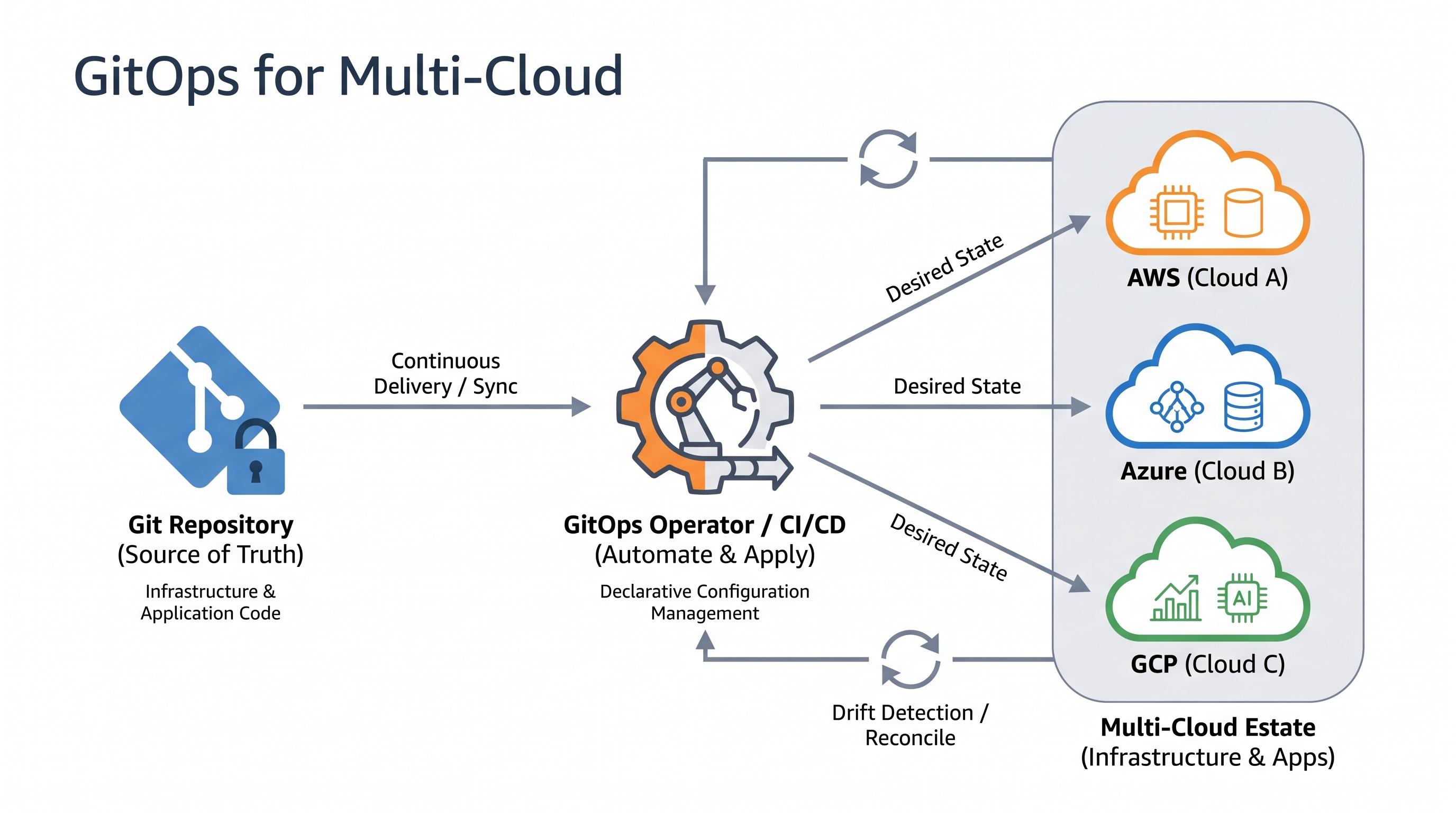
In the relentless pursuit of agility, resilience, and cost-efficiency, enterprises are increasingly adopting multi-cloud strategies. However, this diversification introduces a formidable challenge: managing disparate cloud environments—AWS, Azure, Google Cloud Platform (GCP), and Oracle Cloud Infrastructure (OCI)—with a unified approach to governance, security, and cost control. The traditional methods of manual configuration, ad-hoc scripting, and siloed operations are simply inadequate for the scale and complexity of modern cloud estates. What is needed is a paradigm shift, a methodology that brings the rigor and reliability of software development practices to infrastructure management. This is where GitOps emerges as the definitive answer, promising to version control your entire cloud estate and transform operational chaos into declarative order.
At CloudAtler, we understand that true multi-cloud mastery requires more than just visibility; it demands a unified control plane, intelligent automation, and a deep understanding of financial and security implications. GitOps provides the foundational methodology, and our AI-powered platform complements it by unifying FinOps, cloud security, and automated operations to deliver unparalleled intelligence and control.
Understanding GitOps Beyond Kubernetes
GitOps, at its core, is an operational framework that takes DevOps best practices used for application development—like version control, collaboration, compliance, and CI/CD—and applies them to infrastructure automation. While often associated with Kubernetes, where it truly shines in managing containerized workloads, the foundational principles of GitOps are universally applicable to any declarative system, including your entire multi-cloud infrastructure, encompassing IaaS, PaaS, and even some SaaS configurations.
The core tenets of GitOps are:
Declarative Configuration: The desired state of your infrastructure (e.g., a VPC, an EC2 instance, an Azure database, a GCP storage bucket, an OCI compute instance) is explicitly declared in configuration files.
Version Controlled: All changes to the desired state are stored in a Git repository, providing an auditable, revertible history of every modification. Git becomes the single source of truth.
Pulled Automatically: An automated agent or operator continuously observes the desired state in Git and the actual state of the infrastructure, automatically reconciling any discrepancies. This "pull" model is a key differentiator from traditional "push" CI/CD.
Continuously Reconciled: The system actively works to ensure the actual infrastructure always matches the declared state in Git, detecting and remediating configuration drift.
When we extend GitOps to a multi-cloud environment, we are essentially declaring the desired state of resources across AWS, Azure, GCP, and OCI within a centralized Git repository. This repository then becomes the authoritative blueprint for your entire cloud footprint, enabling consistent deployment, robust security enforcement, and precise cost management.
The Multi-Cloud Conundrum: Why Traditional Approaches Fail
Managing a single cloud provider is complex enough; scaling that complexity across multiple providers exponentially increases the challenges. Enterprises often grapple with:
Configuration Drift: Manual interventions or inconsistent scripts lead to environments deviating from their intended state, creating security vulnerabilities and operational instability.
Inconsistent Security Posture: Implementing uniform security policies (e.g., network segmentation, IAM roles, encryption standards) across different cloud providers with varying native controls is a monumental task, often leading to gaps and compliance failures.
Lack of Unified Cost Visibility and Control: Disparate billing systems, varied pricing models, and inconsistent tagging strategies make it nearly impossible to gain a holistic view of cloud spend, forecast budgets accurately, or identify optimization opportunities.
Operational Silos: Different teams specializing in different clouds lead to fragmented knowledge, inconsistent tooling, and slower incident response times.
Compliance Headaches: Demonstrating adherence to regulatory requirements (e.g., GDPR, HIPAA, PCI-DSS) across a sprawling multi-cloud estate without a centralized, auditable record of infrastructure changes is a significant burden.
Traditional approaches, which often rely on a mix of manual configurations, custom scripts, and cloud-specific CI/CD pipelines, exacerbate these issues. They lack the inherent auditability, consistency, and automated reconciliation that GitOps provides, leaving organizations vulnerable to human error, security breaches, and escalating cloud costs.
Architecting Multi-Cloud GitOps: Key Components and Workflow
Implementing GitOps for a multi-cloud environment requires a thoughtful architectural approach that leverages a combination of tools and methodologies. The goal is to establish Git as the single source of truth for all infrastructure and configuration, regardless of the underlying cloud provider.
Centralized Git Repository Structure
The foundation is a well-structured Git repository (or repositories). For multi-cloud, a monorepo approach often proves beneficial for centralized governance and visibility, though polyrepos can work for larger, highly distributed organizations. A typical structure might look like this:
        /cloud-estate
        ├── /aws
        │   ├── /regions
        │   │   ├── /us-east-1
        │   │   │   ├── /prod
        │   │   │   │   ├── /vpc.tf
        │   │   │   │   ├── /ec2-app-server.tf
        │   │   │   │   └── /s3-policy.json
        │   │   │   └── /dev
        │   │   │       ├── /vpc.tf
        │   │   │       └── /ec2-test-instance.tf
        │   ├── /policies  (e.g., OPA policies for AWS)
        ├── /azure
        │   ├── /subscriptions
        │   │   ├── /prod-subscription
        │   │   │   ├── /resource-groups
        │   │   │   │   ├── /rg-app-prod/main.bicep
        │   │   │   │   └── /rg-network/vnet.bicep
        │   │   │   └── /policies (e.g., Azure Policy definitions)
        ├── /gcp
        │   ├── /projects
        │   │   ├── /project-prod-123
        │   │   │   ├── /main.tf
        │   │   │   ├── /gke-cluster.yaml
        │   │   │   └── /iam-policy.yaml
        │   ├── /org-policies (e.g., GCP Organization Policies)
        ├── /oci
        │   ├── /compartments
        │   │   ├── /prod-compartment
        │   │   │   ├── /vcn.tf
        │   │   │   └── /compute-instance.tf
        ├── /shared
        │   ├── /modules (reusable IaC modules)
        │   ├── /global-policies (e.g., cross-cloud OPA policies)
        │   └── /templates (common configuration templates)
This structure ensures logical separation by cloud provider, environment, and resource type, facilitating easier management and permission control.
Infrastructure as Code (IaC) and Configuration as Code (CaC)
IaC is non-negotiable for GitOps. For multi-cloud, Terraform stands out as the predominant choice due to its provider-agnostic nature. It allows you to define resources across AWS, Azure, GCP, and OCI using a single language (HCL). For cloud-native resources or specific needs, you might still leverage:
AWS: CloudFormation
Azure: ARM Templates or Bicep
GCP: Google Deployment Manager or native Terraform providers
OCI: OCI Resource Manager (based on Terraform)
The GitOps repository would contain the IaC definitions. For Configuration as Code (CaC) at the OS or application layer, tools like Ansible, Chef, or Puppet can be integrated, with their playbooks/cookbooks also stored in Git.
Policy as Code (PaC)
Security and compliance policies are codified and stored in Git. Tools like Open Policy Agent (OPA) with Gatekeeper for Kubernetes, or Sentinel for Terraform Enterprise, allow you to define granular policies that are enforced throughout the GitOps pipeline. Examples include:
Ensuring all S3 buckets are encrypted and not publicly accessible (AWS).
Mandating specific VM sizes for cost optimization (Azure, GCP, OCI).
Restricting IAM role permissions (all clouds).
Enforcing resource tagging for FinOps and governance (all clouds).
These policies are checked pre-deployment (e.g., during a pull request review) and continuously post-deployment by the GitOps operator.
GitOps Operators and Reconciliation
While tools like Argo CD and Flux CD are Kubernetes-native, the core concept of a "GitOps operator" can be extended. For non-Kubernetes multi-cloud resources, this typically involves custom automation or specialized controllers:
Terraform Automation: A CI/CD pipeline (e.g., GitLab CI, GitHub Actions, Jenkins) is configured to monitor the Git repository. Upon a merge to the main branch, it triggers a
terraform plan(for review) and then aterraform apply(for execution) against the relevant cloud provider. This acts as the "reconciliation engine."Cloud-Native Automation: Leveraging cloud-native services like AWS CodePipeline/CodeBuild, Azure DevOps Pipelines, or GCP Cloud Build, triggered by Git events, to deploy cloud-specific IaC.
Custom Controllers: For highly bespoke scenarios, you might develop custom agents that poll Git and invoke cloud APIs to reconcile state.
The key is that the "operator" pulls the desired state from Git, rather than being pushed commands from an external system.
Secrets Management
GitOps mandates that secrets (API keys, database credentials) are never stored directly in Git. Integrate with robust secrets management solutions:
HashiCorp Vault
AWS Secrets Manager
Azure Key Vault
GCP Secret Manager
OCI Vault
Your IaC or application configurations will reference these secrets by name, with the GitOps operator or application runtime dynamically retrieving them at deployment or runtime.
GitOps for Multi-Cloud FinOps Optimization
GitOps is a powerful enabler for FinOps, especially in a multi-cloud context, by embedding cost awareness and control directly into your infrastructure provisioning and management workflows.
Cost Visibility and Governance Through IaC
By declaring all resources in IaC, you inherently gain visibility into what is being provisioned. This allows for:
Mandatory Tagging: Enforce resource tagging policies via PaC (e.g., OPA, Sentinel) to ensure every resource across AWS, Azure, GCP, and OCI has owner, cost center, and environment tags. This is crucial for accurate cost allocation and chargebacks. CloudAtler's platform further enhances this with automated tagging capabilities, ensuring consistency even with legacy resources.
Standardized Resource Types: Define and enforce approved resource types and sizes. For instance, prohibiting expensive GPU instances in development environments or mandating specific database tiers.
Resource Lifecycle Management: IaC allows for clear definition of resource lifecycles, enabling automated de-provisioning of temporary resources, preventing zombie infrastructure and associated costs.
Rightsizing and Iterative Optimization
GitOps facilitates continuous optimization by making every change version-controlled. When a team identifies an opportunity to rightsizing an EC2 instance, an Azure VM, or a GCP SQL database, the change is proposed via a pull request. This allows for:
Cost Impact Analysis: Before merging, tools can analyze the financial implications of the proposed change. CloudAtler's cost impact calculation feature, for example, can show you the estimated savings or additional costs associated with a change before it's deployed, directly integrating into your GitOps workflow.
A/B Testing of Configurations: Deploying different configurations (e.g., smaller VMs) to specific environments to test performance and cost, with easy rollback if issues arise.
Tracking Optimization History: Every rightsizing effort, every change in resource allocation, is recorded in Git, providing an immutable audit trail of your FinOps journey.
Budget Guardrails and Policy Enforcement
Policy as Code is instrumental in enforcing financial guardrails across your multi-cloud estate:
Preventing Over-provisioning: Policies can block deployments of resources exceeding predefined cost thresholds or those that don't adhere to specific budget categories.
Enforcing Commitment Utilization: For Reserved Instances (RIs) or Savings Plans, policies can prioritize the use of existing commitments before provisioning on-demand resources, maximizing savings. CloudAtler offers advanced commitment intelligence to optimize these decisions.
Budget Forecasting Integration: By having a declarative state, you can feed this into advanced budget forecasting tools like those offered by CloudAtler, gaining predictive insights into future cloud spend based on your desired infrastructure state.
By integrating these FinOps principles into your GitOps workflow, organizations gain unprecedented control over their multi-cloud spend, moving from reactive cost management to proactive financial governance. This is a cornerstone of a robust Financial Operations Platform strategy.
Enhancing Multi-Cloud Security with GitOps
Security is paramount, and GitOps fundamentally shifts cloud security left, embedding it into the development and deployment lifecycle, rather than an afterthought. This is particularly critical in a multi-cloud environment where security postures can vary widely.
Immutable Infrastructure and Configuration Drift Detection
GitOps promotes immutable infrastructure. Once a configuration is deployed, any deviation (drift) is automatically detected by the GitOps operator and reconciled back to the desired state defined in Git. This:
Reduces Attack Surface: Eliminates manual, unrecorded changes that could introduce vulnerabilities.
Ensures Consistency: Guarantees that all environments (dev, staging, prod) adhere to the same security baselines.
Automated Remediation: If a rogue actor or misconfiguration occurs, the system automatically reverts to the secure, desired state, significantly reducing response times for security incidents.
Centralized Policy Enforcement via Policy as Code
With PaC, security policies are defined once in Git and applied consistently across all cloud providers:
Network Security: Enforce strict network ACLs, security groups (AWS), Network Security Groups (Azure), firewall rules (GCP), and Security Lists (OCI) to control ingress/egress traffic. For example, a policy could dictate that no database port is open to the public internet across any cloud.
Identity and Access Management (IAM): Define least-privilege IAM roles and policies in code. This ensures consistent RBAC across AWS IAM, Azure AD roles, GCP IAM, and OCI IAM, preventing over-privileged accounts.
Encryption Standards: Mandate encryption at rest for all storage (S3 buckets, Azure Blobs, GCP Cloud Storage, OCI Object Storage) and encryption in transit for all data flows.
Compliance Guardrails: Integrate compliance checks directly into the GitOps pipeline. Policies can automatically flag or block deployments that violate industry standards like PCI-DSS or internal security benchmarks.
Auditability and Compliance
Every change to your cloud infrastructure, from a new firewall rule to a modified IAM policy, is a commit in Git. This provides an immutable, timestamped, and auditable record of all changes, including who made them and when. This drastically simplifies:
Compliance Audits: Auditors can review the Git history to verify that security policies were consistently applied and that changes followed proper approval workflows.
Incident Response: In the event of a breach, the Git history helps pinpoint when and how a vulnerability might have been introduced.
Security Posture Management: CloudAtler’s security management features integrate seamlessly with GitOps, providing a unified dashboard for multi-cloud security posture, drift detection, and automated remediation based on your Git-defined desired state. This is a critical component for any CISO security strategy.
Automated Vulnerability Management and Patching
While GitOps primarily manages infrastructure state, it can be extended to integrate with vulnerability management and patching strategies:
Image Management: Define base OS images with required patches in IaC. Update these images in Git, triggering automated rebuilds and deployments.
Patch Remediation: When new vulnerabilities are detected, the desired state in Git can be updated to include the necessary patches or configuration changes. The GitOps operator then automatically applies these across all affected instances, ensuring consistent and timely remediation. CloudAtler's patch remediation capabilities can be integrated to intelligently apply patches, considering their financial and operational impact.
Operationalizing GitOps Across Disparate Clouds: Challenges and Solutions
While the benefits are clear, implementing GitOps for multi-cloud is not without its challenges. Addressing these systematically is key to success.
Tooling Heterogeneity
Challenge: Each cloud provider has its own APIs, services, and native IaC tools (CloudFormation, Bicep, Deployment Manager). Managing this diversity can lead to complexity.
Solution: Standardize on a cross-cloud IaC tool like Terraform. While you might still use some native tools for specific edge cases, Terraform should be your primary language for declaring multi-cloud infrastructure. Leverage Terraform modules to abstract away cloud-specific details and promote reusability across environments and clouds.
State Management
Challenge: Terraform (and other IaC tools) maintain a state file that maps declared resources to actual cloud resources. Managing this state securely and reliably across multiple clouds and teams is complex.
Solution: Use remote state management with locking. For Terraform, this means using cloud-native storage like AWS S3 with DynamoDB locking, Azure Blob Storage with Lease Locks, or GCP Cloud Storage with GCS object locking. HashiCorp Terraform Cloud/Enterprise offers built-in state management and collaboration features designed for multi-team, multi-cloud scenarios. Ensure robust access control (IAM) to these state backends.
Identity and Access Management (IAM)
Challenge: Each cloud has its own IAM system (AWS IAM, Azure AD, GCP IAM, OCI IAM). Consistently managing user identities, roles, and permissions across these can be arduous.
Solution: Implement federated identity management. Use a central identity provider (IdP) like Okta, Azure AD, or Ping Identity to manage user identities and provision them to each cloud's IAM system. Define IAM roles and policies for your GitOps operators and human users in Git (Policy as Code) to ensure least privilege and consistent access control across all cloud providers.
Network Connectivity and Security
Challenge: GitOps agents or CI/CD runners need secure network access to deploy resources into each cloud environment, potentially across multiple regions and VPCs/VNets.
Solution: Design a secure multi-cloud network architecture. Use private endpoints (AWS PrivateLink, Azure Private Link, GCP Private Service Connect) where possible. Deploy GitOps agents or runners within secure network segments in each cloud or leverage secure VPN/Direct Connect connections to a central management plane. Ensure all communication is encrypted and adheres to network security policies defined in Git.
Observability and Monitoring
Challenge: Monitoring the actual state of resources and the health of the GitOps reconciliation loops across disparate cloud monitoring systems (CloudWatch, Azure Monitor, GCP Cloud Monitoring, OCI Monitoring) is difficult.
Solution: Implement a unified observability platform. Aggregate logs, metrics, and traces from all cloud providers into a central system (e.g., Datadog, Splunk, ELK Stack, Grafana Cloud). Monitor the GitOps pipeline itself for failures, reconciliation errors, and drift detection events. CloudAtler’s unified dashboard provides a single pane of glass for multi-cloud operational intelligence, security posture, and FinOps insights, making it easier to monitor the outcomes of your GitOps deployments.
Cultural Shift and Team Structure
Challenge: Moving to a GitOps model requires a significant cultural shift from traditional operations, empowering developers with infrastructure control and demanding collaboration between development, operations, finance, and security teams.
Solution: Foster a DevOps culture. Invest in training and education for all teams on GitOps principles, IaC, and PaC. Establish clear roles and responsibilities. Encourage cross-functional teams and shared ownership of infrastructure code. Implement robust code review processes for all infrastructure changes in Git.
The CloudAtler Advantage: Unifying GitOps for Enterprise Multi-Cloud
Implementing GitOps for a complex multi-cloud environment lays a powerful foundation for consistent, secure, and cost-effective operations. However, the sheer volume of data, the complexity of policy enforcement, and the need for proactive intelligence often exceed what a purely open-source GitOps stack can provide out-of-the-box. This is where CloudAtler’s AI-powered platform becomes an indispensable extension to your GitOps strategy.
CloudAtler acts as the intelligent layer atop your declarative GitOps state, providing the critical insights and automated actions necessary to truly optimize your multi-cloud estate:
AI-Powered FinOps Optimization: While GitOps ensures your desired state is cost-aware, CloudAtler’s Atler AI continuously analyzes your actual cloud consumption against your Git-defined infrastructure. It identifies hidden cost anomalies, makes proactive recommendations for rightsizing, commitment optimization (RIs/Savings Plans), and resource lifecycle management, going beyond basic tagging enforcement to provide predictive cost insights and budget forecasting.
Enhanced Security and Compliance: CloudAtler integrates with your GitOps-managed security policies, providing real-time validation against industry benchmarks and regulatory standards. It detects configuration drift that might bypass your GitOps reconciliation loops (e.g., external API calls) and offers automated remediation actions. Our platform provides deep vulnerability prioritization and patch intelligence, ensuring your Git-defined patch remediations are both effective and financially optimized.
Automated Operations and Drift Detection: Beyond simple reconciliation, CloudAtler provides advanced operational intelligence. It identifies performance bottlenecks, predicts potential outages, and provides intelligent recommendations for optimizing resource configurations defined in your Git repository. It acts as an additional layer of drift detection, identifying discrepancies between your Git-defined desired state and the observed actual state, and can trigger alerts or automated rollbacks.
Unified Multi-Cloud Visibility: Regardless of whether your infrastructure is in AWS, Azure, GCP, or Oracle, CloudAtler’s unified dashboard gives you a single, comprehensive view of your entire cloud estate. This holistic perspective is crucial for validating the outcomes of your GitOps deployments, monitoring performance, security posture, and cost across all environments without switching consoles.
Intelligent Guardrails and Safe Rollbacks: CloudAtler complements your Policy as Code by providing an intelligent guardrail system that prevents non-compliant or financially irresponsible changes from being deployed. In scenarios where a GitOps deployment leads to unforeseen issues, CloudAtler’s capabilities for safe rollbacks can help revert to a known good state quickly and efficiently, minimizing downtime and financial impact.
By combining the declarative power of GitOps with CloudAtler’s AI-driven intelligence and automation, enterprises can achieve true multi-cloud mastery. You move beyond merely version controlling your infrastructure to intelligently optimizing, securing, and operating it with unparalleled efficiency.
Conclusion
The journey to multi-cloud excellence is fraught with complexity, but GitOps offers a clear, consistent, and auditable path forward. By extending its principles beyond Kubernetes to encompass your entire cloud estate, organizations can establish a single source of truth for all infrastructure and configuration. This declarative approach fundamentally transforms how you manage AWS, Azure, GCP, and Oracle environments, delivering unparalleled benefits in consistency, security, auditability, and cost control.
Implementing GitOps means embedding FinOps and security into the very fabric of your cloud operations. Every change is tracked, reviewed, and automatically reconciled, significantly reducing human error, preventing configuration drift, and simplifying compliance. It empowers teams to operate with greater agility while maintaining stringent governance and financial oversight.
However, the full potential of multi-cloud GitOps is realized when augmented with intelligent platforms designed to interpret, optimize, and secure your declared state. CloudAtler provides that essential layer, unifying FinOps, cloud security, and automated operations with AI-powered insights across your diverse cloud environments. It helps you not just version control your cloud estate,
All in One Place
Atler Pilot decodes your cloud spend story by bringing monitoring, automation, and intelligent insights together for faster and better cloud operations.