
The AI Compute Crisis: When GPUs Break the Budget
In the rapid rush to integrate Generative AI into enterprise workflows, organizations have collided with a brutal financial reality: GPU computing in the public cloud is astronomically expensive. The transition from CPU-based microservices to massive parallel processing architectures has broken traditional cloud unit economics. A single misconfigured Kubernetes cluster running NVIDIA H100s or A100s over a weekend can incur tens of thousands of dollars in wasted spend, instantly wiping out months of careful FinOps optimizations in other departments.
Unlike standard x86 compute instances, which have become highly commoditized and easily auto-scaled based on simple CPU and memory thresholds, GPU workloads are fundamentally different. They are stateful, highly volatile, and constrained by physical hardware scarcity. You cannot simply "spin up a thousand GPUs" in a single availability zone without hitting severe quota limits. This scarcity drives up prices and necessitates a completely new paradigm for cost management.
This comprehensive guide dives deep into the architecture, operational strategies, and financial frameworks required to manage GPU costs in 2026. We will explore advanced virtualization, multi-cloud GPU brokering, spot instance survival architectures, and the cultural shift required to align data scientists with FinOps practitioners.
The Utilization Problem: Time-Slicing and Virtualization
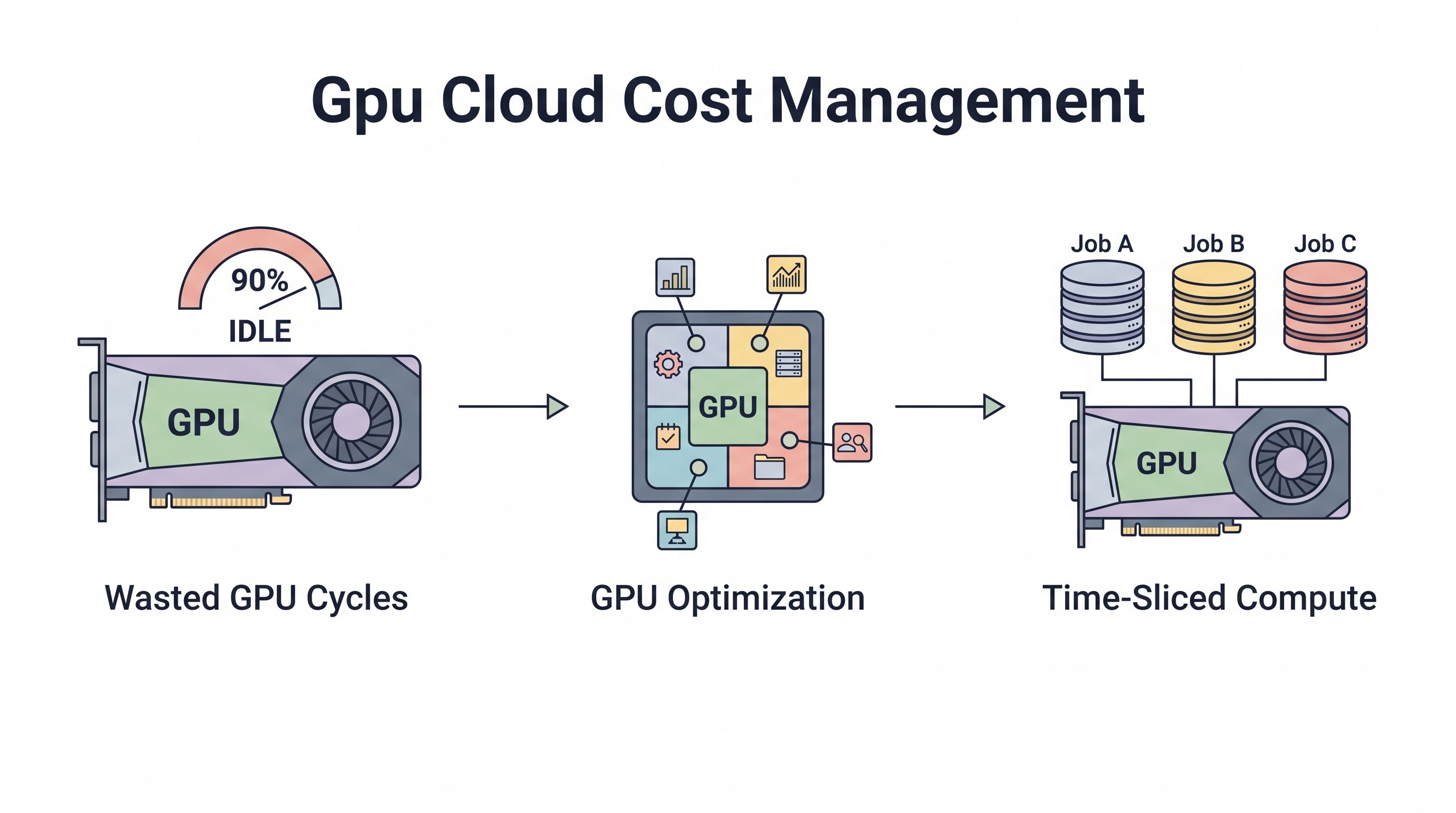
The most common and devastating source of GPU waste is low utilization. An organization might provision a massive instance (e.g., an AWS p4d.24xlarge costing over $30 an hour) for a data science team. However, data science workflows are notoriously spiky. The team spends 80% of their time writing code, prepping data on the CPU, and debugging. During this time, the massive GPU array sits completely idle. When they finally run a training epoch, the GPUs max out for two hours, and then return to idle.
The solution to this is advanced GPU virtualization and time-slicing. In 2026, mature organizations treat GPUs not as dedicated hardware for individual users, but as a shared, highly elastic pool of compute capacity. Technologies like NVIDIA Multi-Instance GPU (MIG) allow a single physical GPU to be partitioned into multiple, fully isolated hardware instances. A single A100 can be sliced into seven distinct instances, each with guaranteed memory and compute isolation.
This means a single high-end GPU instance can simultaneously serve low-latency inference requests for a production web application while also providing a sandbox environment for three different data scientists to test their models. By multiplexing workloads, organizations can drive baseline GPU utilization from an abysmal 15% up to a highly efficient 85% or 90%.
Implementing this requires sophisticated orchestration. Kubernetes has become the de facto standard for this, utilizing device plugins to expose MIG partitions to pods as schedulable resources. Advanced schedulers can dynamically reconfigure these partitions on the fly—merging them together for a massive overnight training job, and slicing them apart in the morning to serve inference traffic.
Spot Instances and Fault-Tolerant Training
For massive, distributed AI model training jobs, paying on-demand prices for GPUs is financially unsustainable. The sheer volume of compute required to train a foundational model from scratch can easily cost millions of dollars. Mature AI organizations rely heavily on Cloud Spot Instances (or Preemptible VMs), acquiring spare GPU capacity at discounts of up to 70% or 80% off the standard on-demand rate.
However, spot instances come with a massive caveat: they can be reclaimed by the cloud provider with only a two-minute warning. If a training job that has been running for three days is abruptly terminated, all progress is lost. To survive in a spot-driven environment, machine learning architectures must be highly resilient and fault-tolerant.
The core mechanism for this is aggressive, continuous checkpointing. Training frameworks (like PyTorch Lightning or Hugging Face Accelerate) must be configured to frequently save the model's weights, optimizer state, and random number generator state to durable object storage (like Amazon S3 or Google Cloud Storage) every few minutes or at the end of every epoch.
When the cloud provider sends the termination signal for the spot instance, the orchestration system (often a specialized framework like Ray or Kubernetes with Volcano scheduler) catches the signal, performs one final rapid checkpoint if possible, and allows the instance to die. The system then automatically requests a replacement spot instance. When the new instance boots, it downloads the latest checkpoint from S3 and resumes training exactly where it left off, with minimal lost time.
Deep Observability: Beyond CPU and Memory
Traditional cloud monitoring tools are inadequate for GPU workloads. Monitoring CPU and system memory provides almost zero insight into what the GPU is actually doing. To optimize GPU spend, organizations must deploy specialized observability stacks that scrape telemetry directly from the GPU drivers (e.g., via NVIDIA DCGM - Data Center GPU Manager).
Key metrics that must be tracked include:
GPU Utilization (SM Activity): The percentage of time the Streaming Multiprocessors are actively executing code.
GPU Memory Utilization: How much VRAM is currently allocated. High compute utilization with low memory utilization might indicate a bottleneck in data transfer.
PCIe/NVLink Bandwidth: The rate at which data is moving between the CPU and GPU, or between multiple GPUs. If this is maxed out, upgrading to a faster GPU will not improve performance; the bottleneck is the interconnect.
Power Draw and Temperature: Critical for understanding thermal throttling, which can drastically reduce performance and waste money.
By piping these metrics into centralized observability platforms (like Datadog, Prometheus, or Grafana), FinOps teams can create "GPU Efficiency Dashboards." These dashboards highlight instances that have been running for more than 24 hours with less than 20% SM utilization—prime candidates for termination or rightsizing.
The Multi-Cloud GPU Arbitrage
Because of hardware scarcity, sticking to a single cloud provider for GPU workloads is a significant risk. If AWS runs out of H100 capacity in your preferred region, your data science team is paralyzed. In 2026, leading organizations practice Multi-Cloud GPU Arbitrage.
This strategy involves building training pipelines that are entirely agnostic to the underlying cloud infrastructure. Data is stored in universally accessible lakes, and training jobs are containerized. A centralized meta-scheduler monitors spot prices and availability across AWS, Azure, GCP, and specialized AI clouds (like CoreWeave or Lambda Labs).
When a researcher submits a training job, the scheduler analyzes the requirements, scans the global market, and dynamically provisions the cluster in whichever cloud provider currently offers the lowest price for the requested hardware. This completely eliminates vendor lock-in and forces providers to compete on price, driving massive cost savings.
Bridging the Gap: Data Scientists and FinOps
The final, and perhaps most difficult, aspect of GPU cost management is cultural. Data scientists are highly paid experts focused on model accuracy and time-to-market. They are rarely incentivized to care about infrastructure costs. If a model trains 5% faster using a GPU cluster that costs 400% more, the data scientist will often choose the expensive cluster.
Bridging this gap requires embedding FinOps principles directly into the MLOps workflow. This is known as "Shift-Left FinOps for AI." When a researcher submits a training job via a Jupyter notebook or an MLOps platform (like Kubeflow or MLflow), the platform intercepts the request and provides an instant cost estimate before the job executes.
The prompt might say: "Training this model on 8x A100s will take 4 hours and cost $130. Alternatively, training it on 8x T4s will take 12 hours but cost only $15. Do you wish to proceed with the expensive option?"
By forcing cost visibility at the point of provisioning, organizations create a culture of financial accountability without acting as a bureaucratic roadblock.
Conclusion: Governing the AI Frontier
Managing GPU costs in the cloud requires a sophisticated blend of hardware virtualization, fault-tolerant software architecture, deep observability, and cultural alignment. As AI continues to consume an ever-larger percentage of enterprise IT budgets, the organizations that master these strategies will gain a massive competitive advantage. They will be able to iterate faster, train larger models, and deploy AI capabilities at scale, all while maintaining a sustainable and predictable financial baseline.
Key Takeaway
As organizations scale their AI and multi-cloud operations, prioritizing deep visibility, robust automation, and strict governance is critical. The successful integration of these advanced technical disciplines with cross-functional financial accountability ensures long-term operational resilience and architectural efficiency.
All in One Place
Atler Pilot decodes your cloud spend story by bringing monitoring, automation, and intelligent insights together for faster and better cloud operations.