
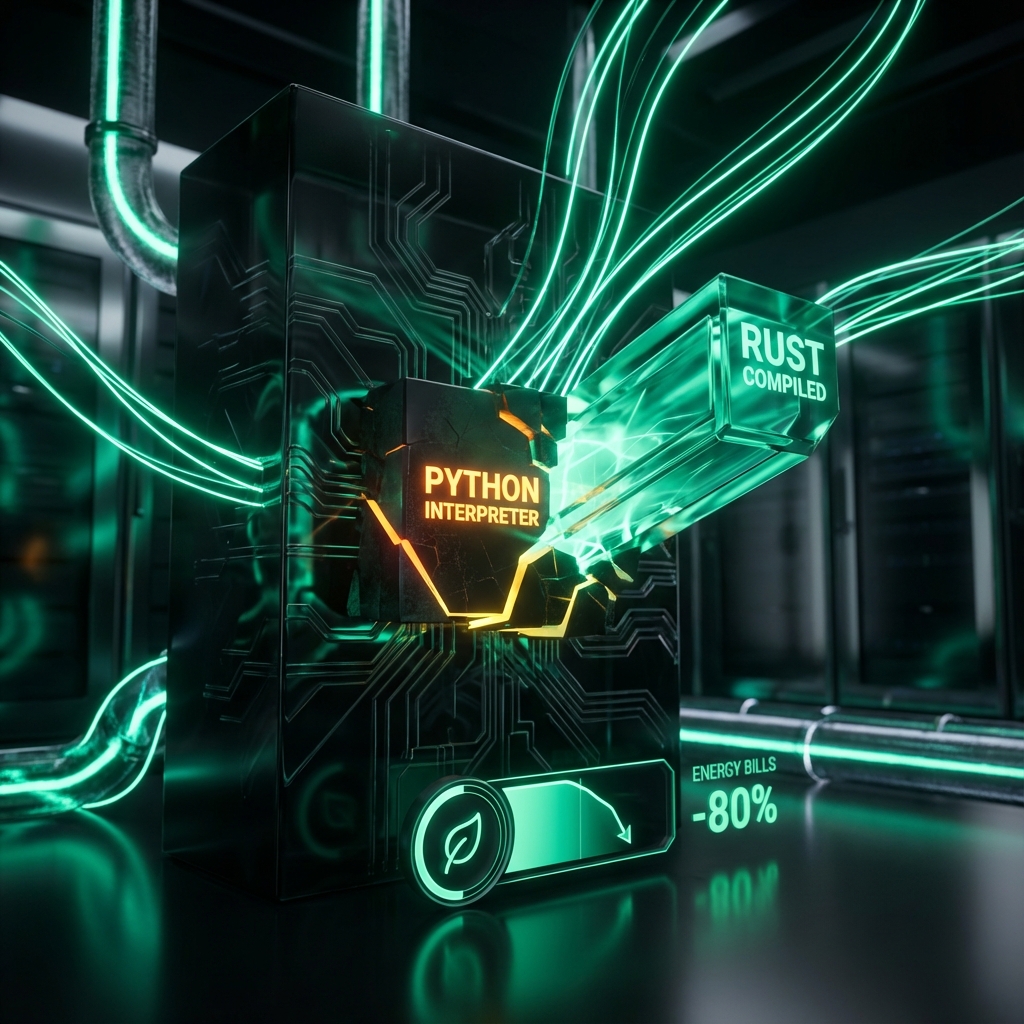
The Interpreted Tax. Everyone loves Python for its simplicity and ecosystem. It is the lingua franca of AI research. But for production systems at scale, it is the enemy of energy efficiency.
While the GPU does the heavy lifting for the matrix multiplication (often using CUDAs compiled C++ kernels), the Data Pipeline surrounding the model often runs involves massive CPU churn. Tokenization, JSON parsing, vector DB retrieval, and HTTP routing—if these run in pure Python, you are burning carbon unnecessarily.
Python's Global Interpreter Lock (GIL) prevents true parallelism on multi-core CPUs, and its dynamic typing adds massive overhead to every operation.
The Rust Advantage
Rust is a systems programming language that offers memory safety without a garbage collector. This "zero-overhead" philosophy makes it incredibly energy efficient.
A landmark study by researchers in Portugal (ranking languages by energy efficiency) found that Python consumes roughly 75 times more energy than C/Rust to perform the same algorithms. 75x!
Rewrite the "Hot Path"
We are not suggesting you rewrite your PyTorch model training code (PyTorch is largely C++ under the hood anyway). We are suggesting you rewrite the Inference Orchestration Layer (the API server).
Scenario: High-Throughput RAG API A service that takes a query, tokenizes it, hits a Vector DB, reranks results, and prompts an LLM.
Python (FastAPI + Uvicorn):
CPU Load: 45% per core
Memory: 250MB per worker
Rust (Axum + Tokio):
CPU Load: 1.5% per core
Memory: 15MB total
By moving the high-frequency JSON handling and HTTP routing to Rust, you remove the bottleneck. Tools like PyO3 allow you to write high-performance Rust modules that can be imported directly into Python as standard libraries, giving you the best of both worlds.
Case Study: The Tokenizer
A major AI SaaS provider rewrote their tokenizer service (which runs on every single requested token) from Python to Rust. The result?
Latency: Dropped from 10ms to 0.5ms (20x speedup).
Server Fleet: Dropped from 100 instances to 8 instances.
That is 92 fewer servers that need to be manufactured, powered, cooled, and monitored. Green Code is Cheap Code. If you are running at scale, "Developer Velocity" (writing code fast) matters less than "Execution Velocity" (running code fast).
In the Serverless era (AWS Lambda), this translates directly to money. A Rust Lambda starts up in milliseconds and runs for a fraction of the time of a Python Lambda, slashing your monthly bill.
All in One Place
Atler Pilot decodes your cloud spend story by bringing monitoring, automation, and intelligent insights together for faster and better cloud operations.