
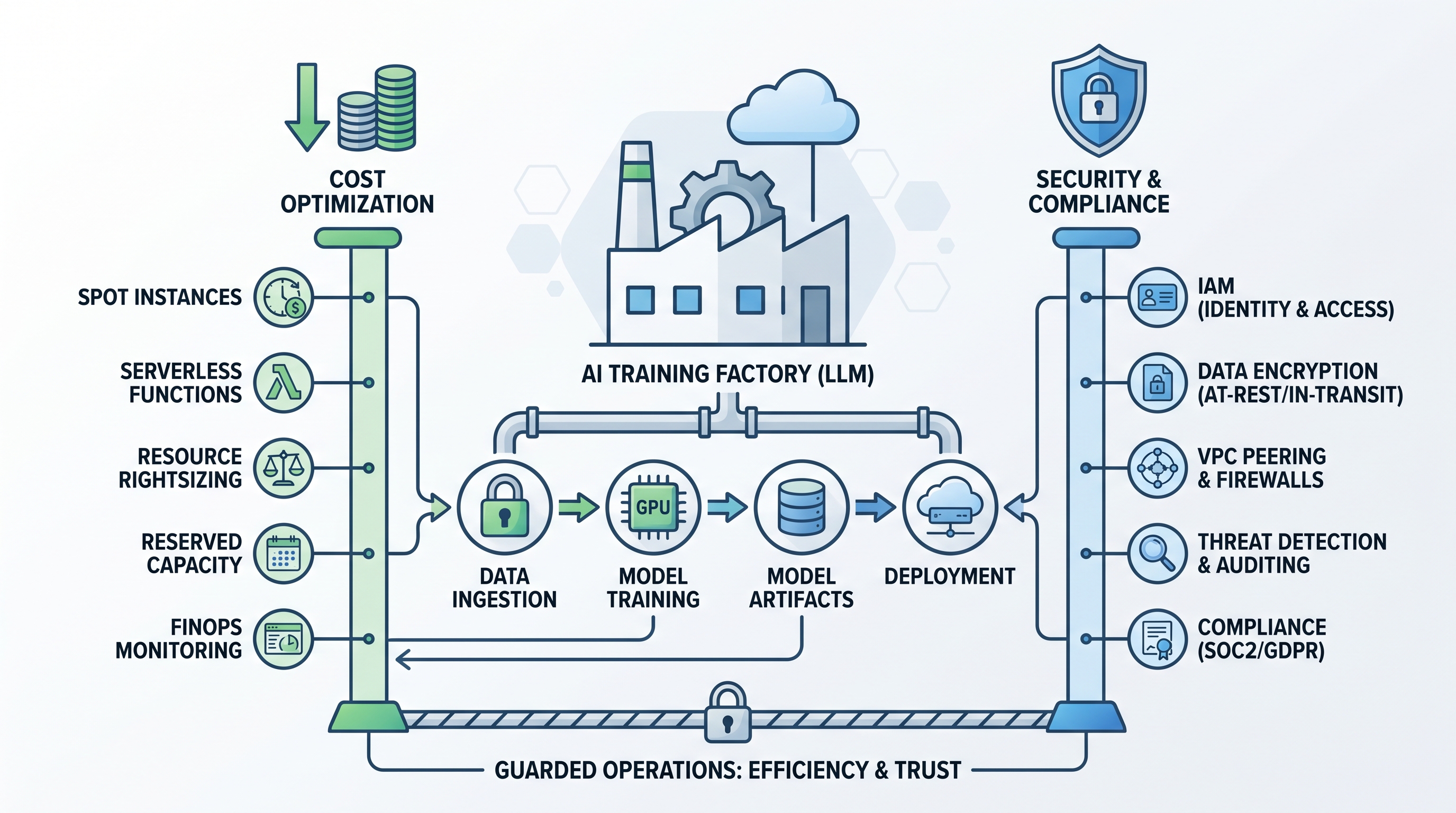
Introduction: The Anatomy of an AI Factory
To train a modern Large Language Model (LLM) with tens or hundreds of billions of parameters—such as Llama 3 or custom domain-specific models—organizations must transition from standard cloud computing paradigms to building highly specialized, high-performance computing (HPC) environments. These environments are often referred to as "AI Factories." Training these models requires running massive distributed jobs across hundreds or thousands of interconnected GPUs (such as NVIDIA H100s, A100s, or cloud-specific accelerators like AWS Trainium and Google Cloud TPUs) for weeks or even months at a time.
This scale introduces unprecedented operational challenges. A single configuration error can lead to silent data corruption, a security breach of proprietary pre-training data, or a runaway cloud bill exceeding hundreds of thousands of dollars in a matter of days. Traditional cloud architectures, built for microservices and horizontal web scaling, fail under the weight of distributed training frameworks like Megatron-LM, DeepSpeed, and PyTorch Fully Sharded Data Parallel (FSDP).
To navigate these challenges, enterprise cloud architects, security engineers, and financial operations teams must implement a unified architecture that balances performance, cost optimization, and rigorous security. This article provides a comprehensive blueprint for designing, securing, and optimizing LLM training infrastructures across multi-cloud environments, ensuring your AI factory remains both highly secure and financially sustainable.
1. The Physical and Logical Architecture of a Distributed LLM Training Cluster
To understand cost and security, we must first examine the physical and logical architecture of an LLM training cluster. The design must minimize latency and maximize throughput across three primary pillars: compute, interconnect, and storage.
Compute Nodes
The foundation of the AI factory rests on GPU-accelerated virtual machines or bare-metal instances, such as AWS p5.48xlarge, Azure ND H100 v5, or Google Cloud a3-highgpu-8g. These instances typically feature 8x NVIDIA H100 Tensor Core GPUs interconnected via high-bandwidth NVSwitch fabrics within the node, delivering up to 3.2 Tbps of bidirectional bandwidth per node. These physical nodes must be placed in close physical proximity within the cloud provider's data center to minimize latency.
Interconnect Topology
Standard TCP/IP Ethernet is wholly insufficient for the microsecond-level latency and massive throughput required by distributed training collective operations (such as All-Reduce, All-to-All, and Reduce-Scatter). Enterprises must deploy Non-Blocking InfiniBand or RoCEv2 (RDMA over Converged Ethernet) fabrics. A lossy network causes packet retransmissions, stalling the entire training cluster and wasting expensive GPU cycles. The network topology must support GPUDirect RDMA, allowing GPUs in different nodes to write directly to each other’s memory spaces without involving the host CPU or operating system kernel.
Storage Architectures
Training datasets often span terabytes or petabytes of unstructured text, code, or multimodal data. The storage system must feed the GPUs continuously to prevent "starvation," where GPUs sit idle waiting for data. Standard object storage (Amazon S3, Azure Blob, Google Cloud Storage) cannot handle the random-access patterns and metadata operations of training. Architects must deploy parallel file systems like Lustre (AWS FSx for Lustre), WekaIO, or GPUDirect Storage (GDS). GDS bypasses the CPU and system memory, transferring data directly from storage NVMe drives to GPU memory via PCIe switches, reducing latency and CPU utilization.
+-----------------------------------------------------------------+
|                         Compute Node                            |
|  +--------------+  +--------------+      +-------------------+  |
|  |  NVIDIA H100 |  |  NVIDIA H100 |      |     Host CPU      |  |
|  +------+-------+  +------+-------+      +---------+---------+  |
|         |                 |                        |            |
|  +------+-----------------+-------+                |            |
|  |           NVSwitch             |                |            |
|  +---------------+----------------+                |            |
|                  |                                 |            |
|         +--------+---------+                       |            |
|         |   PCIe Switch    +-----------------------+            |
|         +--------+---------+                                    |
|                  |                                              |
|         +--------+---------+                                    |
|         |     SmartNIC     |                                    |
|         | (InfiniBand/RoCE)|                                    |
+---------+--------+---------+------------------------------------+
                   |
         +---------+---------+
         | High-Speed Fabric | ---> To Other Nodes & Parallel Storage
         +-------------------+
Network Segmentation
The training cluster must be isolated in a dedicated Virtual Private Cloud (VPC) or Virtual Network (VNet). The high-speed backend network (InfiniBand/RoCEv2) must be physically or logically isolated from the frontend management network. Only control plane traffic (e.g., Kubernetes API, SSH management) should traverse the frontend network, while all data synchronization and training communication are restricted to the high-speed backend fabric.
2. FinOps Tactics: Mitigating Astronomical Compute Costs
The financial impact of LLM training is staggering. Running a 1024-GPU cluster of H100s can cost upwards of $3,000 to $4,000 per hour. Without strict controls, costs can quickly spiral out of control. To optimize this spend, organizations must adopt a rigorous FinOps framework tailored for high-performance computing.
Idle GPU Mitigation & Checkpoint Optimization
The primary driver of wasted spend is idle GPU capacity. During training, if a single GPU fails, the entire training run typically halts. If checkpointing (saving the model state to disk) is slow, the cluster remains idle while writing gigabytes of model state to persistent storage. To mitigate this, implement asynchronous checkpointing using local NVMe storage before offloading to object storage. This reduces the time GPUs spend blocked on I/O operations.
Additionally, leverage Spot/Preemptible instances where possible. While risky for long-running training runs due to eviction rates, you can run smaller fine-tuning or preprocessing jobs on Spot instances. To successfully run large-scale training on Spot instances, implement automated checkpoint-resume frameworks (e.g., using Kubernetes operators or Slurm scripts) that detect eviction notices (typically 30 seconds to 2 minutes in advance) and immediately serialize the model state to a fast distributed file system.
Parallelism Strategies and Memory Management
Choosing the wrong parallelization strategy leads to Out-Of-Memory (OOM) errors and underutilized hardware. Architects must balance the following paradigms:
Data Parallelism (DP): Replicating the model across GPUs and splitting the batch.
Tensor Parallelism (TP): Splitting individual layers (like matrix multiplications) across multiple GPUs (e.g., Megatron-LM).
Pipeline Parallelism (PP): Splitting layers sequentially across different GPUs.
Fully Sharded Data Parallel (FSDP): Sharding model parameters, gradients, and optimizer states across data-parallel workers.
By matching the parallelization strategy to the model's architecture, you maximize Model FLOPs Efficiency (MFE), ensuring you get the maximum computational value out of every billed second. MFE can be calculated using the following formula:
MFE = (Actual FLOPs per GPU per second) / (Theoretical Peak FLOPs of the GPU)
If your MFE is 30% (common for poorly optimized runs), you are wasting 70% of your GPU spend. By optimizing batch size, activation checkpointing, and using advanced kernels like FlashAttention-2, you can raise MFE to 55-60%, effectively cutting your training costs in half.
Commitment and Capacity Planning
On-demand pricing for high-end GPUs is unsustainable for enterprise-scale training. Organizations must leverage structured commitment models, such as AWS Savings Plans, Azure Reserved VM Instances, or GCP Committed Use Discounts. However, static reservations lack flexibility when model architectures shift. Integrating a comprehensive financial operations platform allows teams to continuously evaluate commitment coverage, cross-charging, and optimization opportunities. By utilizing predictive budget forecasting, teams can model the financial impact of multi-month training runs before provisioning a single instance, preventing unexpected overages.
Data Transfer and Egress Cost Optimization
LLM training datasets are massive. Transferring raw data across regions or from on-premises data centers to the cloud can incur crippling egress fees. Always locate your training cluster in the same cloud region as your prepared dataset. Use VPC Endpoints (S3 Gateway Endpoints or PrivateLink) to ensure that data ingestion traffic does not traverse the public internet, avoiding both security risks and astronomical NAT Gateway processing charges.
3. Securing the Training Pipeline: Data Protection and Governance
The raw data used to train LLMs often contains highly sensitive IP, proprietary source code, or personally identifiable information (PII). Securing this "AI Factory" requires a multi-layered security strategy that spans data ingestion, transit, and access control.
Data Ingestion, Sanitization, and Poisoning Prevention
Before data reaches the training cluster, it must undergo rigorous preprocessing. Implement an automated pipeline to scrub PII (using libraries like Microsoft Presidio or custom NLP models) and filter out malicious content. Data poisoning—where an attacker injects malicious samples into the training set to create backdoors in the model—must be mitigated by verifying data lineage and cryptographic hashes of all training partitions. Maintain a secure, immutable ledger of all training data sources.
Encryption at Rest and in Transit
All data must be encrypted at rest using customer-managed keys (CMKs) rotated automatically. In transit, enforce TLS 1.3 across all communication channels. However, standard TLS overhead can degrade the performance of high-speed inter-node communications. For RDMA/RoCEv2 networks, deploy hardware-level encryption (IPsec or MACsec) supported by modern smartNICs (like NVIDIA BlueField DPUs) to secure inter-node traffic without sacrificing throughput.
To govern these environments effectively, security teams must deploy robust cloud security management systems that continuously audit encryption configurations, key rotation policies, and network exposure across all cloud environments.
IAM and Least-Privilege Access Control
Training clusters require access to massive data buckets and container registries. Do not use long-lived IAM user credentials. Instead, leverage short-lived, role-based credentials. In Kubernetes, use IAM Roles for Service Accounts (IRSA) to bind cloud IAM roles to specific Kubernetes service accounts, ensuring that training pods have only the permissions required to read training data and write checkpoints.
Here is an example AWS IAM policy restricting a training job to read-only access on a specific S3 bucket:
{
    "Version": "2012-10-17",
    "Statement": [
        {
            "Effect": "Allow",
            "Action": [
                "s3:GetObject",
                "s3:ListBucket"
            ],
            "Resource": [
                "arn:aws:s3:::your-training-data-bucket",
                "arn:aws:s3:::your-training-data-bucket/*"
            ]
        }
    ]
}
Conclusion
Building an AI factory is a massive undertaking that demands a paradigm shift from traditional cloud architecture. The convergence of ultra-high-speed networking, parallel storage, and thousands of GPUs requires meticulous planning. Without stringent FinOps controls, organizations risk massive cost overruns, and without rigorous security frameworks, they expose highly sensitive training data to significant risk.
By implementing the architectural blueprints, financial guardrails, and security protocols outlined in this guide, enterprises can confidently harness the power of large language models. The organizations that succeed will be those that view their AI infrastructure not merely as a cost center, but as a secure, optimized, and highly governed engine for future innovation.
All in One Place
Atler Pilot decodes your cloud spend story by bringing monitoring, automation, and intelligent insights together for faster and better cloud operations.