
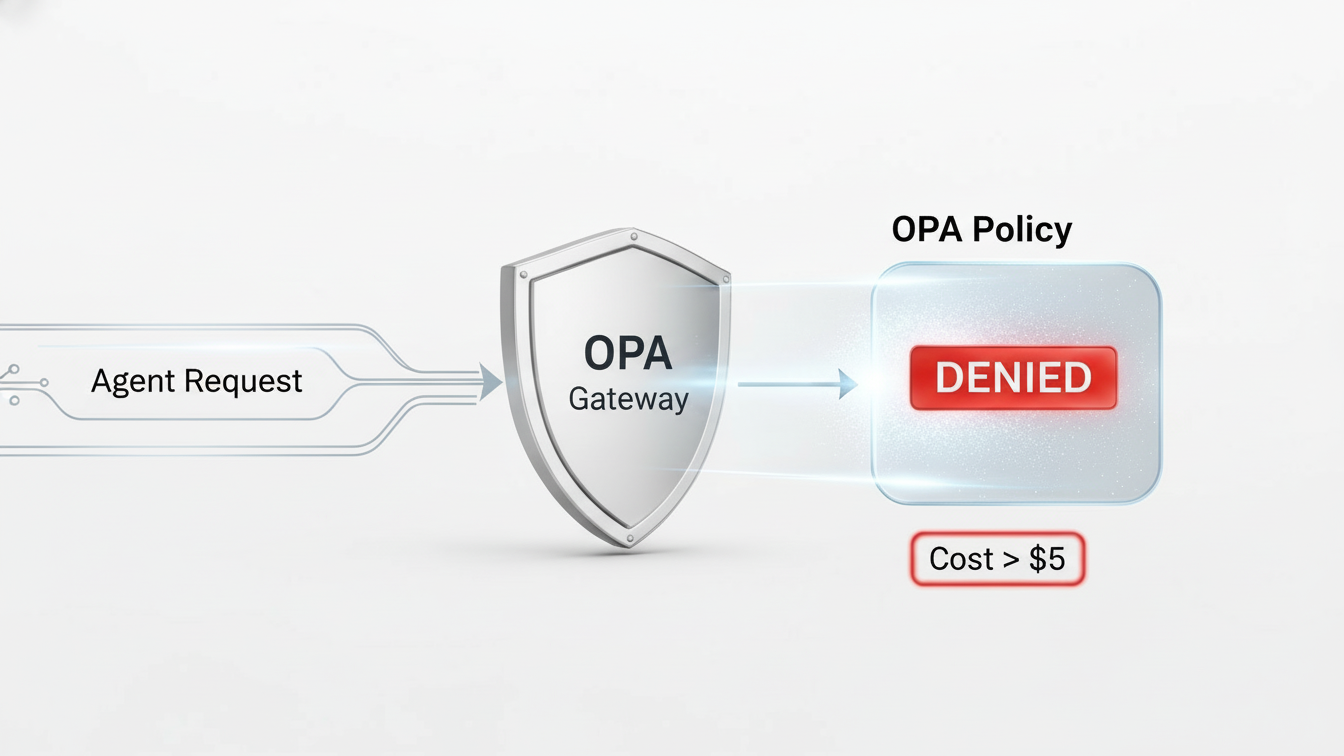
We trust AI agents to code, plan, and speak. Should we trust them with the company credit card? An autonomous agent can easily rack up costs by looping, selecting the most expensive model (e.g., OpenAI o1) for trivial tasks, or downloading massive datasets.
Policy-as-Code (PaC) allows us to enforce financial guardrails at the network or proxy layer, blocking expensive actions before they incur cost.
The Tool: Open Policy Agent (OPA)
OPA is the industry standard for Policy-as-Code. We can place an OPA gateway (like Kong with the OPA plugin) between our Agents and the LLM APIs.
Policy Example 1: The "Model Downgrade" Rule
If an agent tries to use a "Reasoning Model" (expensive) for a "Classification" task (cheap), block it.
Code snippet
package ai.finops

# Deny if using o1 for non-approved tasks
deny[msg] {
    input.model == "openai-o1"
    not input.task_type == "complex_reasoning"
    msg := "Cost Alert: High-cost model 'o1' restricted to reasoning tasks only."
}
Policy Example 2: The "Budget Circuit Breaker"
Stop an agent if its session cost exceeds $5.00. (Requires tracking accumulated spend in the context).
Code snippet
package ai.finops

deny[msg] {
    input.agent_id == "coding_bot_v1"
    input.session_spend_usd > 5.00
    msg := "Budget Exceeded: Agent session has consumed over $5.00. Governance intervention required."
}
Policy Example 3: Context Window Limiting
Prevent agents from sending massive prompts that burn tokens unnecessarily.
Code snippet
package ai.finops

deny[msg] {
    count(input.messages) > 0
    # Estimate token count (approx 4 chars per token)
    total_chars := sum([count(m.content) | m := input.messages[_]])
    total_tokens := total_chars / 4
    total_tokens > 30000
    msg := "Payload too large: Request exceeds 30k tokens. Please summarize context first."
}
Implementation Architecture
Agent sends request to LLM Gateway.
Gateway pauses request and sends metadata (model, prompt length, agent ID) to OPA.
OPA evaluates Rego policies.
OPA returns Allow or Deny.
If Allow: Gateway forwards request to OpenAI/Anthropic.
If Deny: Gateway returns 429 error to Agent with the policy message.
Why this matters: This moves cost control from "reactive monitoring" (looking at dashboards) to "proactive enforcement" (stopping the spend). It is the only way to safely scale autonomous agents in an enterprise environment.
All in One Place
Atler Pilot decodes your cloud spend story by bringing monitoring, automation, and intelligent insights together for faster and better cloud operations.