
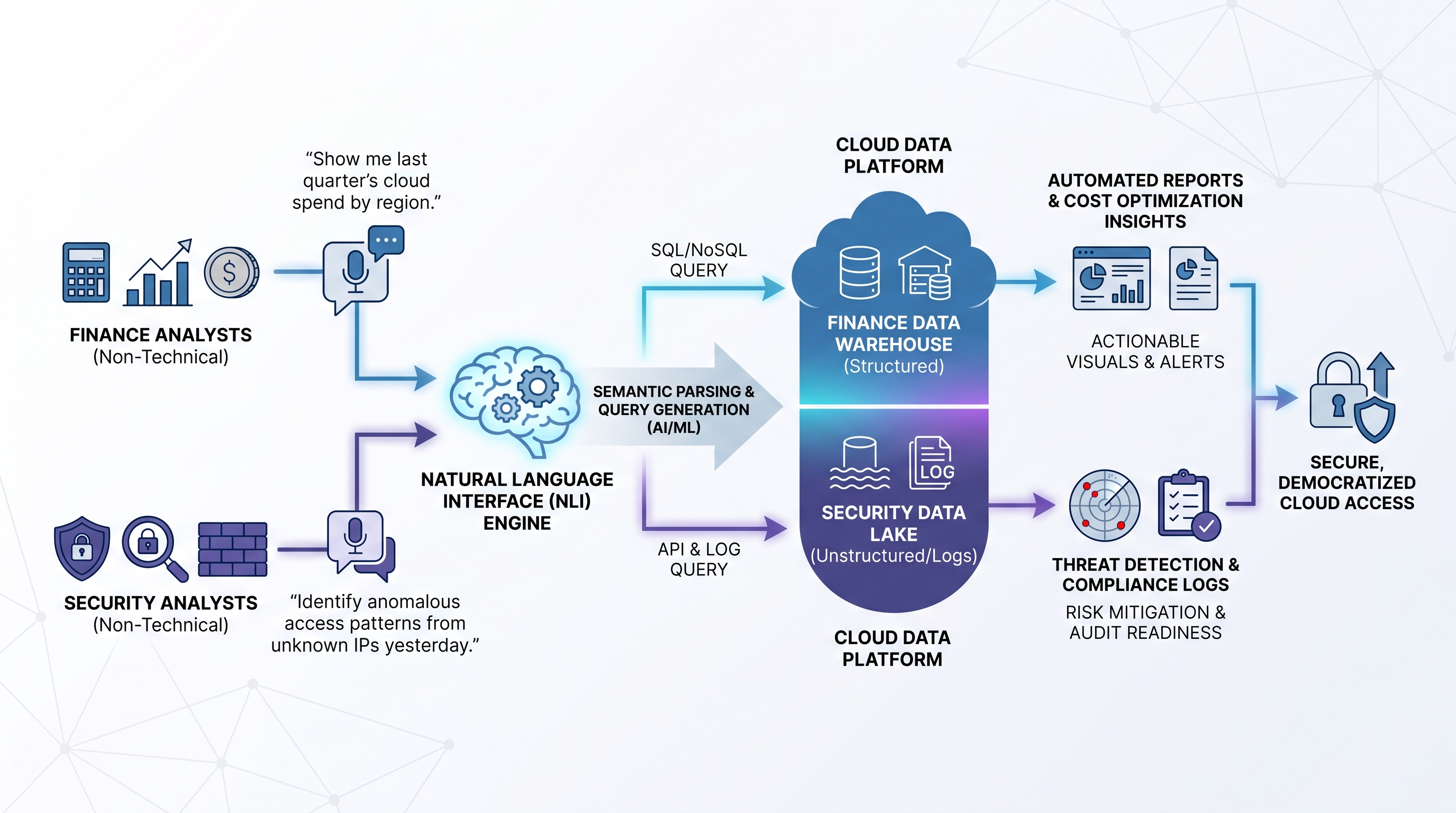
The Cloud Query Bottleneck in Modern Enterprise
Modern enterprise cloud environments are marvels of engineering, but they are also administrative nightmares. As organizations scale across AWS, Azure, GCP, and Oracle Cloud Infrastructure (OCI), their infrastructure generates petabytes of telemetry, billing logs, security events, and configuration metadata. While this data contains critical insights, accessing it has traditionally required highly specialized technical expertise.
Consider the typical workflow for a non-technical stakeholder—such as a financial analyst tracking cloud spend or a compliance auditor verifying security postures. If a finance manager wants to understand why the data transfer costs in us-west-2 spiked by 40% last week, they cannot simply log into the AWS Console and find a clear answer. Instead, they must submit a ticket to the Cloud Center of Excellence (CCoE) or an SRE team. An engineer must then write a complex SQL query against the AWS Cost and Usage Report (CUR) stored in Amazon Athena, or construct a query in Azure Resource Graph, parse the results, format them into a spreadsheet, and send them back. This process introduces significant latency, often taking days or weeks, during which cloud waste continues to accumulate.
The same bottleneck exists within security teams. A security analyst or compliance officer investigating an active threat might need to know: "Which public-facing EC2 instances have IAM roles with administrative privileges and active high-severity vulnerabilities?" Answering this requires cross-referencing data from AWS CloudTrail, Amazon Inspector, IAM policy documents, and VPC flow logs. Writing the nested queries, Kusto Query Language (KQL) statements, or Python scripts to correlate these disparate sources requires hours of engineering effort. In active security incidents, this delay can be catastrophic.
The solution to this systemic bottleneck is the democratization of cloud queries through Natural Language Interfaces (NLIs). By leveraging advanced Large Language Models (LLMs) trained on cloud schemas, API structures, and domain-specific operations, platforms can now translate conversational English into precise, optimized, and secure cloud queries. This technical shift empowers FinOps and SecOps teams to interact directly with their multi-cloud telemetry in real time, bypassing the engineering queue entirely.
Architecture of a Modern Natural Language Interface (NLI) for Cloud Data
Building an enterprise-grade NLI for multi-cloud environments is far more complex than simply wrapping an API call around a public LLM like GPT-4. Public models lack context regarding an enterprise's specific network topology, tagging schemas, organizational units (OUs), and historical spend patterns. Furthermore, sending raw cloud metadata or proprietary system configurations directly to public endpoints poses severe security and compliance risks.
To overcome these challenges, platforms like CloudAtler employ a multi-layered semantic translation architecture. This system acts as an intelligent intermediary, converting natural language input into executable, safe, and highly optimized database queries or API calls. The diagram below represents the logical flow of this architecture:
[User Query: "Find unattached disks in production"]
                    │
                    ▼
       ┌──────────────────────────┐
       │   Semantic Parser &      │
       │   Intent Classifier      │
       └────────────┬─────────────┘
                    │
                    ▼
       ┌──────────────────────────┐
       │  Schema-Aware Metadata   │ <─── [Real-time Cloud Sync]
       │     Context Engine       │
       └────────────┬─────────────┘
                    │
                    ▼
       ┌──────────────────────────┐
       │  Deterministic Query     │
       │  Generator (SQL/KQL/API) │
       └────────────┬─────────────┘
                    │
                    ▼
       ┌──────────────────────────┐
       │    Guardrail & Policy    │ <─── [RBAC & IAM Policies]
       │     Validation Engine    │
       └────────────┬─────────────┘
                    │
                    ▼
       ┌──────────────────────────┐
       │  Cloud Provider Execution│ ───> [AWS, Azure, GCP, OCI]
       └──────────────────────────┘
This pipeline consists of several highly specialized engineering components:
1. Intent Classification and Semantic Parsing
When a user inputs a query like "What did we spend on idle databases last month?", the NLI must first classify the intent. Is this a financial query (FinOps), a security query (SecOps), or an operational query? The semantic parser extracts key entities, filters, and metrics, such as:
Entities: Databases (RDS, Cloud SQL, Azure SQL)
Attributes: Idle state (CPU utilization < 5%, network I/O < 10MB over 7 days)
Temporal Filters: Last month (relative time window calculated dynamically)
Metric: Cost / Spend
2. Schema-Aware Metadata Contextualization
To prevent LLM hallucinations, the platform dynamically injects the enterprise's live cloud schema into the model's context window. This is achieved using Retrieval-Augmented Generation (RAG) combined with a graph database of the customer's multi-cloud inventory. The Atler AI engine maps the user's generic terms ("databases") to the exact resource types present in their environment (e.g., AWS::RDS::DBInstance, Microsoft.Sql/servers/databases).
3. Deterministic Query Generation
Rather than executing raw, unpredictable code generated by an AI model, the system translates the parsed intent into structured, deterministic query formats. For instance, a query targeting AWS cost data is translated into a precise SQL statement execution against the Athena database containing the CUR, while an Azure infrastructure query is translated into Azure Resource Graph KQL.
4. Guardrail and RBAC Validation
Before any query is sent to the cloud providers, it must pass through a strict security boundary. If a financial analyst asks to see a list of resources, but does not have the IAM permissions to view security configurations, the query engine must redact sensitive fields. The guardrail engine enforces Role-Based Access Control (RBAC) at the query level, ensuring that natural language queries cannot be used as a vector for privilege escalation or unauthorized data exfiltration.
Bridging the FinOps Gap: From "What is our spend?" to Direct Cost Optimization
Cloud financial management, or FinOps, is notoriously data-heavy. Traditionally, teams rely on static dashboards that display historical spending. However, dashboards are rigid; they can show that spend increased, but they rarely explain why it increased without deep, manual drill-downs.
Natural Language Interfaces transform this reactive paradigm into an active, conversational exploration of cloud costs. By integrating with a unified financial operations platform, stakeholders can easily identify anomalies, calculate unit economics, and execute cost-saving measures without needing to understand the underlying data structures of cloud billing exports.
Comparing Query Paradigms: Traditional vs. Natural Language
To illustrate the difference, let us look at how a FinOps analyst would identify unattached, high-cost storage volumes in AWS using a traditional SQL query versus a natural language query.
Metric / Aspect | Traditional SQL Query (Athena CUR) | Natural Language Query (CloudAtler) |
|---|---|---|
User Input | SELECT line_item_resource_id, sum(line_item_unblended_cost) ... [50 lines of SQL] | "Show me all unattached EBS volumes in production that have been idle for over 14 days and their monthly run rate." |
Required Skills | SQL, AWS CUR Schema Knowledge, Athena execution mechanics. | Basic understanding of cloud terminology. |
Execution Time | 15–45 minutes (writing, debugging, and executing). | < 5 seconds. |
Multi-Cloud Support | None. Requires completely different SQL/KQL for Azure/GCP. | Unified. Automatically queries AWS, Azure, and GCP resources. |
Behind the scenes, when the user inputs the natural language query, CloudAtler's engine performs a real-time cost impact calculation. It does this by compiling the request into an execution plan that queries the cloud resource graph (to find volumes with an available state) and correlates those resource IDs with the latest billing records to compute the current monthly run rate.
Concrete FinOps Query Scenarios
Let's look at three practical scenarios where natural language completely changes how finance and engineering collaborate on cost containment:
Scenario A: Identifying Orphaned Resources.
Query: "Find all idle load balancers across all AWS and Azure accounts that haven't received traffic in 30 days."
Under the hood: The engine queries AWS CloudWatch metrics (ActiveConnectionCount = 0) and Azure Monitor metrics over a rolling 30-day window, cross-referencing them with active billing items to present a prioritized list of resources to delete.Scenario B: Tracking Kubernetes Microservice Unit Costs.
Query: "Show me the cost breakdown of our payment processing microservice running on EKS by namespace for the last quarter."
Under the hood: The NLI parses the namespace tag, maps it to the underlying EC2 instances, calculates the allocated CPU/Memory share of those instances, and provides a clean visual breakdown of container costs.Scenario C: Evaluating Commitment Coverage.
Query: "Which accounts have the lowest Savings Plans coverage, and how much would we save if we increased coverage to 90%?"
Under the hood: The engine analyzes historical utilization data, models the impact of adding compute Savings Plans based on current pricing APIs, and outputs a recommended purchase strategy.
Empowering Security Teams: Real-Time Threat Hunting and Compliance Auditing
In cloud security, time-to-detection and time-to-remediation are the primary metrics that determine whether an incident is a minor blip or a major breach. However, security analysts are often forced to work across siloed tools: Cloud Security Posture Management (CSPM), Vulnerability Scanners, Identity and Access Management (IAM) analyzers, and Security Information and Event Management (SIEM) systems.
An NLI integrated into a robust cloud security management suite acts as a force multiplier. It allows security analysts, compliance auditors, and even executive leadership to query security postures using conversational language, instantly correlating disparate datasets to identify vulnerabilities.
Example: Correlating Vulnerabilities, Network Topology, and Identity
Consider this complex security query:"Are there any public-facing EC2 instances in production with Log4j vulnerabilities that have an IAM role capable of writing to S3?"
To answer this manually, an analyst would need to perform the following steps:
Query the vulnerability scanner (like Amazon Inspector or Qualys) for active CVEs matching Log4j (e.g., CVE-2021-44228) on running instances.
Query AWS EC2 to find which of those instances are associated with a Security Group allowing ingress traffic on public ports (0.0.0.0/0 on ports 80, 443, 8080, etc.) or are attached to an Internet Gateway.
Inspect the IAM Instance Profile attached to each matching instance.
Parse the IAM policy JSON documents to determine if they contain
s3:PutObjector wildcards3:*permissions on production buckets.
With an NLI-driven query engine, the system automatically builds a unified dependency graph. It translates the query into an AST (Abstract Syntax Tree) that queries the security database, returning a structured JSON response and a human-readable summary within seconds:
{
  "query_intent": "identify_vulnerable_exposed_assets_with_high_privileges",
  "status": "VULNERABILITIES_FOUND",
  "matches": [
    {
      "resource_id": "i-0abcd1234efgh5678",
      "resource_name": "prod-payment-gateway-01",
      "provider": "AWS",
      "region": "us-east-1",
      "vulnerabilities": [
        {
          "cve_id": "CVE-2021-44228",
          "severity": "CRITICAL",
          "package": "log4j-core-2.14.1.jar"
        }
      ],
      "network_exposure": {
        "is_public": true,
        "security_group_rules": [
          { "protocol": "TCP", "port_range": "8080", "source": "0.0.0.0/0" }
        ]
      },
      "iam_risk": {
        "role_arn": "arn:aws:iam::123456789012:role/prod-web-app-role",
        "excessive_permissions": [
          {
            "action": "s3:PutObject",
            "resource": "arn:aws:s3:::prod-customer-financials/*"
          }
        ]
      }
    }
  ]
}
By democratizing access to this level of technical correlation, organizations can reduce their Mean Time to Identify (MTTI) from days to seconds. Non-technical compliance officers can run audits independently, asking questions like: "Show me all storage buckets that do not have encryption at rest enabled and are missing owner tags." This immediate feedback loop significantly hardens the enterprise's security posture.
Technical Deep Dive: Building the Schema-Aware LLM Translator
How does a platform actually build a reliable, schema-aware LLM translator that does not hallucinate? Let's look at the underlying mechanics of context injection and prompt construction.
To generate accurate SQL, KQL, or API calls, the generative AI engine must understand the schema of the targeted dataset. However, passing the entire database schema of a multi-cloud enterprise (which can contain thousands of tables and millions of rows of metadata) into an LLM's context window is inefficient, expensive, and can confuse the model.
Instead, CloudAtler uses a two-stage retrieval process:
Schema Retrieval (Vector Search): The user's query is converted into an embedding vector. The system queries a vector database containing semantic descriptions of the cloud schemas, APIs, and table structures. Only the relevant schemas (e.g., the billing tables and resource inventory tables) are retrieved.
Contextual Prompt Construction: The retrieved schema definitions, along with a few-shot examples of correct translations, are injected into a highly structured system prompt.
Below is a simplified Python representation of how the platform constructs the payload for the model, ensuring that the generated SQL is syntax-correct for the specific target database (in this case, Amazon Athena):
import openai

def generate_cloud_query(user_natural_language_query, target_provider="AWS"):
    # Step 1: Define the target schema dynamically based on semantic context search
    athena_billing_schema = """
    Table: aws_billing_cur
    Columns:
      - line_item_resource_id (string): The unique identifier of the resource.
      - line_item_unblended_cost (double): The cost of the line item.
      - line_item_usage_start_date (timestamp): Start date of usage.
      - line_item_usage_type (string): Type of usage (e.g., BoxUsage:t3.medium).
      - resource_tags_user_environment (string): The value of the 'Environment' tag.
    """

    # Step 2: Construct the system prompt with clear constraints and few-shot examples
    system_prompt = f"""
    You are an expert cloud database engineer. Translate the user's natural language query into a syntactically correct Amazon Athena SQL query.

    Database Schema:
    {athena_billing_schema}

    Rules:
    1. Only return the executable SQL query. Do not write any explanations or Markdown formatting.
    2. Filter by line_item_usage_start_date to limit the query to the last 30 days unless specified otherwise.
    3. Use exact column names from the schema.

    Example:
    User: "Show total cost for production resources last month"
    SQL: SELECT sum(line_item_unblended_cost) as total_cost FROM aws_billing_cur WHERE resource_tags_user_environment = 'production' AND line_item_usage_start_date >= date_add('month', -1, current_date);
    """

    # Step 3: Execute the LLM call
    response = openai.chat.completions.create(
        model="gpt-4-turbo",
        messages=[
            {"role": "system", "content": system_prompt},
            {"role": "user", "content": user_natural_language_query}
        ],
        temperature=0.0
    )

    return response.choices[0].message.content.strip()

# Execution Example
user_input = "Find the total cost of all resources tagged as production over the last 30 days"
executable_sql = generate_cloud_query(user_input)
print(executable_sql)
This deterministic approach guarantees that the LLM functions as a precise translation compiler. The generated SQL is then validated against an AST parser to ensure no destructive operations (like DROP TABLE or DELETE) are present, establishing a robust security sandbox before execution.
The Future of Autonomous Cloud Operations
Democratizing cloud queries is only the first step. The true power of natural language interfaces in cloud environments lies in moving from read-only queries to read-write actions. Once a user can easily find an issue using natural language, the logical next step is allowing them to fix it using the same interface.
For example, after a FinOps analyst asks:
"Show me all unattached EBS volumes in production" and receives the list, they should be able to instantly follow up with:
"Delete all those volumes and notify their owners via Slack."
Similarly, a security analyst who finds an exposed server should be able to command:
"Isolate instance i-0abcd1234efgh5678 by removing its public security group rules and taking a snapshot of its root volume."
This convergence of query, analysis, and automated remediation is the core design philosophy behind CloudAtler. By combining natural language understanding with safe, automated operational guardrails, organizations can bridge the communication gap between business units and cloud engineering, dramatically accelerating operational velocity while maintaining absolute control over cost and security.
Conclusion: Unify Your Cloud Operations with CloudAtler
The era of relying on highly specialized cloud engineering queues for basic financial and security insights is coming to an end. Natural Language Interfaces are breaking down operational silos, allowing finance, security, and operations teams to interact with multi-cloud environments on equal footing.
By translating conversational language into precise, secure, and optimized queries across AWS, Azure, GCP, and Oracle Cloud, CloudAtler democratizes cloud data. The platform ensures that your FinOps teams can optimize spend in real time, and your security teams can identify and remediate threats within seconds—all through a single, intuitive interface.
Ready to eliminate the cloud query bottleneck and empower your entire organization? Explore CloudAtler today and discover how our AI-powered platform can unify your cloud operations, security, and financial management.
All in One Place
Atler Pilot decodes your cloud spend story by bringing monitoring, automation, and intelligent insights together for faster and better cloud operations.