
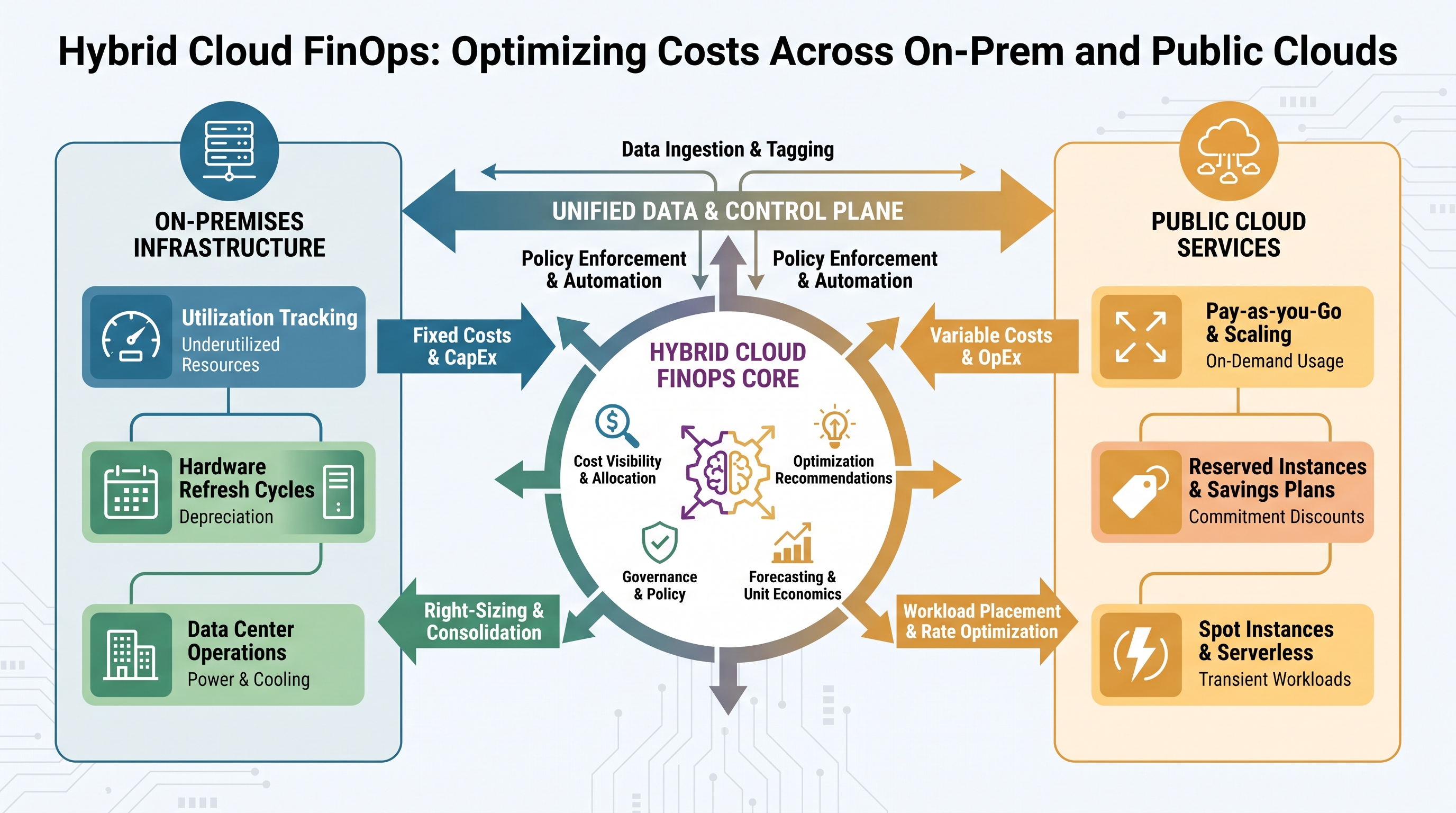
The enterprise IT landscape is no longer a binary choice between on-premises data centers and public cloud. Instead, the reality for most organizations is a complex, interconnected hybrid ecosystem, blending legacy systems with agile cloud-native applications across multiple providers like AWS, Azure, GCP, and Oracle. While this hybrid approach offers unparalleled flexibility, resilience, and compliance capabilities, it also introduces significant challenges, particularly in managing and optimizing costs. This is where Hybrid Cloud FinOps emerges as a critical discipline, extending the principles of financial operations to encompass the entire distributed infrastructure.
Traditional FinOps primarily focuses on the dynamic, consumption-based costs of public clouds. However, a holistic view demands integrating the fixed and variable costs associated with on-premises infrastructure. Without a unified strategy, enterprises risk opaque spending, inefficient resource utilization, and missed opportunities for significant cost savings. This post will provide a highly detailed, technical exploration of Hybrid Cloud FinOps, offering actionable strategies, architectural examples, and insights into how a platform like CloudAtler can unify your financial, security, and operational intelligence across your entire hybrid estate.
Understanding the Hybrid Cloud Cost Landscape
Before optimizing, we must first understand the disparate cost structures inherent in a hybrid environment. Each component — on-premises infrastructure and public cloud services — presents its own unique financial model and set of challenges.
On-Premise Cost Vectors: The CAPEX/OPEX Dichotomy
On-premise infrastructure costs are often perceived as fixed, but a closer look reveals a blend of capital expenditure (CAPEX) and operational expenditure (OPEX). Key cost vectors include:
Hardware Acquisition (CAPEX): Servers, storage arrays, networking equipment, and data center facilities. These are upfront investments that depreciate over time.
Software Licenses (CAPEX/OPEX): Perpetual licenses (CAPEX) or subscription-based models (OPEX) for operating systems, databases, virtualization platforms (e.g., VMware vSphere, Microsoft Hyper-V), and enterprise applications.
Power and Cooling (OPEX): Significant ongoing costs associated with operating data centers, often overlooked but substantial.
Data Center Space (OPEX): Rent, property taxes, physical security, and maintenance.
Networking Infrastructure (CAPEX/OPEX): Routers, switches, firewalls, and recurring internet service provider (ISP) charges.
Personnel (OPEX): Engineers, administrators, security specialists, and support staff required to maintain and operate the infrastructure.
Maintenance and Support Contracts (OPEX): Vendor agreements for hardware and software support, essential for operational continuity.
The challenge with on-prem costs is their often-lumpy nature and difficulty in attributing them directly to specific applications or business units without robust chargeback mechanisms and detailed asset management.
Public Cloud Cost Vectors: The Pay-as-You-Go Paradigm
Public cloud costs are fundamentally different, based on a utility model where you pay for what you consume. This offers tremendous agility but also introduces volatility if not managed effectively. Key cost vectors include:
Compute: Virtual machines (EC2, Azure VMs, GCE), containers (EKS, AKS, GKE), serverless functions (Lambda, Azure Functions, Cloud Functions). Billed by usage (e.g., instance-hours, invocations, memory).
Storage: Object storage (S3, Blob Storage, Cloud Storage), block storage (EBS, Azure Disks, Persistent Disk), file storage (EFS, Azure Files, Filestore). Tiered pricing based on access frequency, redundancy, and capacity.
Networking: Data transfer (ingress typically free, egress often costly), VPNs, Direct Connect/ExpressRoute/Cloud Interconnect, load balancers, NAT Gateways. Egress charges are a common culprit for unexpected spikes.
Managed Services: Databases (RDS, Azure SQL, Cloud SQL), analytics services, AI/ML platforms, security services. These abstract away infrastructure management but come with their own consumption-based pricing.
Licensing: OS and database licenses often bundled (e.g., SQL Server on Azure VM) or bring-your-own-license (BYOL) options.
Commitment Discounts: Reserved Instances (RIs) and Savings Plans (SPs) for compute and sometimes databases, offering significant discounts in exchange for upfront commitment.
The dynamic nature of public cloud costs demands continuous monitoring and optimization, as resources can be provisioned and de-provisioned rapidly, leading to "cloud sprawl" if not governed.
The Intersecting Challenge: Bridging the Cost Divide
The real complexity of Hybrid Cloud FinOps lies in the intersection of these two models. How do you compare the cost of running a database on an aging on-prem server versus a fully managed cloud service? How do you account for the opportunity cost of underutilized on-prem hardware when you're simultaneously paying for similar capacity in the cloud? Without a unified view and consistent cost allocation, these questions remain unanswered, leading to suboptimal decisions and uncontrolled spend. Enterprises need a mechanism to normalize and consolidate financial data from both realms, allowing for true apples-to-apples comparisons and strategic workload placement decisions.
The FinOps Framework for Hybrid Environments
The FinOps Foundation's "Inform, Optimize, Operate" framework provides an excellent blueprint for managing cloud spend. Adapting this framework for hybrid environments requires extending its principles to encompass both on-premise and public cloud infrastructure.
1. Inform: Gaining Unified Visibility and Allocation
The foundational step in Hybrid FinOps is achieving complete, granular visibility into all costs. This is often the most challenging aspect due to disparate data sources and lack of standardization.
Centralized Data Ingestion and Normalization:
To inform effectively, you need to pull data from diverse sources. For public clouds, this involves ingesting billing reports (e.g., AWS CUR, Azure Cost Management, GCP Billing Exports), API usage data, and resource metadata. For on-premises, this means integrating with IT asset management (ITAM) systems, CMDBs (e.g., ServiceNow, BMC Helix), virtualization platforms (e.g., VMware vCenter, Nutanix Prism), network monitoring tools, and even power consumption meters. The ingested data must then be normalized into a consistent format to enable cross-environment analysis.
Unified Cost Dashboards:
A single pane of glass is paramount. Enterprises need unified dashboards that display real-time and historical cost and usage data from AWS, Azure, GCP, Oracle, and on-premises infrastructure side-by-side. This includes visualizing compute, storage, network, and software costs, segmented by business unit, application, environment, or project. Such a dashboard should offer drill-down capabilities to pinpoint specific cost drivers.
Consistent Tagging and Cost Allocation:
Effective cost allocation relies on robust tagging. In public clouds, this means enforcing strict tagging policies for all resources (e.g.,
Project,Environment,Owner,CostCenter). For on-premises, this translates to associating virtual machines, physical servers, and even network segments with similar business identifiers within your CMDB or asset management system. Integrating these tagging strategies allows for consistent showback and chargeback models across the hybrid estate, accurately attributing costs to the consuming teams or applications. Tools that offer automated tagging and enforcement are invaluable here.Cost Anomaly Detection:
With a unified data stream, AI/ML-driven anomaly detection can identify unexpected cost spikes or deviations from baselines in either environment. This could be an overlooked cloud resource, an inefficient on-prem VM, or an unusual network egress pattern, allowing for proactive investigation and remediation.
2. Optimize: Strategic Cost Reduction and Efficiency
Once you have visibility, the next step is to actively reduce and optimize spend across the hybrid landscape. This involves a blend of tactical adjustments and strategic architectural decisions.
Workload Placement Strategy and Cost Modeling:
This is arguably the most impactful optimization tactic. Not all workloads are suited for the public cloud, and not all should remain on-premises. Develop a robust framework for evaluating workloads based on factors like:
Performance Requirements: Latency-sensitive applications might perform better closer to users or on dedicated on-prem hardware.
Compliance and Data Sovereignty: Specific regulatory requirements might mandate on-prem or private cloud residency for certain data.
Existing Licensing: Utilizing existing on-prem software licenses (e.g., Windows Server, SQL Server with Azure Hybrid Benefit) can significantly alter cloud migration cost models.
Predictability of Demand: Highly variable workloads are ideal for public cloud elasticity, while stable, predictable workloads might be more cost-effective on-prem if capacity already exists.
Total Cost of Ownership (TCO) Analysis: Conduct detailed TCO analyses for potential migrations, comparing on-prem CAPEX/OPEX with cloud OPEX (including compute, storage, network, managed services, and personnel). This requires accurate cost impact calculation for proposed changes.
For example, a legacy ERP system with perpetual licenses and stable, high-performance I/O needs might be more cost-effective to modernize on-prem (e.g., via hyperconverged infrastructure) rather than a lift-and-shift to cloud, which could incur substantial re-licensing and egress costs. Conversely, a new microservices application with fluctuating demand is a perfect candidate for serverless or containerized deployment in the public cloud.
Resource Rightsizing and Cleanup:
This applies to both environments:
Public Cloud: Identify idle instances, orphaned storage volumes, underutilized databases, and over-provisioned compute. Implement automation to terminate, downsize, or archive these resources.
On-Premises: Leverage virtualization platform data (vCenter, Hyper-V Manager) to identify "zombie" VMs, over-allocated CPU/memory, or underutilized physical servers. Decommissioning these frees up power, cooling, and potentially licensing costs, or allows for consolidation.
Commitment Management:
Public clouds offer significant discounts through Reserved Instances (RIs), Savings Plans (SPs), and sustained use discounts. Strategic purchasing of these commitments requires careful forecasting of stable workloads. In a hybrid context, this means ensuring that you're not over-committing in the cloud for workloads that could be run more cost-effectively on existing, depreciated on-prem hardware. A platform with reserved savings optimization capabilities is critical.
Storage Optimization:
Public Cloud: Implement data lifecycle policies to move infrequently accessed data to colder, cheaper storage tiers (e.g., S3 Glacier, Azure Archive Storage, GCP Coldline).
On-Premises: Utilize tiered storage solutions, deduplication, and compression on storage arrays. Archive older data to cheaper, higher-density storage or even tape.
Hybrid: Consider hybrid cloud storage gateways (e.g., AWS Storage Gateway, Azure File Sync) to bridge on-prem and cloud storage, leveraging cloud for backup/archive and on-prem for high-performance active data.
Network Cost Control:
Egress fees are a major cost driver in public clouds. Optimize data transfer by:
Minimizing cross-region traffic.
Utilizing CDN services for content delivery.
Compressing data before transfer.
Strategically placing resources to reduce egress (e.g., data processing near data sources).
For hybrid connectivity, evaluate the cost-effectiveness of dedicated connections (Direct Connect, ExpressRoute) versus VPNs based on data transfer volumes and required bandwidth.
License Optimization:
Software licenses (especially for databases and operating systems) can be a substantial cost across both environments. Leverage BYOL (Bring Your Own License) options where applicable in the cloud to utilize existing on-prem investments. Explore open-source alternatives or cloud-native managed services that include licensing. Ensure license compliance to avoid costly audits while also not over-provisioning licenses.
3. Operate: Continuous Improvement and Automation
FinOps is an ongoing practice, not a one-time project. The "Operate" phase focuses on embedding cost management into daily operations and leveraging automation.
Automated Governance and Policy Enforcement:
Implement policies that automatically enforce cost best practices. This includes auto-shutdown of non-production resources outside business hours, instance rightsizing based on utilization, and enforcing tagging policies. For on-premises, this might involve automated VM power management or alerts for underutilized clusters. CloudAtler's guardrails feature can enforce these policies across your hybrid estate.
Budgeting and Forecasting:
Develop a unified budgeting and forecasting process that accounts for both public cloud consumption and on-prem expenditure. Leverage historical data and predictive analytics (often AI-driven) to create accurate forecasts. Implement proactive alerts for budget overruns in either environment. This is where robust budget forecasting capabilities become indispensable.
Performance Management Integration:
Cost and performance are intrinsically linked. Over-provisioning resources for perceived performance gains leads to waste. Under-provisioning leads to performance bottlenecks and potential business impact. Integrate performance monitoring (APM, infrastructure monitoring) with cost data to find the optimal balance. For example, CloudAtler's performance management features allow you to see the cost implications of performance-driven scaling decisions.
Security as a Cost Driver and Enabler:
Security is not just a separate concern; it's a critical component of FinOps. Misconfigurations (e.g., publicly exposed S3 buckets, unsecured databases) can lead to data breaches, which are immensely costly in terms of reputation, compliance fines, and remediation efforts. Proactive security measures like vulnerability management, automated patching, and identity and access management (IAM) best practices prevent these incidents. Conversely, over-provisioning security tools or services without proper rationalization can also be a cost drain. Integrating security management with FinOps ensures that security spend is optimized and directly contributes to risk reduction, rather than acting as a separate, unmanaged expense.
Feedback Loops and Iteration:
Establish regular FinOps review meetings involving engineering, finance, and business stakeholders. Share insights, discuss optimization opportunities, and iterate on strategies. Foster a culture of cost accountability across the organization.
Architectural Considerations for Hybrid FinOps
Implementing Hybrid FinOps requires a thoughtful architectural approach to data integration, governance, and operationalization.
Data Ingestion and Normalization Pipelines
The core challenge is unifying disparate data. An effective architecture includes:
Cloud Billing Connectors: Direct APIs or data exports from AWS (CUR), Azure (Cost Management), GCP (Billing Export), and Oracle Cloud.
On-Premise Data Sources:
Virtualization Platforms: APIs from VMware vCenter, Microsoft System Center Virtual Machine Manager (SCVMM), Nutanix Prism for VM metrics (CPU, memory, disk I/O), and power state.
CMDB/ITAM: Integration with ServiceNow, BMC Helix, etc., for asset details, ownership, and application mapping.
Network Monitoring: Data from network performance monitoring (NPM) tools for traffic patterns and bandwidth usage.
Storage Management: APIs from SAN/NAS solutions for capacity, utilization, and performance.
Power Monitoring: Data from data center infrastructure management (DCIM) systems.
ETL/ELT Processes: Robust data pipelines to extract, transform, and load data into a centralized data lake or data warehouse. This includes schema mapping, data type conversion, and enrichment with metadata (e.g., adding business tags to on-prem assets).
Data Fabric/Mesh: For larger enterprises, a data fabric approach can provide a unified view and access layer over distributed data sources, simplifying consumption for FinOps tools.
Consistent Tagging and Resource Grouping
Achieving a consistent tagging strategy across hybrid environments is non-trivial but essential. This requires:
Standardized Tagging Taxonomy: Define a universal set of tags (e.g.,
CostCenter,Application,Environment,Owner) that apply to both cloud resources and on-prem assets.Automated Tagging Enforcement: Use cloud provider policies (e.g., AWS Tag Policies, Azure Policy, GCP Organization Policies) to enforce tagging. For on-prem, integrate tagging requirements into VM provisioning workflows and CMDB updates.
Mapping and Translation Layers: Develop mechanisms to map on-prem attributes (e.g., vCenter custom attributes, CMDB fields) to cloud tags, ensuring a consistent logical grouping for cost allocation. For instance, a CloudAtler solution can provide this translation and aggregation automatically, presenting a unified view regardless of the underlying infrastructure's native tagging mechanisms.
Hybrid Networking for Cost Efficiency
Network architecture significantly impacts hybrid costs:
Direct Connect/ExpressRoute/Cloud Interconnect: These dedicated connections offer consistent bandwidth and often lower data transfer costs compared to VPNs for high-volume traffic. The CAPEX/OPEX trade-off for these connections versus public internet egress fees needs careful evaluation.
Traffic Optimization: Design network topologies to minimize inter-region and cross-cloud data transfer. Leverage private endpoints and service endpoints to keep traffic within the cloud provider's network where possible.
DNS and IP Management: A unified DNS and IP address management (IPAM) solution is crucial for seamless connectivity and cost-effective routing across hybrid environments.
Compute and Storage Abstraction Layers
Adopting abstraction layers can simplify management and optimize costs by enabling workload portability and consistent operations:
Container Orchestration: Kubernetes (K8s) has become the de-facto standard. Solutions like Anthos (GCP), Azure Arc, or OpenShift (Red Hat) allow you to run and manage K8s clusters consistently across on-prem (e.g., VMware vSphere, bare metal) and public clouds (EKS, AKS, GKE). This provides a consistent deployment and operational model, simplifying workload migration and enabling resource pooling.
Software-Defined Storage (SDS): SDS solutions (e.g., Ceph, Dell EMC PowerFlex, VMware vSAN) can abstract underlying storage hardware, providing a unified storage layer across on-premise clusters. This allows for dynamic provisioning, tiering, and better utilization, mirroring some of the flexibility of cloud storage services.
Serverless/Functions-as-a-Service (FaaS): While primarily cloud-native, frameworks like OpenFaaS or KEDA (Kubernetes-based Event-Driven Autoscaling) can bring serverless paradigms to on-prem K8s, extending the pay-per-execution model to your private infrastructure for certain workloads.
Integrating Security into FinOps Architecture
Security is not an afterthought; it's a foundational element of cost-efficient operations. A robust security posture reduces the likelihood of costly breaches, compliance fines, and operational disruptions. Integrating security into the FinOps architecture involves:
Unified Vulnerability Management: Regularly scan both on-prem systems and cloud resources for vulnerabilities. Prioritize remediation based on risk and potential cost impact. CloudAtler's patch intelligence and vulnerability prioritization features can streamline this, ensuring critical security gaps are addressed efficiently.
Automated Compliance Checks: Continuously monitor configurations against industry benchmarks (CIS, NIST) and regulatory requirements (GDPR, HIPAA). Automation prevents misconfigurations that could lead to non-compliance penalties or security incidents.
Identity and Access Management (IAM): Implement a unified identity solution (e.g., Okta, Azure AD Connect) across hybrid environments. Enforce least privilege access, multi-factor authentication, and regular access reviews to prevent unauthorized resource usage or data exfiltration.
Threat Detection and Response: Deploy extended detection and response (XDR) solutions that cover both on-prem endpoints and cloud workloads. Early detection of threats minimizes dwell time and reduces the financial impact of attacks.
Automated Remediation: Beyond detection, automated remediation of security issues (e.g., closing open ports, patching critical vulnerabilities) reduces manual effort and prevents issues from escalating into costly incidents.
Implementing Hybrid FinOps with CloudAtler
Successfully navigating the complexities of Hybrid Cloud FinOps requires more than just a collection of disparate tools; it demands a unified platform capable of ingesting, analyzing, and acting upon data from across your entire hybrid estate. This is precisely where CloudAtler provides unparalleled value.
CloudAtler is an AI-powered platform designed to unify FinOps, cloud security, and automated operations across AWS, Azure, GCP, Oracle, and on-premise environments. Our value proposition directly addresses the challenges discussed in this article:
Unified Visibility and Cost Intelligence: CloudAtler aggregates billing data, resource utilization metrics, and security posture information from all your public cloud providers and integrates with your on-premise virtualization platforms and CMDBs. This creates a single, comprehensive view of your entire infrastructure spend and security landscape. Our platform normalizes this data, providing a consistent lens through which to analyze costs, identify waste, and track financial performance across hybrid boundaries.
AI-Powered Optimization and Forecasting: Leveraging advanced AI, CloudAtler goes beyond simple reporting. Our Atler AI analyzes usage patterns, identifies anomalies, and provides intelligent recommendations for cost optimization, such as rightsizing opportunities, commitment plan recommendations (RIs/SPs), and workload placement suggestions. It also generates accurate budget forecasts, helping you plan and control hybrid spend proactively.
Automated Governance and Remediation: CloudAtler empowers you to define and enforce cost, security, and operational policies across your hybrid environment. From automated tagging and resource cleanup to enforcing security best practices and initiating patch remediation workflows, our platform automates the enforcement of your FinOps and security guardrails. This minimizes manual effort, reduces human error, and ensures continuous compliance and cost efficiency.
Converged FinOps and Security Operations: Recognizing that security incidents are significant cost drivers, CloudAtler tightly integrates security management with financial operations. Our platform provides insights into the cost impact of security vulnerabilities and compliance gaps, allowing you to prioritize security investments based on both risk and financial implications. This holistic approach ensures that your pursuit of cost optimization does not compromise your security posture, and conversely, that your security spend is efficient and effective.
Actionable Insights for All Stakeholders: CloudAtler’s platform provides role-based dashboards and reports tailored for finance teams, cloud architects, security professionals, and IT operations, fostering a culture of shared responsibility and collaboration in cost management and security.
Key Challenges and How to Overcome Them
While the benefits of Hybrid Cloud FinOps are clear, organizations often encounter significant hurdles:
Data Silos and Inconsistent Naming Conventions:
Challenge: Different teams manage different environments with their own tools, data formats, and naming schemes, making unified analysis difficult.
Overcome: Implement a robust data ingestion and normalization strategy. Standardize tagging and naming conventions across all environments. Utilize a platform like CloudAtler that can abstract and unify this disparate data.
Organizational Silos:
Challenge: Finance, operations, and engineering teams often have conflicting priorities and lack a common language for cost discussions.
Overcome: Foster a FinOps culture that emphasizes collaboration and shared accountability. Establish cross-functional teams and regular review meetings. Provide transparent, role-specific reporting that makes cost data relevant to each stakeholder.
Lack of Skills and Tooling:
Challenge: Managing complex hybrid environments requires specialized skills in both on-prem infrastructure and multiple cloud platforms, coupled with a lack of integrated tools.
Overcome: Invest in training for your teams. Adopt unified platforms that automate data collection, analysis, and remediation across hybrid environments, reducing the operational burden and skill gap.
Legacy Mindsets:
Challenge: Resistance to change, particularly from teams accustomed to traditional on-prem CAPEX models, can hinder FinOps adoption.
Overcome: Demonstrate tangible ROI and cost savings through pilot projects. Emphasize how FinOps empowers teams with better data for decision-making, rather than just imposing cost controls.
Conclusion
Hybrid Cloud FinOps is no longer an optional discipline; it is an imperative for enterprises seeking to maximize the value of their cloud investments, maintain cost visibility across diverse environments, and align technology spending with strategic business goals. By adopting the principles, strategies, and tools discussed in this guide, organizations can tame the complexity of hybrid deployments and turn financial management into a competitive advantage.
Discover more about our unified solutions and how we can transform your multi-cloud architecture at CloudAtler.
All in One Place
Atler Pilot decodes your cloud spend story by bringing monitoring, automation, and intelligent insights together for faster and better cloud operations.