
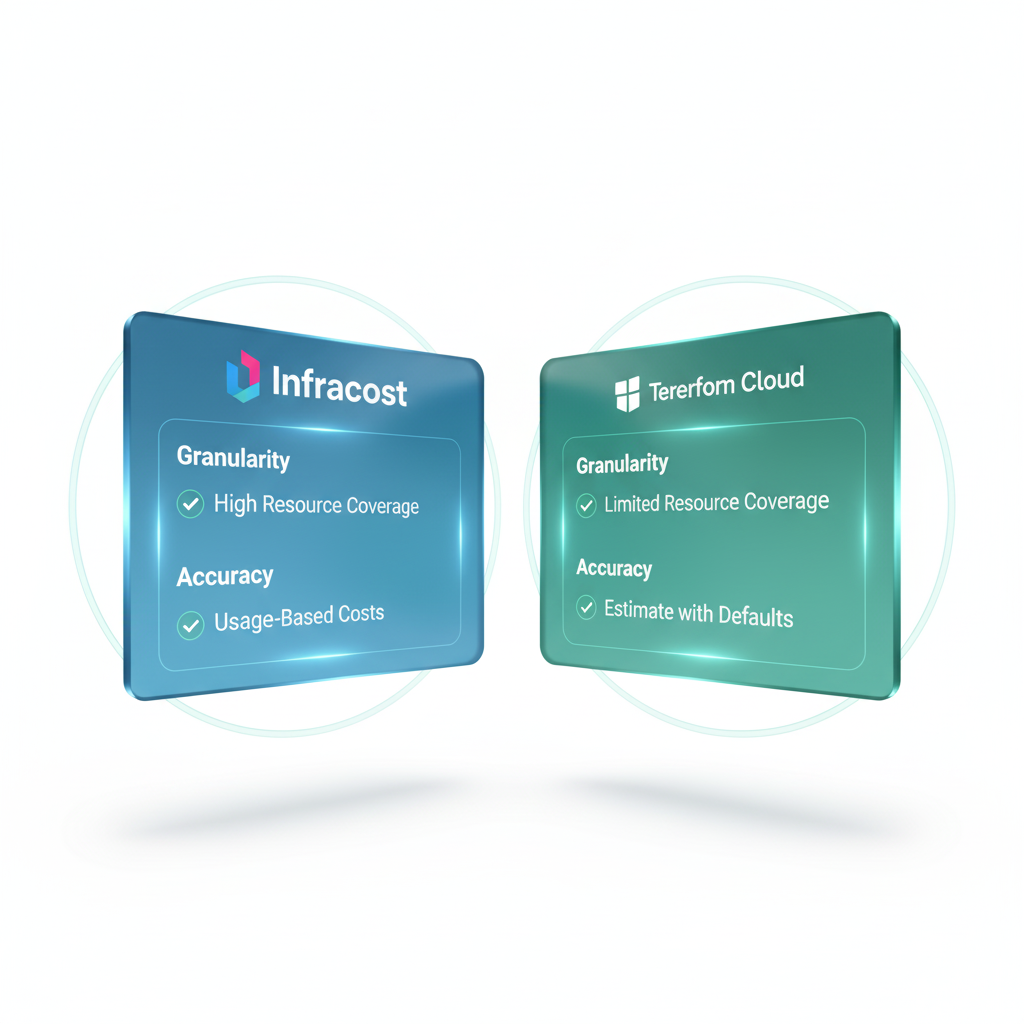
As organizations increasingly adopt FinOps principles, the demand for tools that can predict cloud costs from Infrastructure as Code (IaC) has surged. Two of the most prominent solutions in the Terraform ecosystem are Infracost and HashiCorp's native Terraform Cloud (TFC) cost estimation feature. Both aim to provide pre-deployment cost visibility, but they do so with significant differences in approach, coverage, and capabilities. Choosing the right tool depends on your team's specific needs for resource support, policy enforcement, and developer workflow integration.
Core Functionality and Approach
At a high level, both tools analyze your Terraform code to predict monthly costs. However, their core architecture and how they fit into the broader IaC landscape differ significantly.
Infracost: Infracost is a specialized, open-source tool focused squarely on cost estimation and FinOps governance. It can be used as a standalone CLI, a VSCode extension, or integrated into any CI/CD pipeline. Its primary method involves parsing HCL code directly, which is fast and doesn't require cloud credentials. It is designed to be a flexible component that plugs into your existing workflow.
Terraform Cloud: Cost estimation is an integrated feature within the broader Terraform Cloud platform, which provides remote state management, collaborative runs, and a private module registry. The cost estimation runs as part of a speculative plan within the TFC environment, showing the cost delta in the UI after a plan is complete. It is part of a bundled platform solution.
Feature Comparison: Coverage, Accuracy, and Usage
When evaluating a cost estimation tool, the most critical factors are how many resources it supports and how accurate its estimates are. This is where the differences become most apparent.
Resource Coverage
A cost estimation tool is only as useful as the number of resources it can identify and price.
Infracost: Boasts support for over 1,100 resources across AWS, Azure, and Google Cloud. This extensive coverage is driven by a large open-source community that regularly contributes support for new resources.
Terraform Cloud: Has significantly more limited resource coverage, supporting around 200 resources. This means that for many common services, TFC will simply not provide a cost estimate, leading to incomplete and potentially misleading cost previews.
Estimation of Usage-Based Resources
Infracost: Supports estimating costs for usage-based resources through a YAML configuration file (
infracost-usage.yml). This allows teams to model costs for resources like AWS S3, Lambda, or data transfer, providing a more realistic estimate.Terraform Cloud: Does not currently support estimating costs for usage-based resources. These resources are simply ignored in the cost estimate, which can be a major blind spot.
Price Accuracy and Custom Pricing
Infracost: An independent comparison found that Infracost's price accuracy was consistently correct. Furthermore, Infracost supports custom pricing by allowing you to input your discount levels, such as AWS Enterprise Discount Programs (EDP) and Azure Enterprise Agreements (EA).
Terraform Cloud: The same comparison noted that TFC's estimates were consistently slightly underestimated. It also only supports public, on-demand prices and does not account for any enterprise discounts.
FinOps Governance and Policy Enforcement
Infracost: Offers a robust set of FinOps governance features through its paid Infracost Cloud product. This includes out-of-the-box guardrails for budget checks, best practice policies (e.g., recommending cheaper gp3 volumes over gp2), and a comprehensive tag checker. These checks are presented directly in the pull request comment.
Terraform Cloud: Provides policy as code through its proprietary framework, Sentinel. While powerful, Sentinel is a general-purpose policy engine. To enforce cost-related policies, you must write the logic from scratch, which requires significant engineering effort.
Developer Experience and Workflow Integration
Infracost: Is designed to meet developers where they are. The VSCode extension provides real-time cost feedback as code is written. The CLI can be run locally without cloud credentials, making it fast and easy for engineers to check costs on their own machines before even pushing code.
Terraform Cloud: Cost estimation is tied to the remote run workflow. An engineer must push their code and trigger a plan in TFC to see the cost estimate. There is no local CLI or IDE extension for instant feedback, making the feedback loop longer.
Conclusion: Which Tool is Right for You?
The choice between Infracost and Terraform Cloud for cost estimation depends on your organization's priorities.
Choose Terraform Cloud if:
You are already deeply invested in the Terraform Cloud ecosystem for state management and runs.
Your infrastructure primarily consists of the ~200 resources that TFC supports.
You only need a basic, directional cost estimate and do not require support for usage-based resources or custom pricing.
Choose Infracost if:
You need comprehensive resource coverage across AWS, Azure, and GCP.
Estimating costs for usage-based resources like Lambda and S3 is important for your architecture.
You want more accurate estimates that can factor in your enterprise discounts.
You want to provide engineers with the fastest possible feedback loop via a local CLI and VSCode extension.
You are looking for a dedicated FinOps governance solution with out-of-the-box policies for best practices and tagging, rather than building them from scratch.
While Terraform Cloud offers cost estimation as a convenient, integrated feature, Infracost stands out as a more powerful, accurate, and comprehensive solution. For teams serious about implementing a proactive FinOps culture, Infracost's superior resource coverage, governance features, and developer-centric workflow make it the more robust choice.
All in One Place
Atler Pilot decodes your cloud spend story by bringing monitoring, automation, and intelligent insights together for faster and better cloud operations.