
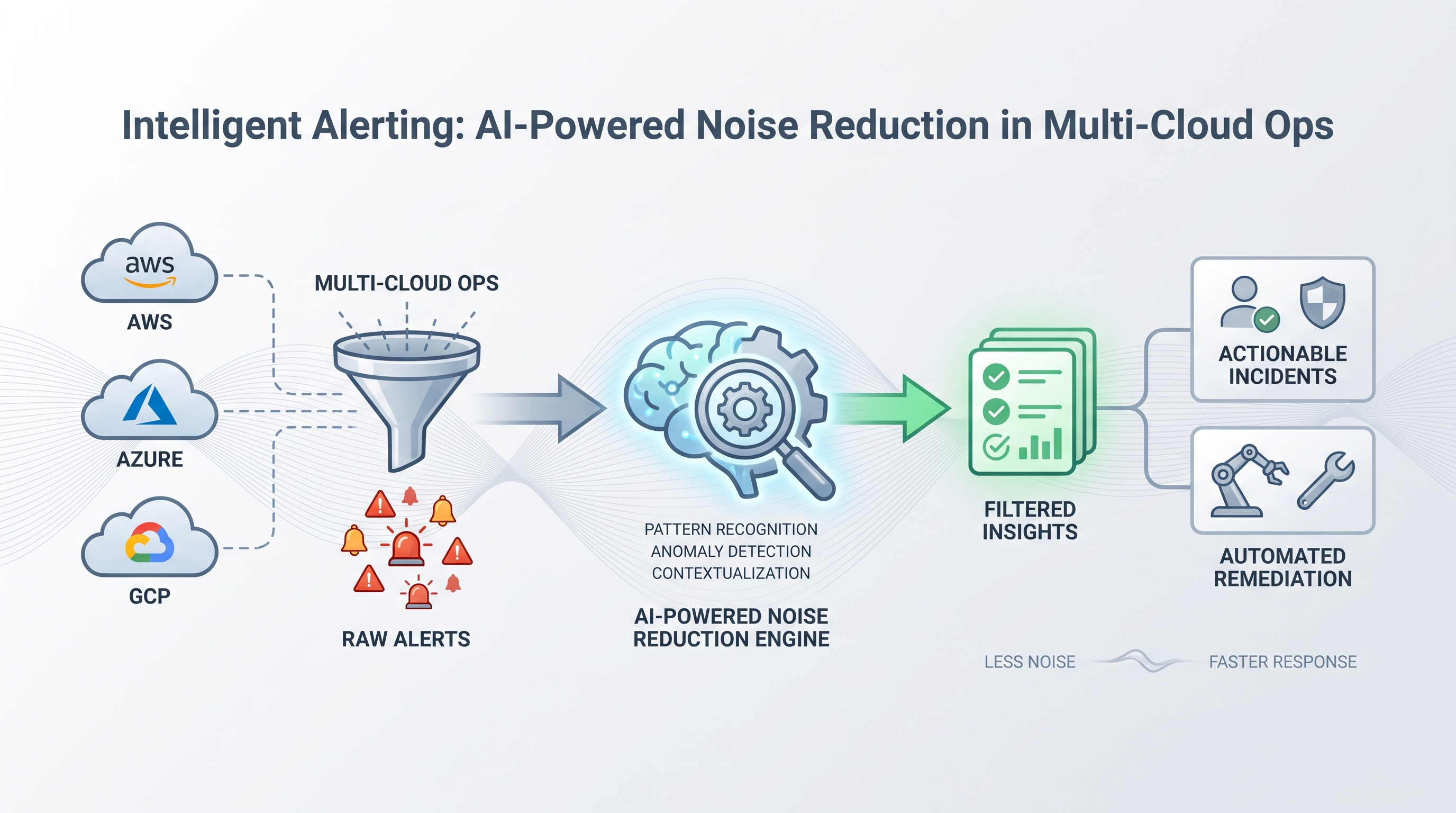
In the relentless pursuit of agility and resilience, enterprises have increasingly adopted multi-cloud strategies, leveraging the distinct advantages offered by providers like AWS, Azure, Google Cloud Platform (GCP), and Oracle Cloud Infrastructure (OCI). While this approach offers unparalleled flexibility and avoids vendor lock-in, it introduces a formidable challenge: the exponential growth of operational complexity. Central to this complexity is the sheer volume of monitoring data and, consequently, the deluge of alerts that operational, security, and financial teams must contend with daily. This "alert fatigue" is not merely an inconvenience; it's a critical operational bottleneck that can lead to missed incidents, delayed remediation, security breaches, and ballooning cloud costs. The traditional, rule-based alerting mechanisms, designed for simpler, monolithic architectures, are simply inadequate for the dynamic, distributed, and ephemeral nature of modern multi-cloud environments. The solution lies in a paradigm shift towards Intelligent Alerting, powered by Artificial Intelligence (AI) and Machine Learning (ML), a core tenet of the CloudAtler platform.
The Escalating Challenge of Multi-Cloud Alert Fatigue
The journey into multi-cloud operations often begins with the promise of agility and efficiency. However, without a unified operational strategy, it quickly devolves into a fragmented landscape of disparate monitoring tools, data silos, and a cacophony of alerts. Understanding the sources and impact of this alert tsunami is the first step towards taming it.
The Deluge: Understanding the Multi-Cloud Alert Tsunami
Each cloud provider offers its own robust suite of monitoring and logging services: AWS CloudWatch, Azure Monitor, GCP Operations (formerly Stackdriver), and OCI Monitoring. These services generate vast amounts of telemetry data—metrics, logs, traces—from every deployed resource, application, and network component. When an enterprise operates across two, three, or even four major cloud providers, the volume of this data multiplies geometrically. Consider a typical enterprise cloud footprint:
Infrastructure Alerts: CPU utilization spikes, memory exhaustion, disk I/O bottlenecks, network latency, instance termination/failure.
Application Alerts: Error rates (HTTP 5xx), latency increases, transaction failures, queue depths exceeding thresholds, container restarts.
Security Alerts: Unauthorized access attempts, anomalous API calls, port scans, misconfigured security groups, compliance violations, data exfiltration attempts (e.g., from AWS GuardDuty, Azure Security Center, GCP Security Command Center).
Network Alerts: VPN tunnel status, firewall rule changes, DDoS attack detection, VPC/VNet peering issues.
Cost Alerts: Unexpected cost spikes, budget overruns, resource idle alerts, unoptimized resource usage.
Each of these categories, multiplied by dozens or hundreds of services across multiple cloud providers and potentially hundreds or thousands of individual resources, generates an overwhelming number of alerts. A single cascading failure—perhaps a regional network issue—could trigger hundreds or thousands of seemingly unrelated alerts across various services and geographies. SREs, SecOps analysts, and FinOps engineers spend an inordinate amount of time sifting through this noise, attempting to correlate events manually, identify root causes, and prioritize actions. This leads to:
Missed Critical Events: Important alerts are buried under a mountain of low-priority or redundant notifications.
Delayed Incident Response: The time to identify, diagnose, and resolve critical issues (MTTR) increases dramatically.
Burnout and Reduced Productivity: Teams are constantly reacting, leading to high stress levels and decreased morale.
Increased Operational Costs: Inefficient incident response directly impacts business continuity and resource consumption.
Beyond Thresholds: Why Traditional Monitoring Fails
Traditional monitoring systems primarily rely on static thresholds. If CPU utilization exceeds 80% for 5 minutes, trigger an alert. If a database connection pool drops below 10, alert. While effective for well-understood, stable systems, this approach quickly breaks down in dynamic cloud environments:
Brittleness: Static thresholds are often too sensitive (false positives) or not sensitive enough (false negatives) as workloads fluctuate. What's normal CPU usage at 2 AM might be critical at 2 PM.
Lack of Context: A high CPU alert on its own provides little actionable insight. Is it part of a scheduled batch job? Is it correlated with a surge in legitimate user traffic, or a denial-of-service attack?
Correlation Challenges: Traditional tools struggle to automatically correlate events across disparate data sources and cloud providers. Manually linking a network latency alert in Azure with an application error in AWS and a database performance issue in GCP is a monumental task.
Blind Spots: Unknown-unknowns, such as novel attack vectors or entirely new performance bottlenecks arising from complex microservice interactions, are often missed by predefined rules.
The human cost of manual triage is unsustainable. Enterprises need a smarter approach that moves beyond reactive, rule-based alerting to proactive, intelligent insights. This is where AI-powered platforms like CloudAtler provide immense value, transforming raw data into actionable intelligence across your entire multi-cloud estate.
The Core Principles of AI-Powered Intelligent Alerting
Intelligent alerting leverages advanced AI and ML techniques to automate the process of filtering, correlating, and prioritizing alerts. It shifts from merely notifying about deviations to understanding the underlying context and predicting potential impacts. CloudAtler's Atler AI is built on these foundational principles.
Anomaly Detection: Learning Normal Behavior
At the heart of intelligent alerting is the ability to distinguish between normal fluctuations and true anomalies. Instead of rigid thresholds, AI models learn the baseline behavior of every metric, log pattern, and event stream over time. This involves:
Statistical Methods: Techniques like Exponentially Weighted Moving Average (EWMA), ARIMA (AutoRegressive Integrated Moving Average), and Holt-Winters forecasting are used to model time-series data and identify deviations outside expected ranges, accounting for seasonality and trends. For instance, a sudden, statistically significant drop in network throughput that deviates from the learned diurnal pattern would trigger an anomaly.
Machine Learning Algorithms: More sophisticated algorithms like Isolation Forests, One-Class Support Vector Machines (OC-SVMs), and Autoencoders are employed for unsupervised anomaly detection. These models can identify outliers in multi-dimensional data without prior labeling of "normal" vs. "anomalous." For example, an Autoencoder trained on typical API call patterns across AWS, Azure, and GCP can detect unusual sequences or volumes of calls that might indicate a compromised credential or a new attack vector.
Contextual Awareness: Anomaly detection must be context-sensitive. AI models are trained to factor in external variables such as scheduled maintenance windows, code deployments, business-specific peak hours, or even global events. A spike in database connections during a major marketing campaign launch might be normal, whereas the same spike at 3 AM on a Sunday could be a critical anomaly. CloudAtler incorporates these contextual signals to reduce false positives and enhance the precision of its anomaly detection capabilities.
This dynamic learning enables the system to adapt to changes in your infrastructure and application behavior, significantly reducing alert fatigue by only notifying you of truly unusual and potentially impactful events.
Event Correlation and Deduplication: From Noise to Signal
One of the most significant pain points in multi-cloud operations is the cascade of alerts triggered by a single root cause. Intelligent alerting systems excel at correlating these seemingly disparate events into a single, cohesive incident. This process involves:
Topological Mapping and Graph Databases: Building a real-time, dynamic dependency graph of all your cloud resources across AWS, Azure, GCP, and OCI is fundamental. This graph understands how an EC2 instance relates to an RDS database, how that database connects to a Kubernetes service, and how all these interact with a global load balancer. When an alert fires, the system can traverse this graph to identify upstream and downstream dependencies.
Time-Series Analysis: By analyzing the temporal relationships between alerts, AI can infer causality. If a network latency alert consistently precedes a series of application error alerts, the system can prioritize the network issue as the likely root cause and suppress subsequent application-level noise.
Natural Language Processing (NLP) for Log Data: Logs are rich in unstructured data. NLP techniques can be used to parse, categorize, and extract entities from log messages, identifying common patterns and anomalies. For instance, multiple log entries across different services containing similar error messages (e.g., "Connection refused to database_cluster_X") can be grouped and attributed to a single underlying database problem, even if they originate from different cloud providers.
Deduplication and Grouping: Simple deduplication removes identical alerts, but intelligent deduplication goes further, grouping alerts that are indicative of the same underlying problem, even if they have slightly different attributes or come from different monitoring sources. For example, a single instance failure might trigger alerts from CloudWatch, an application performance monitoring (APM) tool, and a security agent. An intelligent system consolidates these into one actionable incident.
CloudAtler leverages sophisticated correlation engines to transform hundreds of raw alerts into a handful of prioritized, actionable incidents, providing a clear picture of the true impact and root cause, visible through our unified dashboard.
Predictive Analytics: Anticipating Issues Before They Impact
Moving beyond reactive problem-solving, intelligent alerting incorporates predictive analytics to foresee potential issues before they escalate into critical incidents. This proactive approach saves time, reduces downtime, and minimizes business disruption.
Resource Utilization Forecasting: Using historical data, ML models can forecast future resource consumption trends (CPU, memory, storage, network I/O) for individual instances, services, or entire clusters. If a forecast indicates that a particular database will hit 90% CPU utilization within the next 48 hours based on current growth trends, an alert can be triggered proactively, allowing operations teams to scale up resources or optimize queries before performance degrades.
Identifying Performance Degradation Trends: Predictive models can detect subtle, gradual degradation in performance metrics (e.g., steadily increasing API response times, slowly growing queue depths) that might not immediately breach static thresholds but indicate an impending problem. By identifying these trends early, teams can intervene before users are impacted.
Proactive FinOps: Predictive analytics extends beyond performance to cost management. By analyzing current resource usage patterns, historical spend, and known business events, CloudAtler can forecast potential cost overruns or identify opportunities for cost savings. For example, if a development environment is projected to incur significant costs due to sustained high usage, an alert can prompt a review of its lifecycle or resource allocation. Our budget forecasting capabilities are directly powered by these predictive insights.
This foresight allows teams to move from a "break-fix" mentality to a "prevent-and-optimize" strategy, significantly improving operational efficiency and cost control.
Architectural Blueprint for AI-Driven Alerting in Multi-Cloud
Implementing an AI-driven intelligent alerting system across a multi-cloud environment requires a robust, scalable, and integrated architectural foundation. CloudAtler's platform exemplifies this architecture, designed to ingest, process, and analyze vast quantities of data from disparate sources.
Data Ingestion and Normalization: The Foundation
The first critical step is to centralize and standardize data from all cloud providers and monitoring tools. This involves:
Unified Data Pipelines: Establishing secure, high-throughput data pipelines to ingest metrics, logs, and events from native cloud services (AWS CloudWatch/CloudTrail, Azure Monitor/Activity Logs, GCP Operations/Audit Logs, OCI Monitoring/Audit Logs). This often involves agent-based collection (e.g., Fluentd, Logstash, Vector) for custom applications and serverless functions for cloud-native event streams.
API Integration: Connecting to various security tools (e.g., AWS GuardDuty, Azure Security Center, GCP Security Command Center), configuration management databases (CMDBs), and third-party monitoring solutions via their respective APIs.
Schema Standardization: Raw data from different providers comes in various formats. A normalization layer is essential to transform this heterogeneous data into a consistent, queryable schema. This might involve enriching data with metadata (e.g., resource tags, ownership information) to provide context for later analysis.
Without a clean, normalized, and comprehensive data lake, any subsequent AI/ML analysis will be flawed. CloudAtler excels at this foundational layer, providing seamless data ingestion across all major cloud providers.
The AI/ML Engine: Processing the Deluge
Once data is ingested and normalized, it flows into the core AI/ML engine for real-time processing and analysis.
Real-time Stream Processing: Platforms like Apache Kafka, AWS Kinesis, or GCP Pub/Sub are used to process incoming data streams in real-time. This allows for immediate anomaly detection and event correlation, critical for rapid incident response.
Containerized ML Models: The various anomaly detection, correlation, and predictive analytics models are deployed as containerized microservices (e.g., on Kubernetes). This provides scalability, resilience, and the ability to update models independently. These models continuously learn from new data, refining their understanding of "normal" behavior and improving prediction accuracy.
Reinforcement Learning for Feedback Loops: Human interaction with the alerting system provides invaluable feedback. When an engineer marks an alert as a false positive or manually correlates events that the AI missed, this feedback can be used to retrain and improve the ML models. Over time, the system becomes increasingly accurate and tailored to the specific operational patterns of the organization.
This dynamic, learning engine is what truly differentiates intelligent alerting from static, rule-based systems.
Contextual Enrichment and Graph Databases
To provide actionable intelligence, alerts must be enriched with context. This is where a robust CMDB and intelligent tagging strategies become critical.
CMDB Integration: Integrating with an enterprise CMDB allows the alerting system to pull in static metadata about resources, applications, and business services. This provides critical context, such as service ownership, criticality levels, and associated business units.
Dynamic Dependency Graph: A graph database (e.g., Neo4j, JanusGraph) is used to store and query the relationships between all cloud resources. This graph is dynamically updated as infrastructure changes (e.g., new instances, deleted load balancers). When an alert is triggered, the system can quickly identify all dependent services and applications, providing a clear blast radius and helping prioritize remediation.
Tagging Strategies: Consistent and comprehensive resource tagging across all cloud providers is paramount for contextual enrichment, especially for FinOps and security. Tags like
Environment:Production,CostCenter:Marketing,Application:WebAppX, andSecurityZone:DMZallow the AI to understand the business context and criticality of an alert. CloudAtler's automated tagging features ensure that resources are consistently labeled, providing the necessary metadata for intelligent analysis and FinOps reporting.
By understanding not just what is alerting, but what it is part of and what it impacts, teams can make informed decisions quickly.
Intelligent Remediation and Automation
The ultimate goal of intelligent alerting is not just to provide better insights, but to enable faster, more effective remediation, often through automation.
Integration with ITSM Tools: Automatically creating detailed incidents in ITSM platforms like ServiceNow or Jira, pre-populating them with correlated alerts, root cause analysis, and impact assessment, streamlines the incident management workflow.
Runbook Automation: For well-defined, recurring issues, the intelligent alerting system can trigger automated runbooks. These could be serverless functions (AWS Lambda, Azure Functions, GCP Cloud Functions) that perform actions like restarting a service, scaling up an instance, isolating a compromised resource, or rolling back a recent deployment.
Patch Intelligence and Automated Remediation: Security and operational hygiene often involve patching. CloudAtler's patch intelligence capabilities, combined with intelligent alerting, can identify critical vulnerabilities and automate patch remediation workflows. For instance, if an alert indicates a critical vulnerability on a set of production servers, the system can automatically initiate a controlled patching process, leveraging safe rollbacks to mitigate risk.
Policy-Driven Automation: Define policies that dictate automated responses based on alert severity, affected resource type, and business criticality. For example, a critical security alert on a database containing sensitive customer data might trigger immediate isolation and forensic data collection, while a non-critical performance alert on a dev environment might only trigger a notification to the responsible team.
This shift from manual reaction to intelligent, automated response significantly reduces MTTR and frees up valuable engineering time.
FinOps and Security in the Age of Intelligent Alerting
Intelligent alerting is not solely an operational concern; it profoundly impacts an organization's financial operations (FinOps) and cloud security posture. CloudAtler unifies these domains, providing a holistic view and actionable insights.
FinOps Optimization Through Smarter Alerts
Cost visibility and control are perennial challenges in multi-cloud environments. Intelligent alerting transforms FinOps from a reactive billing review process to a proactive, real-time optimization engine.
Cost Anomaly Detection: AI models can detect sudden, unexplained spikes in cloud spend that deviate from historical patterns, often indicating inefficient resource utilization, misconfigurations, or even malicious activity. For instance, a sudden surge in data transfer costs or unallocated storage could trigger an alert, prompting immediate investigation.
Resource Optimization Alerts: Intelligent systems identify idle or underutilized resources (e.g., EC2 instances with consistently low CPU, unattached EBS volumes, oversized databases, unused load balancers). Alerts can be configured to recommend specific actions, such as rightsizing instances, deleting unused resources, or implementing auto-scaling policies.
Commitment Intelligence: For enterprises utilizing Reserved Instances (RIs) or Savings Plans, intelligent alerts can highlight under-utilization or impending expiration of commitments, allowing FinOps teams to optimize their purchasing strategy and maximize savings. CloudAtler’s commitment intelligence helps avoid costly waste.
Budget Control Alerts and Forecasting: Beyond simple threshold-based budget alerts, AI-powered systems can predict when a budget is likely to be exceeded based on current consumption trends and historical data. This allows for proactive adjustments to resource allocation or budget re-forecasting.
Real-time Cost Impact Analysis: When an operational change or incident occurs, intelligent alerting can provide real-time estimates of its financial impact. For example, a service degradation requiring additional compute resources can immediately show the projected cost increase, allowing for cost-aware decision-making during incident response.
By integrating these FinOps-specific alerts into a unified system, CloudAtler empowers organizations to achieve continuous cost optimization without compromising performance or security.
Elevating Multi-Cloud Security Posture
The sprawling attack surface of a multi-cloud environment makes security management incredibly complex. Intelligent alerting is a game-changer for SecOps teams.
Prioritizing Security Alerts: Not all security alerts are created equal. AI can correlate network flows, identity access management (IAM) events, vulnerability scan results, and configuration changes to prioritize alerts based on actual risk and potential impact. An anomalous API call from an unusual IP address, if correlated with a recent vulnerability scan flagging a critical flaw on the target resource, becomes a high-priority incident.
Behavioral Analytics for Threat Detection: AI models establish baselines for "normal" user and system behavior (e.g., typical API call patterns, login locations, data access volumes). Any deviation from these baselines can trigger an alert, indicating potential insider threats, compromised accounts, or novel attack vectors that traditional signature-based systems would miss.
Proactive Vulnerability Management: Intelligent alerting integrates with vulnerability scanning tools to provide vulnerability prioritization. It correlates vulnerability data with asset criticality, exposure to the internet, and the presence of active exploits to highlight the most pressing risks, rather than presenting a flat list of CVEs.
Automated Security Responses: For detected threats, the system can trigger automated responses, such as isolating compromised instances, updating firewall rules to block malicious IPs, revoking temporary credentials, or initiating forensic data collection. This reduces the mean time to contain (MTTC) a breach, minimizing potential damage.
Compliance and Governance: Intelligent alerts can monitor for deviations from compliance standards (e.g., HIPAA, GDPR, PCI DSS) and internal governance policies. For example, an alert for a publicly accessible S3 bucket containing sensitive data, especially if it's new or recently modified, can be prioritized and automatically remediated.
CloudAtler provides CISOs and security teams with a powerful ally in the fight against multi-cloud threats, offering a comprehensive view of the security landscape and enabling rapid, intelligent responses.
CloudAtler's Approach to Unified Intelligent Alerting
CloudAtler is purpose-built to address the complexities of multi-cloud operations, unifying FinOps, cloud security, and automated operations across AWS, Azure, GCP, and Oracle environments. Our platform’s intelligent alerting capabilities are a cornerstone of this unified approach.
At the core of CloudAtler's intelligent alerting is Atler AI, our proprietary artificial intelligence engine. Atler AI continuously ingests and analyzes vast streams of data—metrics, logs, events, and configuration changes—from all your connected cloud providers. It employs advanced machine learning algorithms for anomaly detection, cross-cloud event correlation, and predictive analytics. This means instead of receiving a flood of individual alerts from CloudWatch, Azure Monitor, and GCP Operations, you receive a single, correlated incident with a clear root cause, impact assessment, and recommended actions.
Our unified dashboard serves as your single pane of glass, presenting these intelligent alerts in a prioritized, actionable format. This eliminates the need for engineers to navigate multiple cloud consoles or disparate monitoring tools, drastically reducing cognitive load and improving incident response times. For FinOps teams, it translates into real-time visibility into cost anomalies and optimization opportunities, while security teams gain immediate insight into prioritized threats and automated remediation workflows.
Beyond simply alerting, CloudAtler empowers automated operations. When a critical issue is identified and correlated by Atler AI, the platform can trigger predefined runbooks or custom automations—from rightsizing underutilized resources to isolating compromised servers or deploying critical security patches. This capability is deeply integrated with our operational intelligence features, ensuring that your cloud environment is not just monitored intelligently, but also managed intelligently.
The real-world impact for CloudAtler users is tangible: significantly reduced Mean Time To Resolution (MTTR) for operational incidents, a dramatically improved multi-cloud security posture, and substantial cost savings through continuous FinOps optimization. We empower your teams to focus on innovation, knowing that CloudAtler is intelligently managing the underlying operational complexities.
Conclusion
The promise of multi-cloud agility can quickly be overshadowed by the operational nightmare of alert fatigue. Traditional monitoring tools, designed for simpler times, are no match for the scale and dynamism of modern enterprise cloud environments. Intelligent alerting, powered by advanced AI and machine learning, is no longer a luxury but a necessity for organizations striving for operational excellence, robust security, and optimal cloud spend.
By moving beyond static thresholds to dynamic anomaly detection, by correlating disparate events into meaningful incidents, and by leveraging predictive analytics to anticipate problems before they occur, enterprises can transform their multi-cloud operations. This shift empowers SREs to focus on innovation, SecOps teams to proactively defend against threats, and FinOps teams to continuously optimize cloud investments, all while significantly reducing the cognitive burden on your valuable engineering talent.
Ready to cut through the multi-cloud noise and transform your operational efficiency, security posture, and financial control? Discover how CloudAtler unifies FinOps, cloud security, and automated operations with AI-powered intelligent alerting across AWS, Azure, GCP, and Oracle environments. Visit CloudAtler.com today to learn more and schedule a demo.
All in One Place
Atler Pilot decodes your cloud spend story by bringing monitoring, automation, and intelligent insights together for faster and better cloud operations.