
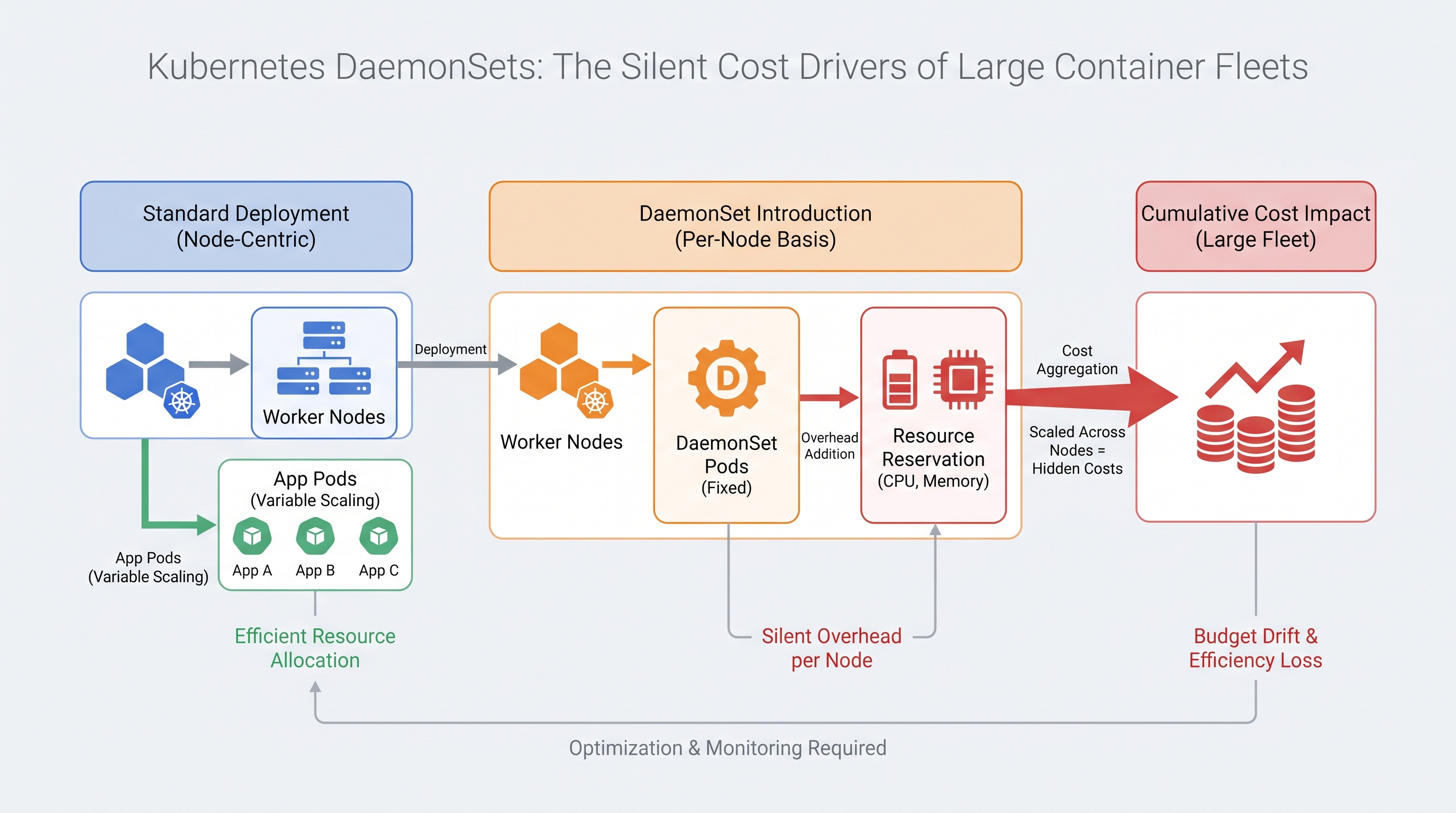
Introduction: The Architectural Convenience of DaemonSets
In the early days of a Kubernetes migration, DaemonSets are heralded as an elegant architectural pattern. They solve a fundamental platform engineering challenge: how do you ensure that every single node in your cluster runs a copy of an administrative pod? Whether it is a log forwarder like FluentBit, an APM agent like Datadog, a runtime security engine like Falco, or a service mesh proxy, the DaemonSet guarantees uniform coverage. As nodes scale up in response to traffic, Kubernetes automatically schedules these critical pods onto the new infrastructure without manual intervention.
However, as enterprise container fleets grow from dozens of nodes to thousands of nodes across multi-cloud environments, this convenience transforms into a silent, compounding financial drain. Because DaemonSets scale linearly with the number of virtual machines (nodes) rather than the actual volume of application workloads, they introduce a fixed "infrastructure tax" per node. In poorly optimized clusters, this tax can consume upwards of 30% to 40% of the total compute capacity, severely undermining the cost-efficiencies that containerization was supposed to deliver in the first place.
To control these runaway expenses, enterprise platform teams must look beyond simple pod-level resizing. Optimizing this layer requires a unified approach that bridges the gap between infrastructure scaling, application requirements, and financial governance. Utilizing a modern financial operations platform allows organizations to gain granular visibility into how these system-level workloads impact their bottom line, transforming silent overhead into highly visible, actionable data.
The Mathematics of DaemonSet Bloat (FinOps Deep Dive)
To understand the financial impact of DaemonSets, we must look at the mathematical relationship between node sizing, cluster autoscaling, and resource requests. Unlike standard Deployments, which scale horizontally based on application metrics (like CPU utilization or request queues), a DaemonSet scales strictly based on the node count ($N$).
The total resource allocation ($R_{total}$) for a set of DaemonSets ($D$) across a cluster of $N$ nodes can be calculated using the following formula:
R_{total} = N \times \sum_{i=1}^{|D|} (Request_{CPU, i} + Request_{Mem, i})
Let us contextualize this with a concrete enterprise scenario. Consider a cluster running 500 nodes. To support platform operations, the engineering team deploys four standard DaemonSets across the entire fleet:
Log Collector (e.g., Fluentbit): Requests 100m CPU, 128Mi RAM
APM/Metrics Agent (e.g., Datadog): Requests 200m CPU, 256Mi RAM
Security Agent (e.g., Falco): Requests 150m CPU, 512Mi RAM
Service Mesh Proxy (e.g., Linkerd-proxy): Requests 100m CPU, 128Mi RAM
Accumulated per node, these four agents request a total of 550m CPU (0.55 vCPUs) and 1024Mi (1 GiB) of RAM. Across a 500-node cluster, this represents a fixed allocation of 275 vCPUs and 500 GiB of RAM dedicated solely to background platform operations.
The Node Sizing Paradox
The financial severity of this overhead is heavily dictated by your cluster's node architecture. If your cluster is built on large instances, such as the AWS m5.4xlarge (16 vCPUs, 64 GiB RAM), the 0.55 vCPU and 1 GiB RAM DaemonSet allocation consumes a mere 3.4% of the node's CPU and 1.5% of its RAM. This is highly acceptable overhead.
However, if your cluster utilizes smaller, highly dynamic instances—such as the m5.large (2 vCPUs, 8 GiB RAM)—the math changes drastically. First, we must account for the Kubernetes node allocatable overhead (Kubelet, OS reservation, eviction thresholds), which typically leaves around 1.8 vCPUs and 7 GiB of RAM for actual pods. On these nodes, our DaemonSets consume 30.5% of the available CPU and 14.3% of the available RAM.
Instance Type | Allocatable CPU | DaemonSet CPU % | Allocatable RAM | DaemonSet RAM % |
|---|---|---|---|---|
| 1.8 vCPU | 30.5% | 7.0 GiB | 14.3% |
| 3.8 vCPU | 14.4% | 14.5 GiB | 6.9% |
| 7.8 vCPU | 7.0% | 29.5 GiB | 3.4% |
| 15.8 vCPU | 3.4% | 60.0 GiB | 1.6% |
In this scenario, nearly a third of your entire compute spend on m5.large instances is consumed by the "DaemonSet tax." If your organization runs thousands of nodes globally, this inefficiency equates to tens of thousands of dollars of wasted capital every month. To prevent this, platform teams must perform continuous compute lifecycle analysis to match their workload profiles with the optimal instance families, ensuring that system overhead does not cannibalize application capacity.
The Scheduling Trap: Resource Requests vs. Limits and Node Allocatable
The financial drain of DaemonSets is exacerbated by the way the Kubernetes scheduler handles resource allocations. When a node is provisioned, the Kubelet calculates the "Allocatable" capacity using the following logic:
Allocatable = Node Capacity - Kube-reserved - System-reserved - Eviction-thresholdWhen the kube-scheduler attempts to place standard application pods on a node, it evaluates whether the sum of the existing pods' resource requests (not actual usage) plus the new pod's request is less than or equal to the Node's Allocatable capacity. DaemonSets, however, operate under a different scheduling paradigm. While they are still bound by the Node Allocatable limits, they are often configured with high Priority Classes (such as system-node-critical or system-cluster-critical) to ensure they are scheduled first and are never evicted.
The "Phantom Node" Autoscaling Effect
Because DaemonSets are guaranteed scheduling priority, they occupy Allocatable space before any of your business applications can claim it. This creates a critical scheduling bottleneck known as the "Phantom Node" effect:
An application deployment attempts to scale out. The scheduler looks for a node with enough remaining Allocatable CPU and RAM to satisfy the application's resource requests.
Even though the existing nodes are physically running at only 20% CPU utilization, their allocated capacity (driven high by DaemonSets and conservative application requests) is at 95%.
The scheduler fails to place the new pods and marks them as
Pending.The Cluster Autoscaler (or Karpenter) detects the pending pods and provisions a brand-new node.
As soon as the new node joins the cluster, the DaemonSets are immediately scheduled onto it, consuming 0.55 vCPU and 1 GiB of RAM before the pending application pod even arrives.
The application pod is finally scheduled, but because of the high DaemonSet footprint, the node is quickly "filled" in terms of logical requests, initiating the loop again when the next pod scales.
This dynamic means that you are scaling up instances not because your applications require more physical hardware, but because your background platform tooling has artificially depleted the logical scheduling space of your cluster. This highlights why tracking infrastructure spend in isolation is insufficient; teams must implement unified CIO FinOps solutions that correlate scheduling configurations with actual physical cloud spend.
Security vs. Utility: The Privileged DaemonSet Dilemma
Beyond the financial implications, DaemonSets represent one of the most significant security attack surfaces in a Kubernetes cluster. By their very nature, administrative agents require deep visibility into the host operating system to perform their duties:
Log forwarders must mount the host's
/var/logand/var/lib/docker/containersdirectories to scrape container stdout/stderr.Security monitors (like Falco or Aqua) require access to the Linux kernel via eBPF or loaded kernel modules, necessitating highly privileged execution contexts.
CNI plugins (like Calico or Cilium) must manipulate the host network namespace (
hostNetwork: true) and modify host iptables/routing tables.
This deep level of integration means that many DaemonSets run with privileged: true, hostPID: true, hostIPC: true, or hostNetwork: true enabled in their Pod Security Context. This presents a severe architectural risk: if an attacker manages to compromise a single DaemonSet pod (perhaps through a vulnerability in an outdated logging library or a dependency in a third-party agent), they do not just compromise a single container—they gain direct, root-level access to the underlying virtual machine host.
The Lateral Movement Risk
Once an attacker compromises a privileged DaemonSet on a node, they can easily access the Kubelet credentials, bypass namespace boundaries, intercept traffic flowing through the host network interface, and read secrets mounted by other pods running on that same node. Because DaemonSets run on every node, a single vulnerability in a platform agent effectively compromises the security integrity of the entire cluster.
To mitigate this risk, platform engineers must enforce strict security management guardrails, including:
Least Privilege Execution: Avoid blanket
privileged: trueconfigurations. Utilize specific Linux Capabilities (e.g.,CAP_SYS_ADMIN,CAP_NET_ADMIN) only where absolutely necessary.Read-Only Root Filesystems: Force DaemonSet containers to run with a read-only root filesystem, mounting ephemeral data to
emptyDirvolumes to prevent persistent malware injection.Seccomp and AppArmor Profiles: Apply strict system call filtering to restrict what the agent can execute on the host kernel.
The following example manifest illustrates a hardened logging DaemonSet configuration that restricts host access while maintaining operational utility:
apiVersion: apps/v1
kind: DaemonSet
metadata:
  name: hardened-log-forwarder
  namespace: logging
spec:
  selector:
    matchLabels:
      app: log-forwarder
  template:
    metadata:
      labels:
        app: log-forwarder
    spec:
      securityContext:
        runAsNonRoot: true
        runAsUser: 10001
        runAsGroup: 10001
        fsGroup: 10001
      containers:
      - name: forwarder
        image: fluent/fluent-bit:2.1.10
        securityContext:
          allowPrivilegeEscalation: false
          readOnlyRootFilesystem: true
          capabilities:
            drop:
            - ALL
        resources:
          requests:
            cpu: "80m"
            memory: "64Mi"
          limits:
            cpu: "200m"
            memory: "128Mi"
        volumeMounts:
        - name: varlog
          mountPath: /var/log
          readOnly: true
        - name: varlibdockercontainers
          mountPath: /var/lib/docker/containers
          readOnly: true
      volumes:
      - name: varlog
        hostPath:
          path: /var/log
      - name: varlibdockercontainers
        hostPath:
          path: /var/lib/docker/containers
Architectural Alternatives to DaemonSets
To break free from the "DaemonSet tax" and reduce the security attack surface of your clusters, platform architects should evaluate alternatives to the standard node-replicated agent model. Depending on the workload characteristics, several alternative patterns can yield massive cost savings and security improvements.
1. The Sidecar Pattern (Targeted Injection)
For services like service meshes or specialized application logging, running a DaemonSet across 100% of your nodes is highly inefficient if only 20% of your workloads actually require those features. By switching to a Sidecar injection pattern, you run the agent container directly inside the application Pod. This ensures that resource consumption scales dynamically with the application instances, rather than the node count.
While sidecars do introduce some resource overhead per pod, they eliminate the fixed per-node tax and allow you to leverage Horizontal Pod Autoscalers (HPA) to scale the agents down during off-peak hours. Furthermore, sidecars do not require host-level privileges, significantly reducing the blast radius of a potential container breakout.
2. Consolidated Node-Level OS Services
For managed node groups where you control the base Operating System image (AMI or VM template), running security and monitoring agents as standard systemd services on the host OS is often far more efficient than running them as Kubernetes DaemonSets.
By running agents directly on the host OS outside of Kubernetes:
You eliminate the Kubernetes API and scheduling overhead associated with managing pod lifecycles.
You avoid reserving "Allocatable" resource capacity within the cluster, preventing the "Phantom Node" autoscaling trigger.
You can enforce host-level security policies through standard OS-level configuration management tools (Ansible, Chef, or Packer) rather than exposing privileged access to the Kubernetes scheduler.
3. Centralized/Agentless Collection (eBPF and API-driven)
Modern monitoring and security architectures are moving toward agentless or consolidated eBPF (Extended Berkeley Packet Filter) models. Instead of running multiple separate DaemonSets for network monitoring, runtime security, and tracing, organizations can deploy a single, highly optimized eBPF-based controller. This controller runs at the kernel level and securely streams telemetry data to a centralized collector, replacing three or four resource-heavy agents with one lightweight kernel-space instrumentation layer.
Enterprise Mitigation and Optimization Playbook
If your architecture absolutely requires the use of DaemonSets, you can still achieve significant cost reductions and security improvements by implementing a rigorous optimization playbook.
Step 1: Segment DaemonSets with Node Affinities and Tolerations
By default, DaemonSets run on every node in the cluster. However, most enterprise clusters feature heterogeneous node pools (e.g., general-purpose pools, high-memory pools, GPU pools, and lightweight serverless pools like AWS Fargate). Running a heavy security agent or logging agent on a dedicated GPU node that costs $10/hour is an expensive waste of premium compute.
Use nodeAffinity and tolerations to ensure DaemonSets only run where they are strictly required. For example, if you have a node pool dedicated to lightweight, stateless batch processing, you may choose to disable heavy APM DaemonSets on those specific nodes:
spec:
  template:
    spec:
      affinity:
        nodeAffinity:
          requiredDuringSchedulingIgnoredDuringExecution:
            nodeSelectorTerms:
            - matchExpressions:
              - key: node-role.kubernetes.io/batch-processor
                operator: DoesNotExist
Step 2: Implement Vertical Pod Autoscaler (VPA) in Recommendation Mode
Platform teams often over-provision DaemonSet resource requests to prevent agents from being OOM (Out Of Memory) killed during traffic spikes. This conservative approach leads to massive amounts of allocated but unused capacity.
Deploy the Kubernetes Vertical Pod Autoscaler (VPA) in Recommender mode specifically for your DaemonSets. The VPA will monitor the real-world CPU and memory usage of the agents over time and provide highly accurate recommendations for resource requests and limits. Using these recommendations, you can safely shave off 50% to 70% of your allocated requests, freeing up massive amounts of scheduling space across your node fleet.
Step 3: Leverage Intelligent Automation
Manually auditing and adjusting DaemonSet allocations across multiple clusters, regions, and cloud providers is a monumental task for platform teams. To scale these optimization efforts, organizations must leverage advanced tooling. Utilizing Atler AI allows platform and FinOps teams to automatically analyze cluster-wide resource utilization, identify over-provisioned system-level pods, and safely apply right-sizing recommendations without risking application stability.
Conclusion: Unify Your Container Operations with CloudAtler
Kubernetes DaemonSets are a powerful operational tool, but left unmanaged, they represent a massive, compounding financial and security tax on your enterprise container fleet. Optimizing this layer requires breaking down the silos between infrastructure provisioning, Kubernetes scheduling, and security engineering.
CloudAtler provides the industry's first unified platform that brings FinOps, cloud security, and automated operations together into a single pane of glass. By analyzing your workloads across AWS, Azure, GCP, and Oracle environments, CloudAtler identifies hidden inefficiencies—like the "Phantom Node" effect driven by over-provisioned DaemonSets—and provides actionable, automated remediation paths to optimize your compute lifecycle.
Stop letting silent system overhead erode your cloud budget and compromise your security posture. Contact CloudAtler today to schedule a demo and discover how our platform can help you unify, secure, and optimize your cloud operations at scale.
All in One Place
Atler Pilot decodes your cloud spend story by bringing monitoring, automation, and intelligent insights together for faster and better cloud operations.