
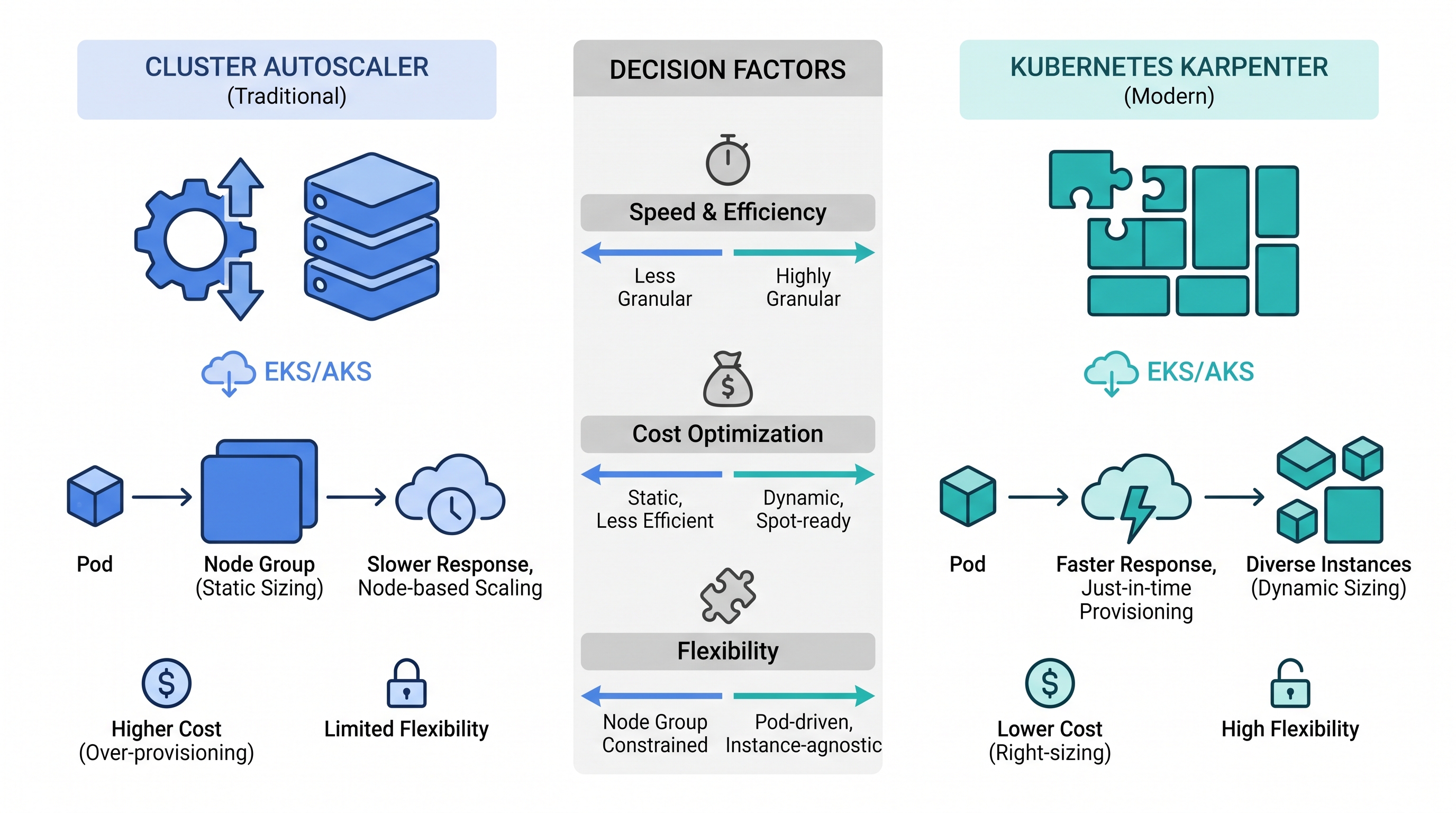
The Evolution of Kubernetes Node Provisioning
In the early days of Kubernetes, scaling the underlying infrastructure to match application demand was a highly reactive, rigid process. The industry standard, Kubernetes Cluster Autoscaler (CA), was designed around a simple premise: monitor the cluster for unschedulable pods, map those pods to pre-defined node groups (such as AWS Auto Scaling Groups or Azure Virtual Machine Scale Sets), and increment the desired capacity of those groups. While this approach successfully decoupled application developers from manual infrastructure provisioning, it introduced significant latency, operational complexity, and financial waste.
As enterprise cloud footprints grew, the limitations of node-group-based scaling became a bottleneck for rapid deployment pipelines and dynamic workloads. This friction catalyzed the development of Karpenter—an open-source, high-performance, group-less node provisioning engine originally built by AWS and now hosted by the Cloud Native Computing Foundation (CNCF). Rather than working through the abstraction layer of cloud provider scaling groups, Karpenter bypasses them entirely, communicating directly with cloud provider APIs to provision the exact compute resources required by pending pods in real time.
For infrastructure architects managing Amazon Elastic Kubernetes Service (EKS) and Azure Kubernetes Service (AKS), choosing between Cluster Autoscaler and Karpenter is no longer just an operational decision; it is a fundamental architectural choice. This decision directly impacts application performance, resource utilization, security boundaries, and cloud spend. To make an informed choice, we must first look under the hood of both engines to understand how they interact with the Kubernetes control plane and the underlying cloud APIs.
Under the Hood: Architectural Comparison
To understand the core differences between Cluster Autoscaler and Karpenter, we must examine their control loops, scheduling behaviors, and how they interact with the Kubernetes API server and cloud provider infrastructure.
Cluster Autoscaler: The Node-Group Centric Loop
Cluster Autoscaler operates as a deployment within your cluster, running a continuous control loop (typically every 10 seconds). Its primary objective is to identify pods that are in a Pending state specifically because of insufficient CPU, memory, or other resource requests. The operational flow of Cluster Autoscaler follows these distinct phases:
Detection: CA queries the API server for pods with a status of
Pendingand a container status indicating that scheduling failed due to inadequate resources.Simulation: CA simulates whether adding a node to any of the existing, pre-configured Node Groups (AWS ASGs or Azure VMSS) would resolve the scheduling failure. It evaluates node selectors, taints, tolerations, and affinity rules against the template of the node groups.
API Call: Once a suitable node group is identified, CA makes an API call to the cloud provider (e.g., AWS Auto Scaling API or Azure Compute API) to increase the desired capacity of that specific group by
N.Provisioning: The cloud provider's control plane receives the request, provisions the virtual machine, executes bootstrapping scripts (such as installing kubelet and registering with the cluster), and joins the node to the Kubernetes control plane.
Scheduling: The standard
kube-schedulerdetects the new node, transitions it toReady, and schedules the pending pods onto it.
This architecture introduces a double-scheduling abstraction. The kube-scheduler is responsible for placing pods on nodes, while Cluster Autoscaler is responsible for matching pods to node templates. Because CA is tightly coupled to homogeneous node groups, scaling multiple workloads with highly diverse resource requirements (e.g., GPU-accelerated machine learning jobs mixed with lightweight microservices) requires maintaining dozens of distinct node groups. This leads to configuration drift, complex priority-expander rules, and significant scaling latency—often taking 3 to 10 minutes for a new node to become ready.
Karpenter: Direct, Group-less Provisioning
Karpenter completely redefines this paradigm by eliminating node groups. It runs as a controller within the cluster but acts as a dynamic scheduler-assistant. Instead of waiting for the kube-scheduler to fail and then trying to fit pods into existing templates, Karpenter actively monitors the Kubernetes scheduling queue for unschedulable pods. Its operational flow is highly optimized:
Direct Evaluation: Karpenter intercepts pending pods and evaluates their precise requirements: CPU, memory, GPU, local storage, architecture (AMD64 vs. ARM64), operating system, availability zones, and billing models (Spot vs. On-Demand).
Decentralized Decision Making: Using its internal bin-packing algorithms, Karpenter determines the optimal combination of virtual machine instances that can accommodate the pending pods. It does not select from a pre-defined list of groups; instead, it dynamically selects from the entire catalog of instances supported by the cloud provider in that region.
Direct API Provisioning: Karpenter calls the cloud provider's fleet provisioning APIs (such as the Amazon EC2 Fleet API or Azure's equivalent node auto-provisioning interfaces) directly. It bypasses ASGs and VMSS entirely, requesting a specific list of instances to be launched and registered.
Fast Bootstrapping: Karpenter-provisioned nodes use optimized launch templates and pre-baked AMIs or VM images, often allowing nodes to register and begin running pods in under 60 seconds.
By operating directly at the cloud provider's API level, Karpenter removes the operational overhead of managing scaling groups. This allows for rapid, diverse, and granular compute allocation that aligns perfectly with the dynamic nature of containerized applications.
FinOps & Cost Optimization Deep Dive
For modern enterprises, cloud spend is a primary operational metric. Efficient autoscaling is one of the most powerful levers for reducing waste, but Cluster Autoscaler and Karpenter approach cost optimization from fundamentally different angles.
Bin-Packing and Instance Selection
Cluster Autoscaler is inherently constrained by the node groups defined by your platform engineering team. If your cluster only has node groups configured for m5.2xlarge instances (8 vCPU, 32 GiB RAM), and a developer deploys a pod requesting 9 vCPUs, CA is forced to provision two m5.2xlarge instances, resulting in significant unused capacity. Alternatively, platform teams must create and maintain a vast array of node groups of varying sizes, which increases operational complexity and API rate-limiting risks.
Karpenter, conversely, uses a highly sophisticated multi-dimensional bin-packing algorithm. It evaluates the aggregate resource requests of all pending pods and selects the single most cost-effective instance type that can satisfy those requests. If a set of pods requires a total of 14 vCPUs and 50 GiB of RAM, Karpenter might dynamically provision a single c6i.4xlarge or a combination of smaller, cheaper instances depending on the current market price and availability of Spot instances. To accurately model and track these dynamic allocation shifts, enterprises leverage a cost impact calculation engine to quantify real-time savings compared to static baselines.
Consolidation and De-provisioning
Scale-down operations are historically where Cluster Autoscaler struggles. CA monitors nodes for underutilization (typically under 50% resource allocation). When it identifies an underutilized node, it attempts to drain the pods and terminate the node. However, CA's scale-down logic is conservative and operates on a node-by-node basis. It does not actively re-architect the cluster to find more cost-effective packing configurations.
Karpenter introduces continuous Consolidation. It constantly analyzes the state of the cluster, looking for opportunities to reduce compute costs. Karpenter evaluates two primary consolidation strategies:
Empty Nodes: Actively deleting nodes that have no workloads running on them.
Multi-Node Consolidation: Identifying if the workloads running on a set of nodes can be consolidated onto a smaller number of existing nodes, or even onto a single, cheaper node of a different instance type. If the cost of the replacement node is lower than the sum of the current nodes, Karpenter will automatically provision the new node, drain the old ones, and terminate them.
This proactive consolidation ensures that the cluster continuously runs at peak efficiency, minimizing idle capacity. When integrated with a comprehensive financial operations platform, finance and engineering teams gain complete visibility into how these automated scaling decisions translate into reduced cloud spend, preventing budget overruns before they occur.
Spot Instance Interruption and Fallback
Spot instances offer up to a 90% discount compared to On-Demand pricing, but they come with the risk of reclamation by the cloud provider with only a two-minute warning. Handling these interruptions gracefully is critical for application availability.
With Cluster Autoscaler, managing Spot instances requires deploying external tools like the AWS Node Termination Handler. When a termination notice is received, this handler drains the node, and CA must then detect the pending pods and trigger the provisioning of a new node within the Spot node group. If the requested Spot instance type is currently unavailable in that Availability Zone, the pods will remain pending until CA times out and attempts to scale an On-Demand node group.
Karpenter handles Spot interruptions natively and elegantly. It monitors the cloud provider's interruption queue (such as AWS SQS or Azure Event Grid) directly. When an Instance Termination Notice (ITN) is received, Karpenter immediately triggers a replacement workflow. It provisions a new node before the old node is reclaimed, utilizing its diverse instance selection capabilities to find an available Spot type or gracefully falling back to On-Demand if Spot capacity is entirely depleted in that zone. This proactive rescheduling minimizes application downtime and maintains strict service level agreements (SLAs).
Security and Governance in Autoscaling
Autoscaling engines require deep integration with cloud provider APIs, making them high-value targets for security vectors. Securing the autoscaling plane requires strict adherence to the principle of least privilege, robust image management, and network isolation.
IAM and Least Privilege
Because Cluster Autoscaler interacts only with scaling group APIs (like AWS ASG or Azure VMSS APIs), its IAM permission boundary is relatively narrow. It requires permissions to describe, scale up, and scale down specific pre-defined scaling groups. It does not have the authority to create arbitrary virtual machines, modify network interfaces, or request specific billing models directly.
Karpenter, due to its group-less architecture, requires a significantly broader and more powerful IAM role. It must have permissions to create, run, and terminate EC2 instances or Azure VMs across a wide range of families, attach network interfaces, assign security groups, and write tags. This expanded permission set demands rigorous governance. Platform teams must implement IAM Roles for Service Accounts (IRSA) on EKS or Azure Workload Identity on AKS to ensure Karpenter's controller token is securely managed and dynamically rotated. Furthermore, Karpenter's controller must be restricted using IAM policy conditions to ensure it can only provision instances within specific subnets, using approved security groups, and applying mandatory enterprise tags.
Vulnerability and Patch Management
Maintaining a secure container environment requires continuously updating the underlying host operating systems to patch kernel-level vulnerabilities (such as Dirty Pipe or log4j-related host exploits). In a traditional Cluster Autoscaler setup, patching nodes involves updating the AMI or VM image in the Launch Template of the node group, and then performing a rolling update of the scaling group. This is often a slow, manual process managed by operational scripts.
Karpenter simplifies and automates this lifecycle. In its node configuration templates (such as the EC2NodeClass in AWS), you can configure Karpenter to dynamically discover the latest patched AMI using SSM parameters or tags. When a new AMI is published, Karpenter's consolidation and drift detection mechanisms automatically recognize that the running nodes are "drifted" from the desired configuration. Karpenter will then systematically and gracefully drain and replace the outdated nodes with new ones running the latest, fully patched image. To ensure this process complies with enterprise security policies, organizations utilize specialized cloud security management systems to continuously audit and verify host compliance during these automated rolling updates.
Detailed Configuration & YAML Manifests
To illustrate the practical differences in configuring these two engines, let us examine the declarative manifests required to deploy and manage them.
Karpenter Configuration (AWS EKS Example)
Karpenter configuration is split into two primary Custom Resource Definitions (CRDs): the NodePool, which defines the constraints and requirements for the pods (such as instance types, billing models, and taints), and the EC2NodeClass (or cloud-specific equivalent), which defines the provider-specific infrastructure settings (such as subnets, security groups, and AMIs).
apiVersion: karpenter.sh/v1beta1
kind: NodePool
metadata:
  name: general-purpose
spec:
  template:
    spec:
      requirements:
        - key: kubernetes.io/arch
          operator: In
          values: ["amd64", "arm64"]
        - key: karpenter.sh/capacity-type
          operator: In
          values: ["spot", "on-demand"]
        - key: karpenter.k8s.aws/instance-category
          operator: In
          values: ["c", "m", "r"]
        - key: karpenter.k8s.aws/instance-generation
          operator: Gt
          values: ["5"]
      nodeClassRef:
        name: default-aws-class
  disruption:
    consolidationPolicy: WhenUnderutilized
    expireAfter: 720h # Automatically recycle nodes after 30 days
---
apiVersion: karpenter.k8s.aws/v1beta1
kind: EC2NodeClass
metadata:
  name: default-aws-class
spec:
  amiFamily: Bottlerocket
  subnetSelectorTerms:
    - tags:
        karpenter.sh/discovery: my-eks-cluster
  securityGroupSelectorTerms:
    - tags:
        karpenter.sh/discovery: my-eks-cluster
  role: KarpenterNodeRole-my-eks-cluster
  tags:
    Environment: Production
    ManagedBy: Karpenter
In this configuration, Karpenter is given the flexibility to choose between AMD64 and ARM64 architectures, Spot and On-Demand billing models, and C, M, and R instance categories (generations 6 and newer). It is also configured to use AWS's highly secure, container-optimized Bottlerocket OS, and will automatically consolidate underutilized nodes continuously, while recycling any node that reaches 30 days of age to prevent configuration drift and ensure fresh patching.
Cluster Autoscaler Configuration (Helm Values Example)
Cluster Autoscaler is typically configured via Helm charts, passing command-line arguments to the controller to define its behavior across pre-existing node groups.
extraArgs:
  v: 4
  stderrthreshold: info
  cloud-provider: aws
  skip-nodes-with-local-storage: false
  expander: least-waste
  balance-similar-node-groups: true
  scale-down-utilization-threshold: 0.5
  scale-down-unneeded-time: 10m
  scale-down-delay-after-add: 10m
  scan-interval: 10s
  node-group-auto-discovery: asg:tag=k8s.io/cluster-autoscaler/enabled,k8s.io/cluster-autoscaler/my-eks-cluster
While this configuration is simpler on the surface, the operational complexity is shifted to AWS or Azure, where platform engineers must manually create and maintain the underlying Auto Scaling Groups or VM Scale Sets, ensuring they are tagged correctly for CA to discover them, and configuring launch templates for each distinct node type.
Karpenter vs. Cluster Autoscaler: Feature Comparison
The following matrix summarizes the architectural and operational differences between the two autoscaling engines:
Scaling AbstractionProvisioning LatencyInstance DiversityConsolidation & Bin-PackingMulti-Architecture SupportSpot Interruption HandlingIAM Permission BoundaryCloud Provider Portability
Feature / Dimension | Cluster Autoscaler (CA) | Karpenter |
|---|---|---|
Node-Group Centric (AWS ASG, Azure VMSS) | Group-less (Direct Cloud Provider API Fleet Provisioning) | |
Slow (Typically 3 to 10 minutes) | Fast (Typically under 60 seconds) | |
Rigid; limited to pre-defined node group templates | Extremely high; dynamic selection from entire cloud catalog | |
Reactive, node-by-node scale-down (utilization-based) | Proactive, multi-dimensional continuous bin-packing and replacement | |
Requires separate, dedicated node groups for ARM64 vs AMD64 | Dynamic; provisions the correct architecture based on pod requests | |
Requires external tools (e.g., Node Termination Handler) | Native; monitors cloud interruption queues and pre-provisions replacements | |
Narrow (restricted to scaling group APIs) | Broad (requires direct EC2/VM creation and deletion privileges) | |
Highly portable; supports AWS, Azure, GCP, OCI, and on-prem | Evolving; native on AWS, in preview/active adoption on Azure (AKS) |
EKS and AKS Implementation Strategies
The decision to deploy Karpenter or Cluster Autoscaler depends heavily on your primary cloud provider and the maturity of your platform engineering team.
AWS EKS: The Karpenter Sweet Spot
On AWS, Karpenter is rapidly becoming the default standard. EKS has first-class integration with Karpenter, and AWS actively contributes to its development. For EKS users, Karpenter offers unparalleled performance and cost-efficiency, especially for workloads characterized by high volatility, batch processing, or machine learning pipelines. To maximize the value of Karpenter on EKS, infrastructure and SRE teams should transition from managed node groups to Karpenter node pools, maintaining only a small, highly available managed node pool spanning multiple AZs to run critical system controllers (such as CoreDNS, VPC CNI, and Karpenter itself).
AKS: The Evolving Landscape
On Azure AKS, Cluster Autoscaler has historically been the only viable option, deeply integrated with Azure Virtual Machine Scale Sets (VMSS). However, Microsoft has recognized the power of the Karpenter model and has introduced AKS Node Auto-Provisioning (NAP), which is built on Karpenter. NAP automatically manages Azure VM lifecycle and dynamic instance selection, bypassing traditional VMSS constraints.
For enterprise architects on AKS, the choice depends on your risk tolerance and workload profile:
Choose Cluster Autoscaler if you require a highly stable, battle-tested engine with full enterprise support, and your workloads have relatively predictable, homogeneous resource requirements.
Choose Node Auto-Provisioning (Karpenter-backed) if you are running highly dynamic, heterogeneous workloads, heavily utilize Spot VMs, or require ultra-fast scaling speeds, and are comfortable adopting Azure's modern, evolving provisioning paradigms.
The Need for Holistic Visibility and Governance
While implementing Karpenter or a highly optimized Cluster Autoscaler is a massive step forward for cloud elasticity, automated scaling engines operate in a vacuum. Karpenter will happily provision hundreds of expensive GPU instances to satisfy a developer's misconfigured deployment manifest, and Cluster Autoscaler will continue to scale up node groups even if the underlying applications are suffering from memory leaks and failing readiness probes.
To prevent automated scaling from turning into automated overspending or security drift, enterprises must wrap their infrastructure in a unified operational control plane. This requires continuous compute lifecycle analysis to audit the efficiency of the autoscaler's decisions, track historical cost trends, and ensure that security policies are strictly enforced across all dynamically provisioned nodes.
Conclusion & Call to Action
Choosing between Kubernetes Karpenter and Cluster Autoscaler is not merely a technical preference; it is a strategic architectural decision. Cluster Autoscaler remains a reliable, highly portable, and battle-tested choice for homogeneous, static workloads. However, for modern enterprises running dynamic, multi-tenant, and cost-sensitive applications on AWS EKS and Azure AKS, Karpenter's group-less, rapid, and FinOps-optimized provisioning model represents the future of cloud-native infrastructure.
Yet, deploying the perfect autoscaler is only half the battle. Without centralized governance, continuous security auditing, and deep financial oversight, the complexity of multi-cloud Kubernetes environments can quickly overwhelm platform teams. This is where CloudAtler delivers transformative value.
All in One Place
Atler Pilot decodes your cloud spend story by bringing monitoring, automation, and intelligent insights together for faster and better cloud operations.