
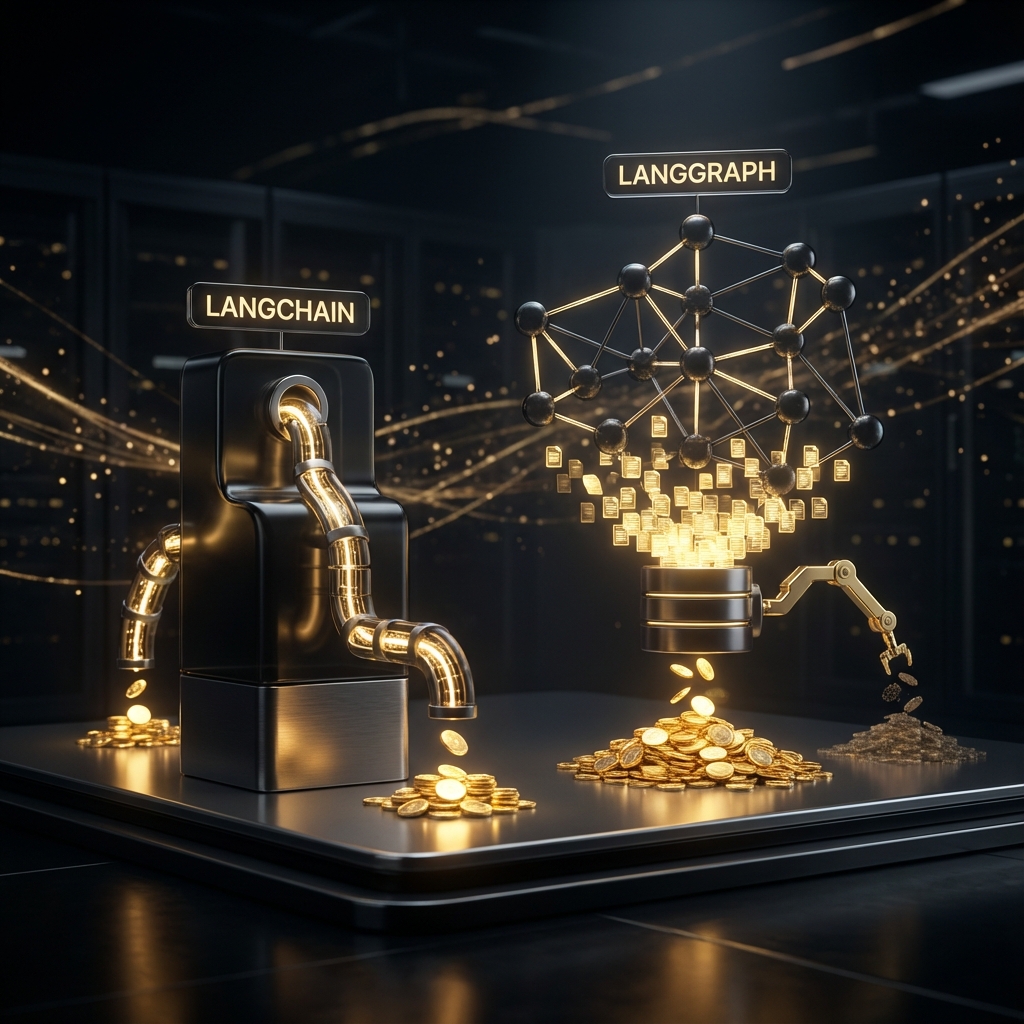
The AI engineering industry has shifted en masse from LangChain (linear pipelines) to LangGraph (cyclic, stateful agents) over the last 12 months. This shift is architectures; cyclic graphs allow agents to loop, correct errors, and handle ambiguity in ways that linear chains cannot.
While Graphs offer superior resilience and control flow, they introduce a significant hidden cost that few developers anticipate: the "Persistence Tax." In this post, we will break down the mechanics of token consumption in both architectures and explain why your LangGraph bill might be 3x higher than your LangChain bill for the exact same task.
The Mechanics of Cost
Linear Chains (LangChain LCEL)
In a traditional Linear Chain, memory is ephemeral unless explicitly managed.
Input -> Step 1 -> Step 2 -> Output
The context window only holds what is needed for the immediate step. Once Step 1 is done, its memory footprint is largely discarded. The prompt sent to Step 2 might only contain the output of Step 1. It is "Fire and Forget."
Cyclic Graphs (LangGraph)
In a LangGraph, the system is designed around a global State object. At every "Super-step" (node execution), the graph infrastructure performs a rigorous ritual:
Read: Fetches the current State from the database (Checkpointer).
Hydrate: Feeds the entire relevant State into the LLM context.
Execute: Runs the node logic.
Write: Saves the new State back to the Checkpointer.
The killer feature here is Context Re-inflation. If you have a loop where an agent tries to fix code 5 times, the State object accumulates the history of all 5 attempts. At the 5th step, you aren't just sending the 5th attempt; you are sending attempts 1, 2, 3, and 4 as well.
Your token consumption isn't linear ($O(n)$); it approaches quadratic ($O(n^2)$) relative to the number of steps, as the context window grows larger with every turn.
The Benchmark: "Research & Write"
We ran a standard task: "Research the history of the S&P 500 and write a 2-paragraph summary."
LangChain Implementation
Flow: Search Tool -> Summarizer LLM.
Outcome: Pass.
Token Cost: 2,500 Tokens. (One pass, straight through).
LangGraph Implementation
Flow: Researcher -> Critic (Loop) -> Writer.
Outcome: Pass (Higher quality, caught one date error).
Token Cost: 8,500 Tokens.
The Graph approach cost 3.4x more. The "Critic" loop triggered 3 times. Each time, it re-read the entire search results. The redundancy was massive.
The Verdict: State Pruning is Mandatory
Is the cost worth it? Yes, for complex tasks where accuracy is paramount. The LangChain version failed to catch a subtle factual error, while the LangGraph version self-corrected using its loop capability. However, to use LangGraph economically, you must implement State Pruning.
Do not keep every intermediate tool output in the global state forever. If your agent does a Google Search that returns 10,000 tokens of junk, and then summarizes it into 50 tokens, delete the 10,000 tokens from the state before the next step.
Code Example: The Reducer Pattern
Use the messages reducer in LangGraph to condense history effectively or implement a custom filter:
Python
from langgraph.graph import MessageGraph

# Custom reducer to keep only the last N messages
def reducer(state: list, new_messages: list):
    # Append new messages
    updated_history = state + new_messages

    # Prune: Keep system prompt + last 5 turns
    if len(updated_history) > 6:
        return [updated_history[0]] + updated_history[-5:]
    return updated_history
By enforcing this "Forgetfulness," you linearize the cost curve while keeping the cyclic control flow.
Conclusion
LangGraph buys you reliability, but you pay for it in tokens. It encourages a "dump everything in the state" mental model that is dangerous for your budget. If you treat your context window like an infinite garbage dump, you will go broke. Manage your state as aggressively as you manage your database schema. If data acts as a liability in GDPR, context acts as a liability in FinOps.
All in One Place
Atler Pilot decodes your cloud spend story by bringing monitoring, automation, and intelligent insights together for faster and better cloud operations.