
The Economics of Large Language Models in Production
Deploying Large Language Models (LLMs) has transitioned from the R&D lab to the core of enterprise application architecture. From automated customer support agents to internal code-generation copilots, LLMs are ubiquitous. However, as these applications scale from hundreds of users to millions, the underlying inference costs have triggered a financial reckoning.
Unlike traditional microservices, where serving an HTTP request costs fractions of a cent, querying a massive frontier model (like GPT-4 or Claude 3 Opus) can cost several cents per request. When multiplied by millions of daily interactions, the monthly bill can easily eclipse the cost of the entire legacy infrastructure stack. Optimizing LLM costs is no longer just a FinOps exercise; it is a fundamental architectural requirement that dictates whether an AI product is economically viable.
This guide provides a deep, tactical breakdown of LLM infrastructure cost optimization in 2026. We will explore semantic caching, model routing, quantization, prompt compression, and the intricate financial debate between utilizing managed APIs versus self-hosting open-source models.
Semantic Caching: The Ultimate Cost Reducer
The most effective way to reduce LLM inference costs is to avoid making the inference call altogether. In traditional web architectures, caching (via Redis or Memcached) is used to serve identical requests instantly. However, traditional caching relies on exact string matching. If a user asks, "How do I reset my password?", and another asks, "What is the password reset process?", a traditional cache sees two different strings and sends both requests to the expensive LLM.
Semantic Caching solves this by leveraging vector databases. When a user submits a prompt, it is instantly converted into an embedding (a mathematical vector representation of the text's meaning). This embedding is then queried against a vector database (like Pinecone, Milvus, or Qdrant) storing previously answered prompts.
If the database finds an embedding that is, for example, 95% similar to the new prompt, it bypasses the LLM entirely and serves the cached response. Because generating an embedding and querying a vector database is orders of magnitude cheaper and faster than generating tokens from a massive LLM, semantic caching can reduce overall inference costs by 30% to 50% in production environments with high query redundancy.
Intelligent Model Routing and Cascading
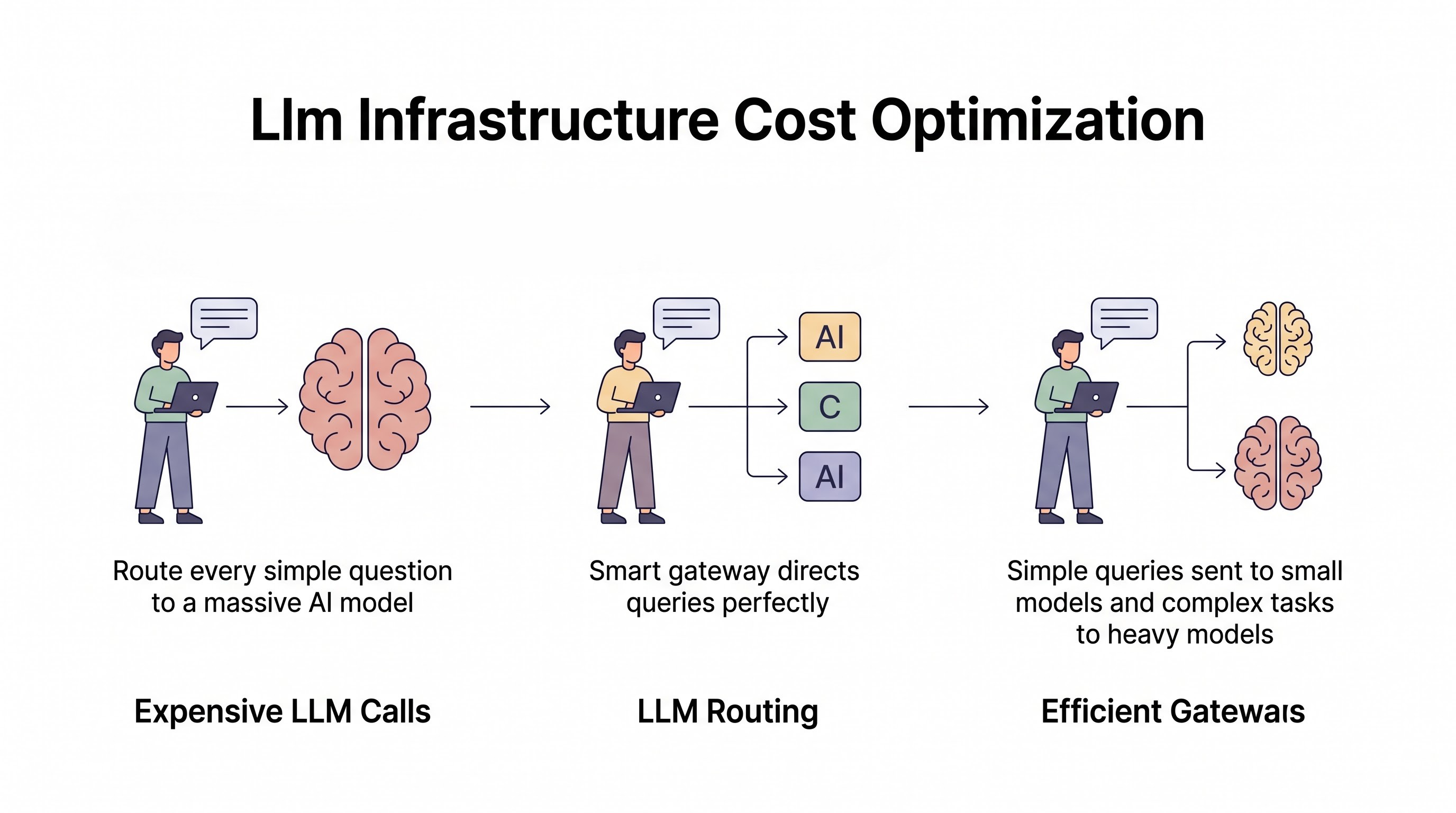
A massive source of financial waste is using a multi-trillion parameter frontier model to perform trivial tasks. Using GPT-4 to summarize a short paragraph or format a date string is the equivalent of using a supercomputer to calculate a restaurant tip.
Mature AI architectures utilize Intelligent Model Routing. An LLM Gateway acts as the entry point for all application requests. This gateway employs a fast, highly optimized classifier model (or a simple rules engine) to assess the complexity of the incoming prompt.
Trivial Tasks (formatting, basic entity extraction, translation of common languages) are routed to a cheap, fast, self-hosted open-source model like Llama 3 8B or Mistral 7B.
Moderate Tasks (document summarization, RAG synthesis) are routed to mid-tier models.
Complex Tasks (deep reasoning, complex coding, edge-case logic) are escalated to the expensive frontier models.
This cascading approach ensures that the organization only pays premium API costs when the cognitive density of the task absolutely requires it. By routing just 60% of traffic to smaller models, overall inference costs can plummet by an order of magnitude.
Prompt Compression and Context Window Management
LLM API pricing is based on tokens—both the tokens you send (input) and the tokens the model generates (output). In architectures utilizing Retrieval-Augmented Generation (RAG), input token costs can spiral rapidly. A typical RAG pipeline might retrieve 10 long documents from a database and shove all of them into the LLM's context window, forcing the model to read 20,000 tokens just to answer a simple question.
Prompt Compression techniques are vital here. Before the retrieved context is sent to the LLM, a smaller, cheaper model (or an extractive summarization algorithm) analyzes the context and strips out all irrelevant sentences, stop words, and formatting. By compressing 20,000 tokens of raw context down to 2,000 tokens of dense, highly relevant facts, the input cost for the frontier model is slashed by 90%.
Additionally, developers must be heavily penalized (via automated linting or CI/CD checks) for passing massive, unfiltered system prompts. Every word in a system prompt costs money every single time the model is invoked.
The Economics of Self-Hosting vs. Managed APIs
A critical strategic decision for any enterprise is determining when to transition from managed APIs (OpenAI, Anthropic) to self-hosting open-source models on their own cloud infrastructure (EC2, GKE, Azure VMs).
Managed APIs offer zero operational overhead, infinite elasticity, and zero upfront cost. However, at a certain volume threshold, the profit margin charged by the API provider makes self-hosting financially attractive. The crossover point depends heavily on the model size and the utilization rate of the underlying GPUs.
If an organization decides to self-host, they must master advanced optimization techniques to make the math work:
Quantization: Reducing the precision of the model's weights (e.g., from 16-bit to 4-bit or 8-bit). This drastically reduces the VRAM required to load the model, allowing massive models to fit on cheaper, widely available GPUs (like the L4 or T4) rather than requiring scarce H100s.
PagedAttention and vLLM: Traditional LLM serving engines waste massive amounts of GPU memory due to fragmentation. Frameworks like vLLM use PagedAttention to manage attention keys and values like an operating system manages virtual memory. This increases the throughput of a self-hosted model by up to 24x, fundamentally altering the unit economics of the GPU cluster.
Continuous Batching: Instead of processing a request sequentially, modern serving engines continuously batch incoming requests at the iteration level, ensuring the GPU is constantly saturated and never waiting for I/O.
Integrating LLMs into the FinOps Framework
Finally, LLM costs must be stripped of their mystique and integrated directly into standard FinOps practices. "AI" is not an excuse for unallocated spend.
Organizations must establish rigorous chargeback mechanisms for API usage. LLM Gateways must enforce strict authentication and append metadata to every request, tracking exactly which engineering team, microservice, or end-user generated the tokens. Budgets must be enforced at the API gateway level, automatically throttling non-critical applications if they exceed their daily token allowance.
Conclusion: Engineering for AI Profitability
The novelty of Generative AI has worn off; the era of AI profitability has begun. Building a cool LLM demo is easy. Building an LLM architecture that serves a million users without bankrupting the company requires intense engineering discipline. By mastering semantic caching, intelligent model routing, aggressive prompt compression, and self-hosting optimization, cloud architects can deliver the magic of AI at a fraction of the default cost.
Key Takeaway
As organizations scale their AI and multi-cloud operations, prioritizing deep visibility, robust automation, and strict governance is critical. The successful integration of these advanced technical disciplines with cross-functional financial accountability ensures long-term operational resilience and architectural efficiency.
All in One Place
Atler Pilot decodes your cloud spend story by bringing monitoring, automation, and intelligent insights together for faster and better cloud operations.