
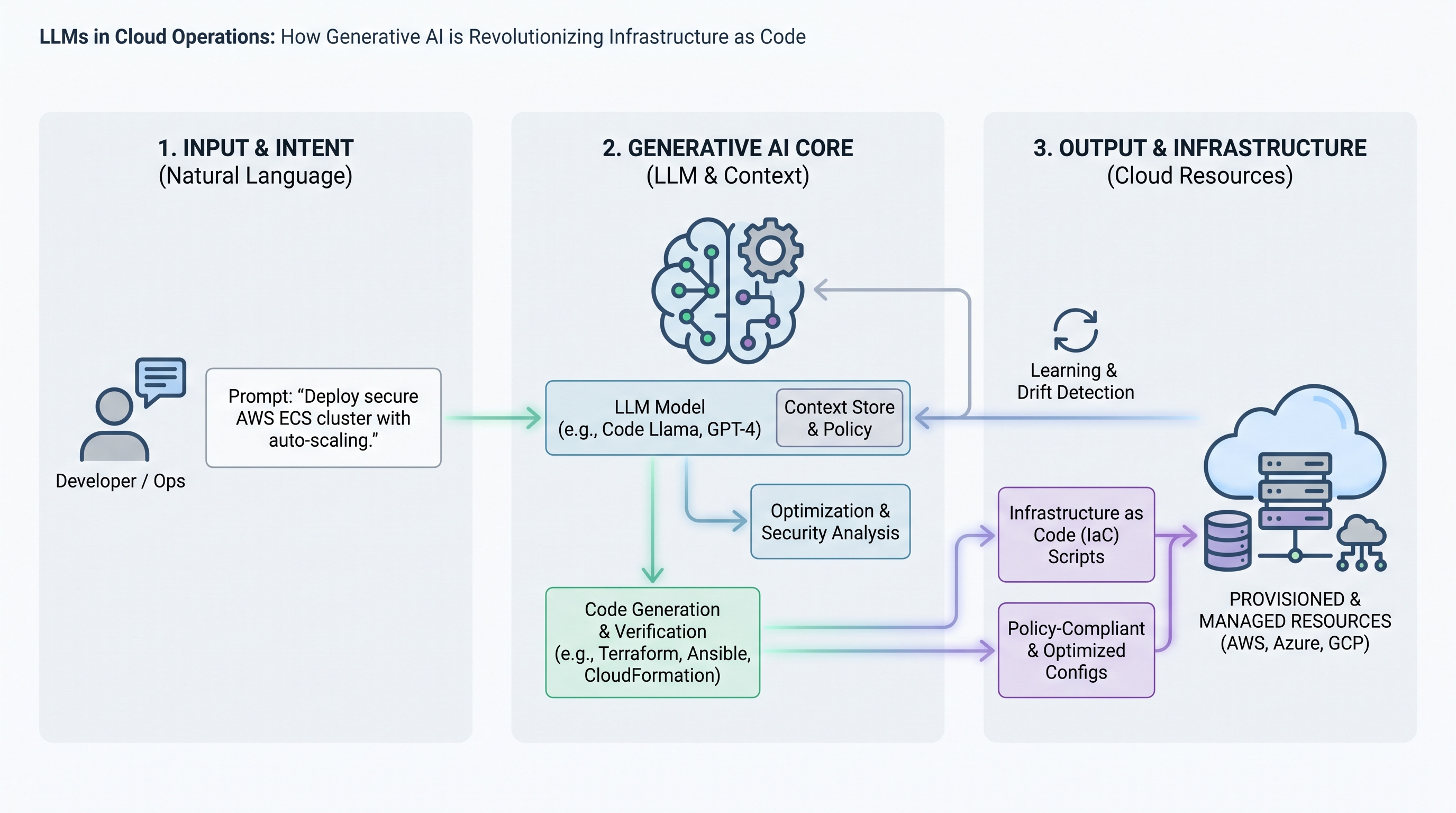
The Evolution of IaC: From Declarative Templates to Cognitive Synthesizers
For over a decade, Infrastructure as Code (IaC) has been the cornerstone of modern cloud engineering. Tools like HashiCorp Terraform, AWS CloudFormation, Pulumi, and Ansible successfully shifted infrastructure management from manual console operations to version-controlled, reproducible declarative code. However, traditional IaC remains bottlenecked by human cognitive limits. Writing, maintaining, and refactoring IaC templates across complex, heterogeneous, multi-cloud environments requires deep domain expertise, constant updates to keep pace with cloud provider API changes, and intensive manual code reviews.
Enter Large Language Models (LLMs). The integration of generative AI into cloud operations marks a paradigm shift from declarative configuration to cognitive synthesis. Instead of human operators manually translating architectural diagrams into thousands of lines of HCL (HashiCorp Configuration Language) or YAML, LLMs act as intelligent translation layers. They parse natural language intent, correlate it with real-time cloud provider schemas, and generate syntactically correct, optimized, and secure infrastructure blueprints.
This evolution is not merely about auto-completing code blocks. It is about building closed-loop autonomous systems capable of understanding context, calculating financial implications, verifying security postures, and executing changes safely. To achieve this at enterprise scale across AWS, Azure, GCP, and Oracle Cloud environments, organizations must move past generic chat assistants and implement robust, agentic architectures designed specifically for cloud operations.
Architectural Blueprint: LLM-Driven IaC Generation and Validation Pipelines
Deploying raw LLM outputs directly to production cloud environments is a recipe for disaster. Hallucinations, outdated knowledge bases, and insecure defaults represent existential risks to enterprise security and stability. A production-grade LLM-driven IaC pipeline must be deterministic, secure, and self-correcting. The diagram and architectural breakdown below outline a robust integration pattern:
+-------------------------+
|  Natural Language Input |
+-------------------------+
             |
             v
+-------------------------+      +------------------------------+
|   Intent Parser &       |<---->|  RAG Engine: Cloud Providers,|
|   Context Builder       |      |  Internal Policies, Schema   |
+-------------------------+      +------------------------------+
             |
             v
+-------------------------+
|   LLM Code Generator    |
+-------------------------+
             |
             v
+-------------------------+
|  AST Parser & Syntax    |
|  Validation (Dry-Run)   |
+-------------------------+
             |
             +-----------------------+
             | (If Syntax Fails)     | (If Syntax Passes)
             v                       v
+-------------------------+     +-------------------------------+
|  Error Feedback Loop    |     | Static Security Analysis      |
|  (Self-Correction)      |     | (tfsec, Checkov, OPA Rego)    |
+-------------------------+     +-------------------------------+
                                     |
                                     +-----------------------+
                                     | (If Policy Fails)     | (If Policy Passes)
                                     v                       v
                                +-----------------------+   +-----------------------+
                                | Policy Feedback Loop  |   | Cost Impact Analysis  |
                                | (Context Refinement)  |   | (FinOps Engine)       |
                                +-----------------------+   +-----------------------+
                                                                 |
                                                                 v
                                                            +-----------------------+
                                                            | Human-In-The-Loop     |
                                                            | Approval & Deploy     |
                                                            +-----------------------+
This architecture relies on several distinct, decoupled layers working in unison:
Retrieval-Augmented Generation (RAG) Engine: LLMs are frozen in time based on their training cutoff. The RAG engine injects real-time state, updated cloud provider API schemas, and internal organizational compliance standards into the model's context window. This minimizes hallucinations and ensures compliance with current standards.
Abstract Syntax Tree (AST) Parsing: Before any generated code is executed, it must be parsed into an AST. This deterministic step ensures that the HCL or JSON structure is syntactically valid before it ever reaches a cloud CLI or API endpoint.
Deterministic Feedback Loops: If the AST parser or static analysis tools detect errors, the stack traces and policy violations are fed back into the LLM as a new prompt. This allows the agent to self-correct its code before presenting it to human operators.
For organizations looking to orchestrate this level of automation without building complex internal tooling from scratch, leveraging a unified financial operations platform and automated operations hub like CloudAtler provides the necessary foundational infrastructure to safely run cognitive cloud pipelines.
Code Generation and Refactoring in Practice
To understand the power of LLM-driven IaC, let us examine a practical scenario. Suppose an infrastructure team needs to provision a secure, highly available, and cost-optimized multi-tier web application on AWS, utilizing a VPC, private subnets, an Application Load Balancer (ALB), and an Auto Scaling Group (ASG) of EC2 instances running behind a NAT Gateway.
Traditionally, writing this configuration from scratch would require several hundred lines of HCL, manual calculation of CIDR blocks, and careful configuration of IAM roles. An LLM agent, powered by the Atler AI engine, can synthesize this entire configuration in seconds based on a high-level prompt, while embedding best practices such as least-privilege IAM policies, encrypted EBS volumes, and tag-based cost allocation.
Consider the following Python script illustrating how an operational LLM agent processes a system prompt and validates the output against a mock Terraform parser:
import openai
import subprocess
import json

def generate_and_validate_iac(prompt: str, max_retries: int = 3) -> str:
    system_instruction = (
        "You are an expert Cloud Architect. Generate valid, secure Terraform code "
        "matching the user's request. Ensure all resources have tags, encryption is "
        "enabled by default, and least-privilege IAM policies are applied. "
        "Output ONLY raw Terraform code. No markdown, no explanations."
    )

    current_prompt = prompt
    for attempt in range(max_retries):
        # Call the LLM (using GPT-4o or a specialized fine-tuned model)
        response = openai.ChatCompletion.create(
            model="gpt-4o",
            messages=[
                {"role": "system", "content": system_instruction},
                {"role": "user", "content": current_prompt}
            ],
            temperature=0.0
        )

        generated_code = response.choices[0].message.content.strip()

        # Write code to a temporary file for validation
        with open("main.tf", "w") as f:
            f.write(generated_code)

        # Run deterministic validation (terraform validate)
        result = subprocess.run(
            ["terraform", "validate", "-json"],
            capture_output=True,
            text=True
        )

        validation_data = json.loads(result.stdout)
        if validation_data.get("valid", False):
            print(f"Success: Valid Terraform synthesized on attempt {attempt + 1}")
            return generated_code

        # If validation fails, feed the error back into the LLM
        errors = validation_data.get("diagnostics", [])
        error_feedback = "\n".join([err.get("summary", "") + ": " + err.get("detail", "") for err in errors])
        print(f"Attempt {attempt + 1} failed validation. Feedback loop initiated.")
        current_prompt = f"The code you generated previously had the following validation errors. Please fix them:\n{error_feedback}\n\nOriginal Request:\n{prompt}"

    raise Exception("Failed to generate valid Terraform code within retry limit.")
This self-correcting code-generation loop is highly effective. By coupling the probabilistic nature of the LLM with the deterministic nature of compilers and validation tools, we create a system that guarantees syntactical accuracy before human review.
FinOps Integration: Cost-Optimized IaC Synthesis
One of the most significant advantages of integrating LLMs into cloud operations is the ability to shift FinOps directly into the design phase of the software development lifecycle (SDLC). Traditionally, FinOps teams act reactively—analyzing cloud bills at the end of the month and identifying idle or oversized resources. With LLM-driven IaC, cost-optimization becomes proactive and preventative.
When an LLM agent is tasked with generating infrastructure, it should not just query provider schemas; it should query real-time cloud pricing APIs. By incorporating current billing data, reserved instance (RI) availability, and savings plans into the prompt context, the LLM can make intelligent trade-offs during the code synthesis phase.
Resource Type | Standard IaC Default | LLM FinOps-Optimized Synthesis | Estimated Cost Reduction |
|---|---|---|---|
Compute (EC2/VMs) | Static, oversized instances (e.g., m5.xlarge) | Graviton-based (t4g/m6g) instances with auto-scaling metrics tuned to actual CPU demands. | 30% - 40% |
Storage (EBS/Disk) | gp2 volumes with high provisioned IOPS | gp3 volumes with baseline IOPS, dynamically adjusted based on runtime telemetry. | 20% |
Database (RDS/SQL) | Always-on Multi-AZ instances | Single-AZ with automated snapshotting for dev/test; Aurora Serverless v2 for unpredictable workloads. | 50% (Dev/Test) |
By using an LLM to analyze the abstract syntax tree of a proposed pull request, the system can generate a detailed cost impact projection before deployment. For instance, if a developer changes an instance type from t3.medium to c5.2xlarge, the LLM agent can intercept the PR, query the cloud provider API, calculate the monthly cost delta, check it against the team's remaining budget allocation, and automatically suggest a more cost-effective alternative or flag the change for financial approval.
Securing the Synthesized Infrastructure: Automated Guardrails and Vulnerability Mitigation
While the speed of LLM-driven infrastructure provisioning is revolutionary, it introduces significant security challenges if left unchecked. LLMs are trained on public repositories, which unfortunately contain millions of examples of insecure code—including hardcoded secrets, wide-open security groups (0.0.0.0/0), unencrypted S3 buckets, and overly permissive IAM roles.
To mitigate these risks, organizations must implement strict, policy-as-code automated guardrails that run concurrently with the LLM generation pipeline. These guardrails act as a deterministic sandbox, ensuring that no matter what code the LLM synthesizes, it cannot violate the organization's core security policies.
For example, you can enforce Open Policy Agent (OPA) Rego policies to evaluate the generated Terraform plan. Consider the following Rego policy designed to block any security group configuration that allows unrestricted SSH access (port 22) from the public internet:
package play

default allow = false

# Allow deployment only if there are no security violations
allow {
    count(violations) == 0
}

# Identify security group rules that allow open ingress on port 22
violations[msg] {
    resource := input.resource_changes[_]
    resource.type == "aws_security_group_rule"
    resource.change.after.type == "ingress"
    resource.change.after.from_port <= 22
    resource.change.after.to_port >= 22
    resource.change.after.cidr_blocks[_] == "0.0.0.0/0"
    msg := sprintf("Security violation: Resource '%v' allows public SSH access (port 22) from 0.0.0.0/0", [resource.address])
}
By embedding these policy checks directly into the continuous integration (CI) pipeline, the system guarantees compliance. When combined with a platform that supports continuous cloud security management, security leaders gain complete visibility into both the generated infrastructure and the real-time runtime state, closing the gap between code-time intent and run-time reality.
Multi-Cloud Orchestration: Bridging the Provider Gap with Generative AI
As enterprises scale, they increasingly adopt multi-cloud strategies to avoid vendor lock-in, meet regional data residency requirements, and leverage best-of-breed services. However, managing infrastructure across AWS, Azure, GCP, and Oracle Cloud requires distinct engineering teams with highly specialized skill sets. The syntax, resource naming conventions, IAM paradigms, and networking topologies differ drastically between providers.
LLMs are uniquely positioned to act as universal translators across cloud providers. Because they have been trained on the documentation and codebase of all major cloud ecosystems, they can seamlessly convert architectural patterns from one provider's dialect to another.
For instance, an engineering team can feed an existing, highly secure AWS CloudFormation template into an LLM agent and prompt: "Translate this AWS infrastructure into equivalent, production-ready Terraform code for Microsoft Azure, utilizing Azure Virtual Machines, Azure Application Gateway, and Azure Key Vault, adhering to the CIS Microsoft Azure Foundations Benchmark."
The LLM does not perform a simple 1:1 text replacement. Instead, it maps complex concepts logically:
AWS IAM Roles and Instance Profiles are translated to Azure Managed Identities.
AWS VPCs and Subnets map to Azure Virtual Networks (VNets) and Subnets.
AWS KMS (Key Management Service) keys map to Azure Key Vault secrets and keys.
AWS S3 Buckets map to Azure Blob Storage containers with equivalent private access policies.
For multi-cloud SRE teams, utilizing dedicated solutions for infrastructure and SRE teams paired with generative AI abstraction layers drastically reduces the cognitive load of managing multi-cloud estates, enabling a small team of engineers to operate with the efficiency of a massive global operations department.
The Future of Autonomous Cloud Operations: Self-Healing and Self-Optimizing Infrastructure
The convergence of LLMs and IaC is leading toward the ultimate goal of cloud engineering: Autonomous Cloud Operations. We are moving rapidly from static infrastructure templates to dynamic, self-healing, and self-optimizing closed-loop feedback systems.
In an autonomous cloud ecosystem, the operational loop is fully closed:
Continuous Monitoring & Telemetry: Runtime monitoring tools continuously ingest performance metrics, cost data, and security events.
Anomaly Detection & Analysis: The AI engine identifies anomalies—such as a sudden spike in database latency, an unpredicted surge in cloud spend, or a drift in security configurations.
Cognitive Synthesis of Remediation: Instead of simply sending an alert to an on-call engineer, the platform uses an LLM to analyze the root cause, determine the optimal configuration change, and write the corrective IaC.
Automated Validation & CI/CD: The generated code is put through AST validation, dry-run testing, security policy checks, and cost calculations.
Deployment & Verification: The code is merged and applied automatically or queued for one-click human approval. The system then monitors the environment to verify that the anomaly is resolved.
This self-healing loop eliminates the manual triage phase of incident response, reducing Mean Time to Resolution (MTTR) from hours to minutes, while ensuring that the actual source of truth (the IaC git repository) is always kept in sync with the real-time cloud state.
Conclusion: Unify and Secure Your Cloud Operations with CloudAtler
The integration of Large Language Models into Infrastructure as Code is not a futuristic concept—it is a competitive necessity for the modern enterprise. By shifting cloud operations from manual, error-prone template writing to cognitive, policy-guarded AI synthesis, organizations can achieve unprecedented velocity, dramatic cost savings, and bulletproof security compliance.
However, unlocking the full potential of generative AI in cloud operations requires more than just raw LLM APIs. It demands a unified, highly secure, and context-aware platform that can bridge the gap between AI generation, FinOps optimization, and enterprise security guardrails across AWS, Azure, GCP, and Oracle Cloud environments.
CloudAtler is the industry's premier AI-powered platform designed to unify FinOps, cloud security, and automated operations. By integrating the advanced cognitive capabilities of generative AI with deterministic policy enforcement, CloudAtler empowers SREs, CISOs, and finance leaders to orchestrate, optimize, and secure their multi-cloud infrastructure from a single, intuitive interface.
Ready to revolutionize your cloud operations and experience the power of safe, AI-driven infrastructure management? Explore CloudAtler today or schedule a personalized demo with our cloud architecture experts to see how we can transform your enterprise operations.
All in One Place
Atler Pilot decodes your cloud spend story by bringing monitoring, automation, and intelligent insights together for faster and better cloud operations.