
The Limitations of Static Rules in Modern Multi-Cloud Environments
For years, Cloud Security Posture Management (CSPM) has relied on static, deterministic rule engines. These systems evaluate cloud infrastructure against pre-defined baselines—such as the CIS Benchmarks, PCI-DSS, or SOC 2 frameworks—using policy-as-code languages like Rego (Open Policy Agent) or proprietary domain-specific languages (DSLs). While highly effective at identifying known, simple misconfigurations (such as an S3 bucket exposed to the public internet or an SSH port open to 0.0.0.0/0), static engines possess a fundamental flaw: they can only detect what they have been explicitly programmed to find.
Modern enterprise cloud architectures are no longer composed of isolated virtual machines and simple databases. They are highly distributed, ephemeral meshes of managed Kubernetes clusters, serverless functions, complex Identity and Access Management (IAM) trust relationships, and deeply integrated third-party SaaS tools across AWS, Azure, GCP, and Oracle Cloud Infrastructure (OCI). In this hyper-complex paradigm, security threats increasingly manifest as "zero-day configuration flaws." These are novel, undocumented vulnerabilities arising from the unexpected interaction of multiple, individually compliant configuration settings, or the introduction of brand-new cloud service APIs whose security implications are not yet understood by static compliance frameworks.
When a cloud provider releases a new service—such as a managed generative AI orchestration tool or a novel cross-region data transit gateway—there is a dangerous latency window. This window exists between the service's release and the point when security teams (and CSPM vendors) write, test, and deploy static rules to govern its configuration. During this period, attackers can exploit undocumented behaviors. To close this gap, enterprises must transition from reactive, signature-based compliance to predictive, machine learning-driven cloud security. By implementing an advanced enterprise cloud security management platform, organizations can shift from manual rule-writing to automated, predictive threat modeling.
Anatomy of a Zero-Day Configuration Flaw: A Multi-Service Attack Path
To understand why machine learning is necessary, we must examine how a zero-day configuration exploit operates in the wild. Unlike software vulnerabilities (such as a buffer overflow in a library), a configuration zero-day relies entirely on legitimate cloud APIs and permissions configured in a way that creates an unintended security boundary bypass.
Consider the following scenario involving a newly released managed Machine Learning (ML) model deployment service in a major cloud provider. Individually, three assets are configured to meet standard compliance checks:
Asset A (S3 Bucket): Encrypted at rest, versioning enabled, and restricted to VPC-only access via a bucket policy. Static CSPM flags this as "Compliant."
Asset B (IAM Role): Assigned to a data science team. It has permissions to read from the S3 bucket and invoke the cloud provider's newly released ML Model Customization API. No administrative permissions are granted. Static CSPM flags this as "Compliant."
Asset C (ML Model Customization Service): A brand-new service that orchestrates training jobs. By default, it runs in a service-owned VPC and, behind the scenes, assumes a service-linked role to read training data from the user's S3 bucket. Because it is a new service, no static CSPM rules exist to audit its network isolation parameters.
The zero-day configuration flaw lies in the undocumented trust relationship and transit path of the new ML service. An attacker compromises the credentials of a low-level data scientist (Asset B). Although the attacker cannot access the S3 bucket directly from the public internet (due to the VPC-only policy on Asset A), they can initiate a model training job using the new ML Service (Asset C). Because the ML Service executes its training jobs in a multi-tenant cloud-provider-owned network and accesses the S3 bucket via a service-linked role that bypasses the customer's VPC endpoint restrictions, the attacker can instruct the model to export its weights—containing memorized training data—to an external, attacker-controlled destination.
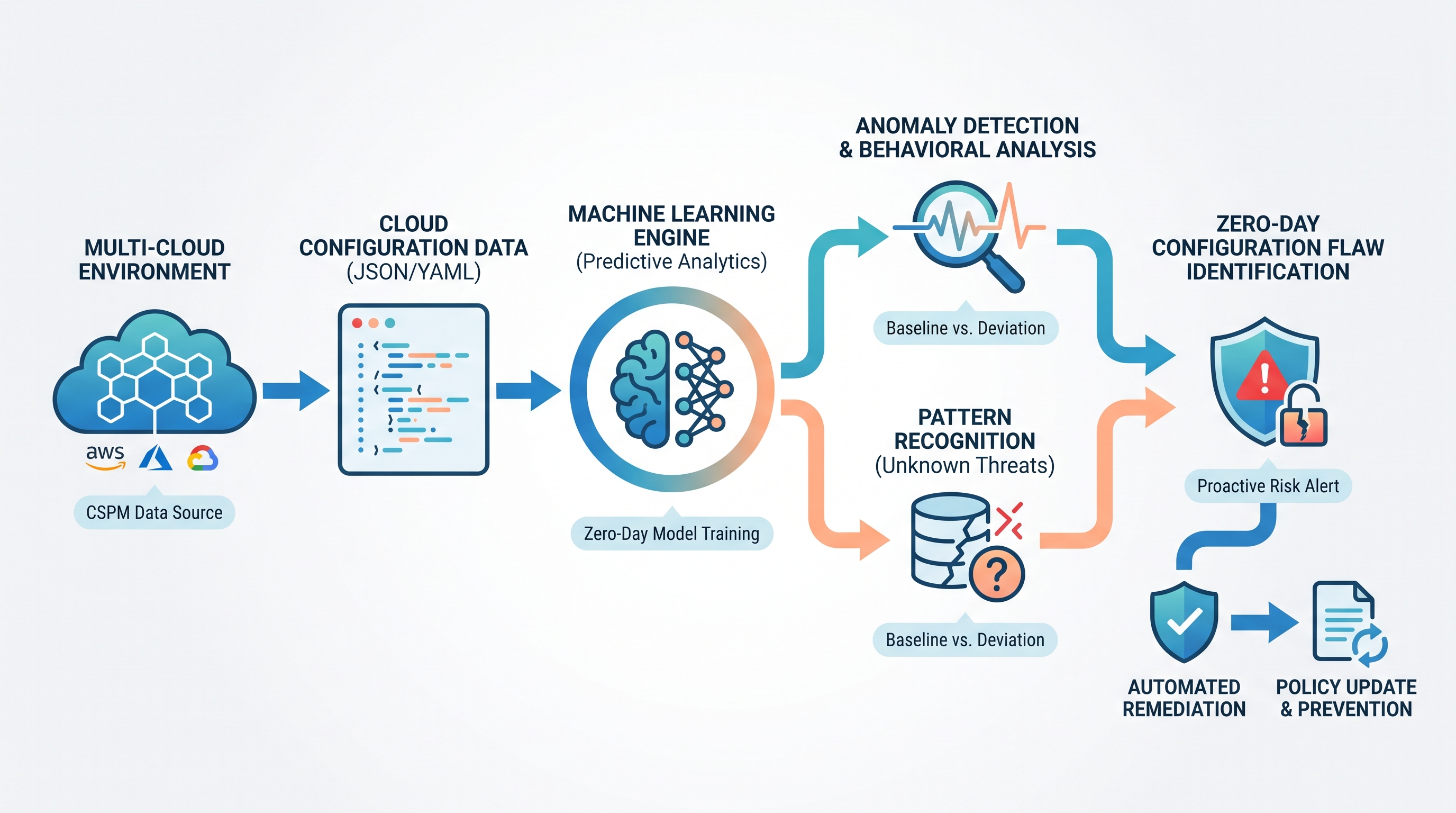
A standard static policy engine would completely miss this attack path because it evaluates each resource in isolation against known rules. A predictive system, however, models the entire cloud ecosystem as a graph, identifying anomalous permission pathways and implicit trust boundaries that deviate from historical baselines.
Mathematical and Algorithmic Foundations of Predictive CSPM
Predictive analytics in CSPM relies on transforming raw cloud configuration metadata into structured mathematical representations that machine learning models can ingest. The primary methodologies used to achieve this are Graph Neural Networks (GNNs) for structural analysis and Isolation Forests / Autoencoders for multidimensional anomaly detection.
1. Graph Representation of Cloud Infrastructure
A cloud environment is naturally represented as a directed, heterogeneous graph $G = (V, E)$, where:
$V$ represents the set of vertices (nodes), corresponding to cloud resources (e.g., IAM Users, EC2 Instances, S3 Buckets, Security Groups, KMS Keys). Each node $v \in V$ has a feature vector $x_v$ representing its attributes (e.g., creation time, tags, region, public exposure status).
$E$ represents the set of directed edges, corresponding to relationships or permissions (e.g.,
AssumesRole,AllowsTrafficTo,DecryptsWith,Contains). Each edge $e \in E$ has a type and weight indicating the strength or privilege level of the connection.
By framing the infrastructure as a graph, we can leverage Graph Neural Networks (GNNs)—specifically GraphSAGE or Graph Convolutional Networks (GCNs)—to generate low-dimensional vector embeddings of our cloud assets. These embeddings capture both the local properties of a resource and its structural position within the broader cloud topology.
2. Node Embedding Generation
In a GNN, the representation $h_v^{(k)}$ of a node $v$ at layer $k$ is computed by aggregating the representations of its immediate neighbors $N(v)$ from the previous layer:
$h_v^{(k)} = \sigma \left( W^{(k)} \cdot \text{AGGREGATE} \left( \left\{ h_u^{(k-1)} , \forall u \in N(v) \right\} \right) + B^{(k)} h_v^{(k-1)} \right)$
Where $W^{(k)}$ and $B^{(k)}$ are learnable parameter matrices, $\sigma$ is a non-linear activation function (such as ReLU), and $\text{AGGREGATE}$ is a symmetric aggregation function (such as mean, pooling, or LSTM). After several layers of aggregation, the final node embedding $z_v = h_v^{(K)}$ encodes complex, multi-hop relationship paths. If an attacker attempts to construct a novel privilege escalation path, the structural embedding of the involved assets will deviate significantly from the "normal" structural patterns learned by the model, triggering a high-severity predictive alert.
3. Multi-Dimensional Anomaly Detection with Autoencoders
To detect zero-day configurations that do not rely on topological anomalies, we use deep autoencoders to analyze the feature vectors of individual resource configurations. An autoencoder is trained to reconstruct "normal" configuration states. The network consists of an encoder function $f_\theta$ and a decoder function $g_\phi$:
$\hat{x} = g_\phi(f_\theta(x))$
The model is trained by minimizing the reconstruction error (Loss) across a dataset of historically secure configurations:
$L(x, \hat{x}) = \frac{1}{d} \sum_{i=1}^d (x_i - \hat{x}_i)^2$
When a zero-day configuration flaw is introduced—such as a database configured with an unusual combination of cross-region replication, unencrypted local cache, and a newly released federated identity provider—the autoencoder will fail to reconstruct this novel feature combination accurately. This results in a high reconstruction error (anomaly score), alerting security engineers to inspect the resource long before any signature-based rule is written for it.
Architectural Blueprint: Building a Predictive CSPM Pipeline
To implement predictive analytics for zero-day configuration detection, enterprise organizations must construct a real-time data ingestion, processing, and inference pipeline. Below is the technical architecture diagram of a modern, predictive CSPM system:
Stage | Components Involved | Data/Payload Processed |
|---|---|---|
1. Ingestion | AWS EventBridge, Azure Event Grid, GCP Pub/Sub, CloudAtler API Collectors | Raw JSON API configuration state payloads and IAM Policy documents. |
2. Normalization | Apache Flink / Spark Streaming, Custom Schema Parsers | Standardized Entity-Relationship JSON (Mapping multi-cloud resources to a unified schema). |
3. Graph Database | Amazon Neptune, Neo4j, or TigerGraph | Active update of the global cloud topology graph (Nodes, Edges, and Properties). |
4. ML Inference | PyTorch Geometric (PyG), scikit-learn, Atler AI predictive engine | Execution of GNN node classification and Autoencoder reconstruction loss evaluation. |
5. Action / Orchestration | Jira, Slack, AWS Systems Manager, CloudAtler Automated Remediation Engines | Triggering of auto-isolation scripts, IAM policy restrictions, or ticketing workflows. |
Let us dive deeper into the code required to execute the machine learning inference stage. Below is a production-grade Python implementation utilizing an Isolation Forest model to identify anomalous configuration states across cloud resource metadata. This script extracts configuration features, normalizes them, trains an unsupervised model, and flags anomalous resources that deviate from the enterprise norm.
import numpy as np
import pandas as pd
from sklearn.ensemble import IsolationForest
from sklearn.preprocessing import OneHotEncoder
from sklearn.compose import ColumnTransformer

# Simulated multi-cloud configuration dataset
# Features: public_exposure, iam_privilege_level, MFA_enabled, multi_region_replication, api_version_age_days
config_data = [
    {"resource_id": "s3-prod-data", "exposure": "private", "privilege": "low", "mfa": "yes", "replication": "yes", "api_age": 365},
    {"resource_id": "iam-role-lambda", "exposure": "private", "privilege": "medium", "mfa": "no", "replication": "no", "api_age": 120},
    {"resource_id": "rds-prod-db", "exposure": "private", "privilege": "high", "mfa": "yes", "replication": "yes", "api_age": 450},
    # Zero-day anomaly: Brand-new service, high privilege, no MFA, public exposure through an undocumented API pathway
    {"resource_id": "new-genai-gateway", "exposure": "public", "privilege": "high", "mfa": "no", "replication": "no", "api_age": 2},
    {"resource_id": "ec2-web-server", "exposure": "public", "privilege": "low", "mfa": "no", "replication": "no", "api_age": 600}
]

df = pd.DataFrame(config_data)

# Define categorical and numerical columns for preprocessing
categorical_cols = ["exposure", "privilege", "mfa", "replication"]
numerical_cols = ["api_age"]

# Pipeline preprocessing using OneHotEncoder
preprocessor = ColumnTransformer(
    transformers=[
        ('cat', OneHotEncoder(handle_unknown='ignore'), categorical_cols),
        ('num', 'passthrough', numerical_cols)
    ])

X = preprocessor.fit_transform(df.drop(columns=["resource_id"]))

# Initialize and fit the Isolation Forest model
# contamination parameter defines the expected proportion of outliers in the dataset
model = IsolationForest(n_estimators=100, contamination=0.2, random_state=42)
model.fit(X)

# Predict anomalies (-1 indicates anomaly, 1 indicates normal)
predictions = model.predict(X)
df["anomaly_score"] = model.decision_function(X)
df["is_anomaly"] = np.where(predictions == -1, True, False)

# Output flagged configurations
anomalies = df[df["is_anomaly"] == True]
print(anomalies[["resource_id", "anomaly_score"]])
In a real-world enterprise deployment, this model would ingest tens of thousands of configuration parameters hourly. By analyzing continuous configuration changes through predictive monitoring and operations, the system automatically builds an baseline of your infrastructure's normal operating state, flagging any multi-vector changes that indicate the formation of an exploit chain.
FinOps and Security Alignment: The Financial Cost of Zero-Day Flaws
Security vulnerabilities do not exist in a vacuum; they have direct, compounding financial implications. When a zero-day configuration flaw is exploited, the financial impact extends far beyond standard regulatory fines and brand damage. It often manifests as immediate, catastrophic cloud resource bill inflation.
Attackers who exploit configuration loopholes typically seek to monetize their access as quickly as possible. The two most common vectors are:
Cryptojacking: Spinning up high-performance GPU instances (such as AWS
p4d.24xlargeor AzureNDv4instances) to mine cryptocurrency. A single compromised credential or open orchestration API can allow an attacker to spin up dozens of these instances across multiple regions simultaneously, racking up tens of thousands of dollars in charges per hour.Data Egress Exploitation: Exfiltrating terabytes of enterprise database backups. While cloud data storage is relatively inexpensive, data transit (egress) fees out of cloud environments to the public internet are priced aggressively. Attackers exfiltrating sensitive data can generate unexpected egress bills that dwarf the value of the compromised assets themselves.
By implementing a predictive CSPM system, organizations achieve immediate alignment with FinOps principles. Machine learning models designed to detect structural configuration anomalies can also identify anomalous resource provisioning patterns. For example, if a developer accidentally misconfigures an auto-scaling group template—combining a zero-day IAM policy with an unrestricted scaling policy—the predictive engine will intercept the misconfiguration before the system scales out of control, saving the enterprise from devastating "billing shock." To manage these compounding operational risks, organizations utilize automated security guardrails that enforce both configuration compliance and budget-aware spending limits simultaneously.
Advanced Machine Learning Techniques for Zero-Day Mitigation
As cloud architectures continue to evolve, simple anomaly detection must be augmented with advanced ML techniques to keep pace with sophisticated adversaries. Below are three frontier methodologies currently being integrated into next-generation CSPM platforms:
1. Natural Language Processing (NLP) on Cloud Provider Documentation
To identify zero-day risks before they are even configured in an enterprise environment, advanced platforms utilize NLP models (such as customized BERT or GPT-based transformers) to continuously scrape and analyze cloud provider release notes, API documentation, and SDK updates. By semantic-parsing descriptions of new API parameters (e.g., a new parameter in an AWS RDS API called EnablePublicS3Import), the model can automatically predict whether enabling this parameter creates a potential lateral movement path, dynamically updating the predictive risk engine's feature weights before the service is widely adopted by engineering teams.
2. Federated Learning for Multi-Tenant Security Intelligence
One of the biggest challenges in machine learning-driven security is the lack of training data. Zero-day configuration exploits are, by definition, rare. Federated learning allows a security platform to train its predictive models across a distributed network of multiple, distinct customer environments without ever centralizing or sharing sensitive configuration metadata or proprietary data. The model weights are updated locally within each tenant's secure boundary, and only the mathematically abstracted gradient updates are synchronized. This allows the global predictive model to learn from novel attack patterns identified at one enterprise and immediately protect all other enterprises in the network.
3. Reinforcement Learning for Automated Remediation Paths
Identifying a zero-day configuration anomaly is only the first half of the solution; remediating it without disrupting production traffic is often more challenging. Reinforcement Learning (RL) agents are being deployed in isolated "digital twin" simulations of enterprise cloud environments. When a complex anomaly is detected, the RL agent explores thousands of potential remediation steps (e.g., modifying security groups, altering IAM trust policies, or creating VPC endpoints) to find a resolution path that maximizes security while minimizing the disruption to legitimate business applications. Once the optimal policy is learned, the remediation steps are autonomously executed in the production environment.
Conclusion
The era of static, rules-based Cloud Security Posture Management is rapidly coming to an end. As enterprise cloud architectures continue to scale in complexity and interconnectivity, the surface area for zero-day configuration flaws expands exponentially. To defend against sophisticated adversaries attempting to exploit these novel, undocumented attack paths, organizations must embrace predictive analytics.
By transforming cloud infrastructure into graph structures, leveraging Graph Neural Networks for structural analysis, and deploying deep autoencoders for multi-dimensional anomaly detection, security teams can transition from reactive compliance to proactive threat mitigation. Integrating these machine learning pipelines into a robust platform like CloudAtler ensures that zero-day vulnerabilities are identified and remediated before they can be exploited. The future of cloud security is not defined by the rules you write today, but by the intelligence of the models predicting the threats of tomorrow.
All in One Place
Atler Pilot decodes your cloud spend story by bringing monitoring, automation, and intelligent insights together for faster and better cloud operations.