
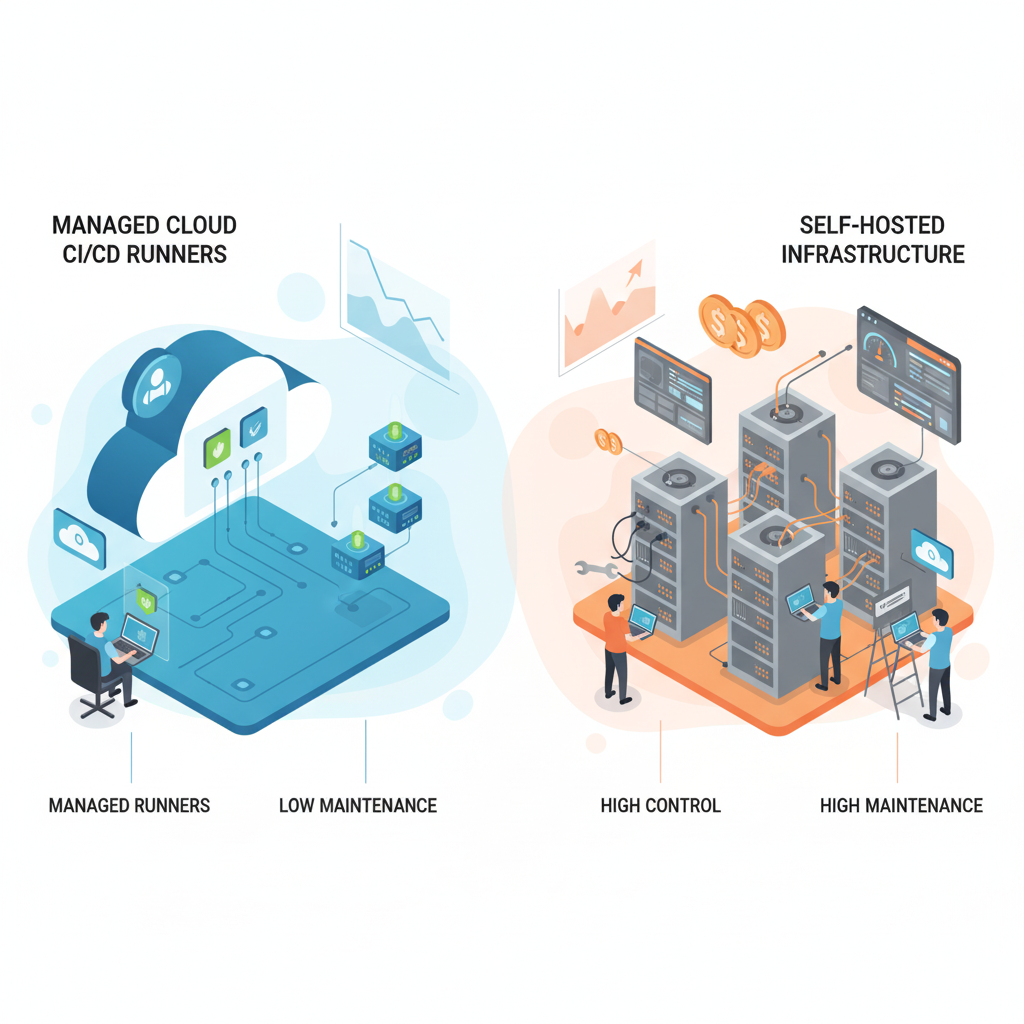
When setting up a CI/CD pipeline, a critical decision is where the jobs will run. You have two primary options: use managed runners provided by your CI/CD vendor (like GitHub Actions) or build your own fleet of self-hosted runners.
A true TCO analysis of self-hosted vs. managed runners reveals a complex picture beyond a simple cost comparison. The decision involves a trade-off between convenience and control, with significant hidden costs on both sides.
The Managed Runner Model: Paying for Convenience
Managed runners are the default solution offered by SaaS CI/CD platforms.
How it Works: You pay a per-minute fee for the time your jobs run on the provider's infrastructure, and they handle all maintenance, scaling, and security.
Pros:
Zero maintenance overhead.
Simple and fast to get started.
Predictable for small teams with infrequent builds.
Cons:
Expensive at scale; per-minute costs can lead to a large, unpredictable bill for high-volume teams.
Less control over hardware, networking, and software.
The Self-Hosted Runner Model: Paying for Control
Self-hosting involves running the CI/CD agent software on your own compute infrastructure.
How it Works: You are responsible for provisioning, managing, and scaling your own fleet of runner machines.
Pros:
Lower raw compute cost at scale, especially using Spot Instances.
Full control and customization over the hardware and software environment.
Enhanced security by keeping runners within your private network.
Cons:
High Operational Overhead: This is the biggest hidden cost. Your team must maintain this critical infrastructure, including setup, monitoring, and on-call support. This requires significant, ongoing engineering time.
A TCO Framework: Calculating the True Cost
A proper TCO analysis for self-hosting must include all hidden costs. Annual Cost = (Cloud Infrastructure Cost) + (Storage & Network Cost) + (Monitoring Cost) + (Engineering "People" Cost)
The "People Cost" is the most frequently underestimated variable.
Calculation: (Number of Engineers) x (% of Time on CI/CD Maintenance) x (Average Engineer Salary)
Example: If two platform engineers spend 25% of their time managing runners at a $200,000/year loaded salary, the annual people cost is $100,000. This cost alone can often dwarf any savings on raw compute.
The Verdict: A Decision Framework
The right choice depends on your scale, expertise, and requirements.
Choose Managed Runners if: You are a small-to-medium team, prioritize developer velocity, and have standard build requirements.
Choose Self-Hosted Runners if: You have very high build volume, a dedicated platform team with automation expertise, and strict security requirements.
Consider a Hybrid Approach: Use managed runners for standard workloads and a small fleet of self-hosted runners for jobs with special requirements.
Conclusion
The decision is a classic "buy vs. build" trade-off. While self-hosting offers the allure of lower raw compute costs, it comes with a significant price in operational overhead and engineering time. A thorough TCO analysis that honestly accounts for these "people costs" is essential.
All in One Place
Atler Pilot decodes your cloud spend story by bringing monitoring, automation, and intelligent insights together for faster and better cloud operations.