
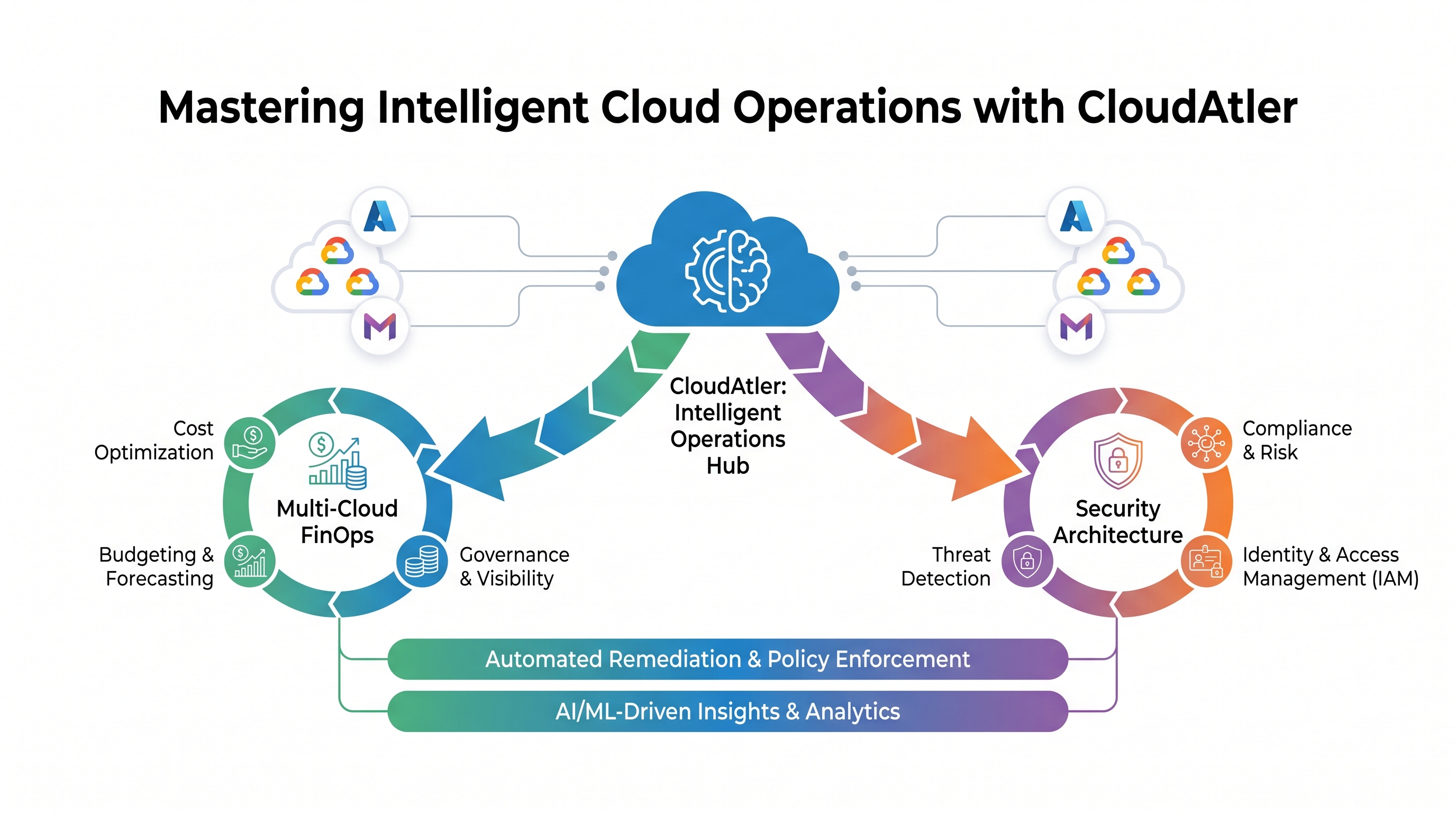
The Modern Multi-Cloud Operational Crisis: Silos, Sprawl, and Soaring Costs
Enterprise cloud adoption has reached a tipping point of complexity. Modern infrastructure is no longer confined to a single public cloud provider; instead, organizations routinely deploy workloads across Amazon Web Services (AWS), Microsoft Azure, Google Cloud Platform (GCP), and Oracle Cloud Infrastructure (OCI). While this multi-cloud strategy prevents vendor lock-in and allows engineering teams to leverage best-of-breed services, it introduces a severe operational tax.
The core of this operational tax is the fragmentation of visibility. Traditional operations rely on native, cloud-specific consoles and telemetry pipelines. A Cloud Engineer might use AWS CloudWatch and Trusted Advisor, a Security Analyst monitors Azure Security Center, while a Finance Administrator parses GCP BigQuery billing exports. This disjointed approach creates operational blind spots, leading to three critical failures:
Financial Leakage: Idle virtual machines, unattached block storage volumes, orphaned load balancers, and misconfigured database instances silently accumulate costs. Without a unified view, correlating idle resources with ownership and application context is nearly impossible.
Security Vulnerability Drift: Security teams cannot enforce consistent policies. A misconfigured S3 bucket in AWS, an open blob storage container in Azure, or an overly permissive IAM policy in GCP might go unnoticed for weeks because there is no single source of truth for compliance.
Operational Inertia: When an incident occurs, troubleshooting across multiple platforms leads to prolonged Mean Time to Resolution (MTTR). Teams waste valuable hours correlating logs, metrics, and traces across disparate systems instead of executing automated, policy-driven remediations.
To overcome these challenges, progressive enterprises are transitioning from reactive cloud management to Intelligent Cloud Operations. This paradigm unifies FinOps, cloud security, and automated operations into a single, closed-loop system. By utilizing the unified cloud operations dashboard provided by CloudAtler, organizations can break down these traditional silos and establish a continuous, data-driven optimization loop.
Architecting Unified Visibility Across Heterogeneous Cloud Environments
Achieving intelligent cloud operations requires a highly resilient, scalable ingestion architecture capable of normalizing metadata from different cloud providers in real-time. CloudAtler accomplishes this through an agentless, API-driven ingestion engine that leverages native cloud APIs, event-driven webhooks, and identity federation.
The Normalization Engine
Every cloud provider defines its resources, billing metrics, and security configurations differently. For example, a virtual machine is an EC2 Instance in AWS, a Virtual Machine in Azure, a Compute Engine Instance in GCP, and a Compute Instance in OCI. To perform meaningful cross-cloud analysis, CloudAtler ingests these raw payloads and maps them to a standardized, extensible schema. Below is a conceptual representation of how raw metadata is ingested, normalized, and stored in CloudAtler's unified graph database:
+-------------------------------------------------------------------------+
|                           Cloud Providers                               |
|   [AWS API]            [Azure Resource Manager]       [GCP Cloud API]   |
+-------+---------------------------+--------------------------+----------+
        |                           |                          |
        v                           v                          v
+-------------------------------------------------------------------------+
|                       CloudAtler Ingestion Gateway                      |
|                  (OAuth2 / OIDC IAM Role Federation)                     |
+------------------------------------+------------------------------------+
                                     |
                                     v
+-------------------------------------------------------------------------+
|                       Schema Normalization Engine                       |
|   - Normalizes Compute, Storage, Network, and Identity Metadata         |
|   - Evaluates Resource Relationships & Dependency Mappings             |
+------------------------------------+------------------------------------+
                                     |
                                     v
+-------------------------------------------------------------------------+
|                        Unified Graph Database                           |
|       - Tracks Real-Time State, Cost Metrics, and Security Posture      |
+-------------------------------------------------------------------------+
This graph database does not merely list resources; it maps the relationships between them. It understands that a specific AWS EBS volume is attached to an EC2 instance, which resides in a private VPC subnet, receives traffic from an Application Load Balancer, and is tagged under the "Payment Gateway" billing cost center. This relationship-aware architecture is critical for both accurate cost allocation and impact analysis during security incidents.
Secure, Agentless Authentication
To maintain a robust security posture, CloudAtler avoids the use of static, long-lived credentials (such as AWS IAM User Access Keys or Azure Service Principal client secrets). Instead, it utilizes role federation and OpenID Connect (OIDC). By establishing trust relationships between the CloudAtler platform and your cloud accounts, CloudAtler assumes short-lived, low-privilege IAM roles to query metadata APIs. This ensures that even in highly regulated environments (such as PCI-DSS or HIPAA-compliant infrastructures), data collection remains secure, auditable, and compliant with the principle of least privilege.
Advanced FinOps: Moving Beyond Reactive Cost Reporting
Most organizations approach cloud cost management reactively: they receive a massive bill at the end of the month, panic, and task engineering teams with finding savings. This manual approach is inefficient and unsustainable. True FinOps maturity requires moving from reactive reporting to proactive, automated optimization.
With CloudAtler, enterprises implement CIO-driven FinOps strategies that operationalize cost control without throttling developer velocity. This is achieved through three key mechanisms: accurate unit economics, automated lifecycle management, and predictive forecasting.
1. Establishing True Unit Economics
To understand the business value of cloud spend, you must look beyond raw dollar amounts and measure unit metrics—such as cost per active user, cost per API transaction, or cost per search query. CloudAtler integrates with application performance monitoring (APM) tools and business databases to correlate application telemetry with real-time cloud billing data.
For instance, if your AWS bill increased by 20% last month, a standard billing tool would flag this as a negative anomaly. However, if CloudAtler's data shows that your active user base grew by 50% during that same period, the platform calculates that your cost per user actually decreased by 20%. This level of detail empowers product owners to make informed architectural decisions based on business efficiency rather than arbitrary budget caps.
2. Automated Lifecycle and Right-Sizing Tactics
Manual right-sizing is a tedious process that engineers often ignore because they lack confidence in the recommendations. CloudAtler utilizes machine learning models to analyze CPU, memory, disk I/O, and network utilization patterns over 14-day, 30-day, and 90-day windows to deliver highly accurate, low-risk recommendations.
Consider the following common optimization scenarios that CloudAtler automates:
Block Storage Upgrades: Upgrading AWS EBS volumes from
gp2togp3. Thegp3volume type offers a baseline performance of 3,000 IOPS and 125 MB/s throughput regardless of volume size, at a price point that is up to 20% cheaper per gigabyte thangp2. CloudAtler identifies these volumes and can execute zero-downtime upgrades programmatically.Orphaned Resource Reclamation: When a virtual machine is terminated, its associated block storage volumes, elastic IP addresses, and network interfaces are often left behind. CloudAtler automatically scans your multi-cloud environment, flags these orphaned resources, and cleans them up according to your organization's retention policies.
Database Instance Right-Sizing: Database instances (such as Amazon RDS, Azure SQL, or GCP Cloud SQL) are frequently over-provisioned to handle peak loads that only occur once a month. CloudAtler analyzes historical query loads and suggests migrating to smaller instance classes, utilizing read replicas, or transitioning to serverless database models where appropriate.
3. Predictive Budget Forecasting and Anomaly Detection
Standard budget alerts fire only after a threshold has been breached. CloudAtler's predictive budget forecasting engine utilizes advanced time-series analysis to model future spending patterns based on historical data, seasonal variations, and planned infrastructure deployments.
If an engineering team spins up a GPU-intensive Kubernetes cluster for an AI training model and forgets to tear it down, a standard alert might not trigger for days. CloudAtler's real-time anomaly detection engine identifies the sudden, non-linear spike in spend within hours. It isolates the specific billing tags, identifies the provisioning resource, maps it to the responsible engineer, and suggests an immediate remediation path before the cost escalates into a major budget overrun.
Cloud Security Posture Management (CSPM) and Automated Remediation
In a multi-cloud architecture, security cannot be treated as an afterthought or a separate phase of the software development lifecycle. It must be woven directly into the fabric of daily cloud operations. Misconfigurations remain the single largest cause of cloud data breaches, often stemming from human error during manual provisioning or poorly configured Infrastructure as Code (IaC) templates.
To protect enterprise workloads, security leaders must leverage an advanced security management platform that continuously audits infrastructure configurations against industry standards (such as CIS Benchmarks, SOC 2 Type II, ISO 27001, and HIPAA).
The Shift-Left Security Paradigm and Continuous Compliance
CloudAtler bridges the gap between development and security through a "shift-left" operational model. This process begins in the CI/CD pipeline, where CloudAtler scans Terraform, CloudFormation, or Ansible templates before any infrastructure is deployed. If a developer attempts to commit code that provisions an unencrypted S3 bucket or exposes port 22 (SSH) to the public internet (0.0.0.0/0), CloudAtler flags the violation and blocks the pull request.
However, security posture management must also be continuous in production environments. Developers may make manual changes in the cloud console (known as "configuration drift"), or new vulnerabilities may be discovered in existing services. CloudAtler monitors your multi-cloud environments in real-time, instantly flagging any deviations from your established security baselines.
Event-Driven Automated Remediation Architecture
Detecting a security vulnerability is only half the battle; the real value lies in minimizing the window of exposure. When CloudAtler detects a high-severity security risk, it doesn't just send an email alert that might sit in an inbox for hours. Instead, it triggers an event-driven remediation workflow.
Let's look at a concrete technical example of how CloudAtler automatically remediates an over-permissive AWS IAM Role. Suppose a developer creates an IAM role with administrative privileges ("Effect": "Allow", "Action": "*") assigned to an EC2 instance that is accessible from the public internet. This represents a critical security risk: if the EC2 instance is compromised, the attacker gains full administrative access to the entire AWS account.
The following sequence diagram illustrates the automated remediation loop executed by CloudAtler:
+--------------+             +-----------------+             +------------------+             +-----------------+
| Cloud Resource|             |   CloudAtler    |             |  Remediation     |             |  Security Team  |
| (AWS/Azure)  |             |  Engine (CSPM)  |             |  Service (Lambda)|             |  (Slack/Jira)   |
+------+-------+             +--------+--------+             +--------+---------+             +--------+--------+
       |                              |                               |                                |
       |  1. Configuration Drift      |                               |                                |
       |=====(IAM Role Modified)=====>|                               |                                |
       |                              |  2. Evaluate Policy Baseline  |                                |
       |                              |=====(Violation Detected)=====>|                                |
       |                              |                               |                                |
       |                              |                               |  3. Apply Least-Privilege      |
       |                              |<==============================|     Policy Update              |
       |  4. Enforce Restricted Policy|                               |                                |
       |<=============================|                               |                                |
       |                              |                               |  5. Send Audit Log             |
       |                              |===============================================================>|
       |                              |                               |                                |
To implement this level of security control, CloudAtler works alongside enterprise CISOs to deploy enterprise CISO security solutions that strike the perfect balance between risk mitigation and developer autonomy. For lower-risk environments, CloudAtler can be configured to alert first and wait for approval; for high-risk production environments, it can immediately revoke non-compliant access to protect sensitive data.
Building a Resilient Operations Playbook with CloudAtler
To scale intelligent cloud operations across hundreds of accounts and thousands of applications, organizations must document and automate their standard operating procedures (SOPs). This is where the CloudAtler cloud operations playbook becomes an essential asset for engineering teams.
A resilient cloud operations playbook is a collection of automated, declarative workflows that define how the system should respond to specific operational, financial, or security events. These workflows are written in clean YAML or JSON configuration files, allowing them to be managed as code and integrated into your existing version control systems.
Anatomy of a CloudAtler Automated Workflow Playbook
Below is an example of a CloudAtler playbook configuration designed to handle idle compute resources across AWS and Azure. This playbook automatically detects idle virtual machines, notifies the owner via Slack, waits 48 hours for a response, and then stops the instance if no action is taken:
version: "1.0"
name: "reclaim-idle-compute"
trigger:
  event_type: "resource.anomaly"
  conditions:
    - field: "metrics.cpu_utilization_95th_percentile"
      operator: "less_than"
      value: 5.0
    - field: "metrics.network_in_out_average_daily"
      operator: "less_than"
      value: "100MB"
    - field: "resource.state"
      operator: "equals"
      value: "running"

actions:
  - name: "get_owner_metadata"
    type: "enrichment"
    properties:
      fields: ["owner_tag", "cost_center", "environment"]

  - name: "notify_owner_slack"
    type: "notification"
    properties:
      channel: "#cloud-ops-alerts"
      message: "Warning: The virtual machine ${resource.id} (${resource.name}) in ${resource.provider} has been identified as idle. If no action is taken within 48 hours, it will be stopped to prevent financial waste."
      recipient: "${resource.tags.owner_email}"

  - name: "wait_for_approval"
    type: "delay"
    properties:
      duration: "48h"
      bypass_allowed: true
      bypass_users: ["cloud-admin@company.com"]

  - name: "stop_idle_instance"
    type: "remediation"
    properties:
      action_type: "power_off"
      dry_run: false
By defining operational procedures programmatically, organizations eliminate human error, reduce response times, and free up platform engineering teams to focus on building new features rather than performing routine maintenance tasks.
The Business Impact: Quantifying the Value of Unified Cloud Operations
Implementing intelligent cloud operations yields tangible, measurable business results across three primary dimensions: financial savings, operational efficiency, and risk reduction.
Operational Metric | Before CloudAtler | After CloudAtler | Business Impact |
|---|---|---|---|
Cloud Waste / Idle Spend | 25% - 35% of total cloud budget | < 5% of total cloud budget | Significant reduction in annual cloud spend |
Mean Time to Detect (MTTD) Vulnerabilities | 14 to 30 Days | < 60 Seconds | Near-zero window of vulnerability exposure |
Security Configuration Drift Remediation | Manual, ticket-driven (Days/Weeks) | Automated, event-driven (Minutes) | Reduced operational load on security teams |
Cost Allocation and Tagging Accuracy | 40% - 60% accurate (manual tagging) | > 98% accurate (automated tagging) | Accurate chargebacks and financial clarity |
Beyond these metrics, unified cloud operations fosters a culture of shared responsibility. Engineers become more cost-conscious because they have real-time visibility into the financial impact of their architectural decisions. Finance teams gain confidence because budgets are predictable and automatically enforced. Security teams can rest easy knowing that compliance baselines are continuously audited and programmatically maintained.
Conclusion: Take Control of Your Multi-Cloud Environment
Managing multi-cloud infrastructure does not have to mean accepting chaotic cost overruns, security blind spots, and operational inefficiencies. By unifying FinOps, cloud security posture management, and automated playbooks into a single platform, enterprises can transform their cloud operations from a costly bottleneck into a strategic business accelerator.
It is time to eliminate the operational silos that hold your engineering and security teams back. Establish a single source of truth, automate your security remediation workflows, and optimize your cloud spend in real-time. Unify your cloud operations, optimize your infrastructure, and secure your enterprise with CloudAtler today.
All in One Place
Atler Pilot decodes your cloud spend story by bringing monitoring, automation, and intelligent insights together for faster and better cloud operations.