
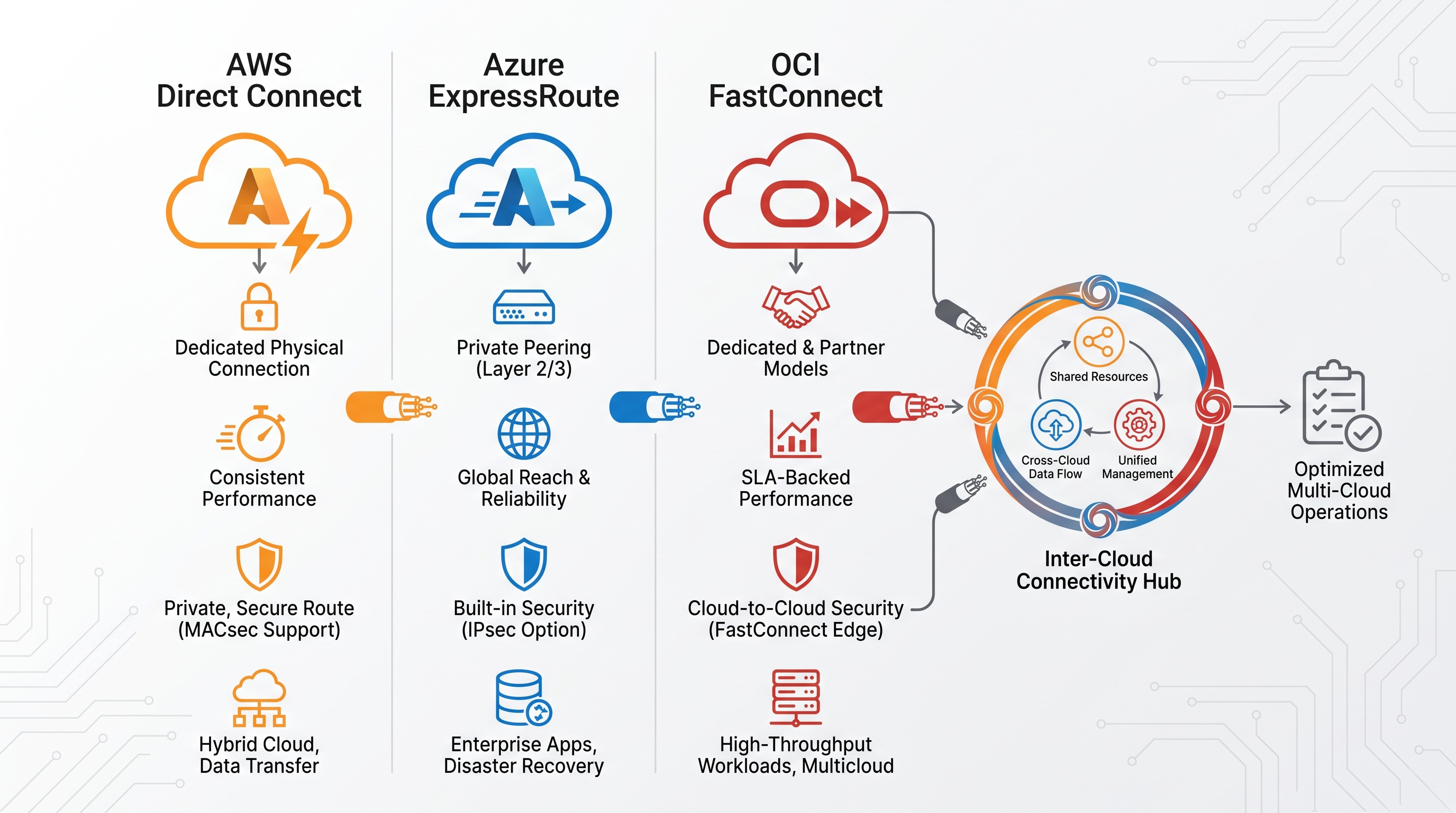
1. Introduction to Modern Inter-Cloud Architecture
As enterprises transition from simple hybrid clouds to sophisticated multi-cloud environments, the network becomes the critical bottleneck. Relying on the public internet or standard IPsec VPNs for cross-cloud traffic introduces unacceptable latency, packet delivery variance (jitter), and security vulnerabilities. More importantly, standard internet egress fees can quickly devastate an enterprise cloud budget.
To establish predictable, high-performance, and secure pathways between on-premises datacenters and multiple public clouds, cloud providers offer dedicated private connectivity services: AWS Direct Connect (DX), Azure ExpressRoute, and Oracle Cloud Infrastructure (OCI) FastConnect. Designing an architecture that spans these three providers requires a deep understanding of their physical and logical differences, routing protocols, security mechanisms, and cost models.
This guide provides a comprehensive technical comparison of these three dedicated connectivity options. We will explore how to architect high-availability topologies, secure data in transit with MACsec and IPsec, and manage the complex billing models associated with private backbones. We will also demonstrate how to leverage a unified multi-cloud dashboard to maintain observability and control across these disparate network fabrics.
2. Deep-Dive: AWS Direct Connect (DX)
AWS Direct Connect bypasses the internet to deliver a dedicated network connection from your premises or colocation facility directly to AWS routing infrastructure. Connections are established at designated AWS Direct Connect locations globally.
Physical and Logical Architecture
AWS Direct Connect can be provisioned in two primary physical deployment models:
Dedicated Connections: A physical ethernet port (1 Gbps, 10 Gbps, or 100 Gbps) associated directly with your AWS account. You manage the physical cross-connect in the AWS Direct Connect partner facility.
Hosted Connections: Provisioned by an AWS Direct Connect Partner (e.g., Equinix, Megaport) on your behalf. These support capacities ranging from 50 Mbps up to 10 Gbps, allowing finer granularity for smaller workloads.
Logically, AWS Direct Connect relies on Virtual Interfaces (VIFs) mapped to 802.1Q VLANs to segregate traffic over the physical connection:
Private VIF: Used to access private resources within a single Virtual Private Cloud (VPC) via a Virtual Private Gateway (VGW) or across multiple VPCs via a Direct Connect Gateway (DXGW).
Transit VIF: Used to associate a Direct Connect connection with an AWS Transit Gateway (TGW). This is the standard pattern for scalable enterprise hub-and-spoke topologies, supporting up to thousands of VPCs.
Public VIF: Enables access to public AWS endpoints, such as Amazon S3, DynamoDB, or AWS systems management APIs, without traversing the public internet.
[On-Premises Router]
       | (Physical Fiber / Partner Circuit)
[AWS Direct Connect Location]
       |
       +---> Private VIF ----> Direct Connect Gateway (DXGW) ---> VPCs
       |
       +---> Transit VIF ----> Transit Gateway (TGW) -----------> Enterprise VPC Mesh
       |
       +---> Public VIF -----> AWS Public Endpoints (S3, DynamoDB)
Figure 1: AWS Direct Connect Logical Interfaces and Routing Paths.
Routing and BGP Configuration
AWS Direct Connect uses Border Gateway Protocol (BGP) to exchange routing information. AWS requires External BGP (eBGP) with single-hop routing. You must configure a private Autonomous System Number (ASN) or a public ASN that you own. For Private and Transit VIFs, BGP sessions utilize 802.1Q VLAN tags to split traffic. Bidirectional Forwarding Detection (BFD) is highly recommended and supported natively by AWS to reduce BGP failover convergence time from standard timeouts down to sub-second thresholds (typically 300ms intervals with a multiplier of 3).
Security and Encryption
By default, data traversing AWS Direct Connect is unencrypted at the physical and network layers. To secure transit data, enterprise architects have two choices:
MACsec (IEEE 802.1AE): Supported on dedicated 10 Gbps and 100 Gbps connections at select locations. MACsec provides line-rate encryption at Layer 2 between your customer gateway and the AWS Direct Connect device, ensuring zero performance overhead.
IPsec VPN over DX: For connections where MACsec is unavailable or for Layer 3 encryption, you can provision an IPsec VPN tunnel over a Public or Private VIF. While secure, this limits throughput to the maximum capabilities of your VPN gateway (typically 1.25 Gbps per tunnel unless using Equal-Cost Multi-Path routing across multiple tunnels).
FinOps and Cost Structure
AWS Direct Connect pricing consists of two primary billing components:
Port Hours: A flat hourly fee based on the capacity and type of connection (Dedicated vs. Hosted). For example, a 10 Gbps Dedicated Port costs approximately $1.08 per hour, regardless of utilization.
Data Transfer Out (DTO): The cost per gigabyte of data sent from AWS to your external location. Standard internet egress from AWS can be as high as $0.09 per GB, whereas DX DTO is significantly cheaper, ranging from $0.02 to $0.04 per GB depending on the region.
3. Deep-Dive: Azure ExpressRoute
Azure ExpressRoute lets you extend your on-premises networks into the Microsoft cloud over a private connection facilitated by a connectivity provider. It provides access not only to Azure Infrastructure-as-a-Service (IaaS) but also to Microsoft 365 and Dynamics 365 SaaS offerings.
Physical and Logical Architecture
ExpressRoute connections are established through ExpressRoute Circuits. These circuits represent logical connections between your physical infrastructure and Microsoft enterprise edge (MSEE) routers. ExpressRoute is offered in two primary deployment tiers:
ExpressRoute Provider-Managed: A partner handles the physical connection, and you provision virtual circuits through their portal. Bandwidth options range from 50 Mbps to 10 Gbps.
ExpressRoute Direct: Provides direct dual 10 Gbps or 100 Gbps physical connectivity into Microsoft’s edge routers. This is ideal for massive data migrations, high-performance computing, and scenarios requiring MACsec.
ExpressRoute supports two distinct routing domains, known as peerings:
Azure Private Peering: Connects your on-premises network to private virtual networks (VNets) in Azure. This is the primary mechanism for connecting virtual machines, database instances, and private endpoints.
Microsoft Peering: Connects your on-premises network to Microsoft public services, including Microsoft 365, Dynamics 365, and Azure PaaS services with public IPs (e.g., Azure SQL Database, Storage Accounts). Microsoft Peering requires strict routing controls, including public IP ownership validation and NAT configuration.
To connect an ExpressRoute circuit to an Azure Virtual Network, you must deploy an ExpressRoute Virtual Network Gateway inside a dedicated subnet named GatewaySubnet. The gateway SKU (Standard, High Performance, Ultra Performance, or ErGw3AZ) dictates the maximum throughput and support for features like FastPath, which bypasses the gateway to route traffic directly to VMs, reducing latency.
Routing and BGP Configuration
Every ExpressRoute circuit is provisioned with redundant physical connections to two MSEEs. This dual-active configuration is mandatory; Microsoft will not honor its SLA if you only configure a single BGP session. ExpressRoute uses eBGP to advertise prefixes. Like AWS, BFD is supported and highly recommended to ensure rapid path failover.
Security and Encryption
ExpressRoute Direct supports MACsec (802.1AE) encryption at Layer 2, allowing you to secure the physical links between your network equipment and Microsoft MSEEs. For Layer 3 encryption, you can establish an IPsec VPN tunnel over ExpressRoute Private Peering. This is typically achieved by deploying an Azure VPN Gateway in parallel with the ExpressRoute Gateway or by running virtualized network appliances (NVAs) within the VNet.
To ensure these complex security boundaries are maintained across all your cloud deployments, utilizing a specialized multi-cloud security management platform is critical to prevent configuration drift and detect exposed endpoints.
FinOps and Cost Structure
Microsoft offers two billing models for ExpressRoute circuits:
Metered Data: You pay a lower flat monthly port fee, but you are charged for all outbound data transfer (egress) on a per-GB basis. Inbound data transfer is free.
Unlimited Data: You pay a significantly higher flat monthly port fee, but all inbound and outbound data transfers are entirely free of charge. This is highly cost-effective for enterprises moving tens of terabytes of data out of Azure every month.
4. Deep-Dive: OCI FastConnect
Oracle Cloud Infrastructure (OCI) FastConnect provides an easy, elastic, and economical way to create a dedicated, private network connection to OCI. Known for its highly disruptive pricing model, FastConnect is a foundational component for enterprises running multi-cloud database architectures, particularly those coupling Oracle Database workloads in OCI with application tiers in AWS or Azure.
Physical and Logical Architecture
FastConnect operates under similar physical paradigms as its competitors:
FastConnect Direct: You lease a physical cross-connect (10 Gbps or 100 Gbps) directly to Oracle routing equipment at an OCI FastConnect location.
FastConnect Partner-Managed: Provisioned via an Oracle Partner Network (OPN) provider, supporting granular speeds from 10 Mbps up to 10 Gbps.
At the logical layer, FastConnect relies on a Dynamic Routing Gateway (DRG). The DRG acts as a virtual router attached to your OCI Virtual Cloud Networks (VCNs). Unlike the early generations of OCI gateways, the modern DRG (v2) is a highly sophisticated transit routing engine that can route traffic between multiple VCNs, on-premises connections, and remote peering connections without requiring complex routing tables inside individual subnets.
OCI FastConnect supports two virtual circuit types:
Private Virtual Circuit: Used to access private resources within your VCNs using private IPv4 addresses.
Public Virtual Circuit: Used to access OCI public services, such as Object Storage, OCI APIs, and public-facing PaaS resources, without traversing the public internet.
Routing and BGP Configuration
FastConnect mandates eBGP. OCI supports standard BGP attributes, including AS-Path prepending and BGP communities, allowing network engineers to influence ingress and egress routing paths. FastConnect also supports BFD for sub-second failure detection. A unique feature of OCI's DRG is its ability to import and export route distributions dynamically, making it exceptionally flexible when integrating with complex hybrid SD-WAN architectures.
Security and Encryption
Like AWS and Azure, OCI FastConnect does not natively encrypt traffic at the network layer out of the box. Security teams must configure MACsec on FastConnect Direct ports for Layer 2 encryption, or deploy Libreswan, strongSwan, or Cisco/Palo Alto NVAs within OCI VCNs to run IPsec tunnels over FastConnect Private Virtual Circuits.
FinOps and Cost Structure
OCI's pricing model for FastConnect is the most aggressive in the industry. Oracle charges zero egress fees for data transferred out of OCI via FastConnect. The only cost associated with FastConnect is the flat hourly port fee, which is significantly lower than both AWS and Azure. For instance, a 1 Gbps FastConnect port costs approximately $0.0225 per hour, and a 10 Gbps port costs approximately $1.275 per hour. This makes OCI the ideal destination for data-intensive workloads, data warehouses, and disaster recovery environments where large volumes of data must be moved or replicated.
5. Direct Inter-Cloud Connectivity: The OCI-Azure Interconnect
While connecting on-premises datacenters to individual clouds is the traditional hybrid cloud model, modern enterprises frequently require direct, low-latency links between cloud providers. The most prominent native example of this is the OCI-Azure Interconnect (also known as the Oracle Database Service for Azure).
This partnership allows enterprises to connect an OCI FastConnect circuit directly to an Azure ExpressRoute circuit in select co-located regions (e.g., Ashburn/Washington DC, London, Frankfurt, Tokyo) without deploying physical routers in an intermediary datacenter. Microsoft and Oracle have established a direct physical fiber connection between their edge routers in these regions.
+---------------------------+               +---------------------------+
|      Azure VNet           |               |         OCI VCN           |
|  [App Tier / Web VMs]     |               |   [Exadata Database]      |
+-------------+-------------+               +-------------+-------------+
              |                                           |
    ExpressRoute Gateway                         Dynamic Routing Gateway
              |                                           |
    ExpressRoute Circuit <=========================> FastConnect Circuit
                         (Direct Partner Fiber Link)
                         Latency < 2.0 Milliseconds
Figure 2: OCI-Azure Interconnect Architecture with Sub-2ms Latency.
This architecture delivers sub-2 millisecond latency, enabling real-time application-to-database communication. From a cost perspective, there are no port charges or egress fees specifically for the Interconnect traffic in OCI, and standard ExpressRoute local pricing applies on the Azure side, making it highly cost-effective.
For other cloud combinations (e.g., AWS to Azure, AWS to OCI), architects must rely on software-defined cloud routers provided by Megaport, Equinix Fabric, or PacketFabric. These providers host virtual routing engines inside their high-speed colocation facilities, acting as the "meet-me" point to bridge AWS DX, Azure ExpressRoute, and OCI FastConnect.
6. Comparative Analysis Matrix
To assist infrastructure architects and financial operations leads in evaluating these services, the following matrix compares the core technical and economic parameters of each dedicated connection type:
Feature / Dimension | AWS Direct Connect (DX) | Azure ExpressRoute | OCI FastConnect |
|---|---|---|---|
Bandwidth Options | 50 Mbps to 100 Gbps | 50 Mbps to 100 Gbps | 10 Mbps to 100 Gbps |
Routing Engine / Gateway | Direct Connect Gateway (DXGW) / Transit Gateway (TGW) | ExpressRoute Virtual Network Gateway | Dynamic Routing Gateway (DRG v2) |
BGP Requirement | eBGP (Single-hop) | eBGP (Dual-active required for SLA) | eBGP |
Layer 2 Encryption | MACsec (10G/100G Dedicated only) | MACsec (ExpressRoute Direct only) | MACsec (FastConnect Direct only) |
Egress Fees (Data Out) | Charged per GB (Reduced rate: ~$0.02 - $0.04/GB) | Metered (per GB) OR Unlimited (Flat-rate port charge) | $0.00 (Free) |
High Availability SLA | Up to 99.99% (with 4-location architecture) | 99.95% (Dual-active session native) | 99.9% to 99.95% (depending on topology) |
7. Enterprise Security Best Practices for Dedicated Circuits
Private connections are not inherently secure; they merely isolate traffic from the public internet. A common and dangerous security misconception is treating a Direct Connect, ExpressRoute, or FastConnect link as a trusted "internal" network. To protect sensitive enterprise data, security teams must apply Zero Trust principles to inter-cloud networks.
Implement Layer 2 MACsec
Where physically supported (such as on Dedicated Connections or ExpressRoute Direct), configure MACsec. Unlike IPsec, which operates at Layer 3 and adds significant packet encapsulation overhead, MACsec operates at the Ethernet frame layer. This allows you to achieve line-rate encryption (even at 100 Gbps) with negligible impact on latency or packet processing. Ensure that your on-premises edge routers support the required MACsec standards (802.1AE and 802.1X key agreement protocol) and that you have a secure process for key rotation.
Routing Security and BGP Filtering
BGP hijacking and route leaks are real threats, even over private peering links. Implement strict route filtering on your edge routers and virtual cloud gateways:
Prefix Limits: Configure maximum prefix limits on your BGP sessions to prevent a misconfigured router from advertising the entire internet routing table into your VPCs or VNets.
Asymmetric Routing Mitigation: Ensure that your inbound and outbound traffic paths are deterministic. Asymmetric routing occurs when traffic leaves your network via AWS DX but returns via Azure ExpressRoute. This can cause stateful firewalls to drop connections and makes security monitoring highly complex. Use BGP attributes like AS-Path prepending and Local Preference to force symmetric traffic flows.
Continuous Configuration Auditing
Because these network connections span multiple cloud provider consoles, configuration drift is highly common. A security group change in AWS or a route table modification in Azure can open backdoors or bypass central firewalls. Organizations should deploy a comprehensive cloud security management solution to continuously audit security groups, route tables, and firewall configurations across all connected clouds, ensuring compliance with internal security baselines.
8. FinOps Optimization Strategies for Hybrid & Inter-Cloud Routing
Managing the costs of inter-cloud connectivity is a core focus of enterprise FinOps. Because billing models differ wildly between providers, a poorly architected network can result in massive, unexpected monthly invoices.
The "Data Gravity" Arbitrage Strategy
Because OCI charges $0.00 for egress via FastConnect, whereas AWS and Azure charge metered egress rates, smart architects design their data gravity strategies accordingly. If you have large databases that must replicate data to multiple clouds, hosting the primary database in OCI and streaming data out to application tiers in AWS or Azure using FastConnect is vastly cheaper than hosting the database in AWS and streaming data to OCI.
Choosing the Right Azure ExpressRoute Billing Model
For Azure ExpressRoute, the choice between Metered and Unlimited data plans requires continuous analysis. If your outbound data transfer is low or highly bursty, the Metered plan is cheaper. However, once your egress exceeds a specific tipping point (typically around 200 TB to 300 TB per month, depending on the circuit speed and region), switching to the Unlimited plan will yield massive savings. FinOps teams should use a specialized FinOps and financial operations platform to model these scenarios and automate plan transitions.
Eliminating Idle Port Costs
Many enterprises provision redundant Direct Connect or ExpressRoute circuits for disaster recovery (DR) but leave them completely idle. While you may save on egress fees, you are still paying 100% of the flat hourly port fees. Consider utilizing lower-bandwidth connections for your standby DR paths and dynamically scaling the bandwidth up during a DR event or testing window, provided your partner network supports elastic bandwidth adjustments.
To accurately model these architectural shifts, use a dedicated cost impact calculation engine before modifying your physical or virtual routing topologies. This prevents unexpected bill shocks and provides executive leadership with clear ROI metrics on network re-architecture projects.
9. Unified Management & Monitoring at Scale
Managing dedicated network connections across AWS, Azure, and OCI using native tools is an operational nightmare for SRE and network operations teams. Each cloud provider has its own terminology, monitoring metrics, and alerting frameworks:
AWS monitors Direct Connect via CloudWatch metrics such as
ConnectionBpsIngress,ConnectionBpsEgress, andConnectionState.Azure tracks ExpressRoute via Azure Monitor metrics like
BitsInPerSecond,BitsOutPerSecond, andBGPStatus.OCI utilizes Monitoring Service metrics including
FastConnectStatusandVirtualCircuitPacketsReceived.
When a network degradation occurs, engineers waste valuable time switching between three different cloud consoles to correlate metrics, leading to elevated Mean Time to Resolution (MTTR). To bridge this operational gap, infrastructure and SRE teams must adopt a unified observability layer.
A unified management platform ingests telemetry from AWS, Azure, and OCI simultaneously. By normalizing BGP state data, packet loss metrics, and traffic volume across all active circuits, operations teams can identify bottleneck patterns, predict impending circuit failures, and automatically trigger failover routines before users are impacted.
10. Conclusion and Action Plan
Mastering inter-cloud connectivity is not just about establishing a physical connection; it is about balancing high-performance routing, robust security controls, and strict FinOps principles across multiple cloud ecosystems. AWS Direct Connect, Azure ExpressRoute, and OCI FastConnect each offer unique technical capabilities and pricing structures.
All in One Place
Atler Pilot decodes your cloud spend story by bringing monitoring, automation, and intelligent insights together for faster and better cloud operations.