
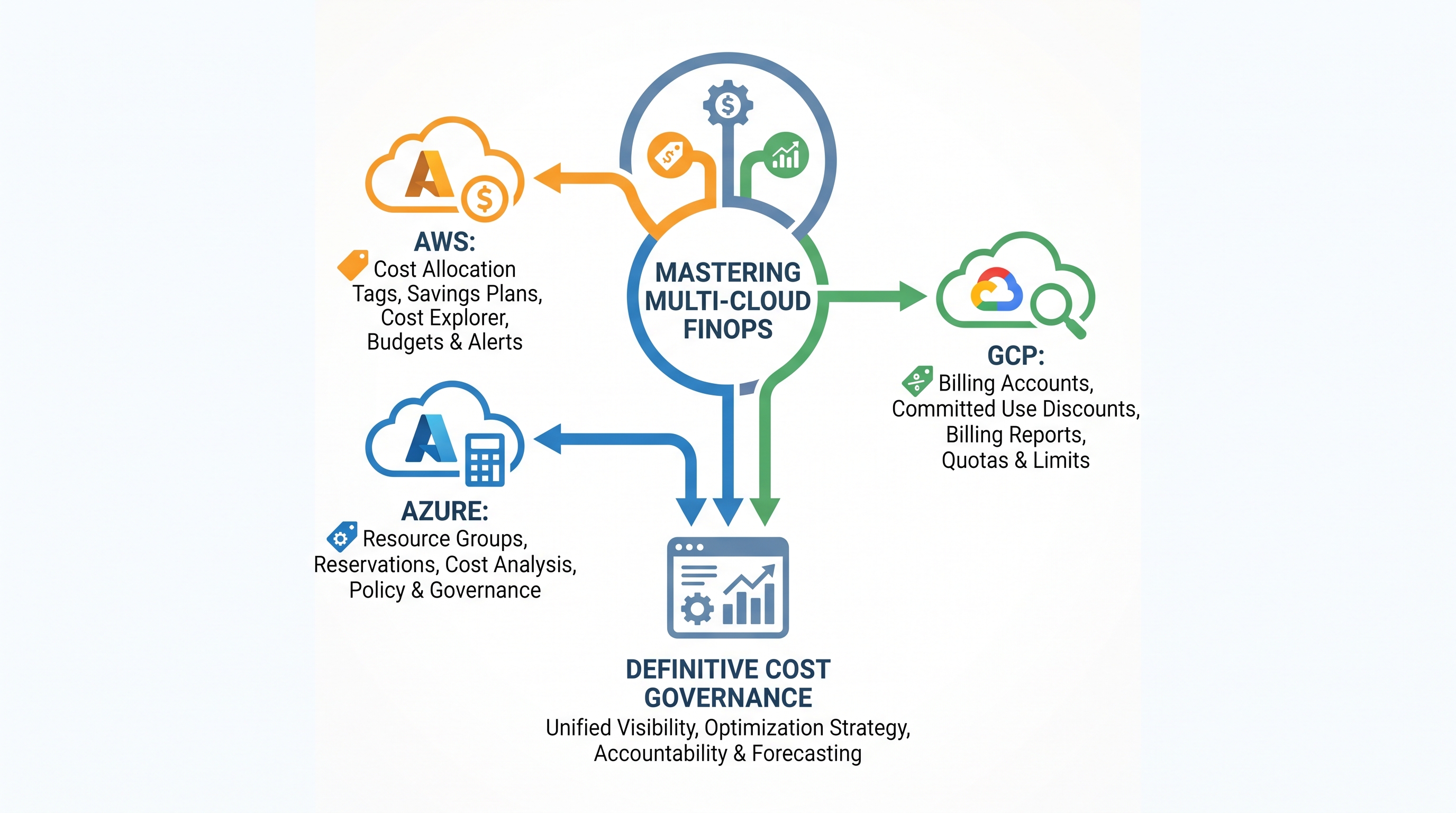
In the rapidly evolving landscape of multi-cloud infrastructure, managing environments across AWS, Azure, GCP, and Oracle requires a profound shift in operational strategy. When tackling the complexities of Mastering Multi-Cloud FinOps: The Definitive Guide to Cost Governance Across AWS, Azure & GCP, engineering and finance teams must align to avoid the pitfalls of cloud sprawl and security drift.
Hybrid Cloud Financial Management
Tagging is the foundational prerequisite for any FinOps practice. Without a comprehensive and strictly enforced tagging taxonomy, cost allocation is impossible. Organizations must define mandatory tags such as 'Environment', 'Application', 'CostCenter', and 'Owner'. However, relying on humans to remember to tag resources consistently is a failing strategy. Infrastructure must be deployed via CI/CD pipelines (like Terraform or Pulumi) where tagging compliance is checked via static analysis before the infrastructure is ever provisioned. Any untagged infrastructure attempting to be created via the console should be immediately blocked or automatically tagged by an event-driven function.
Enterprise network architecture in the cloud requires meticulous planning. Transit Gateways (AWS), Virtual WANs (Azure), and Shared VPCs (GCP) provide centralized hubs for routing traffic securely between diverse environments and on-premises data centers. However, this centralization can create financial bottlenecks if data transfer costs are not monitored. Egress traffic passing through a NAT Gateway or crossing regional boundaries incurs significant charges. To optimize this, teams must deploy VPC Endpoints (PrivateLink) to route traffic to native cloud services internally, avoiding the public internet and eliminating associated NAT Gateway data processing fees.
Data lifecycle management is a frequently overlooked vector for both cost optimization and compliance. AWS S3 Intelligent-Tiering, Azure Blob Storage Lifecycle Management, and GCP Object Lifecycle Management offer native tools to transition cold data to cheaper storage classes (e.g., Glacier, Archive Access). However, setting up these policies across thousands of buckets requires an overarching governance strategy. Automated FinOps tools must analyze access patterns globally and enforce lifecycle rules via Infrastructure as Code (IaC), ensuring that compliance mandates for data retention are met without paying premium storage prices for archaic data.
Visibility alone does not solve cloud sprawl. When a dashboard flags a $5,000 anomaly, human review delays remediation, burning capital by the hour. The future of cloud operations mandates automated remediation workflows. If an Amazon RDS instance is flagged for zero connections over 30 days, the platform should automatically snapshot the database, terminate the instance, and log the action. If an Azure Blob Storage container is inadvertently exposed to the public internet, serverless functions should immediately restrict access to authorized Virtual Networks. This shift from reactive reporting to proactive, automated remediation is what separates mature cloud organizations from those struggling with uncontrollable sprawl.
Continuous Optimization: Regularly analyzing utilization metrics to implement appropriate resource sizing.
Policy Enforcement: Utilizing native governance tools to prevent configuration drift.
Automated Remediation: Shifting from reactive reporting to proactive, automated security and cost fixes.
Building a FinOps Culture Across Engineering
Microsoft Azure's hierarchical structure—from Management Groups down to Subscriptions and Resource Groups—offers robust governance capabilities. However, a misconfigured Azure Policy can inadvertently halt deployments or allow unauthorized spending. Implementing proactive cost controls means utilizing Azure Cost Management alongside custom automation to enforce tagging requirements at the time of creation. Un-tagged resources should trigger immediate remediation workflows, either alerting the specific resource owner or automatically de-provisioning the non-compliant asset. This rigorous policy enforcement is the backbone of zero-trust FinOps architectures in Azure.
Serverless architectures, utilizing AWS Lambda, Azure Functions, or Google Cloud Functions, shift the operational burden away from infrastructure management. While they eliminate idle compute costs, they introduce new financial complexities. Billed by the millisecond and memory allocation, inefficient code can lead to 'serverless sprawl.' Over-allocating memory to a function that doesn't need it exponentially increases the cost per invocation. Furthermore, cold starts can degrade application performance. Engineering teams must rigorously profile their serverless functions, using automated tools to pinpoint the exact memory allocation that balances execution speed with cost efficiency.
Building a FinOps culture requires breaking down the silos between Finance, Engineering, and Operations. Historically, engineers optimized for speed and reliability, while finance optimized for cost. FinOps aligns these competing priorities by introducing unit economics. Instead of asking 'why did our AWS bill go up by $10,000?', the question becomes 'what is our cloud cost per transaction or per active user?'. If the total bill goes up because customer usage exploded, that is a positive outcome. Dashboards must translate raw billing data into these business-centric metrics, pushing cost accountability to the edge where engineering teams can actually influence it.
Spot instances offer the most significant compute discounts available—often up to 90% off on-demand prices. However, their preemptible nature means they can be reclaimed by the cloud provider with only a two-minute warning. Utilizing spot instances effectively requires a robust, fault-tolerant architecture. Stateless microservices, batch processing jobs, and big data analytics are prime candidates. To avoid catastrophic downtime, organizations must use automated orchestration layers (like AWS Auto Scaling groups mixed with Spot Fleets or GKE spot node pools) that instantly spin up on-demand replacements when spot capacity is interrupted. This orchestration is the essence of automated FinOps.
Security Posture Management (CSPM) in Action
The modern Security Operations Center (SOC) is inundated with alerts. Alert fatigue causes critical misconfigurations to be overlooked. To combat this, Cloud Security Posture Management (CSPM) must evolve beyond simple reporting. By integrating with IT Service Management (ITSM) tools like Jira or ServiceNow, CSPM platforms can automatically open tickets for vulnerabilities, assign them to the correct resource owner based on tags, and track the remediation lifecycle. Even better, for known, low-risk misconfigurations (like an unencrypted non-production EBS volume), the platform should automatically execute a runbook to encrypt it without human intervention, reserving the SOC's attention for actual breaches.
Google Cloud Platform (GCP) differentiates itself with sustained use discounts, but true optimization relies on Committed Use Discounts (CUDs). Managing GCP CUDs requires predictive analytics, as committing to a specific region or instance family restricts agility. Modern platforms must continuously analyze GCP billing exports in BigQuery to dynamically recommend CUD purchases and modifications. Additionally, optimizing Google Kubernetes Engine (GKE) clusters by right-sizing nodes and implementing horizontal pod autoscalers ensures that compute capacity closely tracks actual demand rather than provisioned peaks.
As enterprises shift heavily toward containerization, securing Kubernetes clusters (EKS, AKS, GKE) becomes paramount. Misconfigured Role-Based Access Control (RBAC), running privileged containers, and failing to implement network policies can lead to catastrophic lateral movement if a pod is compromised. Automated CSPM tools must continuously scan cluster manifests and runtime environments against CIS Benchmarks. Remediation involves not just alerting, but automatically injecting admission controllers to block non-compliant deployments at the CI/CD pipeline level. Integrating these security checks seamlessly ensures that rapid deployment cycles do not bypass critical security gates.
Identity and Access Management (IAM) sprawl is a silent security threat. Over time, developers accumulate permissions they no longer need, and service accounts are granted overly broad wildcard access. This violates the principle of least privilege. Advanced security platforms combat this by utilizing AI to analyze CloudTrail or Azure Activity Logs over a 90-day window, determining exactly which permissions are actually being used. The system then automatically generates tight, least-privilege JSON policies that strip away unused access, vastly reducing the blast radius if an identity is compromised.
Continuous Optimization: Regularly analyzing utilization metrics to implement appropriate resource sizing.
Policy Enforcement: Utilizing native governance tools to prevent configuration drift.
Automated Remediation: Shifting from reactive reporting to proactive, automated security and cost fixes.
Leveraging Spot Instances Safely
Amazon Web Services (AWS) provides a dizzying array of pricing models. While the pay-as-you-go model is the default, organizations operating at scale quickly realize that reserved instances (RIs) and Savings Plans are necessary for financial efficiency. Understanding the nuanced differences between standard RIs, convertible RIs, and Compute Savings Plans can dictate whether an enterprise saves 30% or 70%. Furthermore, data egress costs often blindside teams. Architecting workloads to keep data within a single Availability Zone (AZ) or Region, or leveraging AWS CloudFront to minimize origin fetches, is critical for massive scale deployments. Without automated FinOps tools, tracking these localized optimizations across hundreds of AWS accounts becomes an impossible human task.
Predictive AI and machine learning are revolutionizing cloud budget forecasting. Traditional forecasting relies on linear projections of historical spend, which completely fail to account for seasonal spikes, new product launches, or architectural refactors. By feeding historical billing data, marketing calendars, and CI/CD deployment schedules into a machine learning model, organizations can predict their cloud spend with high accuracy. When actual spend deviates from this AI-generated baseline, anomaly detection algorithms trigger real-time alerts to a Slack or Teams channel, allowing engineers to halt a runaway query before it accumulates a massive bill over the weekend.
The intersection of Cloud FinOps and Cloud Security Posture Management (CSPM) is where the most mature organizations operate. A classic anti-pattern is an engineer taking down a firewall rule or making a storage bucket public to speed up a deployment, only to forget to revert it. When security teams detect this days later, the exposure window has already been massive. Furthermore, these misconfigurations often lead to crypto-mining malware being installed on overly permissive compute instances, immediately skyrocketing cloud bills. An intelligent platform intercepts these high-risk deployments before they hit production, giving DevOps teams peace of mind.
The concept of 'Shift Left' security means integrating security checks as early as possible in the software development lifecycle (SDLC). Instead of waiting for a resource to be deployed to the cloud before a CSPM tool flags a misconfiguration, static application security testing (SAST) and infrastructure as code (IaC) scanning tools analyze the code in the developer's IDE or during the pull request phase. If a Terraform script attempts to deploy a database without encryption enabled, the CI/CD pipeline automatically fails, preventing the insecure configuration from ever reaching the cloud environment. This drastically reduces the cost and effort of remediation.
The Intersection of Security and Cost
For organizations with significant database footprints, Oracle Cloud Infrastructure (OCI) offers performance and licensing advantages. Moving legacy Oracle workloads to OCI can yield substantial savings through Bring Your Own License (BYOL) programs. However, managing autonomous databases and Exadata Cloud Service requires specialized operational metrics. Security posture in OCI heavily relies on rigorous compartment design and Identity and Access Management (IAM) strictures. Unified platforms must map these OCI-specific concepts back to a normalized model to allow a single pane of glass for hybrid multi-cloud administrators.
Managing databases in a multi-cloud environment presents unique challenges regarding data sovereignty, latency, and cost. Fully managed relational databases (RDS, Cloud SQL, Azure SQL) offer convenience but come with a significant premium. For read-heavy applications, implementing aggressive caching layers using Redis or Memcached can drastically reduce the load on the primary database, allowing teams to downsize the expensive primary instance. For analytical workloads, decoupling compute from storage by using data warehouses like Snowflake, Redshift, or BigQuery ensures that you are only paying for compute power when queries are actively running.
Ultimately, the goal of multi-cloud management is to abstract away the underlying complexity of AWS, Azure, GCP, and Oracle, providing a unified operational plane. This is where CloudAtler excels. By ingesting telemetry, billing exports, and security logs from all providers into a centralized, AI-powered engine, CloudAtler provides actionable intelligence that spans the entire enterprise estate. Organizations can confidently deploy workloads to the most appropriate cloud provider based on performance, cost, and compliance requirements, knowing that CloudAtler's automated guardrails will ensure optimal financial efficiency and an uncompromising security posture.
Tagging is the foundational prerequisite for any FinOps practice. Without a comprehensive and strictly enforced tagging taxonomy, cost allocation is impossible. Organizations must define mandatory tags such as 'Environment', 'Application', 'CostCenter', and 'Owner'. However, relying on humans to remember to tag resources consistently is a failing strategy. Infrastructure must be deployed via CI/CD pipelines (like Terraform or Pulumi) where tagging compliance is checked via static analysis before the infrastructure is ever provisioned. Any untagged infrastructure attempting to be created via the console should be immediately blocked or automatically tagged by an event-driven function.
Continuous Optimization: Regularly analyzing utilization metrics to implement appropriate resource sizing.
Policy Enforcement: Utilizing native governance tools to prevent configuration drift.
Automated Remediation: Shifting from reactive reporting to proactive, automated security and cost fixes.
Oracle Cloud Infrastructure (OCI) Modernization
Enterprise network architecture in the cloud requires meticulous planning. Transit Gateways (AWS), Virtual WANs (Azure), and Shared VPCs (GCP) provide centralized hubs for routing traffic securely between diverse environments and on-premises data centers. However, this centralization can create financial bottlenecks if data transfer costs are not monitored. Egress traffic passing through a NAT Gateway or crossing regional boundaries incurs significant charges. To optimize this, teams must deploy VPC Endpoints (PrivateLink) to route traffic to native cloud services internally, avoiding the public internet and eliminating associated NAT Gateway data processing fees.
Data lifecycle management is a frequently overlooked vector for both cost optimization and compliance. AWS S3 Intelligent-Tiering, Azure Blob Storage Lifecycle Management, and GCP Object Lifecycle Management offer native tools to transition cold data to cheaper storage classes (e.g., Glacier, Archive Access). However, setting up these policies across thousands of buckets requires an overarching governance strategy. Automated FinOps tools must analyze access patterns globally and enforce lifecycle rules via Infrastructure as Code (IaC), ensuring that compliance mandates for data retention are met without paying premium storage prices for archaic data.
Visibility alone does not solve cloud sprawl. When a dashboard flags a $5,000 anomaly, human review delays remediation, burning capital by the hour. The future of cloud operations mandates automated remediation workflows. If an Amazon RDS instance is flagged for zero connections over 30 days, the platform should automatically snapshot the database, terminate the instance, and log the action. If an Azure Blob Storage container is inadvertently exposed to the public internet, serverless functions should immediately restrict access to authorized Virtual Networks. This shift from reactive reporting to proactive, automated remediation is what separates mature cloud organizations from those struggling with uncontrollable sprawl.
Microsoft Azure's hierarchical structure—from Management Groups down to Subscriptions and Resource Groups—offers robust governance capabilities. However, a misconfigured Azure Policy can inadvertently halt deployments or allow unauthorized spending. Implementing proactive cost controls means utilizing Azure Cost Management alongside custom automation to enforce tagging requirements at the time of creation. Un-tagged resources should trigger immediate remediation workflows, either alerting the specific resource owner or automatically de-provisioning the non-compliant asset. This rigorous policy enforcement is the backbone of zero-trust FinOps architectures in Azure.
Conclusion
Mastering Mastering Multi-Cloud FinOps: The Definitive Guide to Cost Governance Across AWS, Azure & GCP requires moving beyond manual dashboards and embracing automated, AI-driven platforms. By unifying FinOps, security posture management, and operational workflows, enterprises can accelerate innovation without sacrificing financial control or compliance.
Discover more about our unified solutions and how we can transform your multi-cloud architecture at CloudAtler.
All in One Place
Atler Pilot decodes your cloud spend story by bringing monitoring, automation, and intelligent insights together for faster and better cloud operations.