
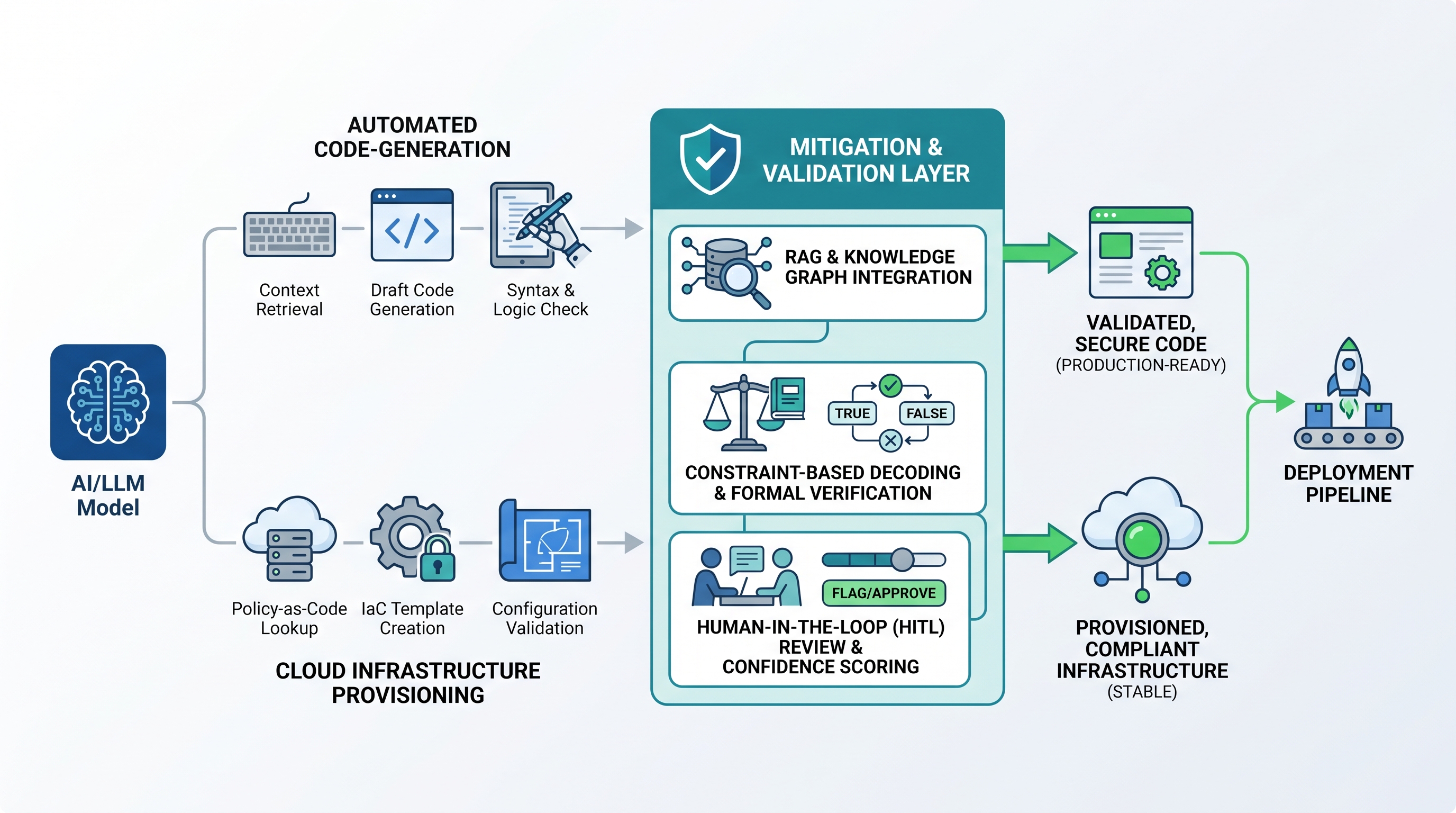
The Paradigm Shift: Generative AI in Cloud Engineering
The integration of Large Language Models (LLMs) into DevOps and GitOps workflows has revolutionized cloud engineering. What once took days of manual writing, testing, and debugging of Terraform modules, CloudFormation templates, or Ansible playbooks is now generated in seconds. However, this velocity introduces unprecedented risks. Unlike human engineers who make predictable errors, LLMs operate on probabilistic token prediction. They do not "understand" cloud architecture; they predict the most likely sequence of characters based on historical training data.
When applied to complex, multi-cloud environments spanning AWS, Azure, GCP, and Oracle Cloud Infrastructure (OCI), this probabilistic approach leads to AI hallucinations. In the context of infrastructure provisioning, a hallucination is not merely an incorrect variable; it manifests as non-existent API parameters, deprecated resource schemas, invalid dependency graphs, or—most dangerously—highly insecure and financially ruinous configurations that bypass standard syntactic validation. To scale automated provisioning safely, enterprises must transition from blind reliance on generative models to a zero-trust, deterministic validation model.
Anatomy of an AI Hallucination in Infrastructure as Code (IaC)
To mitigate hallucinations, we must first categorize how they manifest within IaC and deployment scripts. Through analyzing thousands of AI-generated deployments, cloud architects have classified these anomalies into three primary vectors:
1. Schema and API Syntactic Hallucinations
Cloud providers continuously update their APIs and provider schemas. LLMs, constrained by their training data cutoff dates, frequently generate code utilizing deprecated resources, obsolete API versions, or entirely fabricated arguments. For instance, an LLM tasked with generating an AWS VPC CNI configuration might invent a parameter like enable_hyper_throughput = true because it semantically aligns with performance-optimization prompts, even though no such parameter exists in the AWS Terraform provider. When executed, these lead to immediate deployment failures, stalling continuous integration pipelines.
2. Semantic and Logical Dependency Failures
An LLM might write syntactically perfect Terraform code that is logically catastrophic. It may provision an isolated private subnet but fail to configure the route tables, NAT gateways, or security groups required for legitimate traffic, resulting in silent deployment failures or orphaned resources. Conversely, it might generate cyclic dependencies—such as making Resource A depend on Resource B, which in turn references an attribute of Resource A—causing the execution engine to lock up or crash during the plan phase.
3. Security and Compliance Drift (Insecure Defaults)
LLMs are trained heavily on public code repositories, which are notoriously rife with insecure defaults, quick-start configurations, and proof-of-concept code. Consequently, when asked to generate a "scalable database cluster," the model will often output configurations with open ingress rules (0.0.0.0/0), disabled encryption-at-rest (storage_encrypted = false), or default administrative credentials. These are not syntax errors; the code will compile and deploy perfectly, creating immediate, severe vulnerabilities within your cloud perimeter.
The Blast Radius: FinOps and Security Implications
The consequences of deploying hallucinated infrastructure are distributed across two critical pillars of enterprise cloud governance: Financial Operations (FinOps) and Information Security.
The FinOps Impact: Runaway Cloud Spend
When an LLM is prompted to "provision a high-performance Kubernetes cluster on AWS for a production workload," it lacks context regarding organization-specific budgeting, reserved instances, or savings plans. It optimizes purely for the "high-performance" semantic token. As a result, it may generate a Terraform manifest specifying m5.24xlarge instances or provision expensive provisioned IOPS SSDs (gp3 with 16,000 IOPS and 1,000 MB/s throughput) where a standard burstable instance and GP3 default would suffice.
Without automated cost impact calculation integrated directly into the pull request (PR) workflow, these high-cost resources are provisioned instantly. A single hallucinated instance type can elevate a department's monthly cloud spend by thousands of dollars within hours. This underscores the necessity of continuous cost-governance mechanisms that intercept AI-generated plans and evaluate their financial impact before they reach the cloud provider's API.
The Security Impact: Expanding the Attack Surface
Security vulnerabilities introduced by AI-generated code are particularly insidious because they bypass traditional network-level intrusion detection systems. If an LLM generates an S3 bucket configuration with public_read access or provisions an IAM role with an overly permissive wildcard policy ("Action": "*"), the cloud provider assumes this is intentional.
To prevent these exposures, organizations must implement enterprise-grade security management systems that treat AI-generated code with the same skepticism as untrusted external input. Every line of code must be parsed, transformed into an Abstract Syntax Tree (AST), and evaluated against strict compliance frameworks (such as CIS Benchmarks, SOC2, and ISO 27001) prior to execution.
Architectural Blueprint for a Zero-Trust AI Provisioning Pipeline
Mitigating AI hallucinations requires a shift-left approach to cloud operations. We cannot rely on the LLM to self-correct; instead, we must construct a multi-layered, deterministic pipeline that acts as a sandbox, verification engine, and gatekeeper. The diagram below illustrates the conceptual flow of this zero-trust architecture:
[User/System Prompt]
       │
       ▼
┌────────────────────────────────────────────────────────┐
│ 1. Contextual Generation Layer                         │
│    - RAG with Cloud Provider Schemas                  │
│    - System Prompts & Temperature Controls             │
└───────────────────────┬────────────────────────────────┘
                        │ (Generated Raw IaC)
                        ▼
┌────────────────────────────────────────────────────────┐
│ 2. Syntactic & Static Analysis Layer                   │
│    - AST Parsing                                       │
│    - Linter & Schema Validation (TFLint, Checkov)      │
└───────────────────────┬────────────────────────────────┘
                        │ (Syntactically Valid IaC)
                        ▼
┌────────────────────────────────────────────────────────┐
│ 3. Policy-as-Code (PaC) & Guardrails                   │
│    - Open Policy Agent (OPA) / Rego Validation         │
│    - Cost Impact & Resource Limit Verification         │
└───────────────────────┬────────────────────────────────┘
                        │ (Compliant & Budget-Approved IaC)
                        ▼
┌────────────────────────────────────────────────────────┐
│ 4. Deterministic Execution & Drift Monitoring          │
│    - Terraform Plan / Dry-Run Analysis                 │
│    - Continuous Drift Detection & Automated Rollback   │
└────────────────────────────────────────────────────────┘
Step 1: Contextual Generation and Prompt Engineering
The first line of defense is optimizing the generative process itself. Standard, out-of-the-box LLMs lack the domain-specific context of your enterprise's cloud footprint. By utilizing the advanced cognitive capabilities of Atler AI, organizations can ground the generation process using Retrieval-Augmented Generation (RAG). This feeds the model with real-time, validated Terraform provider schemas, current internal module registries, and active enterprise policies.
Furthermore, setting strict model parameters is essential. For code generation, the model's temperature should be set to 0.0 or 0.1 to minimize creativity and maximize deterministic, reproducible output. System prompts must explicitly forbid the use of deprecated features, mandate explicit resource naming conventions, and require the inclusion of mandatory metadata and tags.
Step 2: Syntactic and Static Analysis Validation
Once the raw IaC is generated, it must be isolated in a sandboxed CI/CD environment. It should never be applied directly to a target cloud environment. The code must undergo rigorous static analysis:
Syntax Validation: Running native commands such as
terraform validateoraz bicep buildto ensure the code compiles and matches the provider's expected schema.Deep Linting: Utilizing tools like TFLint to catch provider-specific errors, such as invalid AWS EC2 instance types or incorrect Azure VM sizes, before calling the cloud APIs.
Static Security Scanning: Employing security scanners (e.g., Checkov, Tfsec, or Terrascan) to analyze the code for common vulnerabilities, misconfigured IAM policies, and unencrypted storage volumes.
Step 3: Policy-as-Code (PaC) Guardrails
Static analysis catches syntax and basic security flaws, but it cannot evaluate organizational business logic. This is where Policy-as-Code (PaC) becomes critical. By defining automated compliance guardrails using languages like Rego (Open Policy Agent) or Sentinel, organizations can programmatically enforce architectural standards.
For example, a PaC rule can state that no resource may be provisioned without specific tracking tags, or that any database instance must be deployed across multiple Availability Zones. If the AI-generated code violates these rules, the pipeline halts immediately, and the violation is logged for remediation.
Step 4: Dry-Run and Plan Analysis
Even if the code passes static and policy checks, the actual state of the cloud environment can introduce conflicts. Therefore, the pipeline must execute a dry-run (e.g., terraform plan -out=tfplan) and convert the execution plan into a structured JSON format. This JSON plan is then parsed by security and FinOps engines to analyze the exact delta: what resources are being added, modified, or destroyed, and what is the projected cost variance?
Technical Deep Dive: Implementing OPA and Static Analysis Safeguards
To illustrate how these guardrails function in practice, let us walk through a concrete implementation of an automated verification pipeline. In this scenario, an AI model has generated a Terraform configuration for an AWS EC2 instance and an associated security group. However, the model hallucinated an insecure ingress rule and specified an excessively large instance type.
The Hallucinated Terraform Code
Below is the raw, unverified output generated by the LLM:
resource "aws_instance" "app_server" {
  ami           = "ami-0c55b159cbfafe1f0"
  instance_type = "c5.18xlarge" # Hallucinated/Over-provisioned size for a simple app server
  key_name      = "deployer-key"

  tags = {
    Name = "AI-Generated-App-Server"
  }
}

resource "aws_security_group" "web_sg" {
  name        = "allow_web_traffic"
  description = "Allow inbound web traffic"

  ingress {
    description      = "HTTP from anywhere"
    from_port        = 80
    to_port          = 80
    protocol         = "tcp"
    cidr_blocks      = ["0.0.0.0/0"] # Insecure default
  }

  ingress {
    description      = "SSH from anywhere"
    from_port        = 22
    to_port          = 22
    protocol         = "tcp"
    cidr_blocks      = ["0.0.0.0/0"] # Severe security vulnerability
  }
}
The Defensive Rego Policy (Open Policy Agent)
To intercept this configuration, we write an OPA policy (policy.rego) that parses the planned changes. This policy enforces two strict constraints: it restricts allowed EC2 instance types to prevent FinOps leaks, and it completely bans open SSH access (port 22) to protect our security posture.
package terraform.validation

import future.keywords.in

default allow = false

# Define allowed instance types (FinOps Control)
allowed_instance_types = ["t3.micro", "t3.small", "t3.medium", "m5.large"]

# Rule: Allow only if there are no violations
allow {
    count(violations) == 0
}

# Violation: Check for unapproved instance types
violations[msg] {
    some resource in input.resource_changes
    resource.type == "aws_instance"
    instance_type := resource.change.after.instance_type
    not instance_type_allowed(instance_type)
    msg := sprintf("FINOPS VIOLATION: Instance type '%s' is not in the approved list.", [instance_type])
}

# Violation: Check for open SSH access (Port 22)
violations[msg] {
    some resource in input.resource_changes
    resource.type == "aws_security_group"
    ingress := resource.change.after.ingress[_]
    ingress.from_port <= 22
    ingress.to_port >= 22
    "0.0.0.0/0" in ingress.cidr_blocks
    msg := "SECURITY VIOLATION: SSH access (Port 22) cannot be open to the public (0.0.0.0/0)."
}

# Helper to check if instance type is allowed
instance_type_allowed(type) {
    type == allowed_instance_types[_]
}
Executing the Verification Pipeline
In our CI/CD pipeline (e.g., GitHub Actions, GitLab CI, or Jenkins), we automate the execution of these checks. The following shell script demonstrates how the pipeline converts the Terraform plan to JSON and runs OPA to evaluate it against our policy:
#!/usr/bin/env bash
set -euo pipefail

echo "Initializing Terraform..."
terraform init -backend=false

echo "Generating execution plan..."
terraform plan -out=tfplan -no-color

echo "Converting plan to JSON..."
terraform show -json tfplan > tfplan.json

echo "Evaluating policy using Open Policy Agent..."
if opa eval --data policy.rego --input tfplan.json "data.terraform.validation.violations" --format pretty > violations.json; then
    VIOLATIONS=$(cat violations.json)
    if [ "$VIOLATIONS" != "[]" ] && [ -s violations.json ]; then
        echo "❌ Deployment Blocked: Policy Violations Detected!"
        echo "$VIOLATIONS" | jq .
        exit 1
    else
        echo "✅ Policy checks passed successfully. Proceeding with deployment."
    fi
fi
When this pipeline runs against the AI-generated code, OPA detects that c5.18xlarge is not in the approved list and that SSH access is open to 0.0.0.0/0. The script exits with a non-zero code, blocking the deployment and outputting clear, actionable feedback. This feedback can then be piped back into the LLM as a correction prompt, enabling automated self-healing before human review.
Post-Deployment Verification and Drift Detection
Even with robust pre-deployment validation, cloud environments are dynamic. Changes occur, manual hotfixes are applied, and API behaviors can drift. To maintain a secure and cost-optimized infrastructure posture, organizations must implement continuous post-deployment verification.
For modern infra and SRE teams, this means establishing real-time drift detection. If a resource's actual state in AWS or Azure diverges from the declared configuration—perhaps due to a runtime modification or a delayed API side-effect of a hallucinated parameter—the system must automatically flag the discrepancy. By continuously reconciling the active cloud state against the validated GitOps repository, organizations can trigger automated rollbacks or alerting mechanisms, preventing configuration drift from hardening into permanent security vulnerabilities.
A Comparative Analysis of Verification Approaches
To design the optimal validation strategy, cloud architects must weigh the pros and cons of different validation methods. The table below compares the key mechanisms used to mitigate AI hallucinations in IaC pipelines:
Validation Method | Target Risk | Execution Stage | Pros | Cons |
|---|---|---|---|---|
Static Analysis (TFLint, Checkov) | Syntax errors, deprecated APIs, basic security misconfigurations | Pre-Plan / Commit Time | Extremely fast, low compute cost, runs locally | Lacks dynamic context; cannot calculate actual cost impact or evaluate runtime states |
Policy-as-Code (OPA, Rego) | Enterprise compliance violations, budget overruns, custom architectural constraints | Post-Plan / Pre-Apply | Highly customizable, decouples compliance from developer code, centralizes governance | Requires learning Rego/Sentinel; complexity increases with multi-cloud scale |
RAG & Schema Constrained Generation | Hallucinated resource types, incorrect attributes, outdated provider configurations | Generation Time (In-Model) | Prevents errors at the source; results in cleaner, more accurate initial drafts | Requires advanced LLM orchestration; dependent on up-to-date documentation vector databases |
Continuous Drift Detection | Manual overrides, silent failures, runtime API side-effects | Post-Deployment (Continuous) | Ensures long-term alignment between declared state and actual state | Can be resource-intensive; requires robust state-locking and reconciliation engines |
Operationalizing AI Safely: The Path Forward
Mitigating AI hallucinations is not about restricting developer velocity; it is about building the guardrails that make high-speed automation safe for the enterprise. As organizations scale their generative AI operations, they must adopt a structured approach to operational readiness:
Treat AI Output as Untrusted: Establish a strict architectural boundary where no machine-generated code is executed without passing through deterministic syntactic, security, and financial validation pipelines.
Unify FinOps and Security: Do not treat budget overruns and security vulnerabilities as separate issues. A misconfigured, over-provisioned cluster is both a financial leak and a potential attack vector. Govern them through a unified control plane.
Automate the Feedback Loop: When a policy check blocks an AI-generated plan, feed the error logs directly back to the generation engine. This allows the system to self-correct and generate compliant code without manual human intervention.
Unify Your Cloud Operations with CloudAtler
Building, maintaining, and scaling a custom verification pipeline across multiple clouds is a monumental engineering challenge. Fragmented tools, disparate APIs, and constantly changing provider schemas often lead to governance silos, leaving your organization vulnerable to both security breaches and runaway cloud spend.
CloudAtler solves this complexity by providing a unified, AI-powered platform that seamlessly integrates FinOps, cloud security, and automated operations across AWS, Azure, GCP, and Oracle environments. With CloudAtler, you get out-of-the-box guardrails, real-time cost impact calculations, and intelligent patch management designed to neutralize the risks of automated provisioning while accelerating your cloud transformation.
Ready to secure and optimize your automated cloud infrastructure? Explore the CloudAtler Platform today or schedule a deep-dive demo with our cloud architecture team.
All in One Place
Atler Pilot decodes your cloud spend story by bringing monitoring, automation, and intelligent insights together for faster and better cloud operations.