
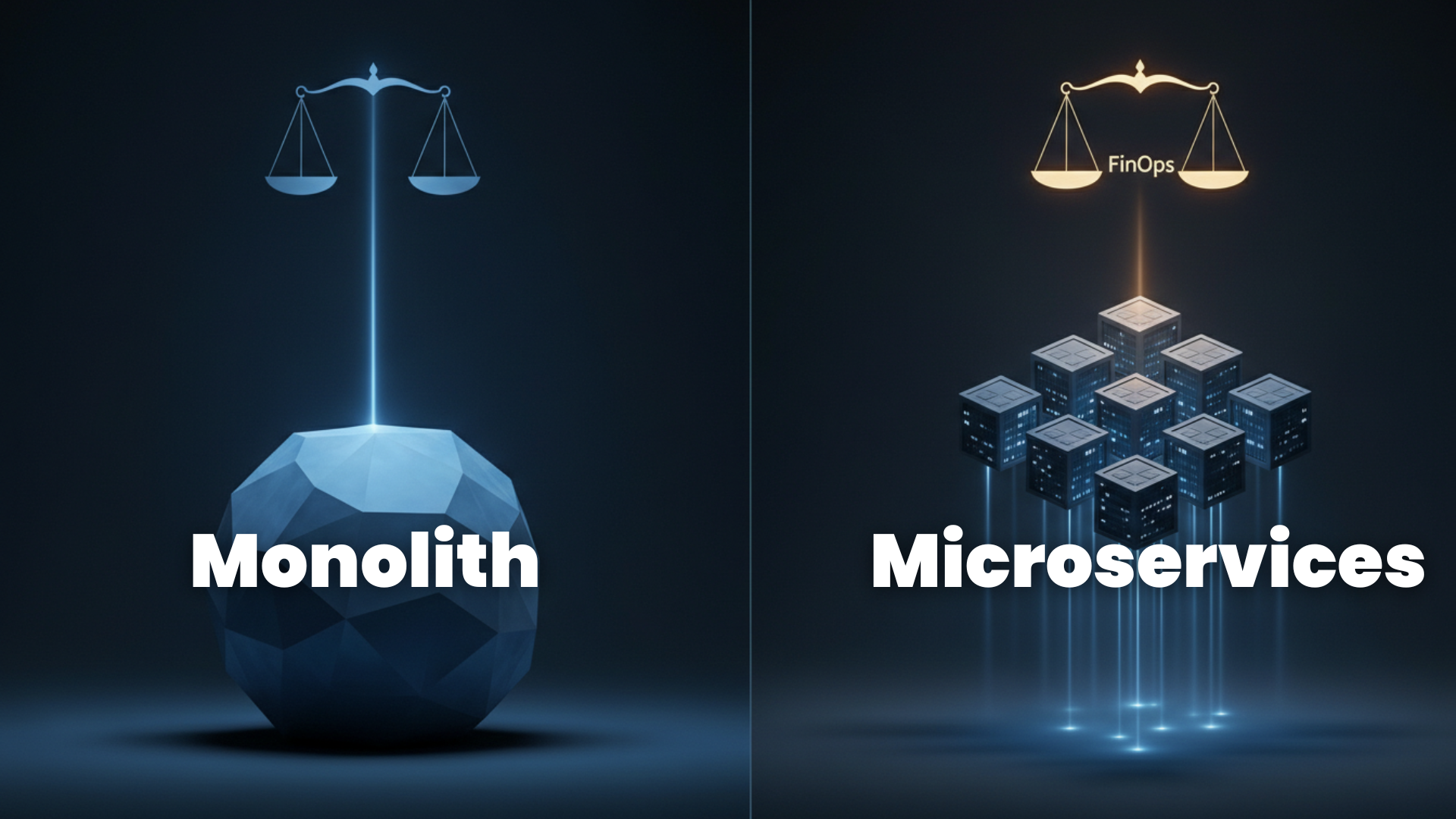
In the world of software architecture, debates often sound like sports rivalries. Frontend vs backend. SQL vs NoSQL. And perhaps one of the most persistent discussions of the past decade is Monolith vs Microservices.
For years, microservices have been marketed as the modern answer to scalability and agility. Startups and enterprises alike rushed to break down their large applications into smaller services, expecting flexibility and faster innovation. And to be fair, microservices did deliver on many of those promises. However, there’s another side to the story that often doesn’t get discussed enough which is cost.
In a cloud-driven era where infrastructure expenses can spiral faster than anyone expects, architectural decisions have a direct impact on the bottom line. What looks technically elegant might quietly become financially inefficient. This is exactly where FinOps enters the conversation.
FinOps short for Financial Operations, focuses on bringing financial accountability to cloud spending. It bridges engineering, finance, and business teams so that everyone understands the cost implications of technical decisions. And when you analyze architecture through a FinOps lens, the classic monolith vs microservices debate becomes far more nuanced.
Microservices may unlock agility, yet they can also introduce operational complexity and unexpected cloud costs. Monoliths may seem outdated. However, they often provide predictable infrastructure spending.
So, the real question is not “Which architecture is better? But Which architecture delivers the best balance of agility, scalability, and cost efficiency? Let’s explore both architectures from a FinOps cost perspective and uncover the hidden financial realities behind them.
Understanding Monolithic Architecture
Before diving into costs, it helps to understand what a monolithic architecture actually is. In a monolithic application, the entire system is built as a single unified codebase. All modules like authentication, payment processing, user management, and reporting, live within one application and typically share the same database. Think of it as one large building where every department operates under the same roof.
Key Characteristics of Monoliths
Single codebase
Shared database
Single deployment unit
Tightly coupled components
Simpler infrastructure
For many years, monoliths powered some of the world’s biggest platforms. Early versions of companies like Amazon, Netflix, and Facebook all started with monolithic architectures. Although monoliths are sometimes seen as “old school,” they still offer several advantages, especially when viewed through a FinOps perspective.
Cost Advantages of Monoliths
1. Lower Infrastructure Complexity
A monolithic application usually runs on fewer servers or containers. This means fewer compute instances, fewer networking components, and fewer supporting services. From a FinOps perspective, this simplicity directly translates into lower infrastructure costs.
2. Reduced Network Overhead
Since all components communicate internally within the same application, there is minimal inter-service communication. In cloud environments, this matters because network calls between services can generate additional charges. With monoliths, communication happens within the same process, which is both faster and cheaper.
3. Easier Cost Tracking
Tracking cloud costs is relatively straightforward with monolithic systems. Since everything runs as a single service, cost allocation is simpler. In contrast, distributed architectures often require complex tagging strategies to understand where money is being spent.
4. Fewer Operational Tools
Microservices typically require additional tooling such as service meshes, API gateways, monitoring stacks, and orchestration platforms. Monoliths, however, can operate with far fewer supporting systems. Less tooling means lower operational overhead and licensing costs.
The Hidden Cost Challenges of Monoliths
Despite their simplicity, monoliths do have financial drawbacks.
1. Inefficient Resource Scaling
With a monolith, you cannot scale individual components independently. If one feature requires more computing power, the entire application must scale. This can lead to resource overprovisioning, where unused components consume infrastructure resources.
2. Slower Development Cycles
Monolithic systems often become harder to maintain as they grow. Deployments may take longer, and small changes can affect the entire application. Although this is primarily a productivity issue, it indirectly impacts cost because longer development cycles delay value delivery.
3. Risk of Large Failures
Since everything is tightly coupled, a single failure can impact the entire application. Recovering from such failures might require scaling infrastructure or performing costly emergency fixes.
Understanding Microservices Architecture
Microservices take a very different approach. Instead of building one large application, the system is divided into many smaller, independent services. Each service handles a specific function and communicates with others through APIs. You can imagine this architecture as a city made up of many small buildings rather than one massive skyscraper. Each microservice can be developed, deployed, and scaled independently.
Key Characteristics of Microservices
Multiple independent services
Decentralized data management
Independent deployments
API-based communication
Highly scalable architecture
Microservices became popular alongside cloud computing, containers, and Kubernetes, which made it easier to manage distributed systems. However, from a FinOps lens, microservices introduce new financial considerations.
Cost Advantages of Microservices
1. Granular Scaling
One of the biggest benefits of microservices is targeted scaling.
If a payment service experiences heavy traffic, only that service needs additional compute resources. The rest of the system can continue operating with minimal infrastructure. This flexibility can lead to better resource utilization.
2. Faster Innovation
Teams can work on different services simultaneously. Deployments become smaller and more frequent. Although this advantage is not directly about infrastructure cost, it improves business velocity, which ultimately impacts financial performance.
3. Improved Fault Isolation
Failures in one microservice usually do not affect the entire system. This reduces downtime and the financial impact of outages.
4. Technology Flexibility
Each microservice can use the most appropriate technology stack. While this may not directly reduce costs, it can improve efficiency and developer productivity.
The Hidden Cost Challenges of Microservices
While microservices offer architectural flexibility, they can also introduce significant hidden costs. And this is exactly where FinOps teams often step in.
1. Infrastructure Sprawl
Each microservice typically runs in its own container or compute instance. A system that once required a few servers might suddenly require dozens or even hundreds of services.
This expansion leads to:
More compute instances
More storage resources
More load balancers
More network traffic
All of these elements add to cloud spending.
2. Increased Network Costs
Unlike monoliths, microservices rely heavily on service-to-service communication. Every API call between services generates network traffic. In cloud environments, cross-zone or cross-region traffic can incur additional costs. At scale, these seemingly small charges can become surprisingly large expenses.
3. Observability and Monitoring Costs
Microservices require sophisticated monitoring systems. Organizations often deploy tools for:
Distributed tracing
Logging systems
Metrics monitoring
Service health checks
While these tools are essential, they also introduce additional infrastructure and licensing costs.
4. DevOps and Operational Overhead
Managing a distributed architecture demands advanced DevOps capabilities. Teams often rely on platforms like:
Kubernetes clusters
Service meshes
API gateways
CI/CD pipelines
Although these tools improve operational efficiency, they also increase engineering and operational costs.
5. Data Management Complexity
In microservices, each service may have its own database. While this improves independence, it can lead to data duplication and increased storage costs. Moreover, maintaining consistency across distributed databases can require additional infrastructure.
FinOps Insights: The True Cost Equation
When organizations evaluate monolith vs microservices, they often focus only on technical scalability. However, FinOps encourages teams to ask a different set of questions:
How does this architecture affect cloud spending?
Can we track costs accurately?
Are we paying for unused resources?
Does the architecture align with business growth?
Interestingly, many companies that aggressively adopted microservices are now reconsidering their approach. Some are even moving toward modular monoliths, a hybrid architecture that combines the simplicity of monoliths with the modular structure of microservices. This approach allows teams to maintain clear module boundaries without introducing the operational overhead of distributed systems.
When Should You Choose a Monolith?
From cloud cost management perspective, monoliths often make sense when:
The application is small to medium in scale
Engineering teams are relatively small
Infrastructure budgets are limited
Rapid experimentation is required
Monoliths allow teams to move quickly without managing complex infrastructure. Many successful startups intentionally begin with monoliths because they prioritize speed and cost efficiency.
When Do Microservices Make Financial Sense?
Microservices become more viable when:
Applications experience massive scale
Multiple teams work on different components
Services require independent scaling
Reliability and fault isolation are critical
In such environments, the operational complexity is justified by scalability and resilience benefits. However, these benefits only materialize when organizations have the engineering maturity to manage distributed systems effectively.
Turn Architectural Complexity into Cost Clarity
Understanding the cost implications of monoliths and microservices is one thing. Managing those costs in real time, however, is an entirely different challenge.
As organizations move toward distributed architectures, cloud bills often become harder to interpret. One service scales, another spins up containers automatically, yet another generates unexpected network costs. Before long, teams are left asking a familiar question: “Where exactly is our cloud budget going?”
This is where FinOps practices supported by the right tools become essential.
Atler Pilot, our intelligent finOps platform, is designed to bring this much-needed clarity to cloud spending. Instead of manually digging through complex billing dashboards, engineering and finance teams can quickly understand how architectural decisions translate into real infrastructure costs.
With AI-powered insights, automated cost monitoring, and real-time anomaly detection, Atler Pilot helps organizations stay ahead of unexpected cloud expenses. Whether you're operating a monolithic application or managing hundreds of microservices, the platform provides a clear view of where resources are being consumed and how spending can be optimized.
More importantly, it encourages collaboration between engineering and finance teams, which is at the heart of successful FinOps practices. Developers can see the cost impact of their deployments, while finance teams gain transparency into infrastructure usage.
The result is a more informed decision-making process where architectural innovation and financial accountability move forward together. If you're exploring ways to bring greater cost visibility into your cloud environment, Atler Pilot offers a practical starting point for building a more proactive FinOps strategy.
Conclusion
The debate between monoliths and microservices is often framed as a purely technical choice. Yet when viewed with a FinOps view, it becomes clear that architecture is just as much a financial decision as it is an engineering one. The smartest organizations today are not blindly choosing one approach over the other. Instead, they are designing architectures with financial awareness built into the decision-making process. After all, cloud architecture is no longer just about writing code or deploying services. It is about building systems that are technically sound, operationally manageable, and financially sustainable.
All in One Place
Atler Pilot decodes your cloud spend story by bringing monitoring, automation, and intelligent insights together for faster and better cloud operations.