
The Imperative of Multi-Cloud FinOps in the Enterprise Landscape
The strategic imperative for enterprises to adopt multi-cloud architectures is undeniable. Organizations leverage AWS, Azure, GCP, and Oracle Cloud Infrastructure (OCI) to mitigate vendor lock-in, optimize for specific workload requirements, enhance resilience, and comply with diverse regulatory mandates. However, this distributed infrastructure introduces significant complexities, particularly in financial management. Without a unified, intelligent approach, the promise of cloud agility and cost-efficiency can quickly devolve into opaque spending, inefficient resource utilization, and unmanaged security risks.
Traditional IT financial management models are ill-equipped to handle the dynamic, elastic, and consumption-based nature of multi-cloud. This is where FinOps — a cultural practice that brings financial accountability to the variable spend model of cloud — becomes critical. For enterprises operating across multiple cloud providers, FinOps must evolve into Multi-Cloud FinOps, demanding a sophisticated framework for governance, optimization, and collaboration. This article introduces a Multi-Cloud FinOps Maturity Model designed to guide enterprises in systematically enhancing their cloud cost management, integrating financial accountability with operational and security excellence.
Defining the Multi-Cloud FinOps Maturity Model
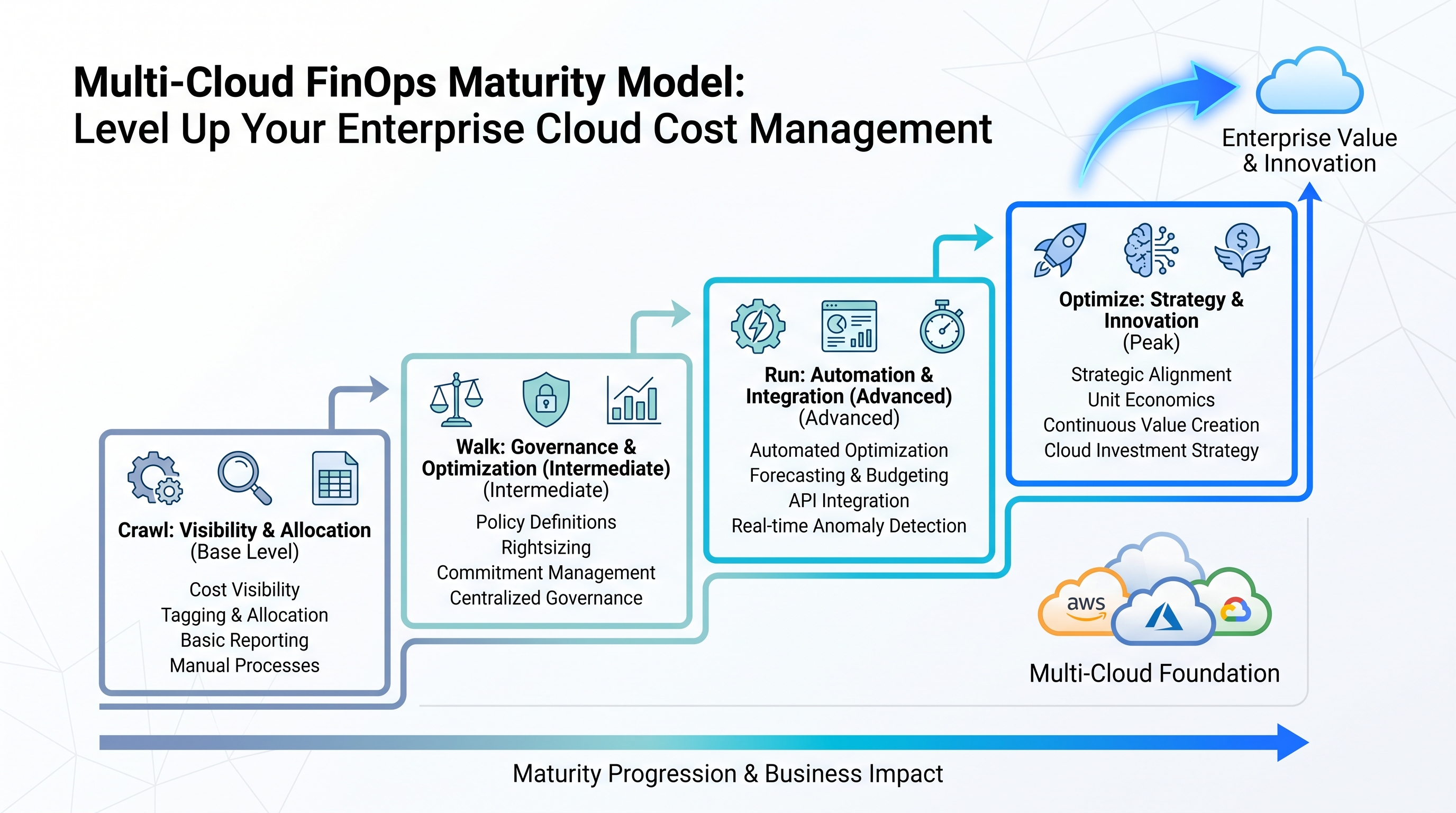
A FinOps maturity model provides a structured roadmap for organizations to assess their current capabilities and define actionable steps to improve. In a multi-cloud context, this model must account for the inherent complexities of disparate billing structures, varied resource types, distinct API sets, and the challenge of establishing consistent governance across heterogeneous environments. Our model outlines four distinct levels, moving from a reactive, ad-hoc state to a proactive, intelligent, and fully automated posture. Each level builds upon the previous, integrating people, processes, and technology to achieve progressively higher states of FinOps excellence.
Advancing through these levels is not merely about cost reduction; it's about achieving greater financial predictability, operational efficiency, enhanced security posture, and ultimately, accelerating business value from cloud investments. It requires a shift from viewing cloud costs solely as an IT expense to understanding them as a strategic lever for business growth and innovation.
Level 1: Ad-Hoc & Reactive (The Crawl)
Characteristics & Challenges
At Level 1, enterprises typically exhibit a fragmented approach to cloud cost management. Billing data is usually reviewed post-facto, often manually, and siloed within individual cloud provider consoles or basic spreadsheet exports. There's a limited understanding of who owns specific costs or why they are incurred. Cloud resource provisioning is often decentralized, lacking standardized tagging or naming conventions. Security practices, while present, are frequently decoupled from cost considerations, leading to potential over-provisioning for perceived security benefits without a true cost-benefit analysis.
Lack of Centralized Visibility: No consolidated view of spend across AWS, Azure, GCP, and Oracle. Each cloud's billing is managed independently.
Manual Processes: Cost allocation, anomaly detection, and optimization efforts are largely manual, time-consuming, and prone to error.
Siloed Data & Teams: Finance, operations, and development teams work in isolation, leading to a "blame game" culture rather than collaborative problem-solving.
Reactive Cost Spikes: Cloud spend often exceeds budgets due to unmonitored resource sprawl, resulting in unexpected billing surprises.
Minimal Optimization: Rightsizing, resource clean-up, and commitment purchasing (e.g., Reserved Instances, Savings Plans) are sporadic or non-existent.
Technical Implementation & Path Forward
Technical efforts at this stage are basic. Teams might log into individual cloud provider dashboards (e.g., AWS Cost Explorer, Azure Cost Management, GCP Billing Reports) to review monthly invoices. There's little to no automated data ingestion or analysis. Cost allocation is often a best-effort manual exercise, relying on informal communication rather than robust tagging. Security teams might enforce policies that inadvertently drive up costs (e.g., requiring oversized instances for specific applications) without a clear mechanism to evaluate the financial impact.
To move beyond Level 1, the immediate focus must be on establishing foundational visibility and data centralization. This involves:
Consolidating Billing Data: Implementing mechanisms to pull billing data from all cloud providers into a single repository or platform.
Basic Tagging Strategy: Beginning to enforce a simple, consistent tagging policy (e.g.,
project,owner,environment) across all cloud resources, even if initially manual.Defining Cost Centers: Identifying key business units or projects responsible for cloud spend.
Initial Budget Setting: Establishing high-level, often static, budgets for overall cloud spend.
Level 2: Centralized & Proactive (The Walk)
Characteristics & Challenges
Level 2 signifies a significant leap forward, characterized by centralized cost visibility and a nascent proactive approach to FinOps. Organizations begin to invest in tools and processes that aggregate multi-cloud billing data, enabling a more holistic view of spend. Initial efforts are made to align cloud costs with business units or projects through standardized tagging and basic showback mechanisms. Commitment-based savings (e.g., AWS Reserved Instances/Savings Plans, Azure Reservations, GCP Committed Use Discounts) are explored and partially utilized.
Consolidated Cost Reporting: A single pane of glass for multi-cloud spend, often through a third-party tool or custom dashboards.
Basic Showback/Chargeback: Costs are allocated to specific teams or departments based on tagging, fostering initial accountability.
Initial Optimization Efforts: Teams actively identify idle resources, conduct rightsizing initiatives, and purchase commitments based on stable workloads.
Budgeting & Forecasting: More structured budgeting processes are in place, with basic forecasting capabilities based on historical spend patterns.
Emerging FinOps Team: A dedicated individual or small team starts to own FinOps responsibilities.
Technical Implementation & Path Forward
Technically, Level 2 involves the deployment of tools or platforms that ingest billing data via APIs from AWS, Azure, GCP, and OCI. This enables the creation of unified dashboards. For instance, a centralized data lake might be used to store Cost and Usage Reports (CURs) from AWS, Azure Billing APIs, and GCP Billing Export to BigQuery, with custom scripts or ETL jobs to normalize the data. Tagging strategies become more robust, moving beyond simple key-value pairs to enforce mandatory tags and leverage cloud-native tagging policies (e.g., Azure Policy, AWS Tag Policies). Security teams might start to correlate security findings with resource costs, understanding the financial impact of remediation activities or specific security controls.
To advance, organizations must refine their data granularity and introduce more automation:
Automated Tagging Enforcement: Utilizing policy engines to automatically apply or validate tags upon resource creation. CloudAtler's automated tagging capabilities are crucial here for multi-cloud consistency.
Granular Cost Allocation: Moving beyond basic project/owner tags to include application, environment, and compliance tags for more precise cost attribution.
Advanced Commitment Management: Developing strategies for managing a portfolio of Reserved Instances and Savings Plans across multiple clouds, optimizing utilization and coverage. CloudAtler's commitment intelligence helps identify optimal purchasing strategies.
Basic Anomaly Detection: Setting up rule-based alerts for sudden cost increases or deviations from historical trends.
Integration with IT Service Management (ITSM): Incorporating cost visibility into change management and service request processes.
Level 3: Optimized & Automated (The Run)
Characteristics & Challenges
At Level 3, FinOps becomes deeply embedded within an enterprise's operational DNA. Cloud cost management is largely automated, proactive, and integrated with broader IT operations and security strategies. Organizations have a mature understanding of their multi-cloud spend, with robust chargeback/showback mechanisms driving accountability down to individual teams. Optimization is continuous, driven by policy and automation, rather than manual intervention. Security is no longer a separate cost center but an integral part of cost-efficient, compliant operations.
Automated Cost Optimization: Rightsizing, scheduling, and resource lifecycle management are automated through policy engines and scripts.
Robust Chargeback/Showback: Accurate, granular cost allocation enables true chargeback, influencing team budgets and resource decisions.
Advanced Budgeting & Forecasting: Predictive models incorporate business drivers, seasonality, and resource elasticity for highly accurate financial planning. CloudAtler offers advanced budget forecasting features.
Cross-Functional FinOps Team: Dedicated FinOps team collaborates closely with engineering, finance, security, and product teams.
Policy-Driven Governance: Cloud governance frameworks include cost optimization and security policies, enforced automatically across all cloud providers.
Security-FinOps Integration: Security policies are designed with cost efficiency in mind, and security findings are prioritized with an understanding of their financial impact.
Technical Implementation & Path Forward
Technical implementations at this level are sophisticated. Enterprises leverage AI-powered platforms like CloudAtler to unify their operations. This includes automated rightsizing recommendations applied directly to instances (e.g., resizing EC2 instances or Azure VMs based on utilization metrics), automated scheduling for non-production environments, and intelligent management of commitment portfolios to maximize savings across AWS, Azure, and GCP. Policy-as-code is prevalent, ensuring that cost and security guardrails are applied consistently across all cloud environments.
For example, a policy might automatically shut down non-tagged resources after 24 hours, or trigger an alert for any new resource deployed without proper cost center tags. Security teams integrate vulnerability management with cost data, using security management platforms to identify critical vulnerabilities and understand the cost impact of their remediation. This allows for risk-based prioritization that considers both security posture and financial efficiency.
To reach Level 4, the focus shifts to leveraging advanced AI and predictive capabilities:
AI-Driven Anomaly Detection: Moving beyond rule-based alerts to machine learning models that identify subtle, non-obvious cost anomalies.
Predictive Optimization: Using AI to forecast future resource needs and proactively optimize for them (e.g., predicting burst capacity and pre-provisioning Spot Instances or low-cost alternatives).
Continuous Feedback Loops: Establishing mechanisms for real-time feedback between cloud usage, cost, and business value.
Automated Remediation: Implementing fully automated responses to identified cost inefficiencies or security non-compliance, with built-in safe rollbacks.
Level 4: Intelligent & Predictive (The Fly)
Characteristics & Challenges
Level 4 represents the pinnacle of multi-cloud FinOps maturity. The enterprise operates a truly intelligent, self-optimizing, and predictive cloud financial and operational environment. AI and machine learning are deeply embedded, driving continuous optimization, anomaly detection, and proactive security posture management. FinOps is no longer a separate function but an intrinsic part of a unified cloud operations strategy, seamlessly blending financial, security, and operational intelligence. Decision-making is data-driven, predictive, and aligned directly with strategic business objectives across all cloud providers.
AI-Driven Predictive Optimization: Machine learning models continuously analyze usage patterns, market conditions, and business demand to make real-time optimization recommendations and automate adjustments.
Proactive Anomaly Detection & Remediation: AI identifies cost anomalies, security vulnerabilities, and operational inefficiencies before they impact the business, often with automated remediation.
Unified Financial, Security, and Operational Intelligence: A single platform provides a holistic view, enabling integrated decision-making. CloudAtler's unified dashboard is exemplary in this regard.
Uncertainty Planning: Sophisticated scenario planning and what-if analysis to model the financial impact of various business and technical decisions.
Dynamic Governance: Policies adapt to changing conditions, automatically enforcing cost, security, and compliance guardrails.
Self-Healing & Self-Optimizing Cloud: Infrastructure that automatically adjusts to demand, optimizes costs, and maintains security posture with minimal human intervention.
Technical Implementation & Path Forward
Achieving Level 4 requires a robust, AI-powered platform capable of ingesting and correlating vast amounts of data from all cloud providers, security tools, and operational metrics. CloudAtler's Atler AI is designed precisely for this, providing predictive insights into spend, performance, and security risks. Technical implementations include:
Advanced Machine Learning Models: For forecasting demand, identifying optimal commitment purchases across a multi-cloud portfolio, and detecting subtle anomalies in spend that human analysis might miss. For example, an AI might detect a gradual, non-linear increase in storage costs in GCP that, while not a sudden spike, indicates an underlying misconfiguration or uncleaned data, and proactively recommend remediation.
Real-time Cost & Security Impact Analysis: Before any change is deployed, its financial and security impact is automatically calculated and presented. For instance, a proposed architectural change in Azure might be automatically analyzed for its potential cost increase, security implications, and performance trade-offs, providing immediate feedback to engineers.
Automated Remediation Workflows: Beyond just recommendations, the system can automatically execute approved optimization actions (e.g., rightsizing, deleting idle resources, adjusting scaling policies) and security remediations (e.g., applying missing patches, reconfiguring network security groups) while ensuring safe rollbacks. This extends to patch management, where patch intelligence can identify critical vulnerabilities, assess their financial impact, and automate remediation with full cost awareness.
Integration with CI/CD Pipelines: FinOps and security guardrails are integrated directly into development workflows, preventing cost-inefficient or insecure deployments before they reach production.
Predictive Monitoring Operations: AI models analyze operational metrics to predict potential performance issues or outages and proactively scale resources or trigger maintenance, ensuring optimal cost-performance balance.
At this level, the enterprise operates with a "financial command center" that provides a holistic, real-time view of financial health, security posture, and operational efficiency across its entire multi-cloud estate. This enables strategic decisions that maximize business value and minimize risk.
Key Pillars for Advancing Multi-Cloud FinOps Maturity
Regardless of the current maturity level, certain foundational pillars are essential for progression:
1. Granular Visibility & Allocation
True FinOps starts with understanding where every dollar is spent. In a multi-cloud environment, this means normalizing billing data from AWS, Azure, GCP, and Oracle into a consistent format. Automated tagging is paramount for accurate resource identification and allocation. Without consistent tagging, chargeback and showback become impossible, hindering accountability. Enterprises must define a robust tagging taxonomy that includes business units, applications, environments, and cost centers, and then enforce it rigorously through policy engines and automation. This enables precise cost impact calculation for every resource.
2. Continuous Optimization & Automation
Manual optimization is unsustainable at scale. Automation must be applied to rightsizing compute resources, identifying and deleting idle assets, scheduling non-production environments, and managing commitment-based savings. This includes intelligently purchasing and exchanging Reserved Instances and Savings Plans across different cloud providers, optimizing for maximum coverage and utilization. AI-driven recommendations are critical here, moving beyond simple utilization thresholds to factor in workload patterns, seasonality, and projected growth.
3. Robust Governance & Policy Enforcement
Establishing clear policies and guardrails is vital to prevent cost overruns and maintain security posture. These policies should cover resource provisioning, tagging, security configurations, and data residency. In a multi-cloud context, this requires a platform capable of enforcing policies consistently across all environments. This includes setting guardrails for spending limits, resource types, and security configurations, triggering alerts or automated remediation when violations occur. Budget control alerts are essential for real-time spend management.
4. Cultural Shift & Collaboration
FinOps is as much about culture as it is about technology. It requires breaking down silos between finance, engineering, operations, and security teams. Fostering a culture of shared responsibility, transparency, and continuous improvement is crucial. Regular communication, shared goals, and cross-functional training help align incentives and empower teams to make cost-aware decisions. Empowering engineers with cost data and the tools to optimize their own resources is a hallmark of mature FinOps.
5. AI & Predictive Analytics Integration
To move beyond reactive cost management, enterprises must leverage AI and machine learning. This enables predictive forecasting, proactive anomaly detection, intelligent optimization recommendations, and automated remediation. AI can analyze complex usage patterns to identify subtle inefficiencies, predict future demand, and even model the financial impact of architectural changes or security remediation efforts. This transforms FinOps from a historical reporting function into a strategic, forward-looking capability.
Implementing a Multi-Cloud FinOps Strategy with CloudAtler
CloudAtler is purpose-built to accelerate enterprises through this Multi-Cloud FinOps Maturity Model. Our AI-powered platform unifies FinOps, cloud security, and automated operations across AWS, Azure, GCP, and Oracle environments, providing the tools and intelligence needed at every stage:
Unified Visibility (Level 1 & 2): Our unified dashboard provides a single, consolidated view of all cloud spend, resources, and security posture across your entire multi-cloud estate. It normalizes billing data and presents it in an intuitive format, breaking down silos and providing immediate transparency.
Automated Cost Allocation & Optimization (Level 2 & 3): CloudAtler’s automated tagging ensures consistent resource identification and accurate chargeback/showback. We provide AI-driven rightsizing recommendations, idle resource identification, and intelligent commitment intelligence to maximize your Reserved Instance and Savings Plan utilization across all clouds. Our budget forecasting capabilities offer granular, predictive insights, allowing for proactive financial planning.
Integrated Security & Governance (Level 3 & 4): CloudAtler integrates security management directly with FinOps. We help you enforce governance policies and guardrails across clouds, ensuring compliance without sacrificing cost efficiency. Our platform identifies security vulnerabilities and calculates the cost impact of remediation, allowing for risk-based prioritization that considers both security posture and financial implications.
Intelligent & Predictive Operations (Level 4): Powered by Atler AI, our platform delivers predictive monitoring, anomaly detection, and automated remediation. We go beyond simple alerts, identifying subtle cost deviations, forecasting future spend with high accuracy, and even automating patch remediation with full cost and operational awareness through our patch intelligence. This enables true self-optimizing and self-healing cloud environments with built-in safe rollbacks.
CloudAtler empowers enterprises to move beyond reactive cost firefighting to a state of proactive, intelligent, and unified cloud operations. By consolidating FinOps, security, and automation into a single platform, we enable organizations to achieve unparalleled financial predictability, operational efficiency, and a robust security posture across their complex multi-cloud deployments.
Conclusion
Navigating the complexities of multi-cloud environments demands more than just basic cost reporting; it requires a mature, integrated FinOps strategy. The Multi-Cloud FinOps Maturity Model provides a clear pathway for enterprises to evolve their cloud financial management, transforming it from a reactive burden into a strategic advantage. By systematically addressing visibility, optimization, governance, and culture, and by embracing the power of AI and automation, organizations can unlock the full economic potential of their multi-cloud investments.
Don't let multi-cloud complexity erode your budget or compromise your security. It's time to unify your cloud operations, gain intelligent insights, and automate your path to financial excellence. Level up your enterprise's multi-cloud FinOps maturity and achieve unparalleled cost efficiency, security, and operational agility.
Ready to transform your multi-cloud cost management and security posture? Discover how CloudAtler's AI-powered platform unifies FinOps, cloud security, and automated operations across AWS, Azure, GCP, and Oracle environments. Visit CloudAtler.com today and schedule a demo to see our platform in action.
All in One Place
Atler Pilot decodes your cloud spend story by bringing monitoring, automation, and intelligent insights together for faster and better cloud operations.