
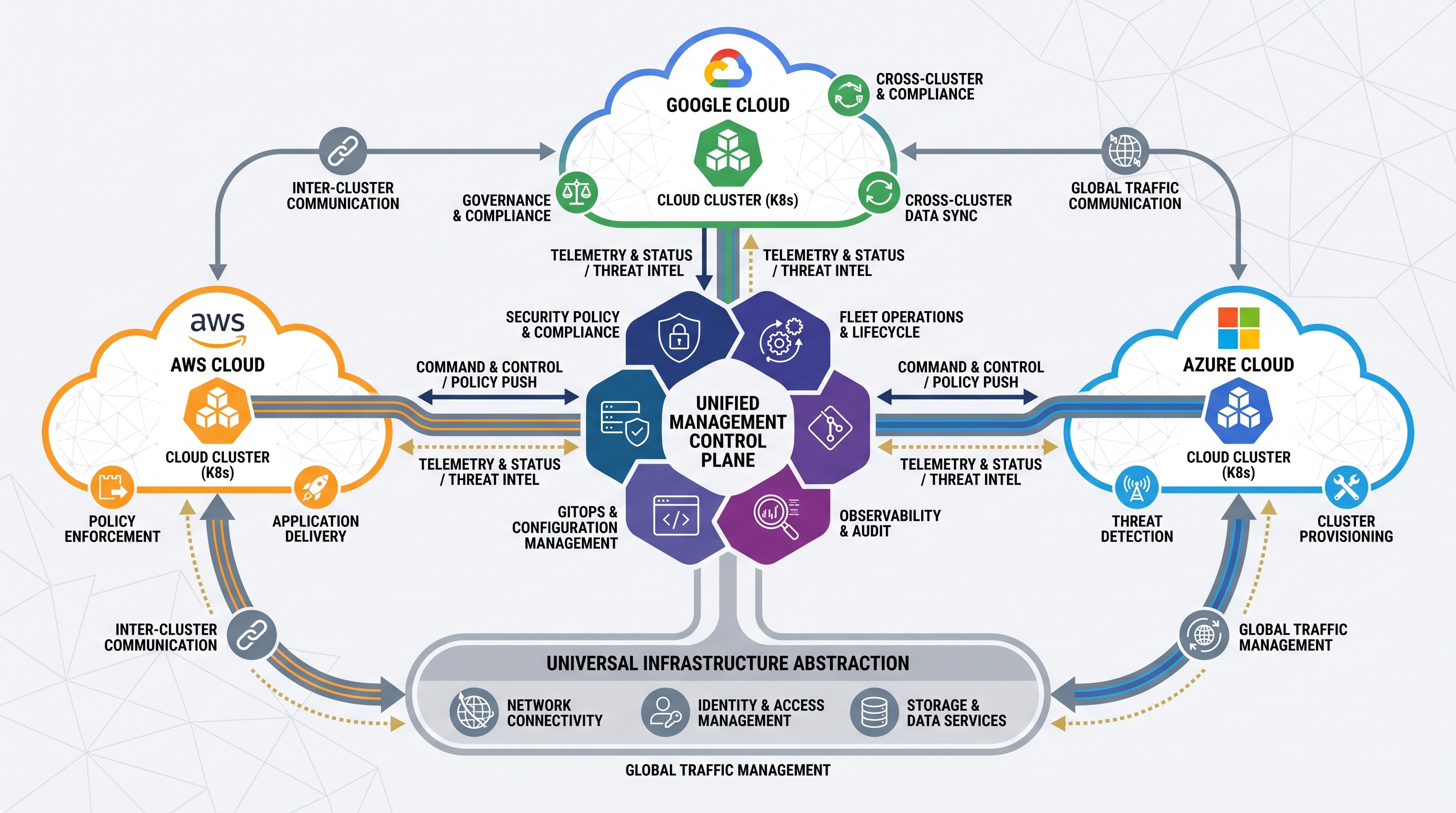
The Reality of Multi-Cloud Kubernetes Sprawl
In the modern enterprise, the single-cluster Kubernetes deployment is an endangered species. Driven by requirements for high availability, geographic proximity, data residency compliance, and blast-radius isolation, organizations routinely deploy dozens or hundreds of Kubernetes clusters. These clusters are rarely homogeneous; they are scattered across Amazon Elastic Kubernetes Service (EKS), Azure Kubernetes Service (AKS), Google Kubernetes Engine (GKE), and Oracle Cloud Infrastructure Container Engine for Kubernetes (OKE).
While this multi-cloud strategy prevents vendor lock-in and optimizes latency, it introduces a highly fragmented operational landscape. Infrastructure teams are forced to grapple with disparate identity and access management (IAM) models, inconsistent network policy engines, varying upgrade cycles, and fragmented visibility. Without a unified management paradigm, operations deteriorate into a reactive game of whack-a-mole, where security configurations drift, resource utilization plummets, and cloud spend escalates unchecked.
To overcome these challenges, platform engineers and cloud architects must transition from managing individual clusters to orchestrating a unified Kubernetes fleet. This transition requires a structured approach across three core pillars: declarative fleet orchestration, federated security and identity, and granular, container-level financial operations (FinOps).
Architectural Patterns for Multi-Cluster Fleet Orchestration
Orchestrating a multi-cluster fleet requires shifting away from manual, imperative cluster configurations (such as running kubectl commands directly against individual API servers) toward declarative, centralized state management. There are two primary architectural topologies utilized for this purpose: the Hub-and-Spoke model and the Peer-to-Peer Mesh model.
1. The Hub-and-Spoke Topology
In a Hub-and-Spoke architecture, a dedicated management cluster (the Hub) acts as the single source of truth and administrative control plane for all workload clusters (the Spokes). The Hub cluster hosts the declarative definitions of all Spoke clusters, managing their lifecycle via tools like Cluster API (CAPI). It also orchestrates the distribution of workloads, configurations, and security policies across the spokes.
The primary advantage of this model is centralized governance. Security policies, access controls, and operational configurations are defined once on the Hub and automatically propagated to the Spokes. However, the Hub represents a single point of failure and a high-value target for attackers. Therefore, securing the Hub cluster with stringent network policies, multi-factor authentication, and robust backup mechanisms is critical.
2. Declarative Cluster Lifecycle Management with Cluster API (CAPI)
Cluster API is a Kubernetes subproject that brings declarative, Kubernetes-style APIs to cluster creation, configuration, and management. By using CAPI, platform teams can define a target cluster as a Custom Resource (CR) in the management cluster. CAPI then interacts with the underlying cloud providers (AWS, Azure, GCP, OCI) to provision the virtual machines, networking infrastructure, and Kubernetes control plane components.
The following is an abstract conceptual example of a Cluster API custom resource definition for provisioning a workload cluster on AWS:
apiVersion: cluster.x-k8s.io/v1beta1
kind: Cluster
metadata:
  name: production-us-east-1
  namespace: fleet-management
spec:
  clusterNetwork:
    pods:
      cidrBlocks: ["192.168.0.0/16"]
  infrastructureRef:
    apiVersion: infrastructure.cluster.x-k8s.io/v1beta1
    kind: AWSCluster
    name: production-us-east-1-aws
---
apiVersion: infrastructure.cluster.x-k8s.io/v1beta1
kind: AWSCluster
metadata:
  name: production-us-east-1-aws
  namespace: fleet-management
spec:
  region: us-east-1
  sshKeyName: production-fleet-key
By defining clusters as code, platform engineers can ensure that every cluster in the fleet is provisioned with identical baseline configurations, reducing the risk of configuration drift and simplifying compliance audits. For organizations seeking to streamline these complex environments, implementing comprehensive infrastructure and SRE solutions is key to maintaining high availability and operational velocity.
3. GitOps at Scale: ArgoCD ApplicationSets
To deploy and maintain workloads consistently across a fleet of clusters, organizations leverage GitOps methodologies. While tools like ArgoCD excel at syncing a Git repository to a single cluster, managing hundreds of clusters individually quickly becomes unmanageable. This is where ArgoCD ApplicationSets solve the scaling challenge.
An ApplicationSet controller uses generators to dynamically target multiple Kubernetes clusters. For example, a Cluster Generator can query the ArgoCD cluster registry, identify all clusters tagged with environment: production, and automatically deploy the specified security agents, monitoring stacks, or application microservices to those clusters. This ensures that any change pushed to the central Git repository is instantly and consistently applied across the entire global fleet.
Unifying Security & Compliance Across Heterogeneous Fleets
Securing a single Kubernetes cluster is complex; securing a multi-cloud fleet is one of the most significant challenges in modern cloud security. Because each cloud provider implements its own native identity and access management (IAM) system, security teams struggle to enforce a uniform least-privilege access model across AWS, Azure, GCP, and Oracle Cloud.
1. Federated Identity with OIDC and SPIFFE/SPIRE
The first step in unifying fleet security is establishing a federated identity plane. Rather than managing static, long-lived credentials (like AWS IAM User Access Keys or GCP Service Account JSON keys) inside Kubernetes secrets—which represent a severe security risk—organizations must leverage OpenID Connect (OIDC) identity federation.
By configuring the Kubernetes API servers across all clusters to trust a central identity provider (such as Okta, Azure Active Directory, or Keycloak), platform teams can implement role-based access control (RBAC) mapped to enterprise directory groups. Furthermore, for pod-to-pod identity across cluster boundaries, implementing the Secure Production Identity Framework for Enterprise (SPIFFE) via SPIRE allows workloads to acquire short-lived, cryptographically verifiable identities. This enables secure, mutual TLS (mTLS) communication between a microservice running in EKS and another running in AKS without relying on complex network-level VPNs or IP whitelisting.
2. Policy-as-Code: Enforcing Guardrails Globally
To prevent developers from accidentally deploying insecure configurations (such as running containers as root, mounting the host filesystem, or omitting resource limits), organizations must enforce policy-as-code engines like Kyverno or Open Policy Agent (OPA) Gatekeeper across the entire fleet.
Rather than manually installing and configuring these policy engines on each cluster, platform teams deploy them via the central GitOps pipeline. A change to a policy is committed to Git, validated in a staging environment, and rolled out globally. For instance, the following Kyverno policy blocks any pod from running with privileged escalation, ensuring that a critical security baseline is maintained across all clusters:
apiVersion: kyverno.io/v1
kind: ClusterPolicy
metadata:
  name: restrict-escalation-privileges
spec:
  validationFailureAction: Enforce
  background: true
  rules:
  - name: check-privilege-escalation
    match:
      any:
      - resources:
          kinds:
          - Pod
    validate:
      message: "Privileged escalation is not allowed. Set allowPrivilegeEscalation to false."
      pattern:
        spec:
          containers:
          - securityContext:
              allowPrivilegeEscalation: false
By utilizing centralized policy enforcement, organizations can achieve continuous compliance. To monitor and maintain these configurations without administrative overhead, integrating an advanced unified security management platform is essential. This allows security teams to detect policy violations, visualize compliance posture across multiple clouds, and remediate drifts in real-time.
FinOps in Multi-Cluster Kubernetes: Eliminating the Black Box of Shared Compute
Kubernetes is highly efficient at packing containers onto virtual machines, but it acts as a financial black box for finance and FinOps teams. When multiple teams, departments, or microservices share a single Kubernetes cluster, the cloud provider's bill merely shows the cost of the underlying virtual machines (EC2 instances, VM scale sets) and storage volumes. It does not show how much of that cost was consumed by Team A's payment service versus Team B's recommendation engine.
1. The Anatomy of Kubernetes Resource Waste
In a multi-cluster environment, financial waste typically stems from three primary sources:
Over-Provisioned Requests: Developers often set CPU and memory requests far higher than actual utilization to prevent out-of-memory (OOM) kills or CPU throttling. This "slack space" represents idle capacity that the organization is actively paying for.
Unallocated Capacity: Clusters that are not properly autoscaled maintain empty nodes to accommodate potential traffic spikes, leading to high infrastructure costs with zero workload output.
Orphaned Resources: Persistent volume claims (PVCs), load balancers, and public IP addresses that remain active long after the associated pods or namespaces have been deleted.
To accurately calculate the financial impact of this waste, FinOps teams must calculate the cost of unallocated capacity ($C_{unallocated}$) using the following formulation:
Cunallocated = Ctotal_nodes - ∑ (Crequested_pod_i + Csystem_overhead)
Where $C_{total\_nodes}$ is the total billing cost of the compute instances, $C_{requested\_pod\_i}$ is the cost allocated to active pods based on their resource requests, and $C_{system\_overhead}$ is the cost of running system-level daemons (kube-proxy, log forwarders, security agents).
2. Implementing Granular Chargeback and Showback
To drive accountability, organizations must implement a robust chargeback or showback model. This requires enforcing a strict metadata tagging strategy. Every namespace, deployment, and pod must be labeled with its corresponding cost center, department, and environment tag. This metadata is then mapped directly to cloud billing data.
By leveraging an enterprise-grade financial operations platform, organizations can ingest raw billing APIs from AWS, Azure, GCP, and OCI, and correlate them with real-time Kubernetes utilization metrics (CPU, memory, storage, and network egress). This correlation allows the platform to break down a $100,000 monthly cloud VM bill into precise, container-level costs, attributing every dollar to specific business units.
3. Dynamic Infrastructure Sizing and Karpenter Autoprovisioning
Traditional Kubernetes autoscaling relies on the Cluster Autoscaler, which reacts when pods fail to schedule due to insufficient resources. However, this model is slow and often results in coarse-grained VM provisioning (e.g., adding an entire node of a pre-configured instance type, even if only a fraction of its resources are needed).
To optimize costs in AWS environments, platform teams are rapidly adopting Karpenter, an open-source, high-performance node provisioning project. Unlike the traditional Cluster Autoscaler, Karpenter bypasses AWS Auto Scaling Groups and directly calls the EC2 fleet APIs. It evaluates the resource requests of unscheduled pods and dynamically provisions the most cost-effective instance type and size that fits those exact requirements. When workloads scale down, Karpenter actively consolidates pods onto fewer nodes and terminates empty instances, drastically reducing idle compute costs.
To ensure that these autoscaling mechanisms do not violate security parameters or operational budgets, organizations can implement automated tagging and governance policies. Implementing a system like CloudAtler's automated tagging engine ensures that every dynamically provisioned node is instantly tagged with the correct cost center, preventing untagged resource leakage.
Automated Patching and Vulnerability Remediation in Multi-Cluster Fleets
One of the most tedious and risk-prone operations in Kubernetes fleet management is lifecycle maintenance—specifically, patching the underlying host operating systems (node upgrades) and upgrading the Kubernetes control plane version. Delaying these upgrades leaves the environment vulnerable to critical security exploits (such as container escapes or privilege escalation vulnerabilities), while executing them manually across hundreds of clusters is a recipe for operational downtime.
1. The Multi-Tier Patching Challenge
Patching a Kubernetes fleet requires a multi-tiered approach:
Layer | Target | Remediation Strategy |
|---|---|---|
Application Layer | Vulnerable container base images (e.g., Log4j, OpenSSL exploits). | Rebuild container images with updated base layers, execute CI/CD pipelines, and trigger rolling restarts of deployments. |
Kubernetes Control Plane | API server, controller-manager, scheduler, etcd. | Execute sequential minor version upgrades (e.g., 1.27 to 1.28) via cloud provider APIs, validating API deprecations beforehand. |
Node Operating System | Host kernel, container runtime (containerd), kubelet. | Perform rolling node replacements (blue/green node groups) by draining active nodes, cordoning them, and replacing them with updated AMIs/images. |
2. Zero-Downtime Rolling Upgrades
To execute node upgrades without disrupting application availability, platform teams must design resilient applications and configure proper Kubernetes primitives. This includes setting PodDisruptionBudgets (PDBs) to guarantee that a minimum number of healthy replicas remain operational during the voluntary disruptions caused by node draining.
For example, a PodDisruptionBudget for a payment service might dictate that at least 80% of replicas must remain available at all times:
apiVersion: policy/v1
kind: PodDisruptionBudget
metadata:
  name: payment-service-pdb
spec:
  minAvailable: 80%
  selector:
    matchLabels:
      app: payment-service
When a node upgrade is initiated, the automation drains the node. The Kubernetes scheduler respects the PDB, evicting pods only when alternative replicas are healthy and running on other nodes. This rolling orchestration ensures that security patches can be applied continuously, even during peak production hours.
To orchestrate this safely across multiple clouds, organizations rely on patch-aware intelligence. This technology analyzes the dependency graphs of running workloads, verifies compatibility with the target Kubernetes version, and schedules rolling upgrades sequentially. This prevents the catastrophic cascades of failures that occur when cluster APIs are upgraded while running incompatible ingress controllers or security agents.
Practical Blueprint: Implementing a Unified Fleet Control Plane
To unify security, operations, and FinOps across a multi-cloud Kubernetes fleet, organization must move away from fragmented, cloud-specific consoles. Instead, architects should construct a unified control plane that acts as an operational overlay across AWS, Azure, GCP, and OCI. Below is a practical, step-by-step blueprint for establishing this architecture:
Step 1: Consolidate Cluster Registration
Establish a centralized management registry where every cluster across all cloud providers is registered. This registry must capture metadata such as the cloud provider, region, environment (dev, staging, prod), compliance requirements (PCI-DSS, HIPAA), and cost center ownership.
Step 2: Deploy Unified Policy and Identity Planes
Configure OIDC federation across all registered clusters to enforce single-sign-on (SSO) and RBAC. Deploy a centralized GitOps operator (such as ArgoCD) on a secure hub cluster, and configure it to manage the deployment of security policy engines (Kyverno/OPA), monitoring agents (Prometheus/Grafana), and logging daemons across all spokes.
Step 3: Integrate Real-Time FinOps Analysis
Connect your clusters to a centralized financial operations engine. Ensure that the engine is pulling utilization metrics from the Kubernetes API and correlating them with your cloud providers' billing data. This setup enables your teams to identify idle resources, calculate unallocated compute costs, and enforce automated tagging policies to ensure 100% cost attribution.
Step 4: Leverage AI-Driven Fleet Intelligence
In a massive multi-cluster fleet, the sheer volume of telemetry data (logs, metrics, audit trails, billing line items) is too vast for human operators to analyze manually. This is where advanced artificial intelligence becomes a critical operational component. By utilizing the Atler AI engine, organizations can ingest this multi-cloud telemetry stream to predict performance bottlenecks, detect anomalous spending spikes, identify zero-day security threats, and automatically optimize resource allocations before they impact the bottom line.
Architectural Best Practice: The Progressive Rollout Strategy
When rolling out fleet-wide configuration changes or patches, never target all clusters simultaneously. Implement a progressive rollout strategy: first deploy to sandbox clusters, wait for a validation window (e.g., 2 hours), proceed to non-critical development clusters, and finally execute rolling deployments across production clusters grouped by geographic regions. This minimizes the blast radius of any misconfiguration.
Conclusion: Unify Your Kubernetes Fleet with CloudAtler
Managing a multi-cluster, multi-cloud Kubernetes fleet does not have to mean accepting fragmented security, operational complexity, and runaway cloud costs. By establishing a declarative fleet architecture, implementing unified identity and policy-as-code, and driving granular container-level FinOps, organizations can unlock the true potential of multi-cloud infrastructure.
CloudAtler provides the ultimate unified control plane for modern enterprise cloud operations. By seamlessly integrating security management, automated patching, dynamic resource optimization, and deep financial intelligence across AWS, Azure, GCP, and Oracle Cloud, CloudAtler empowers platform teams to operate at scale with absolute confidence.
Stop fighting the complexity of multi-cloud sprawl. Unify your cloud operations with CloudAtler today and transform your Kubernetes fleet into a highly secure, cost-optimized, and automated engine for business innovation.
All in One Place
Atler Pilot decodes your cloud spend story by bringing monitoring, automation, and intelligent insights together for faster and better cloud operations.