
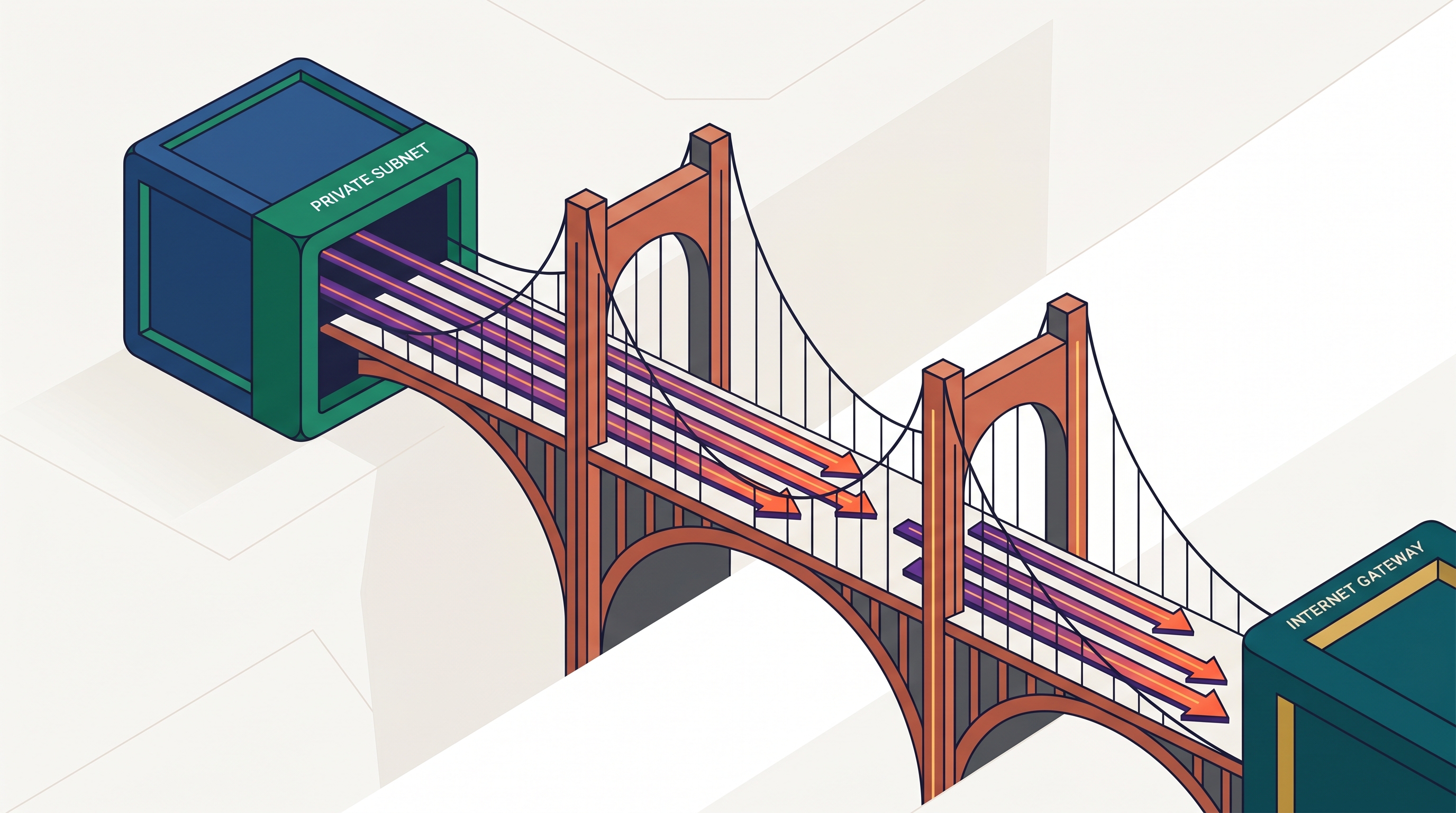
The Silent Budget Killer: Understanding NAT Gateways
Network Address Translation (NAT) Gateways are a fundamental security requirement for any enterprise AWS environment. They allow instances residing in a private subnet (such as backend databases or application servers) to connect to the public internet to download patches, pull Docker images, or interact with external SaaS APIs, while preventing the internet from initiating a connection with those instances.
Security-wise, they are indispensable. Financially, they are often a nightmare. Unlike many AWS services where costs are driven strictly by compute uptime or storage capacity, NAT Gateway costs are driven by data volume—a metric that is notoriously difficult for engineering teams to predict and monitor.
Deconstructing NAT Gateway Pricing
The billing for an AWS NAT Gateway is divided into two distinct components. Understanding this split is critical for effective FinOps management.
1. Hourly Usage Charge
You pay a flat hourly rate for simply having a NAT Gateway provisioned and available in a specific Availability Zone (AZ). In the US-East (N. Virginia) region, this is typically around $0.045 per hour.
At approximately $32 per month per gateway, this hourly cost is negligible for most organizations. If you deploy a highly available architecture with three private subnets across three AZs, your baseline cost is roughly $96 per month. This is not what ruins budgets.
2. Data Processing Charge
This is the true danger zone. AWS charges a Data Processing Fee for every single gigabyte of data that passes through the NAT Gateway. In US-East, this is typically $0.045 per GB.
Consider a machine learning pipeline residing in a private subnet that frequently downloads massive datasets from the internet, or a containerized application pulling gigabytes of logs to an external observability platform. If your workload transfers 50 TB of data through the NAT Gateway in a month, you are facing a $2,250 bill purely for data processing—and that does not include the standard outbound data transfer (egress) fees applied at the internet gateway.
CloudAtler Insight: The most common and expensive mistake we uncover in AWS audits is traffic intended for an AWS service (like S3 or DynamoDB) routing through a NAT Gateway instead of a direct VPC Endpoint. This results in organizations paying massive NAT processing fees to talk to AWS's own services.
High-Impact Strategies to Slash NAT Gateway Costs
Optimizing NAT Gateway spend requires a combination of network visibility and architectural reconfiguration. CloudAtler recommends the following proven methodologies.
1. Deploy Gateway VPC Endpoints for S3 and DynamoDB
This is the highest-ROI action you can take. By default, if an EC2 instance in a private subnet needs to access an S3 bucket, that traffic flows through the NAT Gateway, incurring the $0.045 per GB processing fee.
AWS offers Gateway VPC Endpoints specifically for S3 and DynamoDB at zero additional cost. By provisioning a Gateway Endpoint and updating your VPC route tables, S3 and DynamoDB traffic is routed internally across the AWS backbone, bypassing the NAT Gateway entirely. CloudAtler automatically enforces the deployment of these endpoints across all client VPCs via Infrastructure-as-Code.
2. Utilize Interface VPC Endpoints (AWS PrivateLink)
For AWS services other than S3 and DynamoDB (such as CloudWatch, KMS, ECR, or Secrets Manager), AWS offers Interface VPC Endpoints powered by PrivateLink.
Unlike Gateway Endpoints, Interface Endpoints do incur an hourly fee and a smaller data processing fee (typically $0.01 per GB). However, this processing fee is vastly cheaper than the NAT Gateway fee. If your private workloads are pulling heavy container images from Elastic Container Registry (ECR) or sending massive log volumes to CloudWatch, routing that traffic through Interface Endpoints will yield significant savings.
3. Architecting Centralized vs. Distributed NATs
For enterprises operating multiple VPCs (e.g., via AWS Transit Gateway), deciding where to place NAT Gateways is crucial.
Distributed Model: Placing a NAT Gateway in every private subnet of every VPC ensures isolation but multiplies the hourly usage charges and makes monitoring difficult.
Centralized (Egress VPC) Model: Routing all outbound internet traffic from multiple VPCs through a Transit Gateway into a single "Egress VPC" containing the NAT Gateways. This reduces hourly charges and centralizes security inspection. However, you must factor in the Transit Gateway data processing fees.
CloudAtler's network FinOps engineers model these scenarios mathematically, determining the exact crossover point where a centralized architecture becomes more cost-effective than a distributed one based on your specific traffic volumes.
4. Eliminate "Chatty" Third-Party Integrations
Often, high NAT Gateway costs are driven by inefficient application code. A microservice constantly polling an external SaaS API (like Datadog, Stripe, or Twilio) every second generates massive overhead.
By utilizing VPC Flow Logs combined with Amazon Athena, CloudAtler identifies the exact source IPs and destination IPs driving the most NAT traffic. If an external API is the culprit, we advise engineering teams to implement batching, increase polling intervals, or utilize webhooks rather than continuous polling.
The CloudAtler Network Optimization Framework
Identifying that your NAT Gateway costs are too high is easy; safely modifying production network routes without causing an outage is difficult. Network architecture is fragile, and a misconfigured route table can instantly sever your application's connection to critical databases or APIs.
When you partner with CloudAtler, we take a data-driven, risk-free approach to network FinOps. We ingest your VPC Flow Logs into our advanced analytics platform, mapping every byte of traffic traversing your NAT Gateways. We identify precisely how much data is destined for AWS services versus the public internet.
From there, we provide ready-to-deploy Terraform or CloudFormation modules that inject the necessary VPC Endpoints and update route tables automatically. We implement FinOps guardrails that alert you the moment a new deployment causes NAT Gateway traffic to spike unexpectedly.
Conclusion: Reclaiming Your Cloud Budget
NAT Gateways are the toll booths of the AWS cloud. While necessary for security, allowing unoptimized traffic to flow through them is a direct drain on your startup's runway or enterprise budget. In 2026, relying on default VPC configurations is a luxury no business can afford.
By implementing VPC Endpoints, optimizing network topologies, and analyzing Flow Logs, organizations can routinely reduce their NAT Gateway bills by 60% to 80%. CloudAtler provides the deep network expertise required to execute these optimizations flawlessly. Don't let data processing fees erode your margins—let CloudAtler optimize your network for maximum profitability.
All in One Place
Atler Pilot decodes your cloud spend story by bringing monitoring, automation, and intelligent insights together for faster and better cloud operations.