
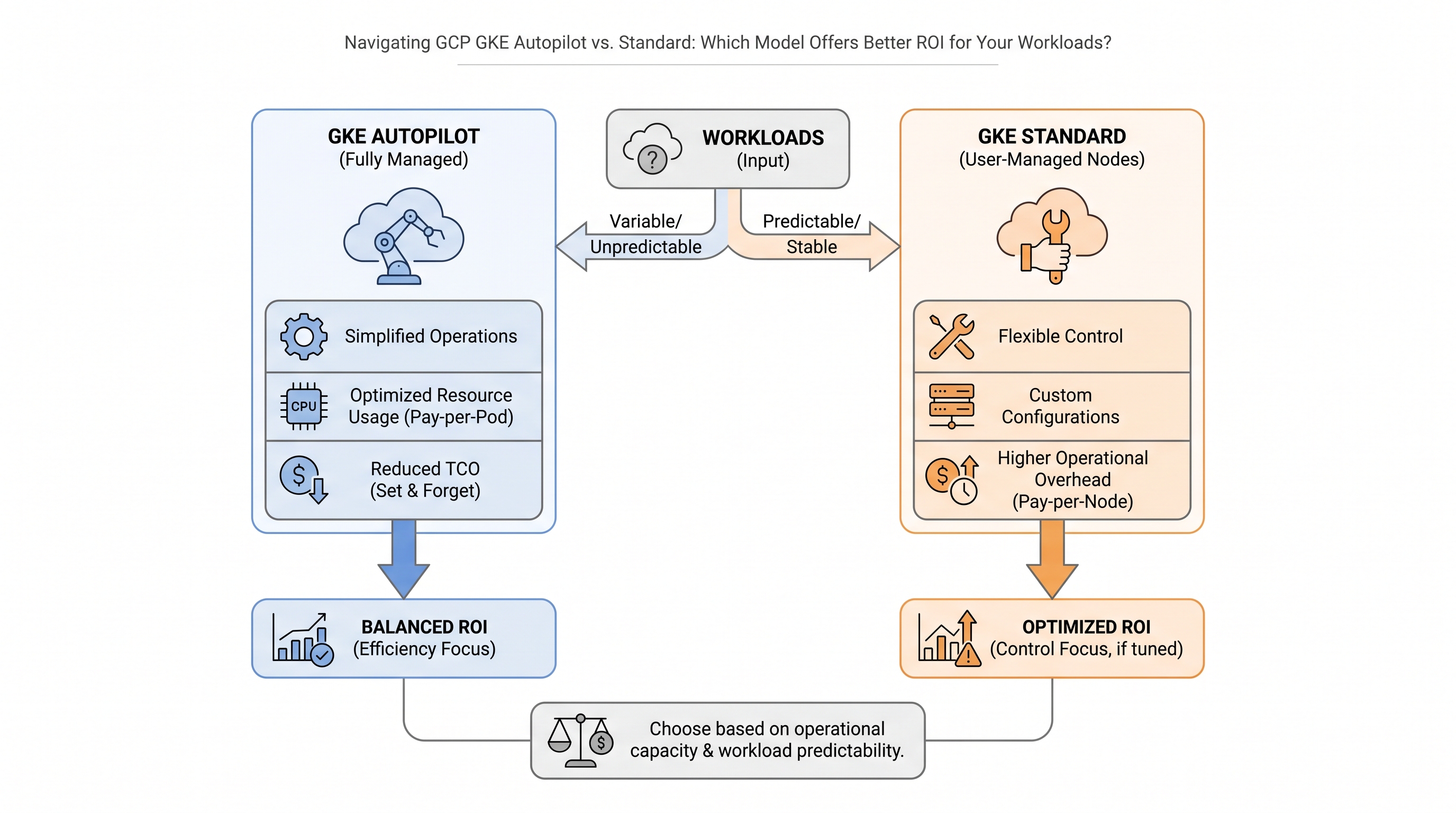
The Modern Kubernetes Dilemma: Control vs. Operational Efficiency
Kubernetes has established itself as the operating system of the modern cloud-native enterprise. However, managing containerized infrastructure at scale introduces a perpetual tension between granular control and operational efficiency. Within Google Cloud Platform (GCP), this tension is materialized in the choice between GKE Standard and GKE Autopilot.
Historically, platform engineering teams default to GKE Standard to maintain absolute control over virtual machine (VM) selection, kernel parameters, node-level configurations, and custom daemonsets. But this control comes with a steep operational tax: continuous node provisioning, OS patching, bin-packing optimization, and scaling configuration tuning. GKE Autopilot, on the other hand, shifts the operational boundary upward, abstracting the node layer entirely and offering a "Pod-as-a-Service" model. Under Autopilot, Google manages node provisioning, scaling, security hardening, and OS maintenance, charging users strictly for the resources requested by their running Pods.
For enterprise FinOps and engineering leaders, deciding between these two models is not merely a technical preference—it is a critical financial and operational decision. To determine which model offers superior Return on Investment (ROI), organizations must look beyond raw compute unit costs and evaluate the total cost of ownership (TCO), including engineering toil, security risk mitigation, and scheduling inefficiencies.
Deep Dive into GKE Standard: Architectural Mechanics and Cost Drivers
GKE Standard represents the classic managed Kubernetes offering. While Google manages the control plane (the master nodes, API server, and etcd database), you retain complete ownership of the data plane. The data plane is composed of Compute Engine VM instances grouped into Node Pools.
1. The Bin-Packing Problem and Resource Underutilization
In GKE Standard, you pay for the underlying Compute Engine VMs regardless of whether your containers are utilizing 100% or 5% of their allocated CPU and memory. This billing model introduces the classic "bin-packing" challenge. To maximize ROI, platform engineers must carefully schedule pods of varying sizes onto VM instances of fixed sizes.
Consider an enterprise workload running on an e2-standard-4 instance (4 vCPUs, 16 GB RAM). If your scheduled pods collectively require only 2.2 vCPUs and 9 GB of RAM, you are still billed for the full 4 vCPUs and 16 GB. The remaining 1.8 vCPUs and 7 GB represent "slack space"—allocated but unused compute resources that directly erode your ROI. Across a cluster of hundreds of nodes, this unutilized capacity can easily amount to 30% to 50% of your total cloud spend.
2. System Overheads and DaemonSet Taxes
Every node in a GKE Standard cluster requires system agents to function. These include the kubelet, container runtime (containerd), kube-proxy, and logging/monitoring agents (such as Fluentbit or the Stackdriver collector). Google reserves a portion of node resources for these daemons, known as non-allocatable resources.
For small VM instances, this system overhead represents a significant percentage of the total node capacity. For example, on a 1-vCPU machine, up to 6% of the CPU is reserved for the system. Furthermore, any custom DaemonSets you deploy for security, observability, or networking (e.g., Prisma Cloud, Datadog, Linkerd) run on every single node, further reducing the allocatable space available for your actual business applications.
3. Scaling Latency and Configuration Complexity
To mitigate underutilization, GKE Standard relies on the Cluster Autoscaler (CA), Horizontal Pod Autoscaler (HPA), and Vertical Pod Autoscaler (VPA). Tuning these autoscalers to work in harmony is an incredibly complex engineering task. If the HPA triggers a scale-up but the existing node pool has no allocatable capacity, the Cluster Autoscaler must provision a new Compute Engine VM. This VM provisioning step introduces a cold-start latency of 60 to 180 seconds, during which your application pods remain in a Pending state, potentially degrading user experience and violating SLAs.
Deep Dive into GKE Autopilot: The Pod-as-a-Service Paradigm
GKE Autopilot fundamentally alters the operational and financial model of Kubernetes. Instead of managing and paying for VMs, you define your resource requirements at the Pod level. Google dynamically provisions, configures, and scales the underlying infrastructure to match your Pod definitions.
GKE Standard vs. GKE Autopilot Operational Responsibility
Operational Layer | GKE Standard | GKE Autopilot |
|---|---|---|
Control Plane Management | Managed by Google | Managed by Google |
Node Provisioning & Sizing | Customer Managed | Managed by Google |
OS Security Patching | Customer Managed | Managed by Google |
Pod Bin-Packing & Scheduling | Customer Managed | Managed by Google |
Billing Model | Pay per VM Instance | Pay per Pod Request |
1. Resource Request-Based Billing
In GKE Autopilot, you are billed strictly for the vCPU, memory, and ephemeral storage resources that your pods actively request in their deployment manifests. If a pod requests 0.5 vCPU and 2 GB of RAM, you are billed precisely for those units, regardless of how Google packs that pod onto its underlying hardware. The financial risk of node underutilization, system overhead, and DaemonSet taxes is shifted entirely from your balance sheet to Google.
2. Autopilot Resource Limits and Minimums
To maintain operational stability, Autopilot enforces specific resource minimums and ratios. For instance, the minimum vCPU allocation for a standard pod is 0.25 vCPU, and the memory-to-vCPU ratio must fall within defined bounds (typically between 1 GB and 6.5 GB per vCPU). If your application is highly lightweight and could run on 0.05 vCPU, Autopilot will automatically scale your request up to 0.25 vCPU, and you will be billed for the higher amount. Understanding these boundary conditions is critical for accurate FinOps modeling.
3. Operational Guardrails and Architectural Restrictions
The operational simplicity of Autopilot comes at the cost of architectural restrictions. Because Google manages the nodes, you do not have SSH access to them. You cannot use custom node OS images, and you cannot run privileged containers that require direct access to the host kernel or host namespaces (such as hostNetwork or hostPID). Furthermore, custom DaemonSets are highly restricted; security and monitoring tools must integrate via Kubernetes API-driven sidecar patterns rather than node-level agents.
The FinOps Math: Standard vs. Autopilot ROI Modeling
To accurately compare the ROI of GKE Standard and GKE Autopilot, we must construct a quantitative model. Let's look at a concrete enterprise scenario: a microservices-based e-commerce platform running on GCP.
Scenario Parameters:
Total Workloads: 150 stateless microservice pods.
Average Pod Resource Requests: 0.5 vCPU and 2 GB RAM per pod.
Total Aggregate Request Capacity: 75 vCPUs and 300 GB RAM.
Workload Pattern: Dynamic, with a daytime peak and nighttime trough (averaging 60% of peak capacity over 24 hours).
Model A: GKE Standard (Self-Managed Bin-Packing)
To run these workloads on GKE Standard, the platform team provisions a node pool using n2-standard-8 instances (8 vCPUs, 32 GB RAM). Due to system reservations, DaemonSets (logging, security, service mesh), and scheduling fragmentation, the team achieves an average bin-packing efficiency of 70%. This is considered a highly optimized, mature Kubernetes environment.
To guarantee peak capacity (75 vCPUs), the team must provision enough VMs to cover both the workload requests and the 30% overhead and slack space. This requires approximately 14 n2-standard-8 nodes, providing a total capacity of 112 vCPUs and 448 GB RAM.
At standard pay-as-you-go pricing (using Iowa region rates as a baseline):
An
n2-standard-8VM costs approximately $0.380 per hour.14 VMs * $0.380/hr = $5.32 per hour for raw compute.
GKE Management fee: $0.10 per hour per cluster.
Total GKE Standard Cost: $5.42 per hour.
However, because the workload is dynamic and averages only 60% of peak capacity over 24 hours, the team relies on the Cluster Autoscaler. Realistically, autoscaling introduces lag, and nodes are often kept alive longer to handle burst traffic. Assuming the autoscaler successfully scales down the node count to an average of 10 nodes over the 24-hour cycle:
Average cost: 10 VMs * $0.380/hr + $0.10/hr = $3.90 per hour.
Model B: GKE Autopilot (Pay-per-Pod)
In GKE Autopilot, the GKE management fee of $0.10/hr is waived for one cluster per billing account. You pay strictly for the pod requests. Autopilot pricing features a premium rate per resource unit compared to raw Compute Engine VMs to account for Google's operational management.
Using standard Autopilot vCPU and Memory rates (Iowa region):
vCPU rate: $0.0445 per vCPU-hour.
Memory rate: $0.004922 per GB-hour.
At peak capacity (75 vCPUs, 300 GB RAM):
vCPU Cost: 75 * $0.0445 = $3.3375/hr
Memory Cost: 300 * $0.004922 = $1.4766/hr
Peak Autopilot Cost: $4.814 per hour.
Because Autopilot bills precisely for active pods, when the dynamic workload scales down to its 60% average (45 vCPUs, 180 GB RAM) during off-peak hours, the billing drops immediately without any VM scaling lag or slack-space penalty:
Average vCPU Cost: 45 * $0.0445 = $2.0025/hr
Average Memory Cost: 180 * $0.004922 = $0.8859/hr
Average Autopilot Cost: $2.888 per hour.
The Financial Comparison and Hidden Operational Costs
In this scenario, GKE Autopilot's average run rate ($2.888/hr) is roughly 26% cheaper than GKE Standard ($3.90/hr). This cost-efficiency is driven by two factors: the elimination of the bin-packing slack space and the immediate, zero-lag scaling of Pod-based billing.
However, the direct cloud bill is only part of the equation. To calculate true ROI, organizations must factor in the engineering hours spent maintaining GKE Standard. Platform engineering salaries, time spent troubleshooting node-level failures, upgrading Kubernetes versions, and configuring autoscaling policies represent significant operational overhead. Implementing comprehensive FinOps strategies for CIOs requires looking at this holistic total cost of ownership (TCO).
Security Architecture & Compliance Posture: Standard vs. Autopilot
Cloud security is a critical driver of enterprise cloud ROI. A single misconfiguration or unpatched vulnerability can result in data breaches, compliance penalties, and catastrophic financial loss.
1. The GKE Autopilot Hardened Baseline
GKE Autopilot enforces Google's best-practice security posture by default. This significantly reduces the attack surface of your Kubernetes clusters without requiring manual intervention from your security team. Key security controls enforced by Autopilot include:
Shielded GKE Nodes: Utilizes hardened node images with boot integrity verification to prevent kernel-level rootkits.
Workload Identity: Enforced by default, eliminating the need for static, long-lived GCP service account keys inside containers.
Disabled Privileged Pods: Prevents containers from running with the
privilegedflag, blocking access to the host node's hardware and kernel.Restricted Linux Capabilities: Drops dangerous capabilities (like
CAP_SYS_ADMIN,CAP_NET_ADMIN) by default.
By automating these configurations, Autopilot eliminates human error in cluster hardening. To achieve this same level of security in GKE Standard, security engineers must write, deploy, and maintain complex Gatekeeper or OPA (Open Policy Agent) policies.
2. Node Patching and Vulnerability Remediation
In GKE Standard, you are responsible for upgrading the node OS images to patch CVEs. While Google provides node auto-upgrades, platform teams often disable or delay them to avoid breaking application compatibility, leading to significant security debt. In Autopilot, Google manages the node lifecycle and patching completely, ensuring that host-level vulnerabilities are remediated rapidly and transparently.
For organizations with strict compliance mandates (such as PCI-DSS, HIPAA, or SOC 2), utilizing an automated, hardened platform like Autopilot simplifies the audit process. However, to maintain continuous compliance across diverse cloud environments, enterprises must leverage automated security management platforms to monitor configuration drift and enforce policies globally.
Decision Matrix: Choosing the Right Model for Your Workloads
To help cloud architects navigate this decision, we have mapped out key workload characteristics and their optimal GKE deployment model:
When to Choose GKE Autopilot (High ROI)
Stateless Microservices: Applications with highly variable traffic patterns that benefit from instant, granular scaling.
Lean Engineering Teams: Organizations without dedicated, specialized Kubernetes platform engineering teams.
Standardized Tech Stacks: Applications that do not require low-level kernel modifications, custom hostPath mounts, or privileged system access.
Rapid Prototyping and CI/CD: Development and staging environments where clusters are spun up and torn down frequently.
When to Choose GKE Standard (High ROI)
Predictable, Steady-State Workloads: Large, monolithic applications or databases that run constantly at high utilization, where raw VM committed-use discounts (CUDs) yield lower unit costs than Autopilot's per-pod rates.
Specialized Hardware Topologies: Workloads requiring complex GPU/TPU multi-node scaling, custom machine families, or local SSD arrays for extreme I/O performance.
Custom DaemonSets and Security Agents: Enterprise security architectures that rely on kernel-level monitoring (eBPF) or deep node integration.
Multi-Tenant Platforms: Organizations building their own internal Developer Platforms (IDPs) that require custom Kubernetes custom resource definitions (CRDs) and deep control plane customization.
Maximizing GKE ROI with CloudAtler
Regardless of whether your architecture is built on GKE Standard, GKE Autopilot, or a hybrid of both, achieving maximum ROI requires continuous visibility, governance, and automated optimization across your entire cloud footprint.
CloudAtler provides an intelligent, unified platform that bridges the gap between FinOps, security, and cloud operations. By integrating deeply with your GCP environments, CloudAtler empowers your organization to optimize GKE spend and secure containerized workloads automatically.
1. Continuous Performance and Right-Sizing Optimization
For GKE Standard deployments, CloudAtler's infrastructure performance management engine continuously analyzes your real-world container utilization. It automatically calculates optimal CPU and memory limits, identifying over-provisioned pods and recommending exact node pool configurations to eliminate bin-packing waste. For Autopilot deployments, CloudAtler ensures your pod requests align perfectly with GKE's resource minimums, preventing accidental over-payment due to misconfigured manifests.
2. Unifying Cost and Security Governance
Managing cloud spend and security in silos inevitably leads to inefficiencies. With CloudAtler's financial command center, your finance and engineering teams get a single, source-of-truth view of GKE expenditures, complete with predictive forecasting and anomaly detection. This financial intelligence is paired with real-time security posture monitoring, allowing you to see the direct cost impact of security configurations and patching schedules.
Through our unified dashboard, platform engineers, CISOs, and CFOs can collaborate seamlessly. You can track GKE cluster efficiency, monitor compliance drift, and automate remediation workflows from a single pane of glass, eliminating operational silos and accelerating your time-to-value.
Conclusion: Aligning Architecture with Business Value
Choosing between GKE Standard and GKE Autopilot is not a one-size-fits-all decision. GKE Standard remains the premier choice for highly customized, specialized, and predictable enterprise workloads that require deep control over the underlying infrastructure. However, for the vast majority of modern, stateless, and dynamic microservices, GKE Autopilot offers a compelling ROI by eliminating operational toil, reducing security risk through hardened defaults, and charging strictly for requested compute resources.
The key to unlocking true cloud value lies in maintaining comprehensive visibility and automation across your entire ecosystem. By aligning your Kubernetes architecture with automated FinOps and security guardrails, you can ensure that every dollar spent on GCP directly drives business growth.
All in One Place
Atler Pilot decodes your cloud spend story by bringing monitoring, automation, and intelligent insights together for faster and better cloud operations.