
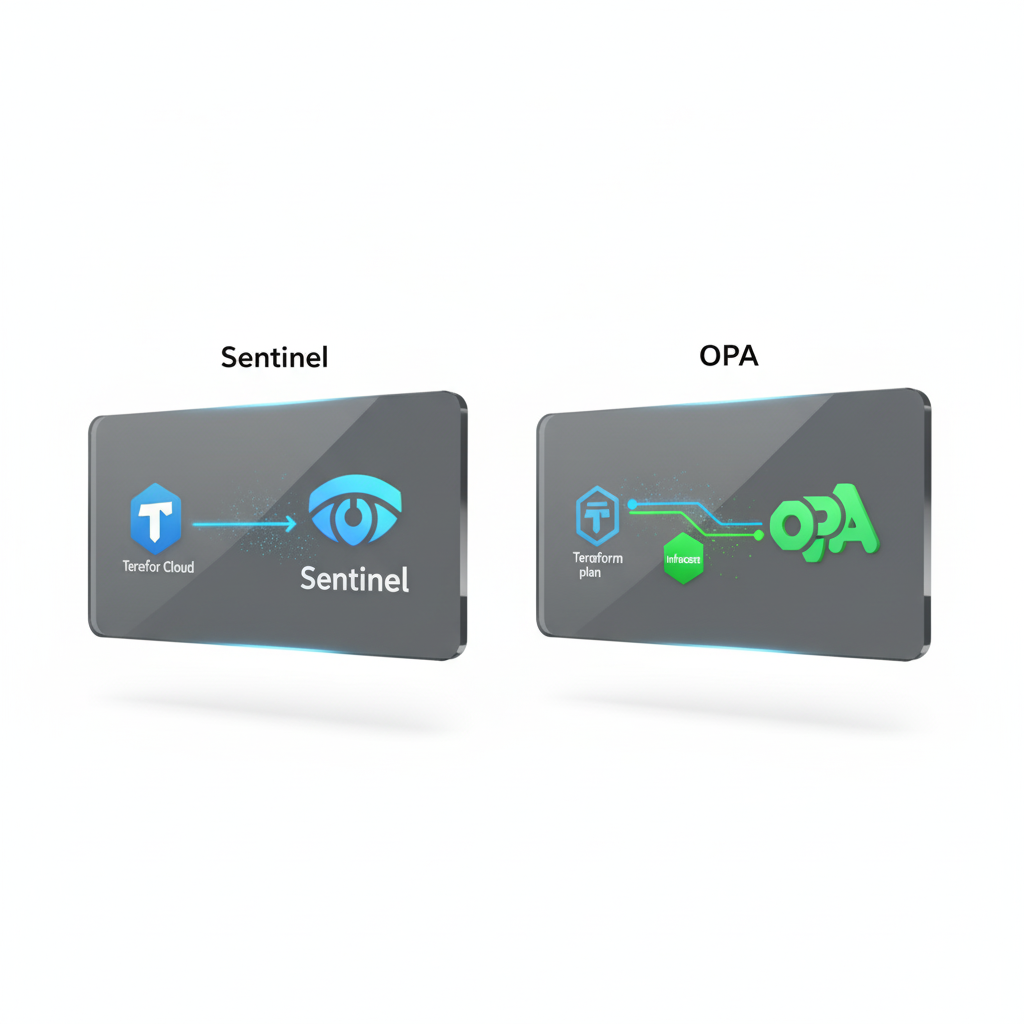
As organizations mature their FinOps practices, they move toward automated financial governance. Policy as Code (PaC) is the mechanism for this, allowing teams to define and enforce cost-related rules directly within their Infrastructure as Code (IaC) workflows. For Terraform users, the two leading choices for implementing PaC are Open Policy Agent (OPA) and HashiCorp Sentinel. While both can be used to enforce cost policies, they have fundamental differences that make them suited for different needs.
Core Differences: Open Standard vs. Integrated Ecosystem
The primary distinction between OPA and Sentinel lies in their scope and origin.
Open Policy Agent (OPA): OPA is an open-source, general-purpose policy engine governed by the Cloud Native Computing Foundation (CNCF). It was designed to be a universal standard for policy enforcement across the entire cloud-native stack. OPA is tool-agnostic; it makes decisions by evaluating arbitrary JSON data against policies written in a declarative language called Rego. Its broad adoption means you can use the same language and framework to govern Terraform, Kubernetes, API gateways, and more.
HashiCorp Sentinel: Sentinel is a proprietary policy as code framework developed by HashiCorp. It is purpose-built for deep integration with HashiCorp's Enterprise products, most notably Terraform Cloud/Enterprise, Vault, Consul, and Nomad. Policies are written in the Sentinel language and have privileged access to the internal data models of these products, enabling highly specific and granular rules.
Comparison by Key Dimensions for FinOps
1. Language and Learning Curve
OPA (Rego): Rego is a powerful, declarative query language inspired by Datalog. It can feel foreign to developers accustomed to imperative languages. However, its power lies in its ability to query complex, nested JSON documents, which is ideal for parsing Terraform plan outputs.
Sentinel: The Sentinel language has a syntax that is generally considered more approachable for those new to policy as code. It is designed to feel familiar to users of other HashiCorp tools.
2. Integration and Data Access for Cost Policies
A policy engine needs cost data to make financial decisions.
OPA: OPA is decoupled. To enforce a cost policy, you must first run a cost estimation tool (like Infracost) to generate a JSON report. This cost report is then passed to OPA as input, alongside the Terraform plan JSON.
Code snippet
# Deny if the monthly cost delta exceeds $500
deny[msg] {
    input.tfrun.cost_estimate.delta_monthly_cost > 500
    msg := "Monthly cost increase exceeds budget of $500"
}
Sentinel: Within Terraform Cloud, Sentinel has native access to the cost estimation data generated by the platform. The
tfrunimport provides a direct path to this information, simplifying the policy-writing process. There is no need to manually integrate a third-party tool's output.Code snippet
import "tfrun"
# Main rule to deny if cost increase is too high
main = rule {
    tfrun.cost_estimate.delta_monthly_cost <= 500
}
3. Ecosystem and Portability
OPA: If your organization is building a unified governance strategy across multiple platforms (Kubernetes, microservices, CI/CD), OPA is the clear winner. The ability to write, share, and reuse policies in Rego across different domains provides immense value. Its open-source nature also prevents vendor lock-in.
Sentinel: If your organization is heavily invested in the HashiCorp ecosystem, Sentinel offers the most seamless and powerful integration. The policies are tightly coupled with the products they govern, providing a cohesive experience within that ecosystem.
4. Commercial vs. Open Source
OPA: As a CNCF project, OPA is truly open-source and community-driven. You can run it anywhere without commercial restrictions.
Sentinel: While the Sentinel CLI is available for local testing, its primary value and enforcement capabilities are unlocked within HashiCorp's commercial products like Terraform Cloud (Plus and Enterprise tiers).
Making the Right Choice for Your Team
Choose OPA if:
You need a single, unified policy framework that extends beyond Terraform to Kubernetes, APIs, and other systems.
You prioritize open-source standards and want to avoid vendor lock-in.
Your team has or is willing to invest in learning Rego for its powerful data-querying capabilities.
You are using an IaC management platform like Scalr or Spacelift that has native OPA support.
Choose Sentinel if:
Your organization is standardized on the HashiCorp stack, particularly Terraform Cloud/Enterprise.
You want the tightest possible integration with Terraform, with direct access to all run data without extra configuration.
Your primary goal is to govern Terraform workflows, and you have less need for a cross-platform policy engine.
Your team prefers a language that may be quicker to adopt for simple Terraform-specific policies.
Conclusion
The choice between OPA and Sentinel for FinOps is a strategic one. Sentinel offers a streamlined, deeply integrated experience for teams committed to the HashiCorp ecosystem. OPA provides a powerful, flexible, and open-standard solution for organizations seeking a unified governance strategy that spans their entire cloud-native landscape. For FinOps, both can effectively enforce cost controls; the decision ultimately hinges on whether you value the tight integration of a single vendor's ecosystem or the portability and universality of an open standard.
All in One Place
Atler Pilot decodes your cloud spend story by bringing monitoring, automation, and intelligent insights together for faster and better cloud operations.