
The High Cost of Compute in the Era of Generative AI
The rapid adoption of Generative AI, Large Language Models (LLMs), and deep learning architectures has triggered an unprecedented demand for high-performance computing hardware. Modern foundation models require massive parallel processing capabilities, making specialized accelerators like NVIDIA’s H100, A100, L40S, and Google’s Tensor Processing Units (TPUs) the cornerstone of modern enterprise cloud environments. However, this architectural shift has introduced a stark economic reality: GPU resources are exceptionally expensive, highly scarce, and incredibly complex to orchestrate efficiently.
Traditional cloud financial management (FinOps) frameworks were built for general-purpose CPU compute instances. These frameworks rely heavily on basic metrics such as average CPU utilization, memory allocation, and disk I/O to determine right-sizing opportunities. When applied to GPU-accelerated workloads, these traditional metrics fail completely. A virtual machine hosting a GPU may report low CPU utilization while the attached physical GPU is running at 100% capacity; conversely, a GPU instance might show 100% "utilization" in basic cloud monitoring tools while its actual Tensor Cores sit completely idle due to input/output (I/O) bottlenecks or memory transfer latencies.
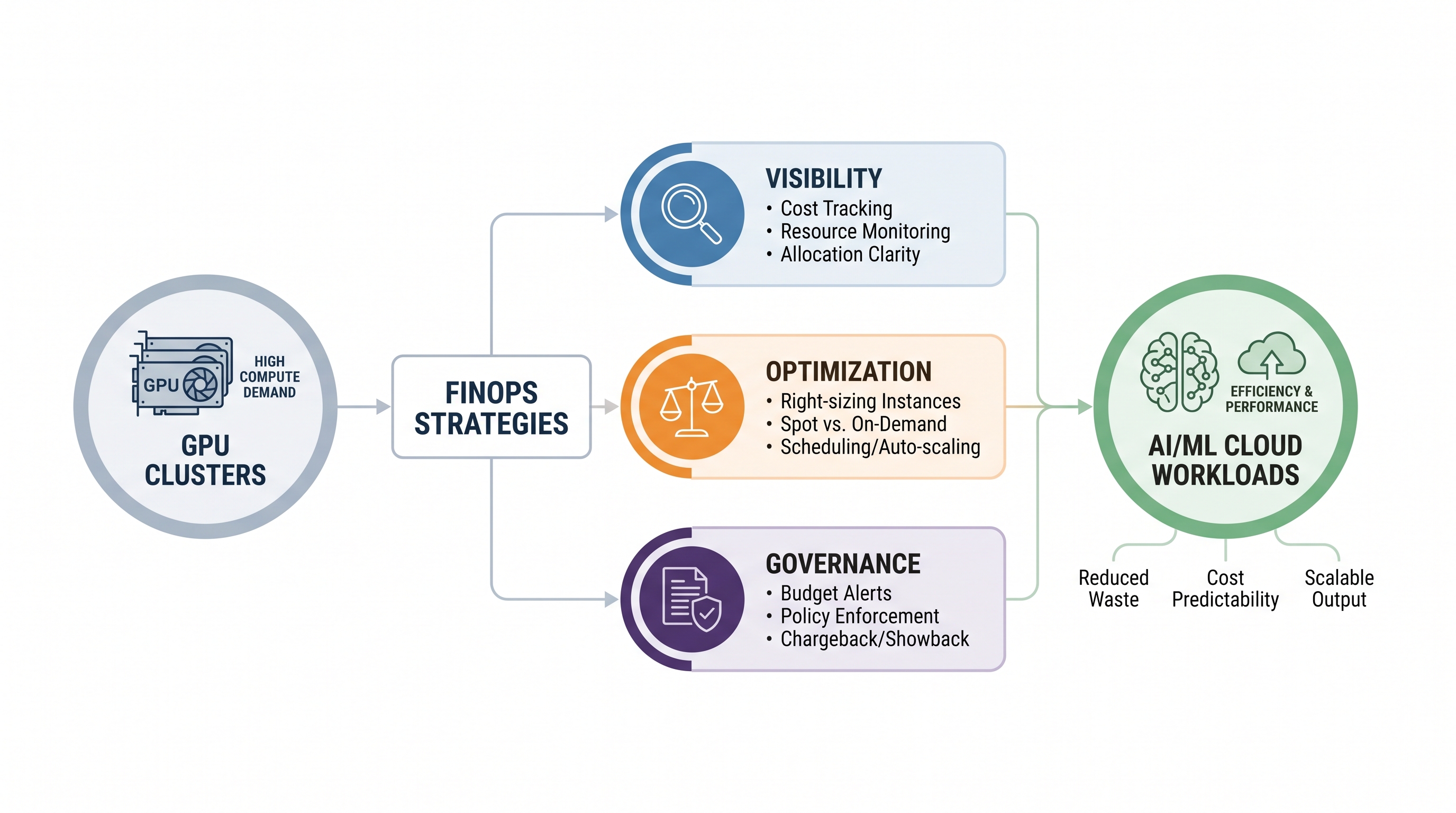
To prevent AI initiatives from becoming bottomless cost sinks, cloud architects and finance teams must adopt specialized FinOps strategies tailored to the unique hardware characteristics of GPU clusters. Achieving this requires a deep understanding of GPU architectures, distributed training bottlenecks, and modern scheduling paradigms. By leveraging a unified financial operations platform, enterprises can bridge the gap between machine learning engineering and financial accountability, ensuring that every dollar spent on accelerated compute delivers measurable business value.
Architectural Underpinnings of GPU Inefficiencies
To effectively optimize GPU clusters, we must first diagnose why these systems are so frequently underutilized. GPU inefficiency is rarely a result of poor model design alone; rather, it stems from systemic bottlenecks across the compute, memory, and networking layers of the cloud infrastructure.
1. VRAM vs. Tensor Core Utilization
A common pitfall in GPU monitoring is confusing Video RAM (VRAM) allocation with active compute execution. When a machine learning model is loaded into GPU memory, it reserves a fixed block of VRAM to store model weights, biases, and activation states. This reservation is reflected in basic monitoring tools as high memory utilization (often close to 100%). However, reserving memory does not mean the GPU's streaming multiprocessors (SMs) or specialized Tensor Cores are actively performing mathematical calculations.
If the training or inference pipeline is bottlenecked by data preprocessing, disk reads, or network transfers, the GPU will sit idle, waiting for data to arrive. During these idle periods, the enterprise is paying the full, premium hourly rate for the GPU instance despite receiving zero active compute cycles. To identify this waste, engineers must monitor SM Active, Tensor Active, and NVLink Bandwidth metrics rather than relying solely on raw memory allocation metrics.
2. Data Loading and Host-to-Device Bottlenecks
The path that data travels from persistent storage to the GPU is a frequent source of performance degradation. The data pipeline typically involves reading raw datasets from object storage (such as Amazon S3, Azure Blob, or Google Cloud Storage), loading them into host system memory (DRAM), performing preprocessing steps (such as image resizing, tokenization, or normalization) via the host CPU, and finally transferring the processed tensors to GPU memory (VRAM) across the PCI Express (PCIe) bus.
If the host CPU cannot preprocess data fast enough, or if the PCIe bus bandwidth is saturated, the GPU will experience "starvation." For example, a PCIe Gen4 x16 slot has a theoretical maximum unidirectional bandwidth of 31.5 GB/s. While this seems fast, it can quickly become a bottleneck when training large models with high-resolution image or video datasets. To mitigate this, modern architectures utilize technologies like GPUDirect Storage (GDS), which enables a direct DMA (Direct Memory Access) path between local NVMe drives and GPU memory, bypassing the host CPU and DRAM entirely, thereby reducing latency and freeing up CPU cycles.
3. Distributed Training Interconnect Bottlenecks
When training models that exceed the memory capacity of a single GPU, workloads must be distributed across multiple GPUs within a single node or across multiple nodes in a cluster. This distributed orchestration relies on specialized communication collectives such as AllReduce, AllGather, and ReduceScatter, implemented via libraries like the NVIDIA Collective Communications Library (NCCL).
In multi-node environments, the network interconnect becomes the primary determinant of scaling efficiency. Standard 10 Gbps or even 25 Gbps Ethernet connections are wholly inadequate for distributed deep learning. Without high-bandwidth, low-latency interconnects like NVIDIA NVLink/NVSwitch (for intra-node communication) and InfiniBand or RoCE (RDMA over Converged Ethernet, for inter-node communication), GPUs spend a significant percentage of their time blocked, waiting for gradient synchronization across the network. This network blocking is one of the most expensive forms of infrastructure waste in modern cloud computing.
Technical Deep Dive: Quantifying GPU Waste with DCGM
To accurately measure GPU efficiency, cloud architects should bypass standard hypervisor-level metrics and implement NVIDIA's Data Center GPU Manager (DCGM). DCGM provides low-level hardware telemetry directly from the GPU driver. Key metrics to analyze include:
DCGM_FI_DEV_GPU_UTIL: Represents the percentage of time one or more kernels were executing on the GPU. Note that a kernel executing at 1% capacity still registers as "active."DCGM_FI_DEV_DEC_UTILandDCGM_FI_DEV_ENC_UTIL: Video decoder and encoder utilization, critical for computer vision pipelines.DCGM_FI_DEV_MEM_COPY_UTIL: The percentage of time spent transferring data over the memory bus. High values combined with low GPU utilization indicate memory bandwidth bottlenecks.DCGM_FI_PROF_GR_ENGINE_ACTIVE: The actual fraction of time the graphics/compute engine is active. This is the gold standard for measuring true compute utilization.
By implementing continuous compute lifecycle analysis, automated systems can correlate these DCGM metrics with billing data to pinpoint exact instances of financial waste where high-cost GPU nodes are running with minimal compute engine activity.
Practical FinOps Optimization Tactics for ML Workloads
Once the root causes of GPU inefficiencies are understood, cloud engineering teams can deploy targeted FinOps optimization tactics. These tactics span scheduling strategies, hardware partitioning, and dynamic scaling mechanisms.
1. Multi-Instance GPU (MIG) and Fractional GPUs
Not every machine learning workload requires the full compute power of an entire A100 or H100 GPU. Lightweight inference tasks, model development, exploratory data analysis, and small-scale testing often utilize only a fraction of the hardware's capabilities. Running these workloads on dedicated, high-end GPUs results in massive financial waste.
NVIDIA’s Multi-Instance GPU (MIG) technology addresses this by allowing physical GPUs (such as the A100 and H100) to be partitioned into multiple isolated, hardware-level instances. Each MIG instance has its own dedicated SMs, memory controllers, and VRAM path. For example, a single 80GB A100 can be partitioned into up to seven independent 10GB GPU instances.
From a FinOps perspective, MIG is a game-changer. It allows multi-tenant Kubernetes clusters to bin-pack multiple lightweight workloads onto a single physical GPU with guaranteed hardware-level isolation, preventing "noisy neighbor" issues while drastically reducing the overall instance count. This level of optimization requires a sophisticated orchestration layer that can dynamically allocate and de-allocate these fractional GPU resources based on real-time demand.
2. Dynamic Scheduling and Intelligent Autoscaling
Unlike standard web applications that exhibit predictable, gradual traffic patterns, machine learning workloads are highly bursty. Batch training jobs require hundreds of GPUs for a few hours, while real-time inference clusters must scale rapidly to handle sudden spikes in user requests. Static provisioning of GPU clusters is a recipe for financial disaster.
To optimize costs, organizations must implement dynamic scheduling and autoscaling utilizing modern Kubernetes controllers such as Karpenter or the native Kubernetes Cluster Autoscaler, tightly coupled with custom metrics. Instead of scaling based on CPU or memory thresholds, the autoscaler must monitor custom GPU metrics (such as pending pod queues, GPU memory pressure, and request latency).
Furthermore, implementing queue-based scheduling engines like Volcano or Kueue allows enterprises to run non-interactive batch training jobs as queued workloads. These engines prioritize high-priority production inference while queuing lower-priority training jobs to run only when compute resources become available, maximizing overall cluster utilization and flattening cost spikes.
3. Spot Instance Orchestration and Graceful Checkpointing
One of the most effective ways to reduce GPU cloud spend is by leveraging Spot Instances (AWS Spot, Azure Spot, or GCP Preemptible VMs). Spot instances offer discounts of up to 60% to 90% compared to on-demand pricing. However, the trade-off is the risk of preemption: the cloud provider can reclaim the hardware at any time with as little as a 30-second to 2-minute warning.
To successfully run GPU workloads on spot instances, applications must be architected for fault tolerance. This is achieved through robust checkpointing mechanisms. For deep learning models, frameworks like PyTorch Elastic (TorchElastic) allow training jobs to dynamically scale up or down as nodes are added or removed from the cluster without failing the entire training run.
A typical resilient Spot GPU architecture involves:
Saving model weights and optimizer states to high-throughput, low-latency shared storage (such as Amazon FSx for Lustre or Google Cloud Filestore) at regular intervals (e.g., every epoch or every N steps).
Listening to cloud provider preemption metadata endpoints (e.g., AWS EC2 Instance Metadata Service) via daemonsets that capture termination warnings and trigger an immediate, graceful save of the current state.
Utilizing mixed-instance-type node pools to allow the autoscaler to provision alternative GPU architectures if the primary requested spot type is unavailable due to capacity constraints.
Advanced Memory and Model Optimization Techniques
FinOps optimization is not solely an infrastructure-level challenge; it is deeply intertwined with how models are configured, compiled, and executed. Machine learning engineers and cloud architects must collaborate to implement software-level optimizations that directly translate to infrastructure cost savings.
1. Mixed Precision and Quantization
Traditionally, deep learning models have been trained using single-precision floating-point format (FP32), where each numerical value occupies 32 bits of memory. However, modern GPU architectures feature specialized Tensor Cores designed specifically for lower-precision arithmetic, such as half-precision (FP16), Brain Floating Point (BF16), and integer formats (INT8, INT4).
By transitioning workloads to Mixed Precision training (using FP16 or BF16 for matrix multiplications while keeping critical master weights in FP32), organizations can achieve up to a 2x to 4x speedup in training time while cutting VRAM footprint in half. This directly reduces the duration of training runs, leading to immediate billing reductions.
For inference, quantization techniques (such as Post-Training Quantization or Quantization-Aware Training) compress model weights to INT8 or even FP4 formats. This compression allows massive LLMs to fit onto smaller, cheaper GPU instances (e.g., running an optimized model on an NVIDIA L4 instead of a far more expensive A100) without significant degradation in model accuracy.
2. Distributed Memory Optimization: DeepSpeed and ZeRO
When training extremely large models, memory consumption is dominated not just by model parameters, but also by optimizer states (e.g., Adam optimizer states can require up to 4x the memory of the model parameters themselves), gradients, and activations.
To overcome these memory limits without continuously buying larger GPU nodes, engineers should implement the Zero Redundancy Optimizer (ZeRO) memory optimization technology, developed as part of the DeepSpeed library. ZeRO eliminates memory redundancy across data-parallel processes by partitioning optimizer states, gradients, and model parameters across the data-parallel processes instead of replicating them.
Optimization Level | What is Partitioned | Memory Reduction | Communication Overhead |
|---|---|---|---|
ZeRO-Stage 1 | Optimizer States | Up to 4x reduction | None (same as standard data parallelism) |
ZeRO-Stage 2 | Optimizer States + Gradients | Up to 8x reduction | None |
ZeRO-Stage 3 | Optimizer States + Gradients + Parameters | Proportional to GPU count (linear scaling) | ~1.5x increase in volume |
By leveraging ZeRO-Offload, developers can even offload partitioned states to host CPU memory or NVMe storage, enabling the training of multi-billion parameter models on a single GPU node. This drastically lowers the entry barrier and infrastructure cost for custom model fine-tuning.
Security, Compliance, and Governance in GPU Clusters
As organizations rush to optimize the cost of their GPU clusters, security must not be treated as an afterthought. High-performance AI clusters present unique security challenges, from the protection of proprietary training datasets and intellectual property (the model weights) to preventing unauthorized access to raw compute power.
1. Secure Multi-Tenancy and Resource Isolation
In shared GPU cluster environments, robust multi-tenancy is critical. Because GPUs lack native, fine-grained virtualization controls out-of-the-box compared to modern CPUs, a rogue or compromised container running on a shared node could potentially access the memory space of another container running on the same GPU.
To enforce strict isolation, cloud security architects must implement:
Kubernetes Network Policies: Restricting communication between different namespaces (e.g., isolating development pipelines from production inference environments).
NVIDIA MIG Isolation: When sharing physical GPUs, utilizing MIG ensures physical hardware-level partition isolation, preventing side-channel attacks and memory leakage between tenants.
Runtime Sandboxing: Utilizing secure container runtimes like gVisor or Kata Containers to run untrusted model code, isolating the container from the host Linux kernel.
2. Data Encryption and Secure Pipelines
Training data often contains highly sensitive information, including personally identifiable information (PII), protected health information (PHI), or proprietary intellectual property. Security teams must ensure that data is encrypted both at rest and in transit throughout the entire training lifecycle.
When streaming data from object storage to GPU clusters, TLS 1.3 encryption must be enforced for all data in transit. Furthermore, using confidential computing instances (such as Azure's confidential VMs with AMD SEV-SNP or AWS Nitro Enclaves) ensures that data remains encrypted even while in use within system memory, protecting the workloads from privileged host administrators or potential hypervisor-level compromises.
Integrating these compliance controls with real-time budget control alerts ensures that security-hardened, high-cost environments do not run indefinitely without strict governance and cost attribution.
Unifying GPU FinOps and Operations with CloudAtler
Optimizing GPU clusters requires a continuous, multi-disciplinary approach that combines infrastructure orchestration, deep learning optimization, financial oversight, and robust security. For many enterprises, managing this manually across multiple cloud providers (AWS, Azure, GCP, and Oracle) leads to fragmented visibility, operational friction, and persistent cost overruns.
This is where CloudAtler provides unparalleled value. As an AI-powered platform, CloudAtler unifies FinOps, cloud security, and automated operations into a single, cohesive command center. By leveraging the Atler AI engine, organizations can automate the complex orchestration of GPU clusters, ensuring maximum performance at the lowest possible cost.
CloudAtler addresses the core challenges of GPU optimization through several advanced features:
Continuous Compute Lifecycle Analysis: CloudAtler continuously monitors low-level GPU hardware telemetry (including SM active time, VRAM allocation, and interconnect bandwidth) to identify idle resources and automatically recommend right-sizing or decommissioning of underutilized clusters.
Unified Financial and Operational Visibility: With CloudAtler's unified platform, finance and engineering teams get a single pane of glass to track cost-per-training-run, attribute GPU spend to specific business units, and forecast future capacity requirements.
Automated Policy Guardrails: Implement automated policies that enforce the use of Spot instances for fault-tolerant workloads, automatically spin down development environments during off-hours, and prevent the deployment of non-MIG configured instances for small-scale tasks.
By implementing CloudAtler's CIO and FinOps leadership solutions, enterprise leaders can confidently scale their AI initiatives, knowing that their cloud infrastructure is secure, optimized, and aligned with financial objectives.
Conclusion & Call to Action
Optimizing GPU clusters is no longer just a technical challenge; it is a business imperative. As the race to deploy AI models intensifies, the organizations that succeed will be those that can scale their compute capabilities efficiently without letting infrastructure costs erode their margins. By understanding the underlying hardware bottlenecks, implementing fractional GPU partition architectures, leveraging spot instances with robust checkpointing, and applying software-level memory optimizations, enterprises can drastically reduce their accelerated compute spend.
However, managing these optimizations across complex, multi-cloud environments requires more than spreadsheets and native cloud tools. It demands a unified, intelligent platform designed for the modern cloud era.
Are you ready to take control of your GPU cluster costs and secure your AI workloads? Unify your cloud operations, eliminate waste, and secure your infrastructure across AWS, Azure, GCP, and Oracle with CloudAtler. Visit CloudAtler today to schedule a demo and discover how our AI-powered platform can transform your cloud operations.
All in One Place
Atler Pilot decodes your cloud spend story by bringing monitoring, automation, and intelligent insights together for faster and better cloud operations.