
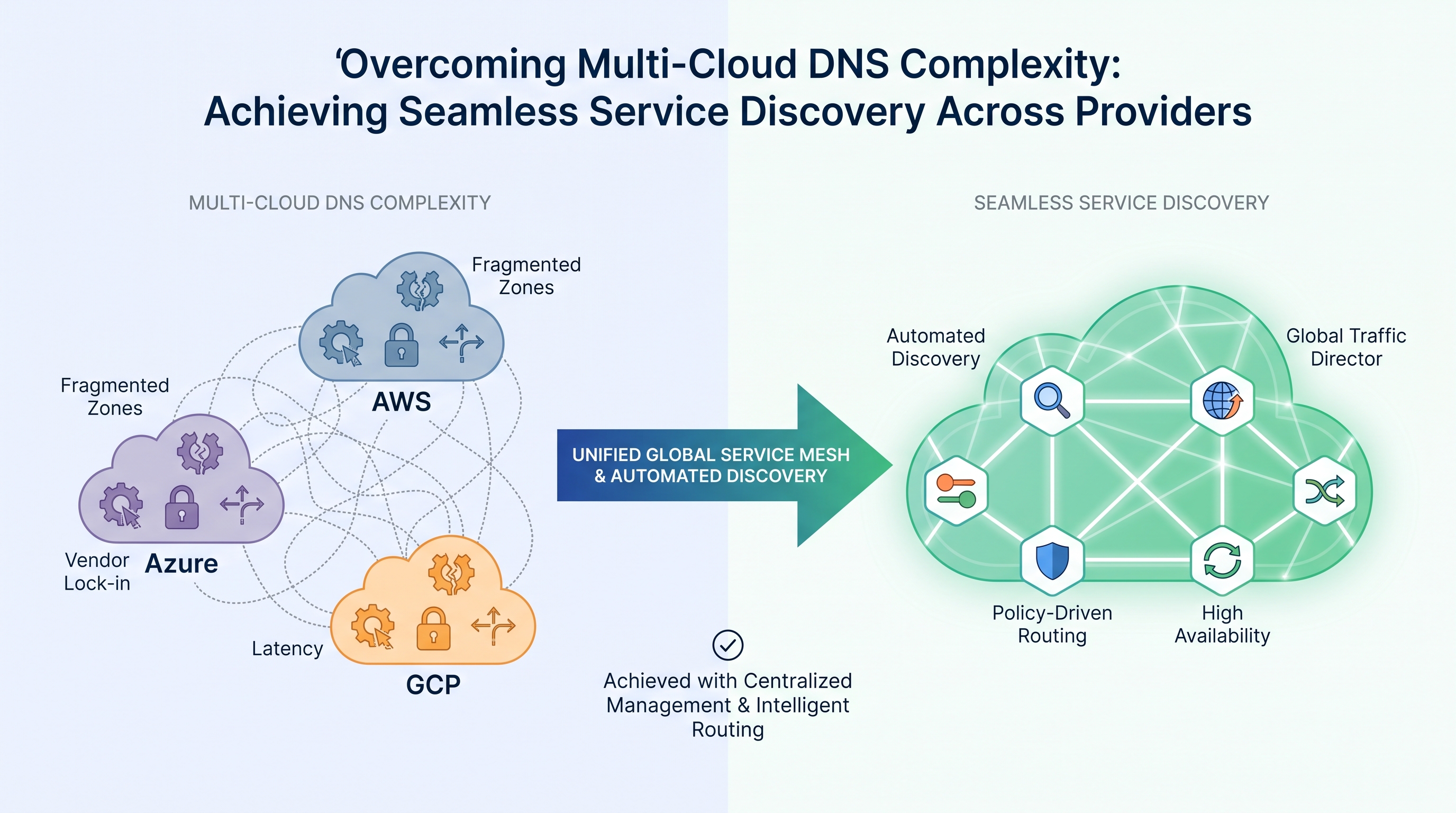
The Paradigm of Multi-Cloud Network Isolation
As enterprises scale their digital footprints across multiple public cloud providers, the necessity for robust, secure, and low-latency communication between heterogeneous environments becomes paramount. Organizations frequently distribute workloads across Amazon Web Services (AWS), Microsoft Azure, Google Cloud Platform (GCP), and Oracle Cloud Infrastructure (OCI) to leverage best-of-breed services, satisfy regulatory compliance, and mitigate vendor lock-in. However, this decentralized infrastructure introduces a fundamental networking challenge: DNS and Service Discovery isolation.
By default, public cloud providers isolate virtual private networks—such as AWS Virtual Private Clouds (VPCs), Azure Virtual Networks (VNets), and GCP Virtual Private Clouds (VPCs)—using proprietary, non-transitive DNS resolution systems. For instance, the AWS Route 53 Resolver (often referred to as the "Dot-Two" router at 169.254.169.253) is natively inaccessible from resources residing within an Azure VNet or an on-premises datacenter. Similarly, Azure's default wire server IP (168.63.129.16) cannot resolve queries originating outside its host VNet without explicit gateway configuration.
Without a unified name resolution strategy, workloads cannot locate each other using human-readable Domain Name System (DNS) names. Engineers are left with brittle workarounds, such as hardcoding IP addresses, managing manual /etc/hosts files, or exposing internal services to the public internet via public DNS zones and Transport Layer Security (TLS) endpoints. These workarounds violate core tenets of enterprise security, dramatically increase operational overhead, and introduce substantial risk of misconfiguration.
Why Native Cloud Resolvers Fail Across Boundaries
To understand why cross-provider DNS is complex, one must look at how cloud providers handle internal DNS queries. Native resolvers use link-local addresses that are unique to the hypervisor hosting the virtual machine (VM) or container. These addresses do not route across Virtual Private Gateways, Transit Gateways, VPN tunnels, or dedicated interconnects like AWS Direct Connect and Azure ExpressRoute.
Consider a scenario where an application running in an AWS VPC (using the private domain service.aws.internal) needs to query a database cluster running in an Azure VNet (using db.azure.internal). Even if a secure IPSec VPN tunnel or a dedicated private interconnect exists between AWS and Azure, the following breakdown occurs:
The AWS EC2 instance queries its local resolver (
169.254.169.253) fordb.azure.internal.The AWS Route 53 Resolver has no intrinsic knowledge of Azure Private DNS Zones.
Because the query is for a non-public domain, the AWS resolver fails to locate an authoritative nameserver on the public internet and returns an immediate
NXDOMAIN(Non-Existent Domain) error.The connection fails, despite the underlying IP routing layer being fully functional.
To bridge this gap, organizations must implement a hybrid DNS resolution architecture that facilitates secure, bidirectional query forwarding across cloud boundaries. This requires a deep understanding of conditional forwarding, inbound/outbound DNS endpoints, and centralized hub-and-spoke network topologies.
Architectural Blueprint: The Centralized DNS Hub
The most scalable and resilient pattern for resolving multi-cloud DNS complexity is the Centralized DNS Hub-and-Spoke Architecture. Instead of establishing peer-to-peer DNS forwarding relationships between every single VPC and VNet (which creates an O(N^2) management nightmare), all DNS traffic is routed through a dedicated "Transit" or "Hub" network in each cloud provider.
These regional hubs are interconnected via high-throughput, private connections (e.g., AWS Transit Gateway connected to Azure ExpressRoute or GCP Cloud Interconnect via a cloud exchange provider like Megaport or Equinix Fabric). Within each hub, cloud-native DNS resolvers or highly available virtual appliances act as intermediaries, forwarding queries to the appropriate authoritative systems.
The Architectural Components
To implement this blueprint, we utilize the following native cloud services:
AWS Route 53 Resolver Endpoints: Inbound Endpoints receive DNS queries from external networks (Azure/GCP/On-Premises), while Outbound Endpoints forward queries to external resolvers based on defined Route 53 Resolver Rules.
Azure Private DNS Resolver: A fully managed service that provides inbound and outbound endpoints, removing the historical need to run self-managed IaaS-based DNS forwarders (such as BIND or Unbound) in Azure VNets.
GCP Cloud DNS Peering and Forwarding Zones: Cloud DNS allows the creation of forwarding zones that direct queries for specific private domains to target name servers located across VPNs or Interconnects.
Query Resolution Flow (AWS to Azure)
Let us trace the precise path of a DNS query originating from an AWS spoke VPC seeking to resolve an Azure resource:
[AWS Spoke EC2] -> [AWS Route 53 Resolver] -> [Route 53 Outbound Endpoint] -> [Private Interconnect / VPN] -> [Azure Private DNS Inbound Endpoint] -> [Azure Private DNS Zone]
This path ensures that no DNS traffic traverses the public internet, satisfying stringent compliance requirements and minimizing latency. However, implementing this model requires precise infrastructure-as-code (IaC) declarations and a thorough understanding of routing tables, security groups, and firewall rules.
Technical Implementation: Configuring Multi-Cloud Forwarding
Let's dive into the technical configuration required to establish bidirectional DNS resolution between AWS and Azure. We will use Terraform to define the necessary infrastructure components, ensuring a repeatable and auditable deployment.
Step 1: Configuring AWS Route 53 Resolver Endpoints
First, we provision the inbound and outbound Route 53 Resolver endpoints within our AWS Transit Hub VPC. These endpoints require dedicated subnets across multiple Availability Zones (AZs) for high availability.
# AWS Provider Configuration
provider "aws" {
  region = "us-east-1"
}

# Hub VPC Definition
resource "aws_vpc" "dns_hub_vpc" {
  cidr_block           = "10.100.0.0/16"
  enable_dns_support   = true
  enable_dns_hostnames = true
  tags = {
    Name = "aws-dns-hub-vpc"
  }
}

# Private Subnets for Resolver Endpoints
resource "aws_subnet" "resolver_subnet_a" {
  vpc_id            = aws_vpc.dns_hub_vpc.id
  cidr_block        = "10.100.1.0/24"
  availability_zone = "us-east-1a"
}

resource "aws_subnet" "resolver_subnet_b" {
  vpc_id            = aws_vpc.dns_hub_vpc.id
  cidr_block        = "10.100.2.0/24"
  availability_zone = "us-east-1b"
}

# Security Group to restrict DNS traffic
resource "aws_security_group" "resolver_sg" {
  name        = "dns-resolver-sg"
  description = "Allow inbound/outbound DNS traffic over UDP and TCP"
  vpc_id      = aws_vpc.dns_hub_vpc.id

  ingress {
    from_port   = 53
    to_port     = 53
    protocol    = "udp"
    cidr_blocks = ["10.0.0.0/8"] # Restrict to internal multi-cloud CIDR block
  }

  ingress {
    from_port   = 53
    to_port     = 53
    protocol    = "tcp"
    cidr_blocks = ["10.0.0.0/8"]
  }

  egress {
    from_port   = 0
    to_port     = 0
    protocol    = "-1"
    cidr_blocks = ["0.0.0.0/0"]
  }
}

# Outbound Resolver Endpoint
resource "aws_route53_resolver_endpoint" "outbound_endpoint" {
  name      = "aws-to-azure-outbound"
  direction = "OUTBOUND"

  security_group_ids = [
    aws_security_group.resolver_sg.id
  ]

  ip_address {
    subnet_id = aws_subnet.resolver_subnet_a.id
  }

  ip_address {
    subnet_id = aws_subnet.resolver_subnet_b.id
  }
}
Step 2: Configuring Azure Private DNS Resolver
On the Azure side, we deploy the Azure DNS Private Resolver inside our central hub VNet. This managed resource acts as the counterpart to the AWS endpoints, exposing an inbound IP address that AWS can target.
# Azure Provider Configuration
provider "azurerm" {
  features {}
}

# Hub Resource Group
resource "azurerm_resource_group" "dns_hub_rg" {
  name     = "rg-dns-hub-prod"
  location = "East US"
}

# Hub Virtual Network
resource "azurerm_virtual_network" "hub_vnet" {
  name                = "vnet-dns-hub-eastus"
  address_space       = ["10.200.0.0/16"]
  location            = azurerm_resource_group.dns_hub_rg.location
  resource_group_name = azurerm_resource_group.dns_hub_rg.name
}

# Subnet for Inbound Endpoint
resource "azurerm_subnet" "inbound_dns_subnet" {
  name                 = "snet-dns-inbound"
  resource_group_name  = azurerm_resource_group.dns_hub_rg.name
  virtual_network_name = azurerm_virtual_network.hub_vnet.name
  address_prefixes     = ["10.200.1.0/24"]

  delegation {
    name = "Microsoft.Network.dnsResolvers"
    service_delegation {
      name    = "Microsoft.Network/dnsResolvers"
      actions = ["Microsoft.Network/virtualNetworks/subnets/join/action"]
    }
  }
}

# Private DNS Resolver
resource "azurerm_private_dns_resolver" "azure_resolver" {
  name                = "azure-dns-resolver"
  resource_group_name = azurerm_resource_group.dns_hub_rg.name
  location            = azurerm_resource_group.dns_hub_rg.location
  virtual_network_id  = azurerm_virtual_network.hub_vnet.id
}

# Inbound Endpoint
resource "azurerm_private_dns_resolver_inbound_endpoint" "inbound_endpoint" {
  name                    = "azure-dns-inbound-ep"
  private_dns_resolver_id = azurerm_private_dns_resolver.azure_resolver.id
  location                = azurerm_private_dns_resolver.azure_resolver.location

  ip_configurations {
    subnet_id                    = azurerm_subnet.inbound_dns_subnet.id
    private_ip_allocation_method = "Dynamic"
  }
}
Step 3: Creating Conditional Forwarding Rules
Once the infrastructure is in place, we must define the routing rules. In AWS, we create a Route 53 Resolver Rule that instructs the Route 53 Resolver to forward any queries destined for azure.internal to the private IP address of the Azure Inbound Endpoint we just created.
# Resolve Rule for Azure Zone
resource "aws_route53_resolver_rule" "forward_to_azure" {
  domain_name          = "azure.internal"
  name                 = "forward-to-azure-dns"
  rule_type            = "FORWARD"
  resolver_endpoint_id = aws_route53_resolver_endpoint.outbound_endpoint.id

  # Target IP: The IP allocated to the Azure Inbound Endpoint (e.g., 10.200.1.4)
  target_ip {
    ip = "10.200.1.4"
    port = 53
  }

  tags = {
    Environment = "Production"
  }
}

# Associate the rule with Spoke VPCs
resource "aws_route53_resolver_rule_association" "spoke_association" {
  resolver_rule_id = aws_route53_resolver_rule.forward_to_azure.id
  vpc_id           = "vpc-0123456789abcdef0" # Replace with actual Spoke VPC ID
}
By establishing this configuration, any application within the AWS Spoke VPC attempting to resolve database.azure.internal will dynamically forward the request across the private connection, query the authoritative Azure Private DNS zone, and receive the correct internal Azure IP address—completely bypassing public networks.
Security & Compliance in Multi-Cloud DNS
DNS is often a primary vector for cyberattacks, including DNS spoofing, cache poisoning, and data exfiltration via DNS tunneling. In a multi-cloud architecture, the surface area for these attacks expands significantly. Securing cross-cloud DNS requires strict implementation of zero-trust network principles, comprehensive logging, and behavioral analysis.
Implementing robust enterprise security management tools is critical to maintaining visibility over these complex, distributed environments. Without centralized monitoring, identifying anomalous DNS queries across multiple cloud providers becomes virtually impossible.
Securing the DNS Data Plane
To secure the DNS data plane across cloud providers, architects must implement the following controls:
Strict Security Group and NSG Rules: Limit access to DNS inbound and outbound endpoints to explicitly defined internal IP ranges (RFC 1918 blocks). Never allow
0.0.0.0/0ingress on port 53.DNS Query Logging: Enable query logging on AWS Route 53 Resolver, Azure DNS Private Resolver, and GCP Cloud DNS. These logs must be aggregated into a central Security Information and Event Management (SIEM) system or data lake for analysis.
DNS over TLS (DoT) and DNS over HTTPS (DoH): Where supported, encrypt DNS queries in transit across cloud boundaries to prevent eavesdropping and man-in-the-middle attacks on cross-cloud connections.
Anomalous Query Detection: Monitor for sudden spikes in DNS queries to unrecognized domains, which can indicate malware command-and-control (C2) traffic or active data exfiltration attempts.
Preventing DNS Exfiltration
DNS exfiltration is a sophisticated technique where attackers encode sensitive data (such as database credentials or customer records) into subdomains of a domain they control (e.g., exfiltrated-data-here.attacker-controlled-domain.com). When the internal DNS resolver attempts to resolve this subdomain, it forwards the query to the attacker's authoritative nameserver, successfully leaking the data.
To combat this, utilize cloud-native DNS firewalls (such as AWS Route 53 Resolver DNS Firewall or Azure Firewall DNS proxy) to block queries destined for newly registered domains, dynamic DNS providers, or known malicious domains. Combined with a comprehensive security posture, these firewalls form a critical defense layer in multi-cloud operations.
FinOps & Cost Optimization for DNS & Service Discovery
While DNS is often viewed as a low-cost utility, the financial reality of multi-cloud deployments can quickly surprise unprepared engineering teams. When designing cross-cloud DNS forwarding, Cloud Financial Operations (FinOps) principles must be integrated directly into the architectural phase.
Using a unified financial operations platform allows organizations to visualize, forecast, and optimize these hidden infrastructure costs before they escalate into significant budget overruns.
Deconstructing the Hidden Costs of Multi-Cloud DNS
Multi-cloud DNS costs are driven by three primary variables:
Cost Component | AWS (Route 53) | Azure (DNS Private Resolver) | GCP (Cloud DNS) |
|---|---|---|---|
Endpoint Provisioning | ~$91.25/month per ENI (Inbound/Outbound) | ~$109.50/month per Endpoint | Free (Native Forwarding Rules) |
Query Pricing | $0.40 per million queries | $0.40 per million queries | $0.40 per million queries |
Data Transfer (Egress) | $0.02 - $0.09 per GB (Cross-Region/Cloud) | $0.02 - $0.08 per GB (Cross-Cloud) | $0.01 - $0.12 per GB (Egress) |
At scale, an enterprise processing 5 billion DNS queries per month across 50 VPCs and VNets can easily incur thousands of dollars in baseline endpoint costs and query fees. More importantly, poorly optimized DNS routing can lead to astronomical cross-cloud data transfer fees.
FinOps Optimization Tactics
To minimize multi-cloud DNS expenditures, implement the following architectural optimizations:
Maximize DNS Caching (TTL Optimization): Ensure that internal application workloads honor DNS Time-to-Live (TTL) values. Setting appropriate TTLs (e.g., 300 seconds to 3600 seconds for stable services) dramatically reduces the number of queries that must traverse outbound endpoints, directly lowering query costs and data transfer fees.
Avoid Global Endpoint Proliferation: Do not deploy inbound and outbound endpoints in every single VPC or VNet. Consolidate endpoints within a single, regional DNS hub per cloud provider and route spoke VPC/VNet queries to the hub via low-cost local peering.
Localize Resolution for Cloud-Native Services: Use private endpoints (such as AWS VPC Endpoints or Azure Private Link) locally within each cloud to access native services, preventing DNS queries for cloud APIs from being routed across expensive cross-cloud connections.
Next-Gen Service Discovery: Service Meshes vs. DNS
While DNS is highly effective for static or slow-moving resources (such as virtual machines, databases, and managed services), it is often ill-suited for highly dynamic, containerized environments like Kubernetes (EKS, AKS, GKE) where pods are ephemeral and scale up and down in seconds.
For these dynamic workloads, platform engineers and site reliability engineers (SREs) frequently deploy service meshes (such as Istio, Linkerd, or Consul) alongside traditional DNS. These systems provide near real-time service discovery, traffic management, and mutual TLS (mTLS) encryption directly at the application layer.
Implementing advanced infrastructure SRE solutions ensures that whether your workloads rely on traditional DNS forwarding or container-native service discovery, your engineering teams maintain a single pane of glass for monitoring latency, error rates, and system health across all providers.
Comparing DNS and Service Mesh Service Discovery
DNS-Based Discovery: Highly compatible with all legacy applications, simple to configure, and integrated natively into the operating system. However, it suffers from caching delays (TTL propagation issues) and lacks advanced traffic-routing capabilities (like canary deployments or blue-green switching).
Service Mesh Discovery: Offers instantaneous updates, client-side load balancing, circuit breaking, and granular security policies. However, it introduces significant operational complexity, requires sidecar proxy deployment, and consumes additional CPU and memory resources.
A modern, resilient multi-cloud architecture typically leverages a hybrid approach: DNS is used to establish the foundational connectivity between cloud providers and locate stable infrastructure control planes, while a service mesh manages high-velocity microservice-to-microservice communication within and across those boundaries.
Achieving Operational Excellence with CloudAtler
Designing, securing, and optimizing a multi-cloud DNS and service discovery architecture is a monumental task. The complexity of managing disparate cloud-native configurations, monitoring for security threats, and tracking hidden network costs across AWS, Azure, GCP, and OCI can quickly overwhelm even the most sophisticated engineering teams.
This is where CloudAtler transforms multi-cloud operations. CloudAtler is an AI-powered platform that unifies FinOps, cloud security, and automated operations into a single, cohesive interface. By integrating deep visibility into your cross-cloud network topologies, CloudAtler enables organizations to eliminate operational blind spots and maintain absolute control over their distributed environments.
With Atler AI, our advanced operational intelligence engine, you can automatically detect misconfigured DNS routing paths, identify anomalous query patterns that signify security vulnerabilities, and receive actionable recommendations to optimize your cross-cloud data transfer costs. CloudAtler bridges the gap between cloud silos, allowing your platform engineers, security analysts, and finance teams to work in perfect alignment.
Conclusion & Next Steps
Overcoming multi-cloud DNS complexity is not merely a technical challenge; it is a strategic business imperative. By moving away from brittle, ad-hoc configurations and adopting a centralized, secure DNS hub-and-spoke architecture, enterprises can unlock the true potential of their multi-cloud investments. This approach ensures that workloads can communicate seamlessly, securely, and cost-effectively, regardless of which cloud provider hosts them.
As you scale your multi-cloud environment, do not let operational complexity, security risks, and unpredictable costs bottleneck your innovation. Unify your cloud operations, secure your infrastructure, and optimize your FinOps posture with CloudAtler.
All in One Place
Atler Pilot decodes your cloud spend story by bringing monitoring, automation, and intelligent insights together for faster and better cloud operations.