
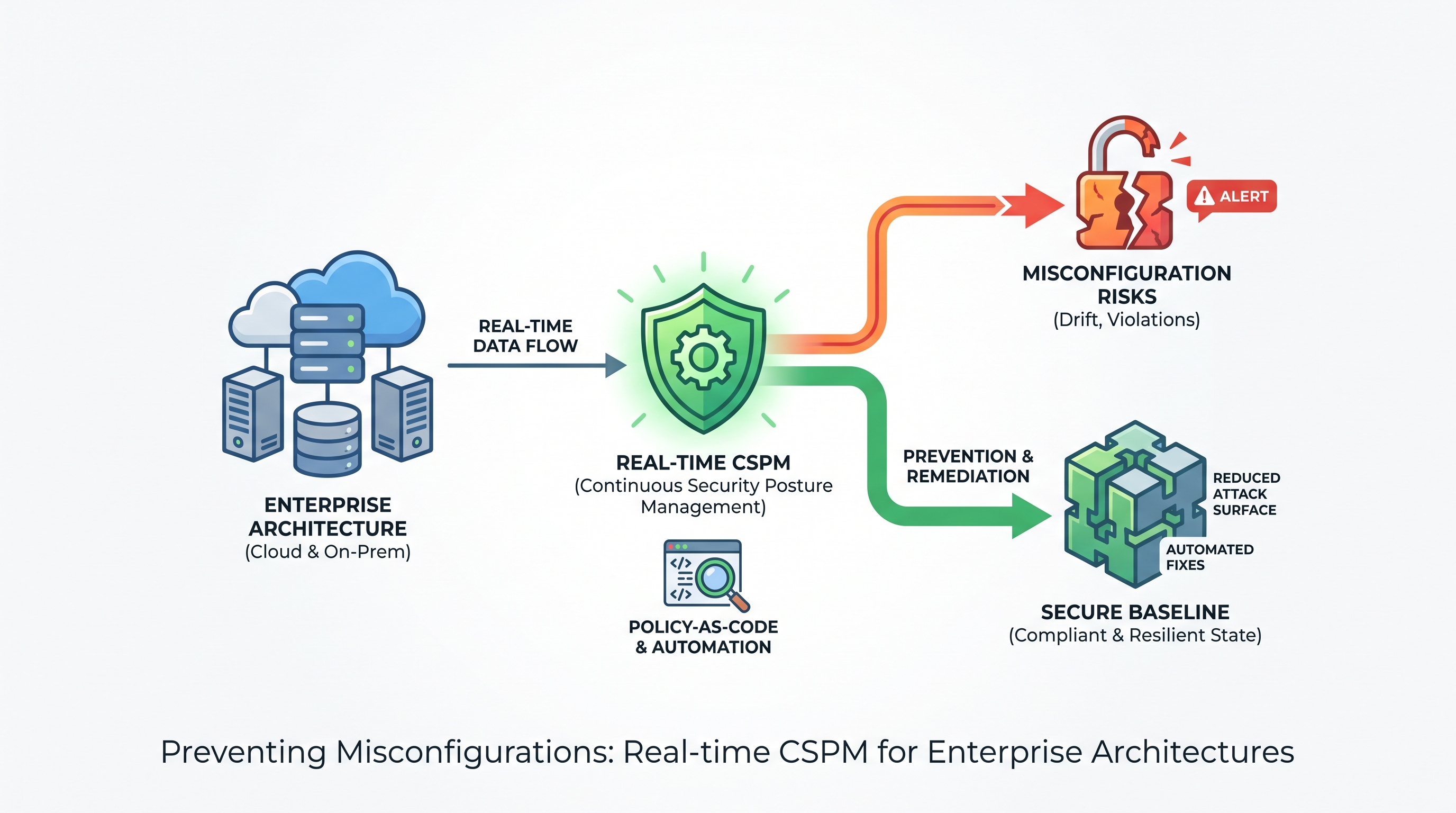
The Pervasive Threat of Misconfigurations in Enterprise Cloud
In the expansive and dynamic landscape of enterprise cloud, misconfigurations stand as a silent, yet formidable, adversary. Unlike sophisticated zero-day exploits, misconfigurations are often simple human errors, oversight, or a lack of understanding of complex cloud service intricacies. Yet, their impact can be catastrophic, leading to data breaches, compliance violations, and significant financial penalties. For large organizations operating across AWS, Azure, GCP, and Oracle environments, the sheer volume and velocity of infrastructure changes amplify this risk exponentially. A single misconfigured S3 bucket, an overly permissive IAM role, or an open network security group can become the Achilles' heel of an otherwise robust security posture.
The challenge is multifaceted. Enterprise architectures are characterized by thousands of ephemeral resources, a myriad of interconnected services, and a constant churn of deployments and updates driven by agile development methodologies. Traditional security scanning tools, designed for static on-premises environments, are inherently ill-equipped to keep pace. They offer point-in-time snapshots, leaving critical windows of vulnerability open between scans. This reactive approach is no longer sustainable. What enterprises desperately need is a proactive, continuous, and intelligent mechanism to identify and rectify misconfigurations as they occur – a real-time Cloud Security Posture Management (CSPM) solution.
At CloudAtler, we understand that unifying FinOps, cloud security, and automated operations is paramount for managing these complex environments. Our AI-powered platform is engineered to address these challenges head-on, providing the real-time visibility and control necessary to prevent misconfigurations from becoming critical incidents.
Beyond Reactive Scans: The Imperative for Real-time CSPM
Many organizations initially attempt to manage cloud security posture using a combination of manual audits, periodic vulnerability scans, and basic cloud-native policy engines. While these methods offer some baseline protection, they are fundamentally reactive and suffer from critical limitations in an enterprise context:
Snapshot-in-Time Vulnerability: Periodic scans, whether daily or weekly, leave substantial gaps. A misconfiguration introduced immediately after a scan could remain undetected for hours or days, providing ample time for exploitation. In a dynamic cloud environment where resources are spun up and down in minutes, this is an unacceptable risk window.
Alert Fatigue and Lack of Context: Cloud environments generate an enormous volume of security alerts. Without intelligent correlation and prioritization, security teams are overwhelmed by noise, making it difficult to identify genuine threats. Traditional tools often lack the contextual understanding of an asset's criticality, blast radius, or its relationship to other services, leading to inefficient incident response.
Manual Remediation Bottlenecks: Identifying a misconfiguration is only half the battle. Manual remediation processes are slow, error-prone, and don't scale with the pace of cloud adoption. This creates a backlog of security issues and increases the mean time to repair (MTTR).
Compliance Drift: Maintaining continuous compliance with regulatory frameworks (e.g., PCI DSS, HIPAA, GDPR, NIST, ISO 27001) is a moving target. Manual checks struggle to ensure that configurations remain compliant as infrastructure evolves, leading to "compliance drift."
Multi-Cloud Complexity: Each cloud provider (AWS, Azure, GCP, Oracle) has its own unique security constructs, APIs, and policy languages. Managing security posture consistently across these diverse ecosystems with disparate tools is a monumental, if not impossible, task for human operators.
Real-time CSPM addresses these shortcomings by providing continuous, automated monitoring and enforcement, shifting the paradigm from reactive firefighting to proactive prevention and rapid remediation.
Architectural Blueprint of a Real-Time CSPM Platform
A robust real-time CSPM platform is an intricate system designed to continuously assess, monitor, and enforce security posture across an organization's entire cloud footprint. Here’s a deep dive into its core architectural components:
1. Data Ingestion and Discovery Layer
The foundation of any effective CSPM is its ability to ingest comprehensive configuration and activity data from all connected cloud accounts. This layer is responsible for:
API Integration: Securely connecting to cloud provider APIs (e.g., AWS Config, AWS Security Hub, Azure Resource Graph, Azure Security Center, GCP Security Command Center, Oracle Cloud Infrastructure Security) to discover all deployed resources (EC2 instances, S3 buckets, Azure VMs, Storage Accounts, GKE clusters, Cloud SQL instances, OCI Compute, Object Storage, etc.) and their current configurations. This requires granular, least-privilege API keys or roles for the CSPM platform.
Log and Event Ingestion: Collecting security-relevant logs and events from services like AWS CloudTrail, Azure Activity Logs, GCP Audit Logs, and OCI Audit Logs. These logs provide crucial context on who made what change, when, and from where, enabling the detection of unauthorized or suspicious configuration modifications.
Network Flow Data: Analyzing VPC Flow Logs (AWS), NSG Flow Logs (Azure), and VPC Flow Logs (GCP) to understand network traffic patterns, identify anomalous connections, and validate network security group rules against actual traffic.
Agent-based vs. Agentless: Modern CSPM solutions are predominantly agentless, relying on cloud provider APIs and logs to minimize overhead and deployment complexity. However, some may offer optional agents for deeper introspection into OS-level configurations or runtime security.
2. Policy and Rule Engine
This is the brain of the CSPM, where ingested data is evaluated against a predefined set of security and compliance policies. Key aspects include:
Built-in Compliance Frameworks: Out-of-the-box support for industry benchmarks and regulatory standards such as CIS Foundations Benchmarks, NIST CSF, PCI DSS, HIPAA, GDPR, SOC 2, and ISO 27001. These provide a baseline for security posture.
Custom Policy Definition: Enterprises require the flexibility to define their own specific security policies tailored to their unique business requirements, risk appetite, and internal governance. This often involves domain-specific languages (DSLs) or open standards like Open Policy Agent (OPA) with Rego, allowing security teams to codify rules like "all S3 buckets must be encrypted with KMS," or "no public ingress to RDP ports for production VMs."
Policy as Code (PaC): Integrating policy definition directly into the CI/CD pipeline, allowing security checks to be performed on Infrastructure as Code (IaC) templates (Terraform, CloudFormation, ARM templates, Pulumi) before deployment. This "shift-left" approach prevents misconfigurations from ever reaching production.
3. Contextual Intelligence and AI-Driven Analysis
Simply flagging violations isn't enough; enterprises need actionable insights. This is where advanced analytics and Artificial Intelligence (AI) differentiate real-time CSPM solutions like CloudAtler's Atler AI:
Correlation Engine: Connecting disparate data points – a public S3 bucket, an exposed EC2 instance, an overly permissive IAM role – to understand the full attack path and potential blast radius of a single misconfiguration.
Risk Prioritization: Not all misconfigurations are created equal. AI algorithms analyze factors such as the asset's criticality (e.g., production database vs. dev environment), data sensitivity, network accessibility, and historical incident data to prioritize alerts, reducing noise and guiding security teams to address the most impactful risks first.
Drift Detection: Continuously monitoring configurations against a known baseline (e.g., a "golden image" or an approved IaC template). Any deviation from this baseline is immediately flagged, indicating potential unauthorized changes or configuration drift.
Anomaly Detection: Using machine learning to identify unusual patterns in resource configurations, access patterns, or network traffic that might indicate a sophisticated threat or an evolving misconfiguration.
4. Automated Remediation and Guardrails
Identifying misconfigurations is crucial, but automated remediation is where real-time CSPM truly shines in preventing breaches:
Preventative Guardrails: Implementing policies that prevent non-compliant resources from being provisioned in the first place. This can involve integrating with cloud-native services like AWS Service Control Policies (SCPs), Azure Policies, and GCP Organization Policies, or custom webhooks that block deployments.
Reactive Automated Remediation: For misconfigurations that slip through or are introduced post-deployment, the CSPM can trigger automated workflows. This might involve serverless functions (AWS Lambda, Azure Functions, GCP Cloud Functions) to automatically:
Encrypt an unencrypted S3 bucket.
Close an overly permissive security group port.
Revoke an excessive IAM permission.
Apply mandatory tags to untagged resources (critical for FinOps).
CloudAtler offers robust capabilities in automated patch remediation and broader operational intelligence to manage these workflows safely and effectively, including options for safe rollbacks.
Approval Workflows and Integration: For sensitive remediations, the platform can integrate with ITSM tools (ServiceNow, Jira) to create tickets, obtain approvals, and track resolution.
5. Unified Visibility and Reporting
In multi-cloud enterprises, a single, consolidated view of security posture is indispensable. This layer provides:
Centralized Dashboard: A unified dashboard that aggregates security findings, compliance status, and remediation progress across all cloud providers and accounts. This eliminates the need to switch between multiple cloud consoles or disparate tools.
Customizable Reports: Generating reports for various stakeholders – CISO for overall risk, compliance officers for audit readiness, FinOps teams for cost optimization insights, and engineers for specific remediation tasks.
API Access: Offering APIs for integration with existing SIEM, SOAR, GRC platforms, and custom dashboards.
FinOps Synergy: Beyond Security to Cost Optimization
While primarily a security tool, real-time CSPM has profound implications for FinOps, blurring the lines between security best practices and financial efficiency. The cost of misconfigurations extends far beyond potential data breaches:
Direct Security Breach Costs: The most obvious financial impact comes from data breaches, which incur costs related to forensics, legal fees, regulatory fines, customer notification, reputational damage, and lost business.
Resource Waste from Insecurity: Misconfigurations often lead to resource bloat. For example:
Orphaned Resources: An insecure resource might be quarantined or taken offline, but not properly de-provisioned, leading to continued billing.
Over-provisioning: In an attempt to "be safe," teams might over-provision resources (e.g., larger VMs, more storage) if they lack confidence in their security posture, leading to unnecessary spend.
Lack of Tagging: Misconfigurations related to missing or incorrect tagging can cripple cost allocation and accountability, making it impossible to identify cost owners or optimize spend effectively. CloudAtler's automated tagging capabilities are crucial here.
Compliance Fines and Audit Costs: Failing to maintain continuous compliance due to misconfigurations can result in hefty fines and increased audit costs.
Operational Inefficiency: Security incidents caused by misconfigurations divert engineering resources from innovation to firefighting, impacting productivity and project timelines.
How CSPM Drives FinOps Optimization:
A real-time CSPM solution contributes to FinOps optimization by:
Resource Hygiene: By continuously monitoring and enforcing configuration policies, CSPM helps identify and flag resources that are not properly secured, tagged, or optimized. This includes detecting idle resources, unattached volumes, or services configured with excessive capacity for their actual workload. This data feeds directly into cost optimization strategies.
Cost-Aware Security Decisions: When a CSPM identifies a misconfiguration, it can also provide context on the financial impact of remediation options or the cost implications of leaving a resource exposed. CloudAtler's platform provides cost impact calculation for security and operational changes, enabling budget-aware planning.
Automated Tagging Enforcement: Enforcing consistent tagging policies across all resources is fundamental for accurate cost allocation and chargebacks. CSPM can detect untagged or improperly tagged resources and even initiate automated tagging remediation, ensuring financial visibility.
Optimizing Compute Lifecycle: By identifying misconfigured or underutilized compute instances, CSPM contributes to the overall compute lifecycle analysis, ensuring resources are right-sized and efficiently managed from creation to de-provisioning.
Budget Control and Forecasting: Real-time insights into resource configurations directly inform budget forecasting models. By preventing resource sprawl and enforcing efficiency, CSPM helps maintain budget control alerts and ensures that cloud spending aligns with financial plans.
Enterprise Use Cases and Technical Implementations
Let's explore practical scenarios where real-time CSPM provides tangible benefits for enterprise architectures:
Use Case 1: Protecting Sensitive Data in Cloud Storage (AWS S3 / Azure Blob / GCP Cloud Storage)
Challenge: A common and critical misconfiguration is public exposure of sensitive data in cloud storage buckets. This can occur due to overly permissive bucket policies, ACLs, or misconfigured cross-account access.
Technical Implementation with Real-time CSPM:
Continuous Monitoring: The CSPM's data ingestion layer continuously queries AWS S3 APIs (
GetBucketPolicy,GetBucketAcl,GetPublicAccessBlock), Azure Storage Account APIs, and GCP Cloud Storage APIs to discover all buckets and their access configurations.Policy Evaluation: The policy engine evaluates these configurations against rules such as "No public access allowed for buckets tagged 'production' or containing 'PII'," "All buckets must have encryption at rest enabled," and "Cross-account access should only be allowed from approved organizational accounts."
Real-time Detection: If a developer accidentally pushes a new bucket policy that grants public read access (e.g.,
"Principal": "*","Action": "s3:GetObject"), the CSPM detects this change almost instantaneously by monitoring CloudTrail/Activity Logs forPutBucketPolicyevents and re-evaluating the bucket's posture.Automated Remediation:
Alerting: Immediately triggers high-priority alerts to security teams, integrated into Slack, PagerDuty, or SIEM.
Automated Action: Based on predefined playbooks, the CSPM can trigger a serverless function to automatically revert the bucket policy to a compliant state (e.g., block public access, remove the offending statement) or enable default encryption.
Quarantine: For critical data, the CSPM might temporarily quarantine the bucket by modifying its network access controls until a manual review is completed.
Use Case 2: Enforcing Least Privilege IAM (Cross-Cloud)
Challenge: IAM roles and policies often become overly permissive over time due to convenience or lack of understanding, granting more permissions than necessary (e.g., a service account having admin privileges). This violates the principle of least privilege and increases the attack surface.
Technical Implementation with Real-time CSPM:
Permission Discovery: The CSPM ingests all IAM users, roles, groups, and their associated policies from AWS IAM, Azure AD, and GCP IAM. It also analyzes CloudTrail, Activity Logs, and Audit Logs to understand actual permission usage.
Policy Evaluation: Rules are applied to identify:
Roles with broad administrative privileges that are not strictly necessary.
Unused permissions within existing policies (e.g., a role with
s3:DeleteObjectthat has never performed this action).Identity-based policies that grant access to sensitive resources without resource-based policies.
AI-Driven Analysis: Atler AI can correlate actual usage patterns with assigned permissions to suggest right-sized policies. For instance, if a service account is only observed performing
s3:GetObjecton a specific bucket, the AI can recommend a policy that restricts it to precisely that action and resource, instead of a broaders3:*permission.Automated Remediation:
Recommendations: The CSPM generates prioritized recommendations for IAM policy tightening, including the exact JSON policy statements to apply.
Automated Policy Generation/Attachment: In a controlled environment, the CSPM can generate new, least-privilege policies and attach them, or detach overly permissive ones, after appropriate approval workflows.
Drift Alerting: If an engineer manually attaches a non-compliant policy, the CSPM detects the change via API polling and log analysis, flagging the drift from the desired state.
Use Case 3: Securing Network Boundaries (Security Groups / NSGs / Firewall Rules)
Challenge: Open network ports (e.g., SSH/RDP to 0.0.0.0/0), overly permissive ingress/egress rules, or misconfigured network segmentation expose instances to unauthorized access and lateral movement.
Technical Implementation with Real-time CSPM:
Network Configuration Discovery: The CSPM continuously queries APIs for AWS Security Groups, Azure Network Security Groups (NSGs), and GCP Firewall Rules, along with associated VPCs/VNets.
Policy Evaluation: Policies check for:
Ingress rules permitting SSH (port 22) or RDP (port 3389) from
0.0.0.0/0(anywhere).Unrestricted egress rules from sensitive subnets.
Absence of mandatory network segmentation for different environments (e.g., dev/test/prod).
Real-time Detection: If a new security group is created with an inbound rule allowing port 22 from the internet, the CSPM immediately flags it by monitoring
AuthorizeSecurityGroupIngressor equivalent events.Automated Remediation:
Alert and Block: The CSPM can generate an alert and, if configured, trigger a serverless function to automatically remove the offending rule or replace it with a more restrictive one (e.g., allowing access only from a corporate VPN IP range).
Integrate with IaC: Enforce network policies at the IaC stage, ensuring that non-compliant network configurations are rejected during CI/CD pipeline execution.
CloudAtler's Holistic Approach to Cloud Security and FinOps
For enterprises navigating the complexities of multi-cloud environments, a fragmented approach to security, operations, and finance is no longer viable. CloudAtler provides a unified, AI-powered platform that seamlessly integrates FinOps, cloud security, and automated operations across AWS, Azure, GCP, and Oracle.
Our solution goes beyond traditional CSPM by offering:
AI-Driven Intelligence: Leveraging Atler AI to provide deep contextual analysis, intelligent risk prioritization, and predictive insights, significantly reducing alert fatigue and improving response efficiency.
Unified Financial and Security Visibility: Providing a single pane of glass for both security posture and financial performance, enabling FinOps teams to make cost-aware security decisions and security teams to understand the financial impact of their actions. Our security management features are deeply integrated with financial intelligence.
Automated Operations: From automated tagging and resource cleanup to proactive patch remediation and safe rollbacks, CloudAtler empowers organizations to automate routine operational tasks, freeing up valuable engineering time and reducing the window of vulnerability.
Enterprise-Grade Scalability: Designed for the most demanding enterprise architectures, ensuring consistent policy enforcement and real-time monitoring across thousands of accounts and subscriptions.
Conclusion
Cloud misconfigurations represent a persistent and evolving threat that demands a sophisticated, real-time solution. For enterprise architectures operating at scale across multiple cloud providers, traditional security approaches are simply inadequate. Real-time CSPM is not merely a tool for compliance; it is a fundamental shift towards proactive security posture management that integrates deeply with FinOps objectives, ensuring both security and efficiency.
By providing continuous monitoring, AI-driven contextual analysis, automated remediation, and unified visibility, real-time CSPM empowers organizations to prevent misconfigurations from becoming costly security incidents. It enables a culture of security by design, where policies are enforced consistently, and financial implications are understood at every stage of the cloud lifecycle.
Ready to secure your enterprise cloud architecture, prevent misconfigurations in real-time, and unify your FinOps and security operations?
Discover how CloudAtler's AI-powered platform can transform your cloud security posture and optimize your financial operations across AWS, Azure, GCP, and Oracle environments. Take control of your cloud destiny today.
All in One Place
Atler Pilot decodes your cloud spend story by bringing monitoring, automation, and intelligent insights together for faster and better cloud operations.