
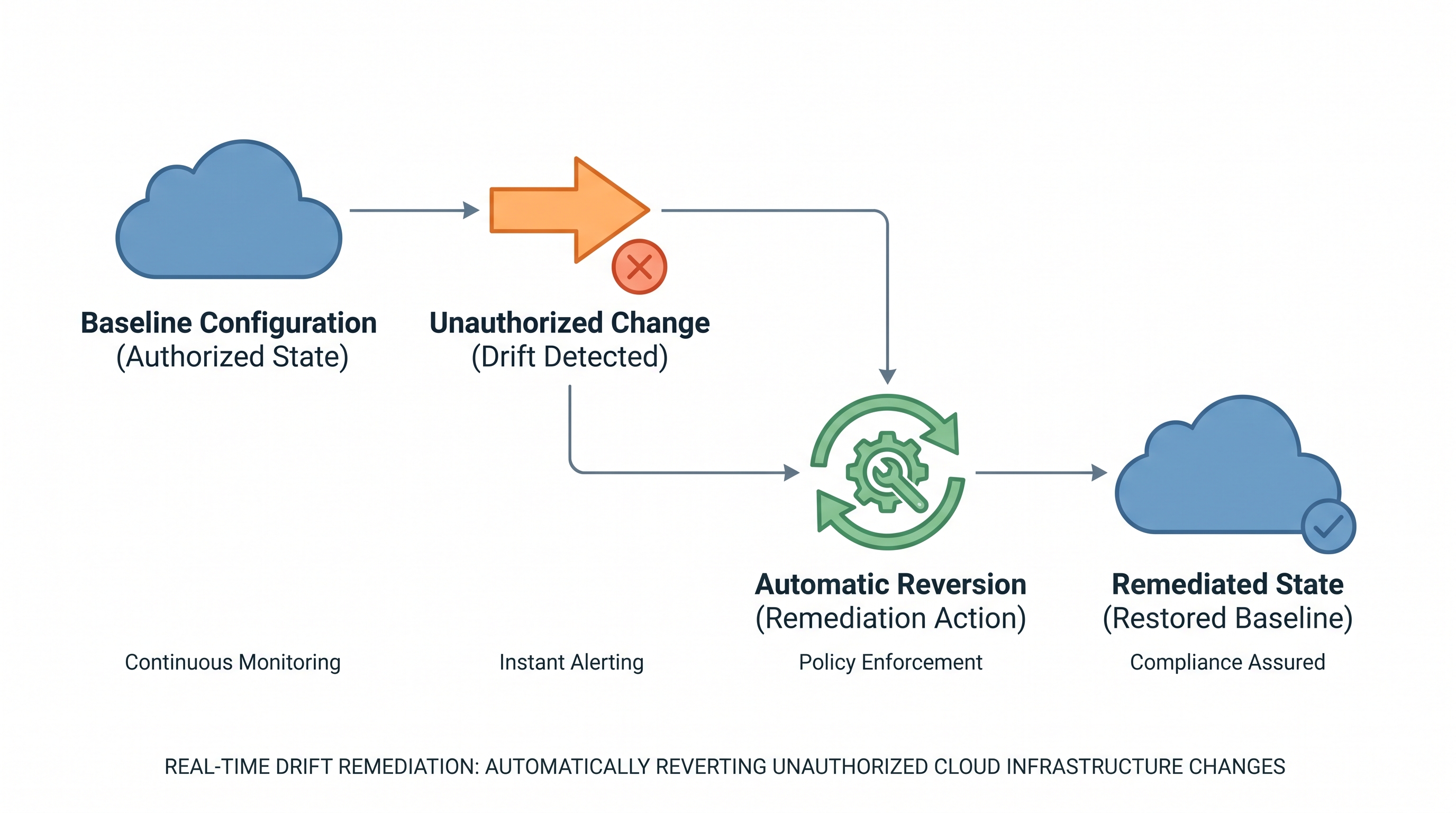
The High Cost of Infrastructure Drift in Enterprise Cloud
In modern, multi-cloud enterprise environments, infrastructure is typically defined, versioned, and deployed using Infrastructure as Code (IaC) frameworks like Terraform, OpenTofu, AWS CloudFormation, or Pulumi. This declarative approach guarantees that the deployed cloud state matches the defined configuration in your Git repositories. However, the reality of day-to-day operations often breaks this paradigm. This discrepancy is known as infrastructure drift.
Drift occurs when the actual state of a cloud resource deviates from its defined "source of truth" in IaC. This deviation is rarely malicious in its origin; more often, it is the result of:
Emergency Hotfixes: An engineer manually modifies a security group rule or increases an autoscaling limit directly in the cloud console to resolve an active production incident, intending to update the IaC code later—but forgets to do so.
Rogue Scripts: Legacy automation scripts or localized cron jobs run imperative API commands that modify resource configurations outside of the established CI/CD pipeline.
Out-of-Band Operator Interventions: Teams lacking mature IaC practices manually adjust instance sizes, attach unencrypted volumes, or spin up test databases that bypass the peer-review process.
While seemingly benign in isolation, infrastructure drift introduces catastrophic risks to both enterprise security management and FinOps (Financial Operations) predictability.
The Security Implications of Untracked Drift
From a security perspective, drift is an open invitation for exploitation. A single manual change opening port 22 (SSH) or 3389 (RDP) to 0.0.0.0/0 on an internal virtual machine bypasses all static analysis checks performed during the CI/CD pull request phase. Similarly, disabling S3 bucket public access blocks, modifying IAM trust relationships, or turning off CloudTrail logging can occur in seconds via the console, leaving the organization exposed to data exfiltration, ransomware, and compliance violations (such as SOC2, ISO 27001, and PCI-DSS) for days or weeks before the next audit cycle.
The FinOps Implications: Uncontrolled Cost Escalation
From a financial standpoint, drift directly undermines budget forecasting and cost control. An engineer might manually upgrade an Amazon EC2 instance from a cost-effective t3.medium to a massive m5.24xlarge to run a localized compute job, intending to scale it back down. If left unreverted, this single drifted resource can accumulate thousands of dollars in unexpected charges in a matter of days. Furthermore, orphaned disks, unattached Elastic IPs, and provisioned IOPS storage volumes left behind by manual tests continue to generate silent waste that standard budgeting tools struggle to attribute to specific business units.
The Limitations of Periodic Scanning vs. Real-Time Event-Driven Architecture
Historically, organizations have attempted to combat drift through periodic reconciliation loops. This typically involves running a scheduled cron job (e.g., daily or weekly) that executes a terraform plan or runs a cloud provider compliance scan (such as AWS Config or Azure Policy evaluation) and reports discrepancies.
While periodic scanning is better than no monitoring at all, it suffers from a fundamental flaw: the window of vulnerability. If an unauthorized, highly insecure, or excessively expensive change occurs five minutes after a daily scan completes, that change will remain active and undetected for nearly 24 hours. During this window, data can be stolen, or massive cloud spend can be accrued.
To achieve true enterprise resilience, organizations must transition from reactive, periodic scanning to a proactive, real-time event-driven architecture (EDA). Instead of polling the cloud APIs for status updates, an event-driven model listens to the cloud control plane's audit logs in real time, immediately evaluates the changes against policy engines, and triggers automated remediation workflows within seconds of the drift occurring.
Metric / Feature | Periodic Scanning (Legacy) | Real-Time Event-Driven Remediation |
|---|---|---|
Time to Detection | Hours to Days (Scan interval dependent) | Seconds to Minutes |
API Rate Limiting Risk | High (Massive bulk API polling requests) | Low (Subscribes to native push event streams) |
Vulnerability Window | Large (Up to 24 hours or more) | Near-Zero |
FinOps Protection | Delayed (Waste accumulates until next run) | Immediate (Halts runaway costs instantly) |
Architectural Deep Dive: Building a Multi-Cloud Event-Driven Drift Detection Pipeline
Implementing a real-time drift detection and auto-remediation pipeline requires tapping into the native audit logging and event-routing frameworks of each major cloud provider. Let us break down the architectural patterns for AWS, Microsoft Azure, and Google Cloud Platform (GCP).
1. AWS Architecture: EventBridge and CloudTrail
In AWS, every API call—whether initiated by an IAM user, an SDK, or an internal service—is recorded by AWS CloudTrail. By routing CloudTrail events to Amazon EventBridge, we can build a highly responsive serverless detection pipeline:
The Trigger: A user modifies an AWS resource (e.g., calling
ModifySecurityGroupRules).The Event Stream: CloudTrail captures the API call and publishes the log event.
The Router: An EventBridge rule is configured to filter for specific API write events (e.g.,
Create*,Modify*,Delete*,Update*,Authorize*).The Processor: EventBridge routes the matching event JSON payload to an AWS Lambda function or an AWS Step Functions state machine for evaluation and remediation.
2. Azure Architecture: Event Grid and Activity Logs
In Azure, the control plane is managed by Azure Resource Manager (ARM). To capture drift in real time:
The Trigger: An operator alters a resource configuration via the Azure Portal or Azure CLI.
The Event Stream: Azure Activity Logs capture the administrative operations.
The Router: Azure Event Grid is configured with a system topic that subscribes to the Azure subscription’s Activity Logs.
The Processor: Event Grid delivers the event payload to an Azure Function or an Azure Logic App. This function parses the event to determine if the change was authorized or if it drifted from the baseline policy.
3. GCP Architecture: Cloud Logging and Pub/Sub
Google Cloud Platform handles real-time resource tracking through its Asset Inventory and Cloud Logging mechanisms:
The Trigger: A modification occurs on a GCP resource (e.g., a firewall rule update in a VPC).
The Event Stream: Google Cloud Logging captures the audit log, or Cloud Asset Inventory detects a real-time asset change.
The Router: A log sink is configured to export administrative activity logs immediately to a Google Cloud Pub/Sub topic.
The Processor: A Cloud Function subscribes to the Pub/Sub topic, extracting the resource metadata and executing the policy validation logic.
Technical Implementation: Real-Time Auto-Remediation with Code Examples
Once an event is captured, the remediation processor must determine whether the change is authorized. Simply reverting every manual change blindly can disrupt legitimate, emergency operations. Therefore, the remediation logic must follow a rigorous evaluation path:
Parse the event payload to extract the resource ID, user identity, and specific configuration modifications.
Check if the user identity matches an authorized CI/CD service principal or runner IP. If the change originated from the authorized CI/CD pipeline, it is marked as authorized, and the execution terminates.
If the change was manual (e.g., executed by an IAM user session), query the Git repository or IaC state file to retrieve the desired configuration baseline.
Compare the drifted state with the desired baseline.
If a discrepancy exists, execute an automated rollback to revert the resource to its declared state.
Let us examine a concrete Python implementation designed to run inside an AWS Lambda function. This function detects unauthorized security group modifications (specifically, opening SSH port 22 to the public internet) and immediately reverts the configuration using the AWS Boto3 SDK.
import boto3
import json
import logging

logger = logging.getLogger()
logger.setLevel(logging.INFO)

ec2_client = boto3.client('ec2')

# Define the authorized CIDR blocks for administrative access
AUTHORIZED_CIDR_BLOCKS = ["10.0.0.0/8", "192.168.0.0/16"]

def lambda_handler(event, context):
    logger.info(f"Received event: {json.dumps(event)}")

    # Extract details from the EventBridge CloudTrail event
    detail = event.get('detail', {})
    event_name = detail.get('eventName')
    user_identity = detail.get('userIdentity', {})
    arn = user_identity.get('arn', '')

    # 1. Bypass check: Was this change made by our authorized CI/CD Pipeline Role?
    if "role/GitLab-CI-Runner" in arn or "role/Terraform-Deployer" in arn:
        logger.info(f"Change authorized. Executed by CI/CD pipeline role: {arn}")
        return {"status": "authorized", "reason": "Executed by CI/CD Pipeline"}

    # 2. Focus on security group ingress modifications
    if event_name in ["AuthorizeSecurityGroupIngress", "RevokeSecurityGroupIngress"]:
        request_parameters = detail.get('requestParameters', {})
        group_id = request_parameters.get('groupId')
        ip_permissions = request_parameters.get('ipPermissions', {}).get('items', [])

        for permission in ip_permissions:
            from_port = permission.get('fromPort')
            to_port = permission.get('toPort')
            ip_ranges = permission.get('ipRanges', {}).get('items', [])

            # Check if port 22 (SSH) is being exposed
            if from_port <= 22 <= to_port:
                for ip_range in ip_ranges:
                    cidr_ip = ip_range.get('cidrIp')

                    # If the CIDR block is outside our corporate authorized list, trigger immediate rollback
                    if cidr_ip not in AUTHORIZED_CIDR_BLOCKS:
                        logger.warning(f"UNAUTHORIZED DRIFT DETECTED: Group {group_id} exposed port 22 to {cidr_ip} by user {arn}")

                        # 3. Execute immediate auto-remediation (Rollback)
                        try:
                            logger.info(f"Initiating rollback: Removing unauthorized ingress rule from {group_id}...")
                            ec2_client.revoke_security_group_ingress(
                                GroupId=group_id,
                                IpPermissions=[
                                    {
                                        'IpProtocol': permission.get('ipProtocol'),
                                        'FromPort': from_port,
                                        'ToPort': to_port,
                                        'IpRanges': [{'CidrIp': cidr_ip}]
                                    }
                                ]
                            )
                            logger.info(f"SUCCESS: Revoked unauthorized rule on Security Group {group_id}")
                            return {
                                "status": "remediated",
                                "resource_id": group_id,
                                "unauthorized_cidr": cidr_ip
                            }
                        except Exception as e:
                            logger.error(f"FAILED to revoke rule on Security Group {group_id}: {str(e)}")
                            raise e

    return {"status": "no_action_required"}
In a production-grade implementation, rather than hardcoding IP ranges or executing raw SDK commands directly inside the Lambda function, the lambda should ideally trigger a targeted run of your IaC tool (e.g., terraform apply -replace="aws_security_group.web_sg") to ensure that the resource is reconciled directly from the declarative state file. This maintains state consistency and avoids discrepancies between the cloud provider's database and your local state files.
Designing Safe Rollbacks to Prevent "Remediation Loops"
While automated drift remediation is incredibly powerful, it introduces a significant operational risk: the Remediation Loop (or "automation death spiral"). This occurs when two automated systems, or an automated system and a manual operator, fight for control over the same resource.
For example, imagine a scenario where an SRE is debugging an active production outage. They manually increase the capacity of an ECS service to handle a sudden traffic spike. The real-time drift remediation engine detects this deviation from the IaC baseline (which specifies a lower task count) and immediately scales the service back down. The SRE, seeing the tasks disappear, manually scales them up again. The remediation engine scales them down. This loop continues, degrading application performance, exhausting API rate limits, and frustrating operations teams.
To prevent these scenarios, organizations must implement safe rollbacks and state reconciliation patterns. A resilient drift remediation framework should incorporate the following safeguards:
1. Circuit Breakers and Rate Limiting
The remediation engine must track the frequency of rollback actions executed against any specific resource. If a resource is remediated more than three times within a rolling 15-minute window, the engine should trigger a "circuit breaker," pausing automatic remediation for that resource, logging an emergency alert to the security operations center (SOC), and flagging the resource for manual review.
2. Maintenance Windows and Temporary Overrides
Engineers must have a mechanism to temporarily pause auto-remediation during scheduled maintenance windows or active incident response cycles. This can be achieved by checking for specific resource tags (e.g., MaintenanceMode: True) or querying an active incident management API (such as PagerDuty or ServiceNow) before executing a rollback. If an active, high-severity incident is mapped to the resource's application scope, the remediation engine should log the drift but defer auto-remediation until the incident is resolved.
3. State Locking and CI/CD Synchronization
To avoid race conditions, the auto-remediation engine must verify if a CI/CD pipeline execution is currently active for the target cloud account or workspace. If a deployment pipeline is running, all drift remediation actions must be queued or paused. This prevents the remediation engine from misinterpreting a planned, in-progress infrastructure deployment as unauthorized drift.
Integrating Drift Remediation with FinOps and Budgetary Controls
Automated drift remediation is not merely a security tool; it is a fundamental pillar of modern cost optimization. When integrated with an enterprise financial operations platform, real-time remediation acts as a dynamic budgetary guardrail, preventing unexpected cost overruns before they impact the bottom line.
Consider the following scenario: A developer spins up a GPU-intensive machine learning instance (such as an AWS p4d.24xlarge costing over $32 per hour) to run a quick training model. They bypass the standard approval process and create the resource manually via the console. If left unchecked, this instance will cost $768 per day, or upwards of $23,000 per month.
By coupling real-time drift remediation with financial policies, the organization can define granular cost-based guardrails:
Cost Threshold Guardrails: Any manually created resource that exceeds a projected run rate of $100/month is immediately flagged. If the resource is not tagged with a valid cost center and approved business justification within two hours of creation, the remediation engine automatically terminates or stops the resource.
Enforcing Automated Tagging: Resource tags are the lifeblood of cost allocation. If a resource is created without mandatory tags (such as
Owner,Environment, andCostCenter), the drift remediation pipeline can automatically apply default "quarantine" tags, notify the creator, and scale down or stop the resource if tags are not applied within a designated grace period. This is where robust automated tagging and metadata enforcement becomes critical to maintaining clean cost allocation data.Orphaned Resource Cleanup: When virtual machines are deleted manually, associated resources like block storage volumes (EBS/Managed Disks), network interfaces, and elastic IPs are often left orphaned, continuing to incur costs. Real-time drift remediation can detect these orphaned states immediately upon the deletion event and safely clean up the detached resources, eliminating silent cost leaks.
Enterprise Governance: Implementing Guardrails without Bottlenecks
The ultimate goal of any engineering enablement team is to build a platform that allows developers to move fast while maintaining absolute security and cost discipline. Imposing overly restrictive IAM permissions that block all manual access can stifle innovation and slow down incident response. Instead, organizations should adopt a "Guardrails over Gatekeepers" model.
By implementing automated cloud guardrails, you shift from preventing actions to continuously validating outcomes. Developers retain the flexibility to experiment and troubleshoot, but they do so with the understanding that the platform is continuously monitoring, correcting, and securing the environment in the background.
The Role of Policy-as-Code (PaC)
To scale drift remediation across thousands of accounts and projects, policy evaluation should be decoupled from the remediation code itself. Using Policy-as-Code engines like Open Policy Agent (OPA) or HashiCorp Sentinel, compliance teams can write declarative rules that define what "authorized" infrastructure looks like. The real-time remediation pipeline simply passes the drifted configuration payload to the policy engine, which returns an immediate "Allow" or "Deny" decision based on version-controlled policies.
Leveraging AI-Driven Anomaly Detection
As cloud footprints grow, writing static rules for every possible drift scenario becomes operationally unsustainable. This is where advanced artificial intelligence and machine learning models step in. An intelligent platform like the Atler AI engine analyzes historical usage patterns, change logs, and engineering behavior to dynamically distinguish between standard operational changes and high-risk anomalies. Instead of relying on rigid, hardcoded scripts, AI-driven operations can automatically evaluate the contextual risk of a drifted resource, determine its financial impact, and execute precise remediation actions without human intervention.
Conclusion: Unify Your Cloud Operations with CloudAtler
Real-time drift remediation is no longer a luxury for enterprise cloud teams—it is a core operational requirement. Manually scanning for configuration changes or waiting for monthly cloud bills to identify cost leaks exposes your organization to severe security vulnerabilities and uncontrolled financial waste. By building a real-time, event-driven remediation pipeline, you ensure that your cloud infrastructure remains secure, compliant, and cost-optimized 24/7.
However, building and maintaining custom, multi-cloud detection pipelines, writing complex Lambda functions, and managing state synchronization across AWS, Azure, GCP, and Oracle is a massive engineering undertaking that distracts your teams from delivering core business value.
CloudAtler solves this complexity by providing a unified, AI-powered platform that seamlessly integrates cloud security, automated operations, and FinOps across your entire multi-cloud estate. With CloudAtler, you get:
Real-time, agentless drift detection and automated, safe remediation.
Out-of-the-box, enterprise-grade policy guardrails that prevent both security breaches and runaway cloud costs.
Advanced AI-driven anomaly detection to identify and resolve complex operational risks before they impact your business.
A single, unified dashboard uniting your engineering, security, and finance teams under one source of truth.
Stop chasing infrastructure drift manually. Protect your cloud budget, secure your digital assets, and empower your engineering teams to innovate with confidence. Contact CloudAtler today to schedule a demo and discover how we can automate your multi-cloud operations.
All in One Place
Atler Pilot decodes your cloud spend story by bringing monitoring, automation, and intelligent insights together for faster and better cloud operations.