
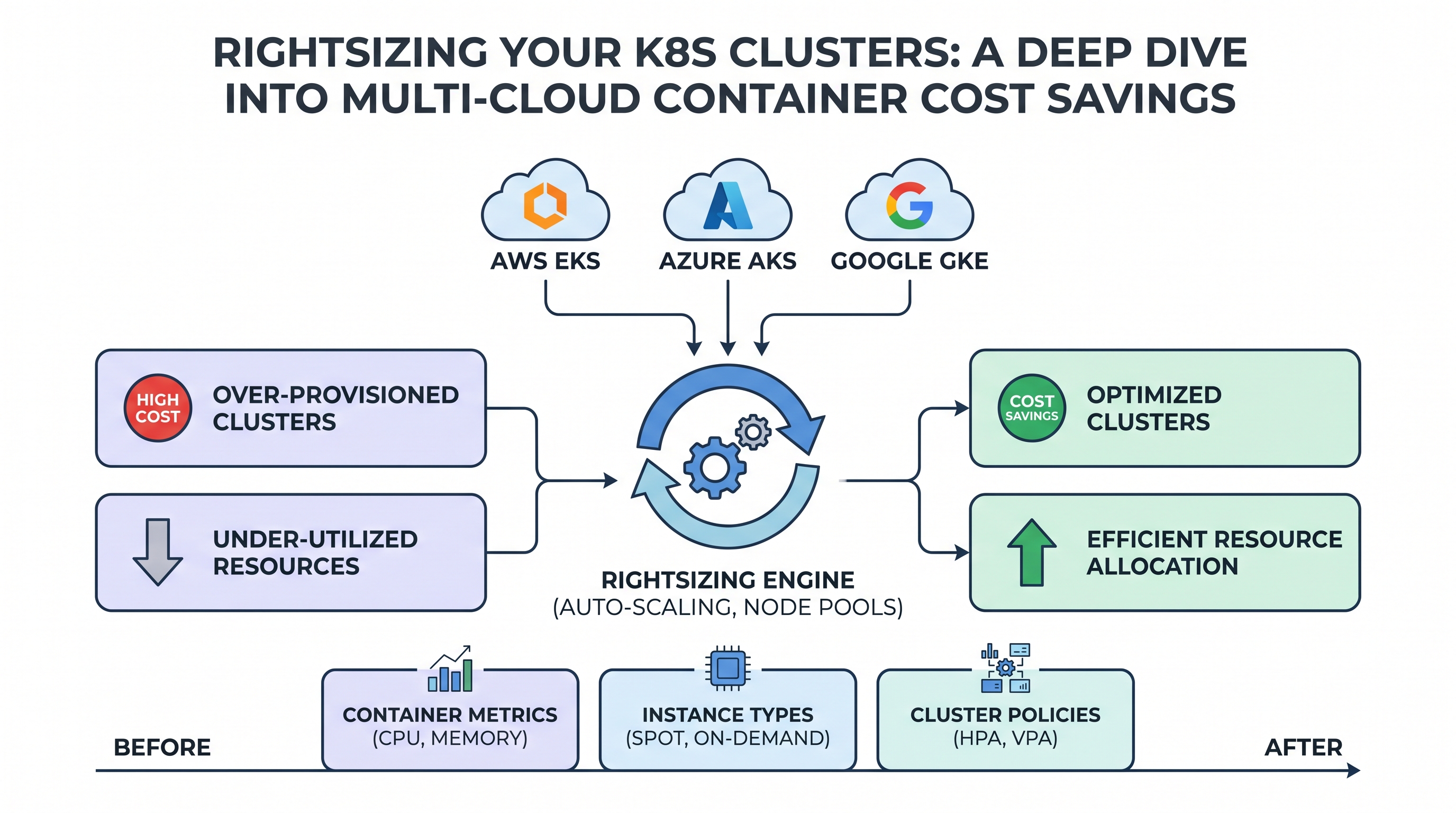
In the relentless pursuit of agility and scalability, enterprises have flocked to Kubernetes as the de facto standard for container orchestration. Yet, as deployments mature and span across hybrid and multi-cloud environments—encompassing AWS EKS, Azure AKS, GCP GKE, and Oracle OKE—a significant challenge emerges: managing and optimizing the burgeoning costs associated with these distributed containerized workloads. The promise of cloud elasticity often masks an underlying reality of overprovisioning, resource waste, and fragmented cost visibility. This is where the strategic discipline of rightsizng becomes not just an option, but an imperative for sustainable multi-cloud operations.
Rightsizing Kubernetes clusters is far more nuanced than merely cutting costs. It's about achieving an optimal balance between performance, reliability, and expenditure. It demands a deep understanding of workload characteristics, infrastructure capabilities, and the subtle interplay of various Kubernetes components and cloud provider services. For enterprise FinOps and cloud security teams, this translates into a complex equation of technical implementation, financial governance, and continuous operational intelligence.
The Multi-Cloud K8s Cost Conundrum: A Fragmented Financial Landscape
The inherent complexity of Kubernetes is magnified exponentially when spread across multiple cloud providers. Each cloud platform presents its own pricing models, instance types, networking costs, and managed service nuances. This fragmentation creates a significant challenge for FinOps teams trying to gain a consolidated view of container spend. Common pitfalls include:
Visibility Gaps: Siloed billing data from AWS, Azure, GCP, and Oracle makes it nearly impossible to attribute costs accurately to specific teams, applications, or even individual Kubernetes namespaces.
Overprovisioning Defaults: Out-of-the-box Kubernetes deployments often default to conservative resource allocations to ensure stability, leading to significant idle capacity across nodes and within pods.
Instance Type Mismatch: Choosing inappropriate underlying virtual machine (VM) types for Kubernetes nodes, failing to align them with the actual CPU, memory, or I/O demands of the workloads.
Ephemeral Nature of Resources: The dynamic scaling of pods and nodes means resource consumption is constantly fluctuating, making traditional static cost tracking ineffective.
Network Egress Charges: Data transfer costs, especially across regions or between cloud providers (if using multi-cluster setups), can become a hidden cost sink.
Addressing these issues requires a holistic approach that integrates technical optimization with robust financial governance, providing a unified dashboard for comprehensive visibility and control across your entire multi-cloud estate.
Understanding Rightsizing in Kubernetes: Beyond Simple Cost Cutting
At its core, rightsizing in Kubernetes means allocating precisely the right amount of compute, memory, and storage resources to each workload and node, at the right time. It's an iterative process driven by data, not guesswork. This involves:
Workload Resource Requests & Limits: Configuring accurate
requests(guaranteed resources) andlimits(maximum allowable resources) for CPU and memory within pod specifications. This is foundational for effective scheduling and resource management.Pod Autoscaling: Leveraging Horizontal Pod Autoscaler (HPA) to scale pods based on metrics like CPU utilization or custom metrics, and Vertical Pod Autoscaler (VPA) to automatically adjust CPU and memory requests and limits for individual pods.
Cluster Autoscaling: Dynamically adjusting the number of nodes in the cluster based on pending pods and resource utilization, ensuring nodes are added only when needed and removed when idle. Tools like Kubernetes Cluster Autoscaler and more advanced solutions like Karpenter (for AWS) or native node auto-provisioning across other clouds play a crucial role here.
Node Instance Type Optimization: Selecting the most cost-effective and performant VM instances for your nodes that best match the aggregated resource requirements of your workloads.
The goal is to eliminate waste (overprovisioning) while preventing performance degradation (underprovisioning), thereby optimizing both expenditure and operational efficiency.
Technical Pillars of K8s Rightsizing: A Deep Dive
1. Workload-Centric Analysis: The Foundation of Pod Optimization
The most granular level of rightsizing occurs at the pod level, where requests and limits are defined. Misconfigurations here are the leading cause of resource waste and performance issues.
CPU Requests and Limits:
Requests: The minimum amount of CPU guaranteed to a container. The scheduler uses this to decide where to place pods. If a pod requests 500m (0.5 CPU core), Kubernetes tries to find a node with at least 0.5 CPU available.
Limits: The maximum amount of CPU a container can use. If a container tries to use more CPU than its limit, it will be throttled. Setting limits too low can lead to performance bottlenecks, while setting them too high (or not at all) can allow a rogue container to starve others on the same node.
Example: A stateless microservice processing API requests might have
requests: cpu: 200m, memory: 256Miandlimits: cpu: 500m, memory: 512Mi. A batch processing job that bursts CPU might have higher limits to allow for spikes.
Memory Requests and Limits:
Requests: The minimum amount of memory guaranteed. If a node doesn't have enough free memory to satisfy the request, the pod won't be scheduled there.
Limits: The maximum memory a container can consume. If a container exceeds its memory limit, it will be immediately terminated by the OOM (Out Of Memory) killer. This is a critical difference from CPU limits, where throttling occurs.
Example: A database pod requires stable memory, so
requestsandlimitsare often set closer, e.g.,requests: memory: 4Gi, limits: memory: 4.5Gi, to prevent OOM kills and ensure stable performance.
How to set them effectively:
Monitor Actual Usage: Use tools like Prometheus, Grafana, or cloud-native monitoring solutions (CloudWatch Container Insights, Azure Monitor for Containers, Google Cloud Operations Suite) to gather historical CPU and memory utilization data for your pods.
Analyze Percentiles: Don't just look at averages. Analyze P90 or P95 utilization to account for spikes without overprovisioning for rare peaks.
Start Conservatively, Iterate: Begin with reasonable requests, monitor, and gradually adjust. For limits, consider setting them 1.5x - 2x the request for CPU (to allow bursting) and slightly above the request for memory (to prevent OOM kills but protect other pods).
Leverage VPA: Vertical Pod Autoscaler (VPA) can automatically recommend or even apply optimal resource requests and limits based on historical usage. This is a powerful tool for dynamic workloads, although it can conflict with HPA on CPU/Memory.
2. Node-Level Optimization: Efficient Bin Packing and Instance Selection
Optimizing the underlying nodes is crucial for maximizing resource utilization and minimizing infrastructure costs.
Instance Type Selection:
CPU-optimized vs. Memory-optimized: Choose instance families that align with your workload profile. For example, compute-intensive batch jobs might benefit from C-series (AWS, GCP) or F-series (Azure), while data caches or analytics might need R-series (AWS) or M-series (Azure).
Burstable Instances: For intermittent or low-utilization workloads, consider burstable instances (e.g., AWS T-series, Azure B-series, GCP E2-micro/small) if their burst credits mechanism aligns with your usage patterns.
Graviton/ARM Processors: Increasingly, ARM-based instances (like AWS Graviton) offer significant price-performance advantages for many workloads. Evaluate compatibility.
Bin Packing Strategies:
Kubernetes schedulers (and Cluster Autoscaler/Karpenter) aim to "bin pack" pods onto nodes as efficiently as possible to minimize node count.
Taints and Tolerations, Node Selectors, Affinity/Anti-affinity: Use these to guide pod placement, ensuring specific workloads land on appropriate node types or preventing high-resource pods from co-locating with sensitive ones.
Leveraging Spot/Preemptible Instances:
For fault-tolerant, stateless, or batch workloads, using Spot Instances (AWS), Azure Spot VMs, or GCP Preemptible VMs can lead to 70-90% cost savings compared to on-demand.
Integrate these into your node pools. Cluster Autoscaler and Karpenter are excellent at managing the lifecycle of these nodes, gracefully draining and replacing them upon preemption.
Node Auto Provisioning (Cluster Autoscaler & Karpenter):
Kubernetes Cluster Autoscaler (CA): Monitors for unschedulable pods and scales up nodes; scales down underutilized nodes. Configurable with various cloud provider integrations.
Karpenter: An open-source, high-performance node provisioner for Kubernetes on AWS. It directly provisions instances based on pod requirements, often leading to more optimal instance selection and faster scaling than CA. It's "just-in-time" and "just-right" provisioning.
Native Cloud Autoscalers: AKS Virtual Nodes (powered by Azure Container Instances), GKE Autopilot, and OKE's managed node pools offer similar abstracted scaling capabilities, reducing operational overhead.
3. Storage Rightsizing: Matching Performance to Persistence Needs
Storage is often an overlooked area for cost optimization in Kubernetes, especially given the variety of PersistentVolume (PV) and PersistentVolumeClaim (PVC) options across clouds.
Storage Classes: Understand the different storage classes offered by your cloud providers (e.g., AWS EBS gp3, io2; Azure Premium SSD, Standard SSD; GCP Persistent Disk balanced, SSD; OCI Block Volumes). Each has different IOPS, throughput, and cost profiles.
Provisioned IOPS vs. Throughput: Don't overprovision IOPS or throughput if your application doesn't require it. Monitor actual storage usage and I/O patterns.
Snapshot Policies and Lifecycle Management: Implement automated snapshot schedules and lifecycle policies to manage backup costs. Delete old, unnecessary snapshots.
Ephemeral Storage: For temporary data, leverage
emptyDiror local ephemeral storage where appropriate, avoiding persistent storage costs.
4. Network Rightsizing: Minimizing Data Transfer Costs
Network egress costs, particularly between regions or cloud providers, can be substantial. Rightsizing here involves architectural and operational considerations.
Regional Placement: Deploy services that communicate heavily within the same region or availability zone to minimize inter-AZ/region data transfer costs.
Service Mesh Optimization: A service mesh like Istio or Linkerd can provide granular traffic management, allowing for intelligent routing, load balancing, and potentially reducing unnecessary network hops. It also offers rich telemetry for understanding network traffic patterns, which can inform cost optimization.
Compression and Caching: Implement data compression for inter-service communication and leverage caching mechanisms to reduce redundant data transfers.
Ingress/Egress Optimization: Consolidate ingress points where possible, and review external data transfer patterns to identify high-cost areas.
FinOps Strategies for Multi-Cloud K8s: Governance and Intelligence
Technical rightsizing is only half the battle. Without robust FinOps practices, even perfectly optimized clusters can become financial liabilities. This is where a platform like CloudAtler excels, providing the necessary intelligence and automation.
1. Cost Visibility and Allocation Across Clouds
The shared nature of Kubernetes clusters makes cost attribution notoriously difficult. A pod might consume resources from a node that serves multiple applications or teams.
Robust Tagging Policies: Implement mandatory and consistent tagging for all Kubernetes resources (namespaces, deployments, services, nodes) and underlying cloud infrastructure (VMs, storage, networks). Tags like
team,project,environment,applicationare critical for chargebacks and showbacks. CloudAtler's automated tagging capabilities can enforce these policies across AWS, Azure, GCP, and Oracle, ensuring consistent metadata for cost allocation.Namespace-based Cost Attribution: Develop mechanisms to attribute node costs proportionally to the namespaces running on them, based on their resource requests or actual usage.
Cross-Cloud Cost Aggregation: Consolidate billing data from all cloud providers into a single platform. This is fundamental for understanding your total cost of ownership (TCO) for Kubernetes. CloudAtler's financial operations platform provides this unified view, breaking down costs by service, account, project, and custom tags.
2. Commitment-Based Savings: Strategic Resource Reservations
For predictable, long-running Kubernetes workloads, leveraging cloud provider commitment programs can yield significant savings.
Reserved Instances (RIs) / Savings Plans (SPs) / Committed Use Discounts (CUDs): These programs offer substantial discounts (up to 70-80%) in exchange for committing to a certain level of resource usage over a 1-3 year period.
Analyzing K8s Workload Stability: Identify core services or base cluster components (e.g., control plane nodes, logging infrastructure, monitoring stacks) that run consistently. Analyze their historical resource utilization patterns to determine the optimal commitment quantity.
Optimizing RI/SP Portfolios: Dynamically manage your commitment portfolio. As K8s workloads evolve, ensure your RIs/SPs still align. CloudAtler's commitment intelligence analyzes your actual usage against your commitments across all clouds, recommending optimal purchases and identifying underutilized reservations.
3. Budgeting and Forecasting for Dynamic K8s Environments
Predicting costs in a dynamic, autoscaling Kubernetes environment is challenging but essential for FinOps. Traditional static budgets often fail.
Historical Data Analysis: Use past consumption trends, factoring in seasonal variations and growth projections, to build more accurate forecasts.
Scenario Planning: Model the cost impact of new deployments, scaling events, or architectural changes. What if you double your microservices? What if traffic increases by 30%?
Integration with Business Metrics: Link Kubernetes costs to business KPIs (e.g., cost per transaction, cost per user) to provide meaningful financial context.
CloudAtler provides budget forecasting capabilities that leverage AI to predict future spend based on historical data and planned changes, helping enterprises set realistic budgets and avoid surprises.
Security Considerations in Rightsizing: The FinOps-Security Nexus
While rightsizing primarily focuses on cost and performance, it has critical implications for cloud security. Under-resourced applications are often unstable, prone to outages, and can become more vulnerable.
Performance as a Security Enabler: Ensuring pods have adequate resources prevents performance bottlenecks that could lead to denial-of-service (DoS) conditions, even from legitimate traffic. An overloaded application is a fragile application.
Resource Guardrails: Implement admission controllers and policies (e.g., OPA Gatekeeper, Kyverno) to enforce minimum and maximum resource requests/limits, preventing developers from deploying applications with insufficient or excessive resource allocations. These guardrails are essential for maintaining a secure and cost-optimized posture.
Security Tooling Resource Allocation: Ensure your security agents, sidecars (e.g., for WAF, IDS/IPS, runtime protection), and scanning tools within Kubernetes are themselves adequately resourced. Under-resourcing these critical components can lead to blind spots or performance degradation of your security posture.
Patching and Vulnerability Management: A dynamic, rightsized environment requires an equally dynamic approach to patch intelligence. Automated node scaling, rolling updates, and immutable infrastructure patterns necessitate robust patch management strategies to ensure that newly provisioned nodes or updated pods adhere to security baselines. CloudAtler's security management features integrate vulnerability detection with operational intelligence to prioritize and automate patch remediation without disrupting optimized clusters.
Pod Security Standards (PSS): When configuring
requestsandlimits, ensure they align with your organization's PSS, which often include recommendations for resource constraints to prevent resource exhaustion attacks.
Implementing Rightsizing: A Phased and Iterative Approach
Effective Kubernetes rightsizing is not a one-time project but a continuous lifecycle.
Phase 1: Discovery & Baseline Establishment
Inventory: Catalog all Kubernetes clusters, namespaces, deployments, and their current resource configurations across all cloud providers.
Monitor: Deploy comprehensive monitoring (Prometheus, Grafana, cloud-native tools) to collect CPU, memory, network, and storage utilization data for pods and nodes over a significant period (e.g., 2-4 weeks) to capture peak and off-peak loads.
Cost Visibility: Aggregate existing billing data to establish a baseline cost for your current K8s footprint.
Phase 2: Analyze & Recommend
Identify Over/Under-provisioning: Use collected data to pinpoint pods with low utilization (overprovisioned) or high utilization/throttling (underprovisioned).
Node Efficiency: Analyze node utilization to identify underutilized nodes or opportunities for better bin packing.
Recommendation Engine: Leverage AI-powered platforms like CloudAtler to generate data-driven recommendations for optimal resource requests/limits, instance types, and autoscaling configurations.
Phase 3: Implement & Iterate
Adjust Resource Allocations: Apply recommended
requestsandlimitsto pods, starting with non-critical workloads or in staging environments.Configure Autoscalers: Fine-tune HPA, VPA, and Cluster Autoscaler (or Karpenter) configurations.
Monitor Impact: Continuously monitor the effects of changes on performance and cost. Be prepared to iterate and adjust.
A/B Testing: For critical applications, consider A/B testing different resource configurations.
Phase 4: Automate & Govern
CI/CD Integration: Integrate resource recommendations and policy enforcement into your CI/CD pipelines.
Policy Enforcement (Guardrails): Implement admission controllers to enforce resource best practices and tagging policies, ensuring new deployments adhere to FinOps and security standards. CloudAtler's guardrails feature allows you to define and automatically enforce these policies across your multi-cloud environment.
Continuous Optimization: Rightsizing is not a one-off task. Establish a FinOps culture of continuous monitoring, analysis, and adjustment.
The CloudAtler Advantage for Multi-Cloud K8s Rightsizing
Navigating the complexities of multi-cloud Kubernetes rightsizing, especially for large enterprises, requires more than just manual effort and disparate tools. It demands a unified, intelligent platform that can cut through the noise and provide actionable insights across your entire cloud estate.
CloudAtler is purpose-built for this challenge. Our AI-powered platform unifies FinOps, cloud security, and automated operations across AWS, Azure, GCP, and Oracle environments, providing a single pane of glass for managing your Kubernetes investments:
Unified Multi-Cloud Visibility: Gain a consolidated view of all your Kubernetes clusters, nodes, and pod resource consumption and associated costs, regardless of the underlying cloud provider. Our platform aggregates data from EKS, AKS, GKE, OKE, and hybrid deployments.
AI-Powered Rightsizing Recommendations: Atler AI continuously analyzes your workload patterns, historical utilization, and cloud pricing data to deliver precise, actionable recommendations for optimal CPU/memory requests and limits, instance type selection, and autoscaling configurations. These recommendations are tailored to your specific performance and cost objectives.
Automated FinOps Governance: Enforce FinOps policies through automated guardrails, ensuring consistent tagging, optimal resource allocations, and adherence to budget controls across your K8s clusters. Receive alerts for deviations and potential cost overruns.
Integrated Security and Operations: Beyond cost, CloudAtler integrates security posture management and operational intelligence. Understand the security impact of resource changes and ensure your rightsizing efforts don't compromise your security baseline. Our platform helps you prioritize vulnerabilities and automate patch remediation, ensuring your optimized clusters remain secure.
Commitment Intelligence: Optimize your cloud commitments (RIs, SPs, CUDs) specifically for your Kubernetes workloads, ensuring maximum savings on stable components while maintaining flexibility for dynamic ones.
By leveraging CloudAtler, enterprises can move beyond reactive cost cutting to proactive, intelligent rightsizing, transforming their multi-cloud Kubernetes operations into a highly efficient, secure, and financially optimized engine.
Conclusion
Rightsizing Kubernetes clusters in a multi-cloud environment is a critical, ongoing journey for any enterprise serious about FinOps and cloud security. It's a discipline that demands deep technical understanding, robust financial governance, and continuous operational intelligence. By meticulously analyzing workload characteristics, optimizing node configurations, implementing intelligent autoscaling, and applying strategic FinOps practices like comprehensive tagging and commitment management, organizations can unlock substantial cost savings without sacrificing the performance or reliability that Kubernetes promises.
The complexity of managing these elements across disparate cloud providers necessitates a unified approach. Don't let the promise of cloud elasticity become a burden of uncontrolled costs and fragmented operations. Take control of your multi-cloud Kubernetes spend and security posture.
Ready to unify your FinOps, cloud security, and automated operations across AWS, Azure, GCP, and Oracle? Discover how CloudAtler can empower your enterprise to achieve unparalleled efficiency and control. Visit CloudAtler.com today to schedule a demo and transform your multi-cloud Kubernetes strategy.
All in One Place
Atler Pilot decodes your cloud spend story by bringing monitoring, automation, and intelligent insights together for faster and better cloud operations.