
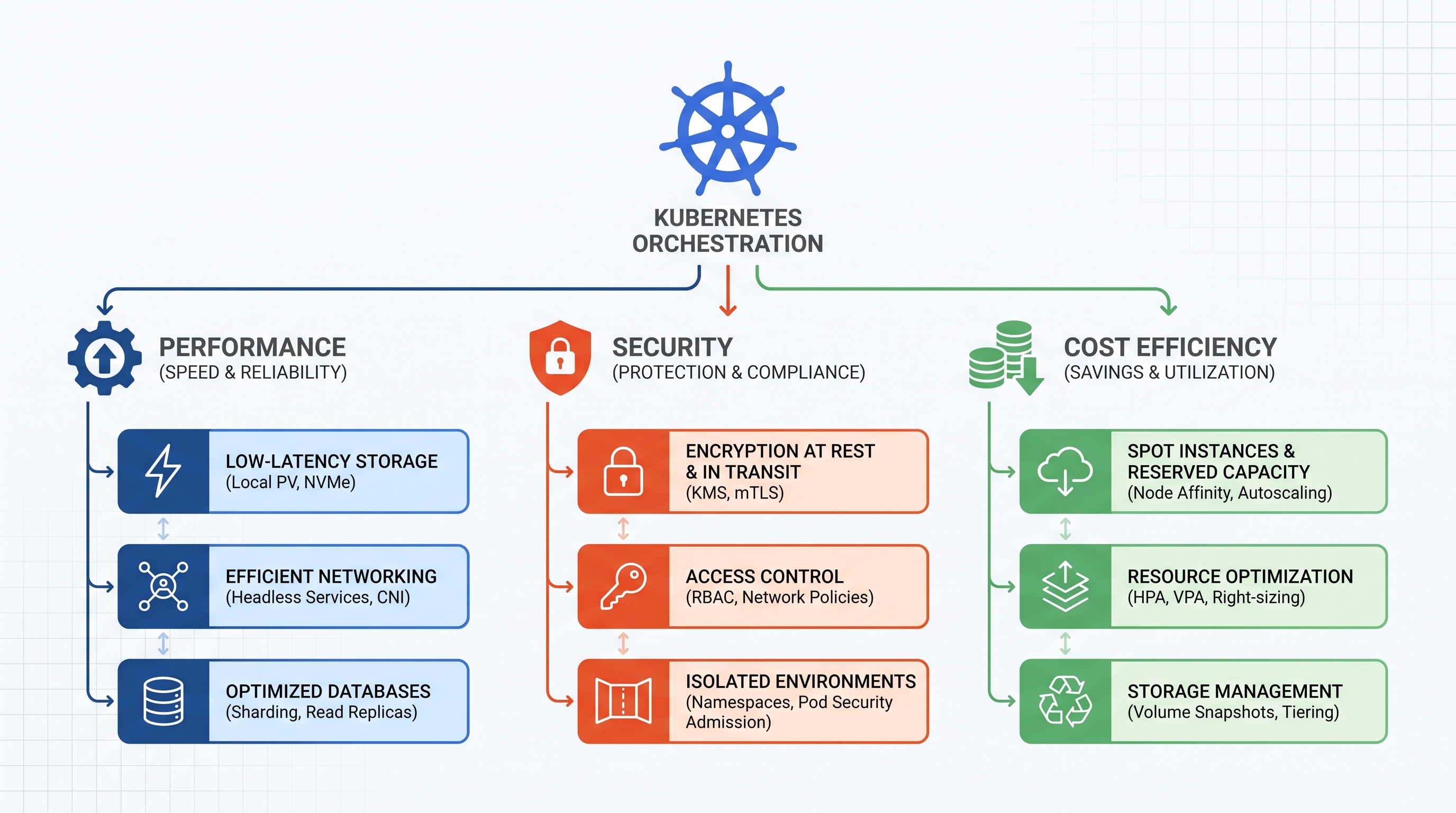
The Stateful Kubernetes Dilemma: Performance vs. Cost
The migration of stateful workloads—such as PostgreSQL, Kafka, Elasticsearch, and Redis—to Kubernetes has become an industry standard. The promise of unified orchestration, declarative configurations, and self-healing systems is highly compelling. However, platform engineering and FinOps teams quickly encounter a harsh reality: running stateful systems on Kubernetes can exponentially inflate cloud storage bills if not architected with extreme precision.
In stateless architectures, scaling up and down is virtually cost-neutral from a storage perspective. In contrast, stateful applications rely on Persistent Volumes (PVs) backed by cloud provider block storage (such as AWS EBS, Azure Managed Disks, or Google Cloud Persistent Disks). These storage resources are often over-provisioned to handle peak loads or historical growth projections. Because cloud providers bill for provisioned capacity and IOPS, rather than utilized capacity, organizations routinely pay for 50% to 80% idle storage space.
Furthermore, operational anti-patterns—such as retaining volumes after deleting StatefulSets, failing to optimize input/output operations per second (IOPS), and keeping uncompressed, redundant snapshots—create a silent financial drain. To solve this, cloud architects must implement a multi-layered strategy that optimizes the Container Storage Interface (CSI), leverages local hardware, tunes application-level caching, and automates lifecycle management.
Dynamic Provisioning and the Over-Provisioning Trap
Dynamic volume provisioning via StorageClasses is one of Kubernetes’ most powerful features. When a user creates a PersistentVolumeClaim (PVC), the CSI driver automatically provisions the underlying cloud disk. However, the default configurations of most cloud CSI drivers favor safety over economy, leading to immediate over-provisioning.
The Danger of Static and Over-Provisioned StorageClasses
Many legacy Kubernetes configurations define StorageClasses with rigid parameters. For example, a standard AWS gp3 StorageClass might default to provisioning a minimum size or a fixed amount of IOPS and throughput, regardless of the workload's actual requirements. When developers deploy databases, they often request 500GB or 1TB of storage "just in case," even if the initial database size is under 10GB. This mismatch results in immediate waste.
Implementing CSI Volume Expansion
To eliminate the need for speculative over-provisioning, platform teams must enable dynamic volume expansion. By setting allowVolumeExpansion: true in the StorageClass definition, Kubernetes allows administrators (and automated controllers) to resize volumes on-the-fly without restarting the underlying pods (provided the underlying filesystem supports online resizing, such as ext4 or XFS).
apiVersion: storage.k8s.io/v1
kind: StorageClass
metadata:
  name: gp3-resizable
provisioner: ebs.csi.aws.com
volumeBindingMode: WaitForFirstConsumer
allowVolumeExpansion: true
parameters:
  type: gp3
  iops: "3000"
  throughput: "125"
Note the use of volumeBindingMode: WaitForFirstConsumer. This is a critical cost-optimization parameter. By delaying volume provisioning until the pod is scheduled, Kubernetes ensures that the cloud disk is created in the exact Availability Zone (AZ) where the pod’s compute node resides. This prevents cross-AZ data transfer fees and avoids provisioning orphaned volumes for pods that fail to schedule due to resource constraints.
To systematically track and eliminate this waste across multi-cloud environments, organizations leverage the CloudAtler financial operations platform. By mapping real-time disk utilization metrics against provisioned CSI capacity, teams can identify underutilized volumes and dynamically trigger resizing policies, ensuring that storage expenditure matches actual data footprints.
Tiered Storage Architectures and Local Ephemeral Storage
Not all stateful data requires the durability and cost overhead of network-attached block storage. Many stateful applications use disk space for caching, indexing, temporary sorting, or write-ahead logging (WAL) that can be easily reconstructed or replicated across cluster nodes.
Leveraging Local NVMe SSDs via Local Persistent Volumes
For high-performance workloads like Cassandra, Elasticsearch, or Kafka, network-attached block storage introduces latency and substantial cost. Modern cloud instances (such as AWS i3en or GCP n2-node series) come equipped with physical, high-speed local NVMe SSDs. These disks offer sub-millisecond latency and hundreds of thousands of IOPS at no additional cost beyond the base instance price.
Instead of mounting network disks, architects should use Local Persistent Volumes (LPVs) for workloads that handle replication at the application layer. If a node fails, the application's native clustering mechanism replicates the lost data to a new node, eliminating the need for expensive cloud provider replication schemes.
apiVersion: v1
kind: PersistentVolume
metadata:
  name: local-nvme-pv
spec:
  capacity:
    storage: 1000Gi
  volumeMode: Filesystem
  accessModes:
  - ReadWriteOnce
  persistentVolumeReclaimPolicy: Delete
  storageClassName: local-nvme
  local:
    path: /mnt/disks/ssd0
  nodeAffinity:
    required:
      nodeSelectorTerms:
      - matchExpressions:
        - key: kubernetes.io/hostname
          operator: In
          values:
          - ip-10-0-1-50.ec2.internal
Hybrid Storage: Local NVMe and Object Storage
For systems like Elasticsearch or Grafana Loki, a hybrid storage approach yields massive savings. Configure the hot tier to run on local NVMe SSDs for rapid indexing and querying, while automatically offloading cold, historical data to highly cost-effective object storage (like AWS S3 or Google Cloud Storage) via CSI drivers like S3FS or native application integrations. Object storage is typically 70% to 90% cheaper than block storage per gigabyte.
Optimizing IOPS and Throughput Without the Cloud Tax
Cloud providers charge heavily for high-performance storage. For instance, AWS charges for provisioned IOPS on io2 volumes at a rate that can quickly dwarf compute costs. Even with newer gp3 volumes, provisioning throughput beyond the baseline 125 MB/s and 3,000 IOPS incurs incremental fees.
Application-Level Caching and Write Buffering
Before paying for provisioned IOPS at the storage layer, architects should optimize the application's memory footprint to reduce disk I/O. By tuning write buffers, dirty page flushes, and read caches, you can absorb spikes in memory rather than committing them immediately to disk.
PostgreSQL Tuning: Increase
shared_buffersto allow more data to be cached in RAM, and adjustwal_buffersandcheckpoint_completion_targetto smooth out write spikes over time, preventing disk queue saturation.Elasticsearch Tuning: Adjust the
index.translog.durabilitysetting. Changing this fromrequest(flush to disk on every request) toasync(flush every 5 seconds) dramatically reduces IOPS requirements, though it introduces a minor risk of losing 5 seconds of data in a catastrophic crash.Kernel-Level Tuning: Use
sysctlparameters inside the container or via a daemonset to optimize dirty page limits (vm.dirty_background_ratioandvm.dirty_ratio) to control how the Linux kernel caches writes before flushing them to the block device.
To ensure these optimizations do not degrade system stability, teams must monitor performance metrics in real-time. Utilizing CloudAtler's performance management capabilities allows engineers to correlate application response times, disk queue lengths, and actual IOPS usage with their direct financial impact, finding the sweet spot where performance and cost converge.
Managing Orphaned Volumes and Snapshot Lifecycle Policies
One of the most common sources of waste in Kubernetes clusters is "zombie" storage. When a developer deletes a namespace or a Helm release containing a StatefulSet, the associated PersistentVolumeClaims may be deleted, but the actual Persistent Volumes often remain in an orphaned state due to default reclaim policies.
The Reclaim Policy Pitfall
Kubernetes StorageClasses support two reclaim policies: Delete and Retain. While Retain is safer for production databases to prevent accidental data loss, it requires manual intervention to clean up the underlying cloud resources. If left unchecked, unattached volumes continue to accrue charges indefinitely.
To mitigate this, platform teams should implement automated reaper controllers or use custom cronjobs that scan the cloud provider APIs for unattached volumes (e.g., EBS volumes with a state of available rather than in-use) and cross-reference them with active Kubernetes PV resources. Any unattached volume older than a specified grace period should be snapshotted and safely deleted.
Smart Snapshotting and Deduplication
Backups are critical, but keeping daily full snapshots indefinitely is financially unsustainable. Cloud provider snapshots are incremental, but if your database has high churn (e.g., constant updates and deletions), every snapshot will capture massive delta changes, rapidly inflating costs.
To combat this, utilize tools like Velero with restic or Kopia integration. These tools perform file-level deduplication and compression before sending backup payloads to low-cost object storage, bypassing expensive block-level cloud snapshots. Before implementing these backup jobs, running a cost impact calculation helps teams understand the exact financial delta between block-level snapshots and object-storage deduplicated backups over a 365-day retention period.
Securing Stateful Storage Without Performance Degradation
Cost optimization must never come at the expense of cloud security. When managing stateful workloads, data-at-rest encryption, access control, and compliance are non-negotiable. However, poorly implemented security controls can introduce significant CPU and I/O overhead, indirectly driving up compute and storage costs.
Efficient Encryption-at-Rest
Avoid software-defined encryption layers inside the container filesystem, which consume valuable CPU cycles and slow down disk I/O. Instead, offload encryption to the cloud provider's hardware-accelerated infrastructure. By configuring your StorageClass to utilize KMS keys directly, the hypervisor handles encryption transparently with zero performance penalty.
apiVersion: storage.k8s.io/v1
kind: StorageClass
metadata:
  name: secure-gp3
provisioner: ebs.csi.aws.com
parameters:
  type: gp3
  encrypted: "true"
  kmsKeyId: arn:aws:kms:us-east-1:123456789012:key/your-kms-key-uuid
Strict RBAC and Network Policies for Stateful Pods
Stateful volumes contain the crown jewels of your organization. To protect them, implement strict Role-Based Access Control (RBAC) to restrict who can create, modify, or delete PVCs and PVs. Additionally, configure Kubernetes Network Policies to isolate database pods, ensuring only designated application microservices can communicate with them.
Integrating these storage architectures with a comprehensive cloud security management framework ensures that your cost-optimized storage assets remain fully compliant with SOC2, ISO27001, and HIPAA standards, automatically alerting on any misconfigured access controls or unencrypted volumes.
AI-Driven Storage Automation and FinOps Orchestration
As clusters scale to hundreds of nodes and thousands of microservices, manual storage optimization becomes impossible. Platform engineers cannot spend their days manually resizing PVCs, adjusting IOPS parameters, or writing scripts to clean up orphaned disks. This is where artificial intelligence and automated operations become vital.
By analyzing historical storage usage, read/write patterns, and cost metrics, machine learning models can predict when a database will run out of space and proactively expand the volume during low-traffic windows. Similarly, AI can detect anomalous I/O spikes and recommend configuration changes to prevent costly throttling or unnecessary upgrades to premium storage tiers.
The Atler AI engine acts as an automated pilot for your multi-cloud infrastructure, continuously scanning AWS, Azure, GCP, and Oracle environments. It dynamically balances storage performance, security compliance, and FinOps targets, executing automated guardrails to ensure your stateful workloads run at peak efficiency without manual intervention.
Conclusion: Unify Your Cloud Operations with CloudAtler
Running stateful workloads on Kubernetes does not have to result in a runaway storage budget. By implementing dynamic volume expansion, leveraging local NVMe SSDs for high-throughput caching, optimizing application-level buffers, and automating the deletion of orphaned volumes, organizations can achieve a highly secure, performant, and cost-efficient infrastructure.
However, managing these disparate strategies across complex multi-cloud environments requires a unified approach. CloudAtler brings together FinOps, cloud security, and automated operations into a single, intuitive platform. Stop guessing your storage needs and paying for idle capacity.
All in One Place
Atler Pilot decodes your cloud spend story by bringing monitoring, automation, and intelligent insights together for faster and better cloud operations.