
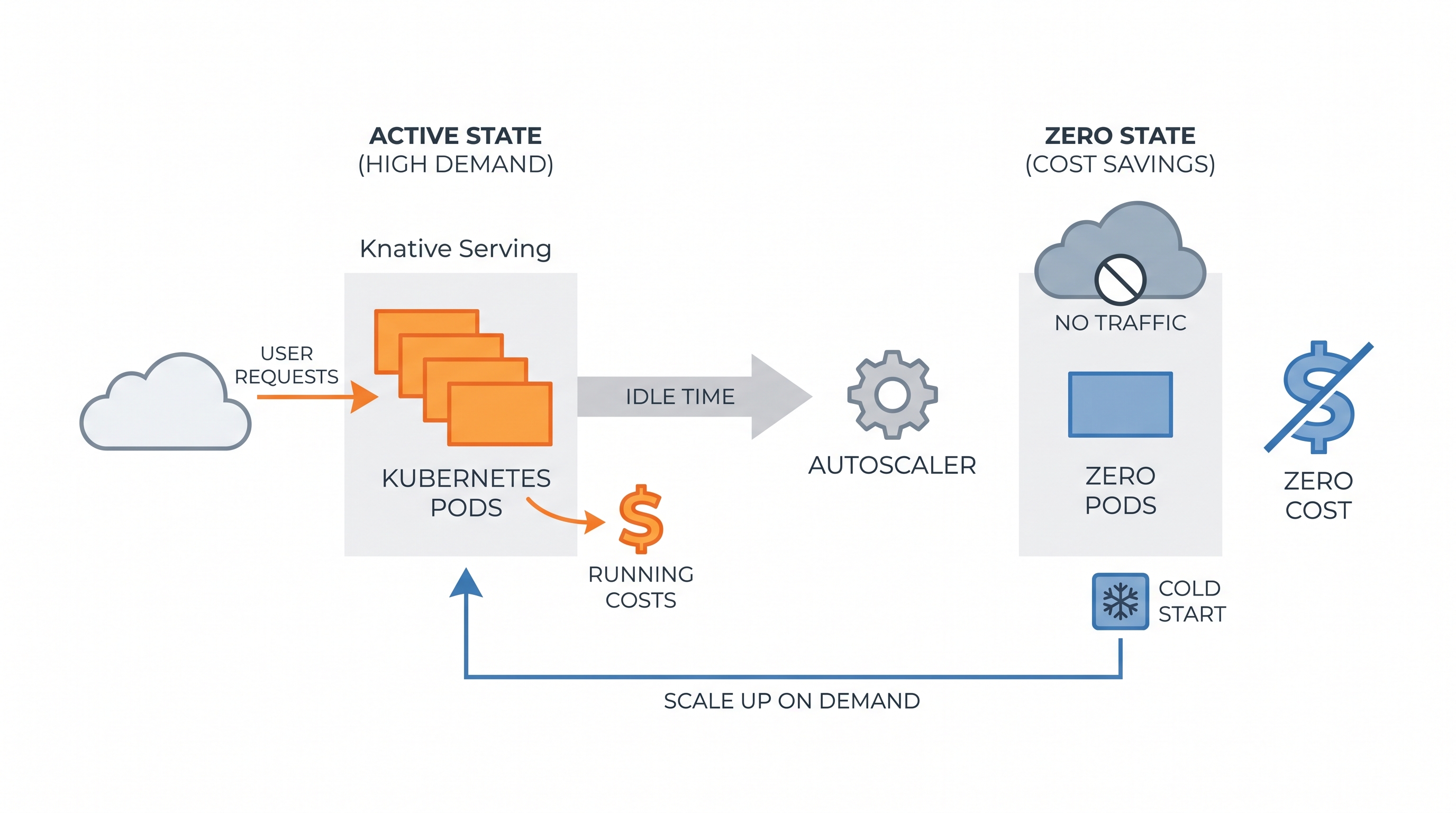
Introduction: The Cost of Idle Kubernetes Resources
In modern enterprise cloud environments, resource over-provisioning is one of the primary drivers of cloud spend waste. Kubernetes, while highly effective at orchestrating containerized applications, was fundamentally designed for long-running, always-on workloads. By default, a Kubernetes deployment maintains a minimum number of running replicas (pods) to handle incoming traffic. When traffic drops to zero—such as during non-business hours, in development and staging environments, or for asynchronous event-driven workers—these idle pods continue to consume CPU and memory allocations.
This idle state represents a direct financial drain. Cloud providers charge for the underlying virtual machines (nodes) that back your Kubernetes clusters, regardless of whether those nodes are executing active business logic or merely hosting idling containers. To solve this efficiency gap, enterprise cloud architects are increasingly turning to serverless container paradigms. By integrating Knative into your Kubernetes clusters, you can transition from static provisioning to request-driven, dynamic autoscaling—including scaling down to absolute zero replicas when idle.
However, implementing scale-to-zero in production is not as simple as deploying a single YAML manifest. It requires a deep understanding of Knative's internal routing data plane, tuning autoscaling metrics, coordinating with cluster-level node autoscalers, mitigating cold starts, and ensuring robust security boundaries. This article provides an exhaustive architectural blueprint for designing, deploying, and optimizing Knative Serving to maximize FinOps efficiency without compromising system performance or security.
1. The Core Architecture of Knative Serving
To successfully run scale-to-zero workloads, we must first understand how Knative Serving restructures the traditional Kubernetes networking and runtime paradigm. Traditional Kubernetes routing sends traffic from an Ingress controller directly to a Service, which forwards it to active Pods via kube-proxy. If there are zero pods, the connection simply fails.
Knative solves this by introducing a highly dynamic routing mechanism that intercepts traffic when pods are absent. The core architectural components of Knative Serving include:
The Controller: A custom Kubernetes controller that monitors Knative Custom Resource Definitions (CRDs) such as
Route,Configuration,Revision, andService(not to be confused with core Kubernetes Services). The Controller translates these CRDs into lower-level Kubernetes resources like Deployments, Services, and Ingress routing rules.The Activator: A highly scalable routing component that acts as a buffer and a traffic gateway. When a Knative Service has scaled down to zero replicas, the routing rules are dynamically updated to point all incoming traffic to the Activator. The Activator holds the incoming HTTP requests in a buffer, signals the autoscaler to spin up new pods, and then proxies the buffered requests to the new pods once they are healthy.
The Knative Pod Autoscaler (KPA): Unlike the native Kubernetes Horizontal Pod Autoscaler (HPA), which primarily relies on CPU and Memory metrics collected periodically via the Metrics Server, the KPA measures concurrent requests. It can scale pods up rapidly during traffic spikes and down to zero when there is no active traffic.
The Queue-Proxy: A sidecar container injected into every Knative-managed Pod. The Queue-Proxy intercepts all incoming traffic to the application container, measuring request concurrency and reporting metrics directly to the KPA at high frequency (every second).
The Scale-to-Zero Request Flow
When a Knative service is idle (0 replicas), the request lifecycle proceeds as follows:
An incoming HTTP request arrives at the cluster's Ingress gateway (e.g., Istio, Contour, or Kourier).
Because the target service is scaled to zero, the Ingress routing table directs the traffic to the Activator.
The Activator buffers the incoming TCP/HTTP connection and immediately sends a metrics update to the Knative Pod Autoscaler (KPA) indicating pending load.
The KPA instructs the Kubernetes API server to scale the deployment from 0 to 1 replica.
The underlying Kubernetes scheduler provisions the pod. Once the pod is running, the Queue-Proxy sidecar reports readiness.
The Activator detects the healthy pod, forwards the buffered HTTP request to the pod's Queue-Proxy, and updates the Ingress routing table to bypass the Activator for subsequent requests.
2. Configuring Knative for Scale-to-Zero
Enabling and tuning scale-to-zero requires configuring both global Knative parameters and specific service-level annotations. Below, we examine the precise configuration steps and manifests required to control the lifecycle of serverless workloads.
Global Autoscaler Configuration
Global defaults for the Knative Pod Autoscaler are managed via a ConfigMap named config-autoscaler within the knative-serving namespace. To enable scale-to-zero globally and define the grace periods, you must configure the following key-value pairs:
apiVersion: v1
kind: ConfigMap
metadata:
  name: config-autoscaler
  namespace: knative-serving
data:
  # Enable scale-to-zero capability
  enable-scale-to-zero: "true"

  # The time window of inactivity before scaling down to zero
  scale-to-zero-grace-period: "30s"

  # The time period over which the autoscaler calculates average concurrency
  stable-window: "60s"

  # The percentage of target concurrency that triggers panic mode (rapid scaling)
  panic-window-percentage: "10.0"

  # The default concurrency target per pod
  container-concurrency-target-default: "100"
In this configuration, the scale-to-zero-grace-period defines how long Knative will wait after traffic drops to zero before terminating the last remaining pod. The stable-window is the evaluation window used to calculate average concurrency. If you set this too short, your system may experience "churning" (frequent scaling up and down); if set too long, you will pay for idle resources longer than necessary.
Service-Level Configurations
While global defaults establish the baseline, individual microservices have different traffic patterns, resource footprints, and latency tolerances. You can override global autoscaling behavior using annotations within the Knative Service (ksvc) manifest:
apiVersion: serving.knative.dev/v1
kind: Service
metadata:
  name: transactional-processor
  namespace: payment-processing
spec:
  template:
    metadata:
      annotations:
        # Override the autoscaling class (KPA is default, HPA can also be used)
        autoscaling.knative.dev/class: "kpa.autoscaling.knative.dev"

        # Override the target concurrency per pod for this specific service
        autoscaling.knative.dev/target: "10"

        # Set the minimum scale (0 allows scaling to zero)
        autoscaling.knative.dev/min-scale: "0"

        # Set the maximum scale to prevent runaway cloud costs
        autoscaling.knative.dev/max-scale: "50"

        # Customize the scale-to-zero grace period for this service
        autoscaling.knative.dev/scale-to-zero-grace-period: "15s"
    spec:
      containerConcurrency: 10
      containers:
        - image: gcr.io/enterprise-registry/transaction-service:v2.1.0
          resources:
            limits:
              cpu: "1"
              memory: "1Gi"
            requests:
              cpu: "200m"
              memory: "256Mi"
          ports:
            - containerPort: 8080
In the manifest above, we explicitly set autoscaling.knative.dev/min-scale: "0". If an application is highly latency-sensitive and cannot tolerate any cold starts, you can set this value to "1". This keeps at least one pod active at all times, which still allows you to leverage Knative's rapid concurrency-based scaling for traffic spikes while sacrificing scale-to-zero savings for that specific workload.
3. Mitigating the Cold Start Penalty
The primary trade-off of scale-to-zero is the "cold start" penalty. When a request hits a service scaled to zero, the user must wait for the container image to be pulled (if not cached), the pod to be scheduled, the container runtime to initialize, and the application runtime (e.g., JVM, Node.js, .NET) to bootstrap and pass readiness probes. This latency can range from a few hundred milliseconds to tens of seconds, which is unacceptable for user-facing, real-time APIs.
To maintain high user experience while optimizing cloud costs, platform engineers must implement aggressive cold start mitigation strategies across multiple layers of the stack. For organizations seeking to balance performance and cost, utilizing an advanced performance management framework is critical to identifying and addressing these latency bottlenecks dynamically.
Container Image Optimization
The size of your container image directly impacts the time it takes for a Kubernetes node to pull the image from a registry. To minimize image transfer latency:
Use Distroless or Alpine Baselines: Avoid bloating your production images with operating system packages, shells, and debugging utilities. A distroless image containing only your compiled binary or runtime dependencies reduces the payload size from hundreds of megabytes to tens of megabytes.
Implement Multi-Stage Builds: Ensure that build-time dependencies (compilers, package managers, test suites) are completely discarded in the final runtime image stage.
Leverage Image Pull Policies: Set
imagePullPolicy: IfNotPresentto ensure that nodes use cached images whenever possible, preventing redundant network requests.
Application Runtime Optimization
Even with a microscopic container image, application startup times can introduce significant delays. Modern JVM frameworks like Spring Boot are notoriously slow to start due to runtime classpath scanning and reflection. Consider these runtime optimizations:
Ahead-of-Time (AOT) Compilation: Use GraalVM to compile Java applications into native machine code. GraalVM native binaries start in milliseconds and consume a fraction of the memory of a traditional JVM.
Lightweight Runtimes: For microservices where cold starts are a critical metric, favor languages with low runtime overhead such as Go, Rust, or optimized Node.js configurations over heavy enterprise runtimes.
Fine-Tune Liveness and Readiness Probes: Ensure your readiness probes are lightweight and execute quickly. If your probe takes 5 seconds to run its first check, you have added an artificial 5-second delay to every cold start.
Kubernetes Infrastructure Optimization
Beyond the application itself, the underlying Kubernetes cluster must be tuned to schedule and initialize pods rapidly:
Pre-pulled Images / DaemonSets: Use a DaemonSet to pre-pull common base layers (like runtime environments or sidecars) onto all nodes in the cluster, reducing the network bottleneck during pod creation.
Local Image Registries: Deploy your container registry in the same cloud region and availability zone as your Kubernetes cluster to maximize network throughput and minimize latency.
eBPF-based Networking: Implement an eBPF-based container network interface (CNI) like Cilium to accelerate network path routing and pod-to-pod communication initialization.
4. FinOps Integration: Scaling the Infrastructure Layer
A common architectural pitfall is configuring Knative to scale pods to zero while leaving the underlying Kubernetes nodes running idle. If your cluster maintains 20 virtual machine instances to host pods that are now scaled down to zero, your cloud bill will remain unchanged. True serverless efficiency requires tight integration between application-level autoscaling (Knative) and infrastructure-level node autoscaling.
To realize the financial benefits of scale-to-zero, you must couple Knative with a dynamic node autoscaler such as Karpenter (on AWS) or Cluster Autoscaler with aggressive consolidation enabled. To understand the economic impact of these scaling decisions across your multi-cloud environment, leveraging a dedicated financial operations platform is essential for mapping container lifecycle events directly to cloud billing data.
Coordinating Karpenter and Knative
Karpenter is a highly responsive, node-provisioning engine designed for Kubernetes. Unlike the traditional Cluster Autoscaler, which scales node groups, Karpenter bypasses node groups and provisions the optimal virtual machine instances directly based on the pending pod resource requirements.
When Knative scales a deployment from 0 to 1, Karpenter instantly detects the unschedulable pod, evaluates the CPU/Memory requests, and provisions a new node in seconds. Conversely, when Knative scales pods down to zero, Karpenter's consolidation algorithm detects that the node is empty (or underutilized) and terminates the virtual machine, stopping the billing meter immediately.
Calculating the Cost Impact
To quantify the savings of this architecture, consider an enterprise microservice with the following parameters:
Resource Allocation: 2 vCPUs, 4 GiB RAM per pod.
Cloud Instance Cost: AWS
c6i.xlarge(4 vCPUs, 8 GiB RAM) costing approximately $122.64/month ($0.168/hour).Workload Profile: Active for only 4 hours a day (e.g., batch processing, business-hours tools). Idle for 20 hours a day.
Without scale-to-zero, maintaining a minimum of 2 pods for high availability requires at least one dedicated c6i.xlarge instance running 24/7, costing $122.64 per month per service.
With Knative scale-to-zero and Karpenter consolidation, the node is terminated during the 20 hours of idleness. The monthly cost drops to:(4 hours/day * 30 days * $0.168/hour) = $20.16 per month.
This represents an immediate 83.5% cost reduction for a single microservice. Across an enterprise catalog of hundreds of staging, development, and intermittent production services, these savings compound into tens of thousands of dollars monthly. By using an automated cost impact calculation, FinOps teams can easily visualize and report these real-time savings directly to stakeholders.
5. Security Architecture in Serverless Kubernetes
Transitioning to a serverless, dynamic container lifecycle introduces unique security challenges. Because pods are constantly being created, terminated, and scaled across different physical nodes, traditional perimeter-based security and static network policies are no longer sufficient. Enterprise architects must implement a Zero-Trust security model tailored for dynamic environments.
A comprehensive security management program for serverless Kubernetes must address identity, network segmentation, and runtime vulnerability posture.
Dynamic Pod Identities
Avoid using shared, broad-permission service accounts for your Knative workloads. Since Knative services scale to zero and spin up on demand, they must be assigned minimal-privilege ServiceAccounts that leverage cloud-native IAM roles (e.g., AWS IAM Roles for Service Accounts - IRSA, or GCP Workload Identity). This ensures that a compromised pod can only access the specific cloud resources (databases, queues, storage buckets) required for its immediate execution.
Mutual TLS (mTLS) and Service Mesh Integration
Because Knative relies on the Activator and Ingress controllers to route and buffer traffic, securing the transit path is paramount. Integrating Knative with a service mesh like Istio or Linkerd allows you to enforce strict mutual TLS (mTLS) across the entire request path:
apiVersion: security.istio.io/v1beta1
kind: PeerAuthentication
metadata:
  name: default
  namespace: knative-serving
spec:
  mtls:
    mode: STRICT
This configuration ensures that all traffic between the Ingress gateway, the Activator, the Queue-Proxy, and the application container is encrypted and authenticated. It prevents man-in-the-middle attacks and unauthorized pod-to-pod communication within the cluster.
Runtime Security and Short-Lived Containers
Traditional security scanners rely on periodic, scheduled scans of running containers. In a serverless environment where pods may only exist for a few minutes or seconds to process a single request, scheduled scans will miss these workloads entirely. To secure short-lived containers:
Admission Controllers: Deploy mutating and validating admission controllers (such as Kyverno or OPA Gatekeeper) to block containers from running as root, enforcing read-only root filesystems, and blocking unapproved registries.
Continuous Vulnerability Scanning: Scan container images at the registry level before deployment. Ensure that any image with critical vulnerabilities is blocked from being scheduled by Knative.
Kernel-Level Runtime Monitoring: Use eBPF-based security tools (like Tetragon or Falco) to monitor system calls and kernel behavior in real time. This allows you to detect anomalous behavior (such as unauthorized process execution or privilege escalation) even within a pod that only exists for a brief window.
6. Enterprise Governance and Multi-Cluster Orchestration
As organizations scale their Knative adoption across multiple business units and cloud providers, governance becomes a critical success factor. Without automated guardrails, decentralized engineering teams can easily misconfigure autoscaling parameters—such as setting min-scale to high values or failing to define resource limits—which completely invalidates the cost-saving objectives of the serverless architecture.
To prevent these inefficiencies, platform teams must establish centralized policies that align developer velocity with executive financial oversight. Supporting CIO FinOps initiatives requires a platform that bridges the gap between raw Kubernetes metrics and business-level budgeting.
Workload Type | Recommended Min/Max Scale | Autoscaler Class | Target Concurrency | FinOps Priority |
|---|---|---|---|---|
Staging & Dev Environments | Min: 0 / Max: 5 | KPA | 10 - 20 | Maximum Savings (Scale-to-zero enforced) |
Asynchronous Event Workers | Min: 0 / Max: 100 | KPA (Eventing) | 1 (Single-threaded execution) | High Efficiency (Match demand precisely) |
Internal Enterprise APIs | Min: 0 / Max: 20 | KPA | 50 | Balanced (Slight cold start tolerance) |
Customer-Facing Checkout APIs | Min: 2 / Max: 200 | HPA (CPU/Memory) | N/A (Resource-based) | Performance First (No cold starts allowed) |
By defining clear tiers of service, as shown in the table above, enterprise architects can enforce automated policy engines that inject correct annotations into Knative manifests based on the namespace or deployment environment. This ensures that development environments automatically default to strict scale-to-zero configurations, while critical production APIs maintain warm replicas to guarantee peak performance.
Conclusion: Unify Your Serverless Operations with CloudAtler
Architecting serverless Kubernetes with Knative offers a powerful, request-driven approach to eliminating cloud waste. By scaling workloads down to zero when idle, organizations can realize massive, immediate savings on their compute bills. However, orchestrating this architecture across multi-cloud environments—while managing performance trade-offs, cold starts, cluster autoscaling, and complex security policies—demands a unified, intelligent operational platform.
CloudAtler solves these operational complexities by unifying FinOps, cloud security, and automated operations into a single, cohesive platform. With CloudAtler, you gain deep visibility into your serverless infrastructure, allowing you to automatically track the cost impact of scale-to-zero policies, optimize your Kubernetes resources, and secure your ephemeral workloads across AWS, Azure, GCP, and Oracle Cloud environments.
Don't let idle resources drain your cloud budget. Take control of your Kubernetes architecture, automate your FinOps governance, and secure your modern cloud-native applications with CloudAtler. Explore the CloudAtler Platform today or schedule a personalized demo to see how we can optimize your cloud operations.
All in One Place
Atler Pilot decodes your cloud spend story by bringing monitoring, automation, and intelligent insights together for faster and better cloud operations.