
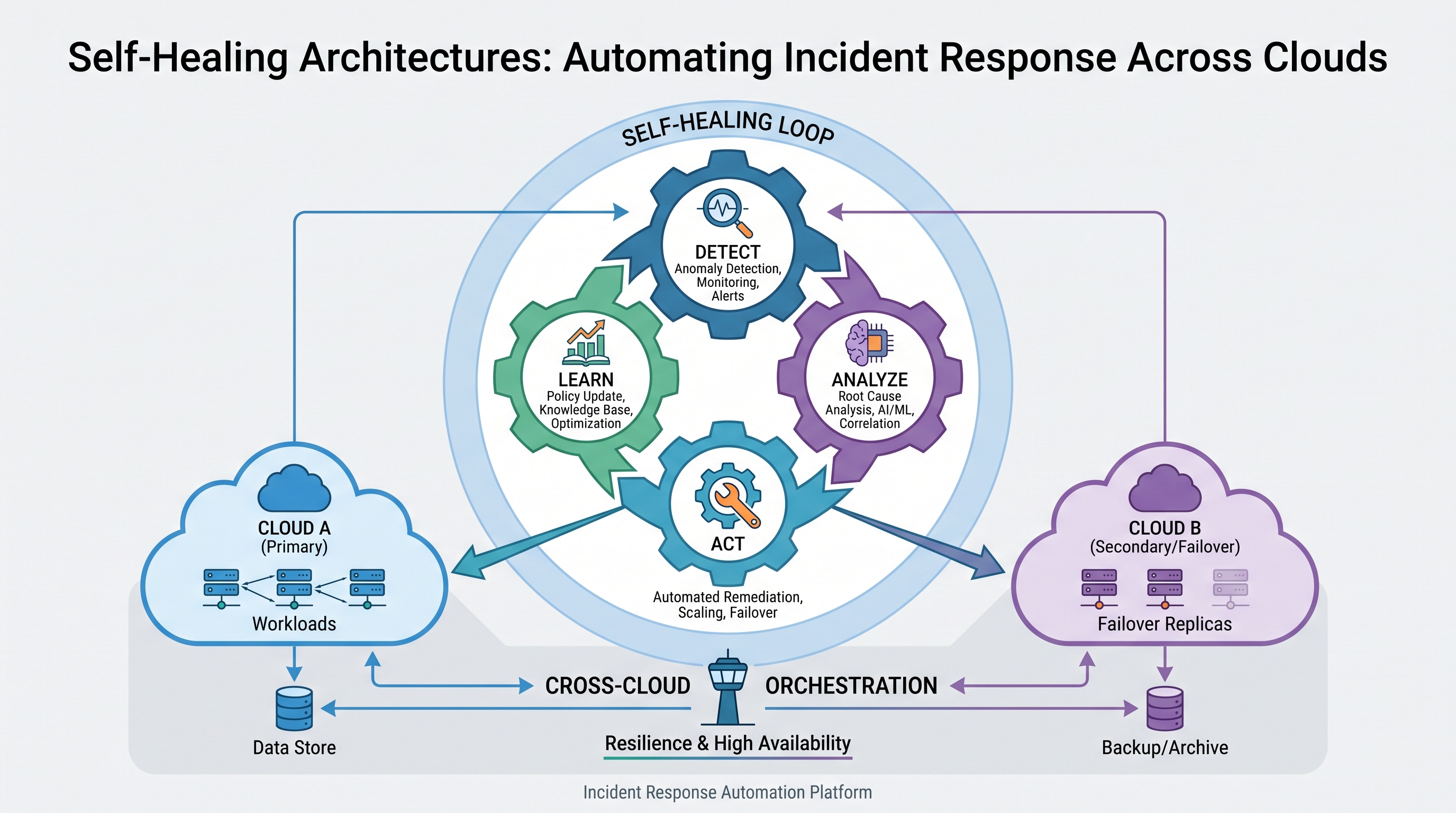
In the intricate landscape of modern enterprise cloud operations, incidents are not a matter of 'if,' but 'when.' The proliferation of microservices, distributed systems, and multi-cloud deployments (AWS, Azure, GCP, Oracle) has dramatically increased the surface area for potential failures, performance degradations, and security breaches. Manual incident response, once a standard practice, is now a bottleneck, leading to unacceptable downtime, escalating operational costs, and compromised security postures. This reality necessitates a paradigm shift towards self-healing architectures – systems designed to autonomously detect, diagnose, and remediate issues with minimal human intervention.
For organizations navigating the complexities of FinOps and cloud security, self-healing is not merely an operational luxury; it's a strategic imperative. It directly impacts the bottom line by reducing mean time to recovery (MTTR), preventing costly outages, optimizing resource utilization, and bolstering an organization's security resilience. At CloudAtler, we understand these challenges intimately, providing an AI-powered platform that unifies FinOps, cloud security, and automated operations across your diverse cloud footprint.
The Imperative for Self-Healing in Modern Enterprise Clouds
The operational burden of managing disparate cloud environments is immense. Each cloud provider offers its unique set of services, APIs, and operational models, creating silos that hinder holistic visibility and consistent incident response. Consider a typical enterprise stack: an application might leverage AWS Lambda for serverless functions, an Azure Kubernetes Service (AKS) cluster for containerized microservices, a GCP Cloud SQL instance for databases, and Oracle Cloud Infrastructure (OCI) for mission-critical legacy applications. A performance degradation originating from a misconfigured network security group in Azure could impact a dependent service running on AWS, yet diagnosing and resolving this cross-cloud issue manually can take hours, if not days.
This complexity translates directly into financial and security risks:
Financial Impact: Downtime costs enterprises millions per hour, not to mention lost revenue, customer churn, and reputational damage. Unplanned incidents often lead to reactive, inefficient scaling decisions, resulting in unnecessary cloud spend. Furthermore, manual incident response consumes expensive engineering hours that could be better spent on innovation.
Security Posture: A slow response to a detected vulnerability or an active threat actor can lead to data breaches, compliance violations, and significant regulatory fines. Manual patching and remediation processes are inherently error-prone and time-consuming, leaving windows of vulnerability open for extended periods.
Operational Overhead: The sheer volume of alerts from various monitoring tools across multiple clouds often leads to "alert fatigue," where critical issues are missed amidst the noise. Manual troubleshooting involves navigating multiple dashboards, correlating logs, and executing predefined runbooks, all of which are inefficient and prone to human error.
Self-healing architectures address these challenges head-on by embedding automation and intelligence into the very fabric of your cloud infrastructure, allowing systems to autonomously restore themselves to a healthy state, thereby enhancing resilience, reducing operational costs, and significantly improving your security posture.
Foundational Pillars of a Self-Healing Architecture
Building a robust self-healing system requires a layered approach, integrating several key components that work in concert across your multi-cloud environment.
1. Robust Observability & Monitoring
The cornerstone of any self-healing system is comprehensive observability. You cannot heal what you cannot see. This involves collecting metrics, logs, and traces from every component across AWS, Azure, GCP, and Oracle environments. A unified approach to data ingestion and analysis is critical to break down cloud silos.
Metrics: CPU utilization, memory consumption, network I/O, disk throughput, request latency, error rates, queue depths. These provide a real-time snapshot of system health. Cloud-native services like AWS CloudWatch, Azure Monitor, and GCP Operations Suite (formerly Stackdriver) are essential, but a centralized aggregation layer (e.g., Prometheus with Grafana, Datadog, New Relic) is often necessary for cross-cloud correlation.
Logs: Application logs, infrastructure logs, security logs (e.g., CloudTrail, Azure Activity Logs, GCP Audit Logs). Centralized log management (e.g., ELK Stack, Splunk, Sumo Logic) is vital for diagnostics and auditing.
Traces: Distributed tracing (e.g., OpenTelemetry, Jaeger, Zipkin) helps visualize the flow of requests across microservices, identifying bottlenecks and failures in complex distributed systems.
The goal is to move beyond simple threshold-based alerting to more intelligent anomaly detection, which can identify deviations from normal behavior even without predefined rules. CloudAtler's platform provides a unified dashboard that aggregates critical operational intelligence and metrics across all your cloud providers, offering a single pane of glass for comprehensive visibility and enabling proactive predictive monitoring operations.
2. Intelligent Alerting & Event Management
Raw telemetry data is useful, but it needs to be processed into actionable insights. Intelligent alerting systems filter out noise, correlate related events, and escalate only the most critical issues. This often involves:
Context-Aware Alerts: Alerts that include relevant metadata (e.g., affected service, team ownership, runbook links) to accelerate diagnosis.
Event Correlation: Using AI/ML to identify patterns and relationships between seemingly disparate events. For instance, multiple failing instances across different Availability Zones might indicate a regional service degradation rather than individual instance failures. CloudAtler leverages multi-resource detection to identify complex interdependencies and trigger more accurate alerts.
Dynamic Thresholds: Leveraging machine learning to establish baselines and detect anomalies that static thresholds might miss, reducing false positives.
Once an alert is triggered, an event management system routes it to the appropriate automated remediation workflow or human operator, ensuring timely response.
3. Automated Remediation Workflows (Playbooks)
This is the core of self-healing. Automated remediation workflows, often called "playbooks" or "runbooks as code," are predefined sequences of actions executed in response to specific incidents. These workflows are designed to be:
Idempotent: Executing the same action multiple times has the same effect as executing it once.
Atomic: Each step is a discrete, testable unit.
Safe: Includes checks and balances, and potentially human approval gates for high-impact actions.
Version-Controlled: Stored in a Git repository, allowing for review, rollback, and auditing.
Examples of tools for building these workflows include AWS Step Functions, Azure Logic Apps, GCP Workflows, Ansible, Terraform, and custom Lambda/Functions/Cloud Run services. For critical operations like patching, CloudAtler provides robust patch remediation capabilities, ensuring that updates are deployed efficiently and safely across your multi-cloud estate, with built-in safe rollbacks in case of issues.
4. Policy-Driven Governance & Compliance
Self-healing systems must operate within defined boundaries to prevent unintended consequences and ensure compliance. This is achieved through policy-as-code and automated governance frameworks:
Infrastructure as Code (IaC): Tools like Terraform, CloudFormation, Azure Resource Manager templates, and GCP Deployment Manager define and manage cloud resources, ensuring consistency and preventing configuration drift.
Security Policies: Automated enforcement of security best practices, such as ensuring all S3 buckets are encrypted, no public IPs are assigned to sensitive databases, or specific ports are blocked.
Cost Optimization Policies: Automatically terminating idle resources, enforcing tag compliance for cost allocation, or rightsizing instances based on utilization.
Compliance Guardrails: Implementing automated checks to ensure configurations adhere to regulatory requirements (e.g., GDPR, HIPAA, PCI DSS).
CloudAtler offers comprehensive security management features, including native governance and guardrails, to enforce policies and ensure your self-healing actions align with your organizational standards and compliance mandates.
Designing for Multi-Cloud Self-Healing: Architectural Patterns and Challenges
Implementing self-healing across disparate cloud environments introduces unique architectural considerations:
Centralized vs. Decentralized Control Plane: While cloud-native services offer powerful automation within their respective ecosystems, a true multi-cloud self-healing architecture often benefits from a centralized control plane. This allows for unified monitoring, consistent policy enforcement, and orchestrated remediation workflows that can span across AWS, Azure, GCP, and Oracle. CloudAtler embodies this centralized approach, offering a single platform to orchestrate operations across all your clouds.
Hybrid Cloud Considerations: Many enterprises still operate significant on-premises infrastructure. Integrating these hybrid components into the self-healing loop requires robust connectivity (e.g., VPNs, Direct Connect, ExpressRoute, Cloud Interconnect) and consistent tooling for monitoring and automation.
Identity and Access Management (IAM): A critical challenge is securely granting permissions for automated systems to perform actions across different cloud providers. This requires careful configuration of IAM roles, service principals, and federated identities, adhering to the principle of least privilege.
Network Fabric: Ensuring secure and efficient communication between automation components and the resources they manage across different cloud networks is paramount. This includes secure API endpoints, private link services, and robust network segmentation.
Data Consistency and DR: Self-healing actions, particularly those involving resource replacement or replication, must consider data consistency and disaster recovery strategies. Automated failover mechanisms should be designed to minimize data loss and ensure rapid recovery.
Real-World Scenarios and Technical Implementations
Let's delve into concrete examples of how self-healing architectures operate in a multi-cloud enterprise context, highlighting both FinOps and security implications.
Scenario 1: Resource Exhaustion & Auto-Scaling
Problem: A sudden surge in user traffic causes high CPU utilization on a set of critical application servers (e.g., AWS EC2 instances, Azure VMs, GCP Compute Engine instances) across different regions, leading to performance degradation and potential outages.
Self-Healing Implementation:
Detection:
AWS: CloudWatch alarms configured for average CPU utilization exceeding 80% for 5 minutes on an EC2 Auto Scaling Group.
Azure: Azure Monitor metrics alert for VMSS (Virtual Machine Scale Set) CPU utilization above 80%.
GCP: Cloud Monitoring alert policy for Instance Group CPU utilization over 80%.
Trigger: The respective cloud monitoring service triggers an event.
Remediation:
AWS: The CloudWatch alarm directly triggers the EC2 Auto Scaling Group to add more instances.
Azure: The Azure Monitor alert triggers an Action Group, which can invoke an Azure Automation Runbook or Azure Function to scale out the VMSS.
GCP: The Cloud Monitoring alert triggers a Cloud Function, which interacts with the Instance Group Manager API to increase the number of instances.
Cross-Cloud Orchestration (CloudAtler): A centralized CloudAtler automation rule detects the performance degradation across multiple cloud providers via its unified monitoring, intelligently assesses the global load, and orchestrates scaling actions across affected services, potentially triggering dynamic scaling for databases or message queues as well.
Verification: Monitoring systems confirm that CPU utilization has returned to normal and application latency has decreased.
FinOps Optimization: Automated scaling prevents over-provisioning during off-peak hours and ensures resources are only added when truly needed, optimizing compute spend. After the incident, CloudAtler’s compute lifecycle analysis can recommend right-sizing adjustments to prevent future, similar incidents from requiring excessive scaling, further reducing costs.
Scenario 2: Security Incident & Automated Containment
Problem: A web server on an AWS EC2 instance is detected attempting to connect to a known malicious IP address, indicating a potential compromise.
Self-Healing Implementation:
Detection:
AWS: AWS GuardDuty detects the suspicious network activity and generates a finding.
Azure: Azure Security Center (now Defender for Cloud) detects a similar outbound connection from an Azure VM.
GCP: GCP Security Command Center or custom VPC Flow Logs analysis detects the anomaly.
Trigger: The security service publishes an event (e.g., EventBridge on AWS, Azure Event Grid, GCP Cloud Pub/Sub).
Remediation:
AWS: An EventBridge rule triggers an AWS Lambda function. The Lambda function automatically modifies the security group of the compromised EC2 instance to deny all outbound internet access, isolates the instance into a quarantine subnet, and takes a snapshot for forensic analysis.
Azure: An Azure Logic App triggered by the Security Center alert updates Network Security Group (NSG) rules to isolate the VM and triggers an Azure Automation Runbook to take a snapshot.
GCP: A Cloud Function triggered by a Security Command Center alert modifies firewall rules to isolate the VM and initiates a disk snapshot.
Cross-Cloud Orchestration (CloudAtler): CloudAtler’s CISO security features detect the threat via integrations with native cloud security services. Its AI-powered engine analyzes the blast radius and orchestrates containment actions across all affected cloud resources, regardless of their provider, ensuring rapid isolation and forensics while minimizing broader service disruption.
Verification: Automated checks confirm the instance is isolated and no further malicious activity is detected. Security teams are notified for deeper investigation.
Security Best Practice: This automated containment significantly reduces the window of opportunity for attackers, limiting data exfiltration and further lateral movement. It ensures compliance with incident response policies and minimizes the financial impact of a breach.
Scenario 3: Application Performance Degradation & Self-Healing Rollbacks
Problem: Following a new deployment to a Kubernetes cluster (e.g., EKS, AKS, GKE), application error rates spike, and latency increases significantly.
Self-Healing Implementation:
Detection:
Multi-Cloud Monitoring: Centralized observability tools (e.g., Prometheus, Datadog) or cloud-native monitoring (e.g., CloudWatch Container Insights, Azure Monitor for Containers, GCP Cloud Monitoring for GKE) detect a sudden increase in 5xx errors and P99 latency for the deployed service.
Trigger: The monitoring system triggers an alert.
Remediation:
Kubernetes Rollback: A webhook or automated pipeline (e.g., Argo CD, Spinnaker, Jenkins) receives the alert and initiates a
kubectl rollout undocommand for the affected deployment, reverting it to the previous stable version.CloudAtler Orchestration: CloudAtler’s performance management capabilities identify the degradation, correlate it with recent deployments across any cloud (AWS CodeDeploy, Azure DevOps, GCP Cloud Build), and automatically trigger a safe rollback to the last known good configuration. This includes verifying the health of the previous version before completing the rollback.
Verification: Monitoring confirms error rates have decreased and latency has returned to acceptable levels. Development teams are notified for root cause analysis.
FinOps Optimization: Rapid automated rollbacks prevent prolonged service degradation, minimizing potential revenue loss and protecting customer satisfaction. This also reduces the need for costly manual intervention during high-stress situations.
Scenario 4: Patch Management & Remediation
Problem: A critical zero-day vulnerability is announced for a widely used operating system or application component running on instances across all cloud providers.
Self-Healing Implementation:
Detection:
Vulnerability Scanning: Automated vulnerability scanners (e.g., Qualys, Tenable, or cloud-native services like AWS Inspector, Azure Security Center, GCP Security Command Center) identify affected instances.
CloudAtler Patch Intelligence: CloudAtler’s patch intelligence capabilities proactively identify critical vulnerabilities and correlate them with your multi-cloud inventory, providing a prioritized list of affected resources based on their business impact.
Trigger: The vulnerability detection system or CloudAtler generates an alert and initiates a remediation workflow.
Remediation:
Automated Patching:
AWS: AWS Systems Manager Patch Manager applies patches to EC2 instances.
Azure: Azure Automation Update Management deploys updates to Azure VMs.
GCP: OS Patch Management applies patches to Compute Engine VMs.
CloudAtler Orchestration: CloudAtler’s patch remediation orchestrates the patching process across all cloud providers. It can automatically create change requests, deploy patches in stages (e.g., dev -> staging -> prod), perform pre- and post-patch health checks, and trigger safe rollbacks if any issues are detected. This process is governed by patch governance policies, ensuring compliance and minimizing risk.
Verification: Post-patch vulnerability scans confirm the vulnerability is mitigated.
FinOps & Security Best Practice: Automated patch management dramatically reduces the attack surface and ensures compliance with security standards, avoiding potential fines and reputational damage. It also frees up valuable engineering time, leading to significant operational cost savings. CloudAtler provides critical financial impact patching analysis, allowing you to understand the cost implications of delaying or performing patches.
FinOps and Security Synergy in Self-Healing
The true power of self-healing architectures emerges when FinOps and security objectives are intertwined with automated operations. CloudAtler’s platform is designed to facilitate this synergy.
Cost Optimization through Automation
Self-healing systems inherently contribute to FinOps by:
Rightsizing: Automated scaling and resource allocation ensure you're only paying for what you need, when you need it. Intelligent systems can detect chronically over-provisioned resources and recommend or automatically implement rightsizing.
Waste Reduction: Automation can identify and terminate idle resources (e.g., forgotten development environments, unused storage volumes) across clouds, preventing unnecessary spend.
Commitment Optimization: By stabilizing resource usage patterns through self-healing, organizations can make more accurate predictions for Reserved Instances (RIs) or Savings Plans, leading to greater discounts. CloudAtler's financial operations platform integrates these capabilities, providing budget forecasting and cost impact calculation for all operational changes.
Enhanced Security Posture
Automated incident response is a critical component of a proactive security strategy:
Rapid Remediation: Automating the response to vulnerabilities and threats drastically reduces the mean time to detect and respond (MTTD/MTTR), minimizing exposure.
Policy Enforcement: Continuous, automated checks ensure security policies are consistently applied across all cloud environments, preventing configuration drift that could introduce vulnerabilities.
Reduced Human Error: Automated processes are less prone to human error than manual procedures, leading to more reliable and consistent security outcomes.
The Role of AI and Machine Learning in Advanced Self-Healing
While rule-based automation forms the backbone of self-healing, AI and ML elevate these capabilities significantly, moving beyond reactive responses to proactive and predictive operations:
Predictive Analytics: AI models can analyze historical data to predict potential failures before they occur, allowing for proactive scaling, preventative maintenance, or even pre-emptive resource replacement.
Intelligent Anomaly Detection: ML algorithms can learn normal system behavior and identify subtle anomalies that traditional threshold-based monitoring would miss, reducing false positives and detecting novel threats.
Automated Root Cause Analysis: AI can correlate complex sets of metrics, logs, and traces across multi-cloud environments to pinpoint the root cause of an incident much faster than human operators.
Self-Optimizing Playbooks: ML can analyze the effectiveness of different remediation playbooks over time, suggesting optimizations or dynamically selecting the most appropriate action based on real-time context.
CloudAtler's Atler AI is central to these advanced capabilities, providing intelligent insights and automation that continuously learn and adapt to your dynamic cloud environments, ensuring your self-healing architecture evolves with your infrastructure.
Implementing a Unified Self-Healing Strategy with CloudAtler
Building a comprehensive, multi-cloud self-healing architecture from scratch is a monumental undertaking. It requires significant investment in engineering, integration, and ongoing maintenance. This is where a unified platform like CloudAtler becomes indispensable.
CloudAtler provides a single, AI-powered platform that unifies FinOps, cloud security, and automated operations across AWS, Azure, GCP, and Oracle environments. Our platform enables:
Unified Observability: Aggregate metrics, logs, and events from all your clouds into a single pane of glass, providing the foundational visibility required for effective self-healing.
Intelligent Automation: Leverage Atler AI to automate incident detection, root cause analysis, and remediation workflows, drastically reducing MTTR and operational overhead.
Cross-Cloud Security Management: Enforce consistent security policies, automate vulnerability remediation, and achieve rapid threat containment across your entire cloud footprint.
FinOps Integration: Tie automated operations directly to cost optimization, ensuring that self-healing actions are not only effective but also cost-efficient, preventing unforeseen spend and maximizing ROI.
Policy-as-Code & Governance: Implement and enforce guardrails and compliance policies uniformly across all your clouds, ensuring consistency and reducing risk.
With CloudAtler, you transform reactive incident response into proactive, automated resilience, allowing your teams to focus on innovation rather than firefighting.
Conclusion
Self-healing architectures are no longer an aspirational goal but a critical necessity for enterprises operating in multi-cloud environments. By automating incident response, organizations can achieve unprecedented levels of resilience, dramatically reduce operational costs, and significantly strengthen their security posture. The journey involves a strategic integration of robust observability, intelligent alerting, automated remediation workflows, and policy-driven governance, all enhanced by the power of AI and machine learning.
The complexities of integrating these components across disparate cloud providers can be daunting. CloudAtler simplifies this by offering a unified, AI-powered platform that brings together FinOps, cloud security, and automated operations into a cohesive strategy. Stop reacting to incidents and start building a truly resilient, cost-optimized, and secure cloud future.
Ready to transform your cloud operations? Unify your FinOps, cloud security, and automated operations across AWS, Azure, GCP, and Oracle with CloudAtler today.
All in One Place
Atler Pilot decodes your cloud spend story by bringing monitoring, automation, and intelligent insights together for faster and better cloud operations.