
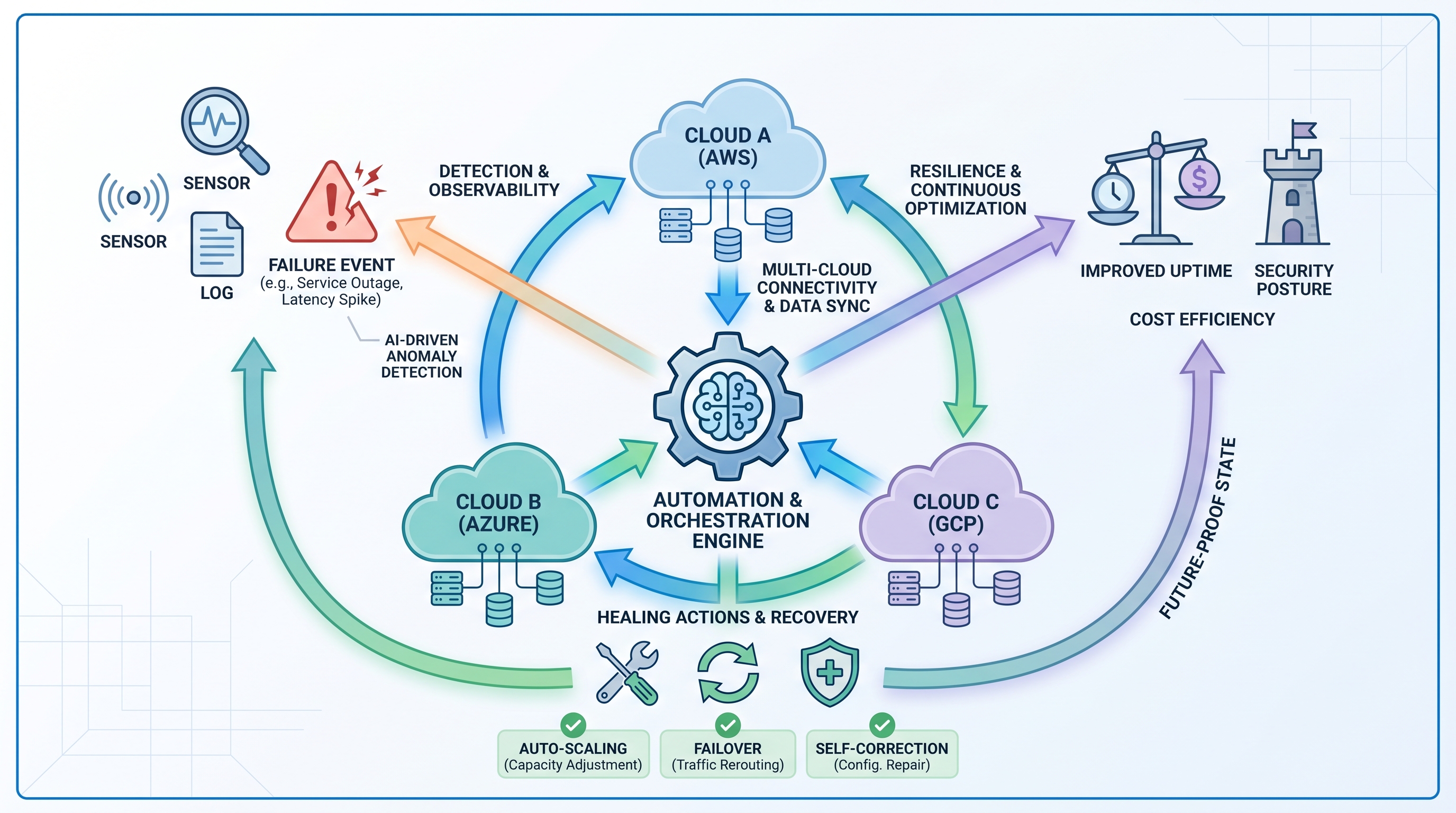
In the intricate landscape of modern enterprise IT, multi-cloud strategies have become the norm, offering unparalleled flexibility, innovation, and risk diversification. However, this distributed power introduces a new paradigm of complexity, where managing interconnected systems across AWS, Azure, GCP, and Oracle environments can quickly overwhelm traditional operational models. The promise of multi-cloud resilience often clashes with the reality of fragmented visibility, inconsistent security policies, and escalating operational costs.
Enter self-healing architectures – a paradigm shift from reactive incident response to proactive, automated remediation. A self-healing system is engineered to detect anomalies, diagnose issues, and automatically initiate corrective actions without human intervention, thereby maintaining desired operational states, optimizing FinOps, and fortifying security postures. For enterprises navigating the multi-cloud maze, implementing self-healing capabilities is not merely an operational luxury but a strategic imperative for sustained business continuity, cost efficiency, and robust security.
This deep dive will explore the foundational principles, architectural patterns, and advanced automation techniques required to build truly resilient, self-healing multi-cloud environments. We'll provide actionable insights for technical leaders, cloud architects, and FinOps practitioners, emphasizing real-world examples and the strategic integration of AI-powered platforms like CloudAtler to unify and automate these critical functions.
The Imperative for Self-Healing in Multi-Cloud Environments
Operating across multiple cloud providers introduces a unique set of challenges that magnify the need for automated resilience. Each cloud has its own service models, APIs, and operational nuances, making unified management a significant hurdle. Without self-healing mechanisms, organizations face:
Increased Mean Time To Recovery (MTTR): Manual incident response across disparate cloud environments is inherently slow and error-prone, leading to extended downtime.
Escalating Operational Costs (FinOps Impact): Prolonged outages directly impact revenue and increase operational expenditures through emergency staffing, resource over-provisioning as a hedge against failure, and lost productivity. Unidentified or unaddressed resource misconfigurations also lead to significant cloud waste.
Inconsistent Security Posture: Manual security checks and remediation efforts struggle to keep pace with dynamic multi-cloud deployments, creating windows of vulnerability and increasing compliance risks. Drifting configurations or unpatched systems in one cloud can expose the entire ecosystem.
Burnout for SRE/Ops Teams: Constant firefighting diverts valuable engineering resources from strategic initiatives, leading to technical debt and employee dissatisfaction.
Reduced Agility: Fear of introducing new failures can stifle innovation and slow down deployment cycles, hindering competitive advantage.
Self-healing architectures directly address these issues by embedding resilience, cost optimization, and security enforcement into the very fabric of the infrastructure, allowing teams to focus on innovation rather than remediation.
Core Principles of Self-Healing Architectures
Building a self-healing system is not about applying a single tool but adopting a holistic approach guided by several core principles:
Comprehensive Observability: You cannot heal what you cannot see. This involves collecting, aggregating, and analyzing metrics, logs, and traces from every component across all cloud environments. A unified view is crucial for detecting anomalies and understanding the blast radius of an issue.
Event-Driven Automation: The system must be able to react to specific events or thresholds. This involves defining triggers (e.g., CPU utilization above 90%, disk full, security policy violation) that initiate automated workflows.
Policy-as-Code and Infrastructure-as-Code (IaC): Desired state configuration must be codified and version-controlled. This enables automated deployment, consistent configuration across clouds, and the ability to detect and remediate configuration drift back to a known good state.
Redundancy and Distributed Systems Design: Architecting applications and infrastructure to be inherently fault-tolerant, using techniques like active-active deployments, multi-region/multi-zone deployments, and stateless services.
Proactive Failure Injection (Chaos Engineering): Regularly testing the system's resilience by intentionally introducing failures (e.g., terminating instances, network latency, resource exhaustion) to validate self-healing mechanisms and identify weaknesses before they impact production.
Architectural Patterns for Self-Healing Multi-Cloud Implementations
Implementing self-healing capabilities across a multi-cloud landscape requires thoughtful architectural choices. Here are several patterns that contribute significantly to resilience:
1. Decentralized Control Plane for Multi-Cluster Management
For containerized workloads, managing Kubernetes clusters across AWS EKS, Azure AKS, and GCP GKE can be challenging. A decentralized control plane, often achieved through technologies like Kubernetes Federation v2 (KubeFed) or custom operators, allows for the consistent deployment and management of applications across multiple clusters in different clouds. While full federation for all resources might be complex, federating critical services like ingress, service discovery, and configuration management ensures that if one cluster or cloud fails, traffic can be seamlessly rerouted to healthy clusters in another cloud.
Example: Deploying a global ingress controller (e.g., NGINX Ingress, Contour) that uses external DNS providers to route traffic to the closest healthy Kubernetes cluster, regardless of its underlying cloud provider. Health checks configured at the DNS level can automatically remove unhealthy endpoints.
2. Service Mesh for Cross-Cloud Resilience
A service mesh (e.g., Istio, Linkerd) provides a programmable network layer for microservices, offering features critical for self-healing. When deployed across multi-cloud clusters, a service mesh can:
Automate Retries and Circuit Breaking: Automatically retry failed requests or "break the circuit" to prevent cascading failures when a service becomes unhealthy.
Traffic Management: Enable intelligent routing, load balancing, and failover across services deployed in different clouds or regions.
Observability: Provide deep insights into service-to-service communication, latency, and error rates, crucial for detecting issues.
Example: An Istio mesh spanning EKS and AKS clusters. If a microservice in EKS experiences high error rates, Istio can automatically reroute traffic to an identical instance in AKS, isolate the failing service, and provide detailed metrics for automated remediation.
3. Global Load Balancing and DNS for Disaster Recovery
Leveraging global DNS services (e.g., AWS Route 53 with Traffic Policies, Azure Traffic Manager, GCP Global External HTTP(S) Load Balancing) is fundamental for multi-cloud disaster recovery. These services can perform health checks on endpoints in different clouds and route user traffic to the closest, healthiest available region or cloud environment.
Example: A web application deployed in active-passive mode across AWS and Azure. Route 53 health checks continuously monitor the primary application in AWS. If the health check fails, Route 53 automatically updates DNS records to point users to the standby application in Azure, minimizing downtime.
4. Data Replication and Consistency Strategies
Data is often the hardest component to make self-healing across clouds due to consistency requirements and latency. Strategies include:
Active-Passive Replication: A primary database in one cloud replicates asynchronously to a standby in another. Manual or automated failover is required.
Active-Active Replication: Data is written to multiple databases simultaneously in different clouds, requiring sophisticated conflict resolution mechanisms (e.g., eventual consistency models with Cassandra, MongoDB Atlas, CockroachDB). This offers the highest resilience but also the most complexity.
Cloud-Native Database Services with Cross-Region/Cloud Capabilities: Some services, like Amazon Aurora Global Database or Google Cloud Spanner, offer built-in global replication, simplifying the architecture but potentially increasing vendor lock-in.
Example: For a high-transactional system, utilizing a multi-master NoSQL database like Cassandra, deployed across AWS and GCP. If one cloud region becomes unavailable, the application can seamlessly continue reading and writing to the healthy instances in the other cloud, relying on eventual consistency.
5. Serverless Functions for Automated Remediation
Serverless compute services (AWS Lambda, Azure Functions, GCP Cloud Functions, Oracle Functions) are ideal for executing lightweight, event-driven remediation tasks. They can be triggered by monitoring alerts, log events, or security findings to perform specific actions.
Example: A Lambda function triggered by a CloudWatch alarm indicating high error rates on an EC2 instance. The function could automatically attempt to restart the service on the instance, or if persistent, cordon off the instance and initiate its replacement via an Auto Scaling Group. Similarly, an Azure Function could respond to an Azure Security Center alert by isolating a compromised VM or updating network security group rules.
Implementing Self-Healing: A Deep Dive into Automation
The backbone of any self-healing architecture is robust, intelligent automation. This extends from detection to diagnosis and finally, to remediation.
1. Automated Incident Detection and Diagnosis
Effective self-healing begins with precise and timely detection of deviations from the desired state. This requires a unified approach to observability across all cloud providers.
Centralized Monitoring and Alerting: Aggregate metrics (e.g., CPU, memory, network I/O, latency, error rates) from AWS CloudWatch, Azure Monitor, GCP Cloud Monitoring, and Oracle Cloud Infrastructure Monitoring into a single pane of glass. Tools like Prometheus, Grafana, Datadog, or CloudAtler's unified dashboard can provide this consolidated view. Define threshold-based alerts for critical metrics.
Log Aggregation and Analysis: Collect logs from all services and applications across clouds into a central logging platform (e.g., ELK Stack, Splunk, Sumo Logic, or cloud-native solutions like CloudWatch Logs Insights, Azure Log Analytics, GCP Cloud Logging). Use AI/ML-driven log analysis to detect anomalies, error patterns, or security events that might not trigger simple metric alarms.
Trace Correlation: Distributed tracing (e.g., OpenTelemetry, Jaeger, Zipkin) is vital for microservices architectures to understand the flow of requests across services and identify performance bottlenecks or failing components in a multi-cloud transaction.
AI/ML for Anomaly Detection: Beyond static thresholds, AI/ML models can learn normal operational behavior and flag subtle anomalies that human operators or rule-based systems might miss. This is particularly effective for predicting impending failures or identifying complex attack patterns. CloudAtler leverages Atler AI to provide predictive monitoring and operational intelligence, identifying deviations that precede critical incidents across your multi-cloud estate.
2. Automated Remediation Workflows
Once an incident is detected and diagnosed, automated workflows execute the corrective actions. These workflows must be idempotent, testable, and have built-in rollback capabilities.
Compute Instance Failure/Degradation:
Detection: High CPU/memory, unresponsive health checks, instance status checks failing.
Remediation: Auto-scaling groups (ASGs) in AWS, Virtual Machine Scale Sets (VMSS) in Azure, Managed Instance Groups (MIGs) in GCP can automatically replace unhealthy instances. For non-ASG instances, a serverless function (e.g., AWS Lambda) triggered by an alert can stop/start or terminate/recreate the instance.
Multi-Cloud Context: If an entire availability zone or region fails, global load balancers combined with multi-region ASGs/VMSS/MIGs can redirect traffic and scale up resources in a healthy region in the same or a different cloud.
Database Latency or Failure:
Detection: High query latency, connection errors, replication lag, storage saturation.
Remediation: For managed databases (e.g., Amazon RDS, Azure SQL Database, GCP Cloud SQL), automated failover to a standby replica is often built-in. For self-managed databases, custom scripts triggered by alerts can promote a read replica to primary, restart the database service, or scale up resources.
Multi-Cloud Context: In an active-passive multi-cloud setup, an orchestrator (e.g., a custom application or a cloud-agnostic tool like Terraform/Ansible) can monitor the primary in one cloud and initiate failover to the standby in another cloud upon detection of a prolonged outage.
Security Policy Drift and Compliance Violations:
Detection: Configuration management tools (Ansible, Puppet, Chef), cloud-native services (AWS Config, Azure Policy, GCP Security Command Center), or dedicated security posture management (CSPM) platforms detect deviations from predefined security baselines (e.g., open S3 bucket, unencrypted database, unauthorized port). CloudAtler's security management features excel at identifying such drift across multi-cloud environments.
Remediation: Automated remediation can include reverting configurations to the desired state, closing exposed ports, applying encryption, or isolating non-compliant resources. Serverless functions or CI/CD pipelines can be triggered to enforce policy-as-code.
Resource Optimization and Cost Anomalies (FinOps):
Detection: Monitoring tools detect idle resources (e.g., unattached EBS volumes, idle VMs), underutilized instances, or sudden spikes in cost that deviate from historical trends. CloudAtler's financial operations platform provides comprehensive insights into cloud spend and resource utilization.
Remediation: Automated actions can include rightsizing instances, terminating idle resources, scheduling non-production environments to shut down during off-hours, or converting on-demand instances to Reserved Instances/Savings Plans based on usage patterns. Automated tagging (CloudAtler's automated tagging) ensures resources are correctly categorized for cost allocation and governance, enabling more precise remediation.
3. Patch Management and Vulnerability Remediation
Proactive patching is a critical self-healing mechanism, preventing known vulnerabilities from escalating into incidents. However, multi-cloud patch management is complex due to different OS versions, application stacks, and cloud-specific agents.
Automated Patch Deployment: Use centralized patch management tools (e.g., AWS Systems Manager Patch Manager, Azure Update Management, or third-party solutions) integrated with CI/CD pipelines. These tools can orchestrate patching across multiple cloud environments, ensuring consistency.
Vulnerability Scanning and Prioritization: Continuously scan for vulnerabilities (CVEs) across all assets. Prioritize patches based on severity, exploitability, and business impact. CloudAtler's patch intelligence provides a unified view of patch status and vulnerability exposure across your multi-cloud estate, enabling intelligent prioritization.
Staged Rollouts and Safe Rollbacks: Implement strategies for phased patch rollouts (e.g., canary deployments, blue/green deployments) to minimize risk. Crucially, have automated rollback mechanisms in place should a patch introduce new issues.
Patch Governance: Define clear policies for patch cycles, approval workflows, and compliance reporting across all cloud environments. Automated governance ensures adherence to enterprise standards.
FinOps Optimization through Self-Healing Architectures
The synergy between self-healing and FinOps is profound. Automated resilience directly translates to cost efficiency and better financial governance.
Reduced Downtime Costs: By minimizing MTTR, self-healing architectures prevent revenue loss, reputational damage, and the direct costs associated with prolonged outages.
Optimized Resource Utilization: Automated rightsizing, termination of idle resources, and dynamic scaling ensure that you pay only for what you need, when you need it. This eliminates waste from over-provisioning – a common multi-cloud challenge.
Proactive Cost Anomaly Detection: Self-healing systems can detect and remediate unexpected cost spikes caused by misconfigurations, runaway processes, or shadow IT, preventing budget overruns. CloudAtler's budget forecasting and control alerts are instrumental here.
Improved Operational Efficiency: Automating manual remediation tasks frees up expensive engineering talent to focus on innovation rather than maintenance, leading to higher ROI on cloud investments.
Enhanced Governance and Compliance: Automated enforcement of tagging policies and resource lifecycle management ensures accurate cost allocation and adherence to financial compliance standards across all cloud providers.
Security Best Practices in Self-Healing Multi-Cloud
Security is not an afterthought but an integral component of self-healing multi-cloud environments. Automation is key to maintaining a strong security posture against an ever-evolving threat landscape.
Automated Security Policy Enforcement: Utilize cloud-native policy services (AWS Organizations SCPs, Azure Policy, GCP Organization Policies) and third-party tools to enforce security guardrails at scale. Self-healing mechanisms can detect and automatically remediate any deviations from these policies.
Threat Detection and Automated Response (SOAR): Integrate threat intelligence with SIEM (Security Information and Event Management) and SOAR (Security Orchestration, Automation, and Response) platforms. When a threat is detected (e.g., suspicious login, unusual network traffic), automated playbooks can isolate affected resources, revoke credentials, or trigger forensic analysis.
Identity and Access Management (IAM) Consistency: Implement centralized identity management (e.g., Okta, Azure AD, AWS IAM Identity Center) to provide consistent access control across all cloud environments. Automated processes can detect and remediate unauthorized access attempts or privilege escalation.
Continuous Vulnerability Management: Integrate automated vulnerability scanning into CI/CD pipelines and production environments. Self-healing processes can then trigger automated patching or configuration changes to address newly discovered vulnerabilities before they can be exploited.
Immutable Infrastructure: Favor immutable infrastructure where servers are never modified after deployment. If a server needs an update or correction, a new, patched, and correctly configured server is deployed, and the old one is decommissioned. This inherently provides a self-healing security posture by preventing configuration drift.
The Role of CloudAtler in Unifying Self-Healing Operations
Building a truly self-healing multi-cloud environment requires a platform that can abstract away the complexity of disparate cloud APIs and provide unified intelligence across FinOps, security, and operations. This is precisely where CloudAtler excels.
CloudAtler is an AI-powered platform designed to unify FinOps, cloud security, and automated operations across AWS, Azure, GCP, and Oracle environments. Our platform provides:
Unified Observability: A single pane of glass to monitor performance, cost, and security posture across your entire multi-cloud estate, facilitating rapid detection of anomalies.
AI-Powered Anomaly Detection and Prediction: Leveraging Atler AI, we identify subtle deviations and predict potential issues before they impact your services or budget, enabling proactive self-healing.
Automated FinOps Remediation: From identifying idle resources and rightsizing recommendations to enforcing budget controls and optimizing commitment-based savings, CloudAtler automates cost optimization actions, ensuring your multi-cloud environment remains cost-efficient.
Enhanced Security Management: Our platform centralizes security management, automatically detecting configuration drift, compliance violations, and vulnerabilities across clouds, and enabling automated remediation workflows.
Intelligent Patch Governance and Remediation: CloudAtler's patch intelligence provides deep insights into your patch landscape, automating vulnerability prioritization and orchestrating secure, validated patch remediation with built-in rollback capabilities.
Operational Intelligence: By correlating operational data with financial and security insights, CloudAtler provides the context needed for intelligent, automated decision-making, transforming reactive operations into a proactive, self-healing system.
With CloudAtler, enterprises can move beyond theoretical self-healing concepts to practical, integrated solutions that deliver tangible improvements in resilience, cost control, and security posture.
Challenges and Considerations
While the benefits of self-healing architectures are clear, implementing them in a multi-cloud context presents challenges:
Complexity of Cross-Cloud Integration: Standardizing automation and policies across heterogeneous environments requires significant effort and robust abstraction layers.
Vendor Lock-in Concerns: While leveraging cloud-native services for self-healing is efficient, it can increase dependency on a single provider. A balanced approach using cloud-agnostic tools where appropriate is crucial.
Data Sovereignty and Compliance: Automated data replication and failover across clouds must strictly adhere to regulatory requirements and data residency laws.
Testing and Validation: Thoroughly testing self-healing mechanisms, especially under stress and failure conditions, is paramount. This includes implementing chaos engineering practices.
Human Oversight and Trust: While automation reduces human intervention, a robust monitoring and alert system for the automation itself is necessary. Building trust in automated systems within the organization is an ongoing process.
Conclusion
Self-healing architectures are no longer aspirational concepts but a fundamental requirement for building truly resilient, cost-effective, and secure multi-cloud environments. By embracing comprehensive observability, event-driven automation, policy-as-code, and intelligent architectural patterns, enterprises can transform their operational models from reactive firefighting to proactive, autonomous management.
The journey to a fully self-healing multi-cloud ecosystem is complex, but the strategic advantages – reduced downtime, optimized FinOps, fortified security, and enhanced operational agility – are undeniable. Platforms like CloudAtler provide the essential AI-powered capabilities to bridge the gap between fragmented cloud operations and unified, intelligent automation.
Are you ready to elevate your multi-cloud resilience, optimize your FinOps, and strengthen your security posture with intelligent automation? Discover how CloudAtler unifies your cloud operations and empowers your enterprise to thrive. Explore CloudAtler today and transform your multi-cloud strategy.
All in One Place
Atler Pilot decodes your cloud spend story by bringing monitoring, automation, and intelligent insights together for faster and better cloud operations.