
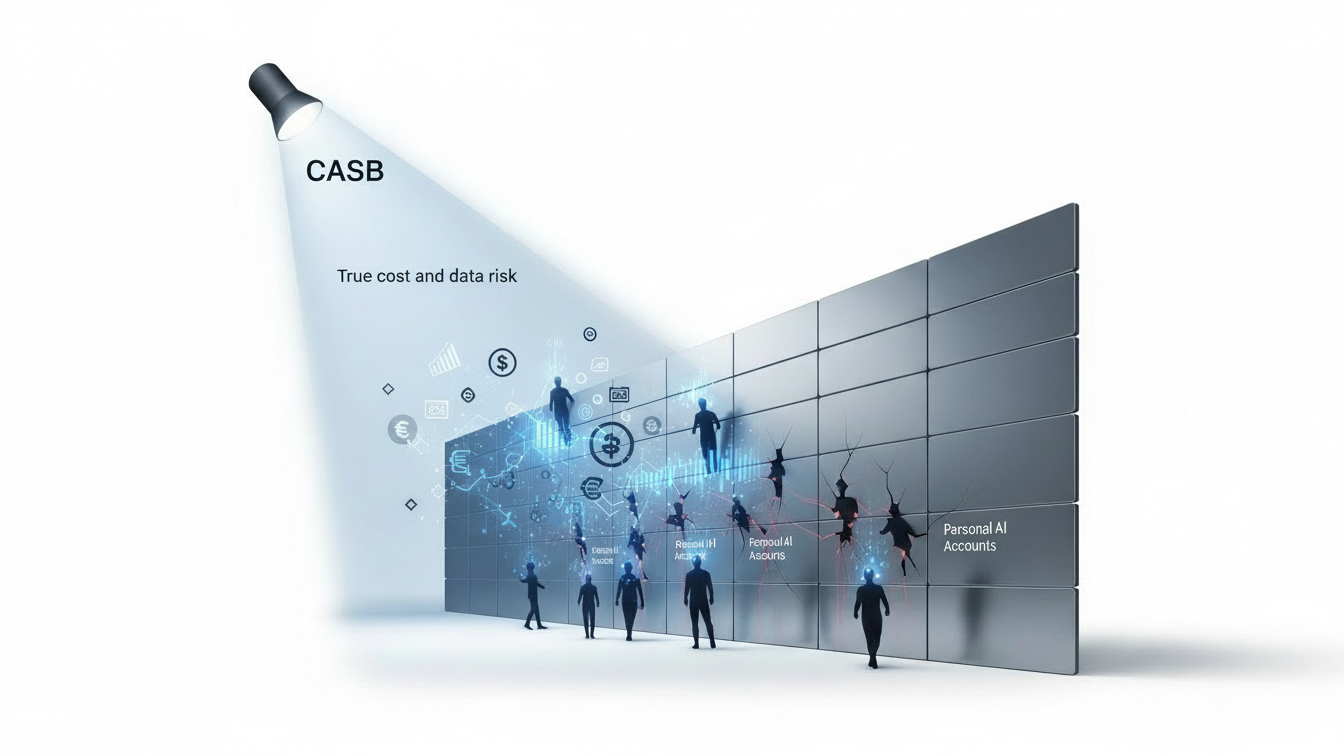
"Shadow AI" describes the unauthorized use of AI tools by employees—subscriptions to Midjourney, ChatGPT Plus, or niche coding assistants expensed on personal credit cards. By late 2025, this accounts for 15–20% of total AI spend in the average enterprise. The risk isn't just financial; it's data exfiltration. When an engineer pastes proprietary code into a personal AI account, that IP leaves your perimeter.
Here is the technical strategy to govern Shadow AI without becoming the "Department of No."
Phase 1: Discovery via Financial & Network Analysis
You cannot govern what you cannot see.
Expense Audits: Search employee expense reports for keywords: "OpenAI," "Anthropic," "Midjourney," "Hugging Face," "Cursor," "Replit".
CASB/DNS Logs: Configure your Cloud Access Security Broker (CASB) or Zscaler logs to flag traffic to known AI domains. In 2025, standard lists exist (e.g., the "AI 500" domain blocklist).
Phase 2: The "Paved Road" Architecture
Blocking AI tools usually leads to employees working around the firewall. The successful strategy is to offer a better, approved alternative—a "Paved Road."
The Enterprise AI Gateway: Instead of letting employees manage their own API keys, route all traffic through an internal gateway (e.g., Portkey, Kong, or a custom proxy).
Benefit 1 (Cost): You negotiate Enterprise Volume Discounts (often 20-30% off) by centralizing billing.
Benefit 2 (Security): The gateway strips PII (Personally Identifiable Information) via regex patterns before the request hits OpenAI.
Benefit 3 (Visibility): You get a dashboard showing exactly which team is using which model and for what purpose.
Phase 3: Policy as Code for SaaS
For SaaS tools where a gateway isn't possible (like a web-based design tool), use SSO Enforcement.
Policy: "Company email addresses can only sign up for AI tools that support SAML/SSO."
Implementation: Configure Okta/Entra ID to block "Sign in with Google" for unapproved AI apps. This forces the vendor to go through your IT procurement process to enable SSO.
The "Personal License" Buy-Back
A trend in 2025 is the "Bring Your Own License" (BYOL) model for coding assistants. Instead of fighting developers who love a specific niche tool, create a "Tools Stipend."
Mechanism: Developers can expense any productivity tool up to $50/month, provided they sign a data usage attestation and use the Enterprise Mode (if available) that disables data training.
Verdict: Govern Shadow AI by competing with it. If your internal platform is faster, cheaper (free to the end user), and safer, Shadow AI disappears naturally.
All in One Place
Atler Pilot decodes your cloud spend story by bringing monitoring, automation, and intelligent insights together for faster and better cloud operations.