
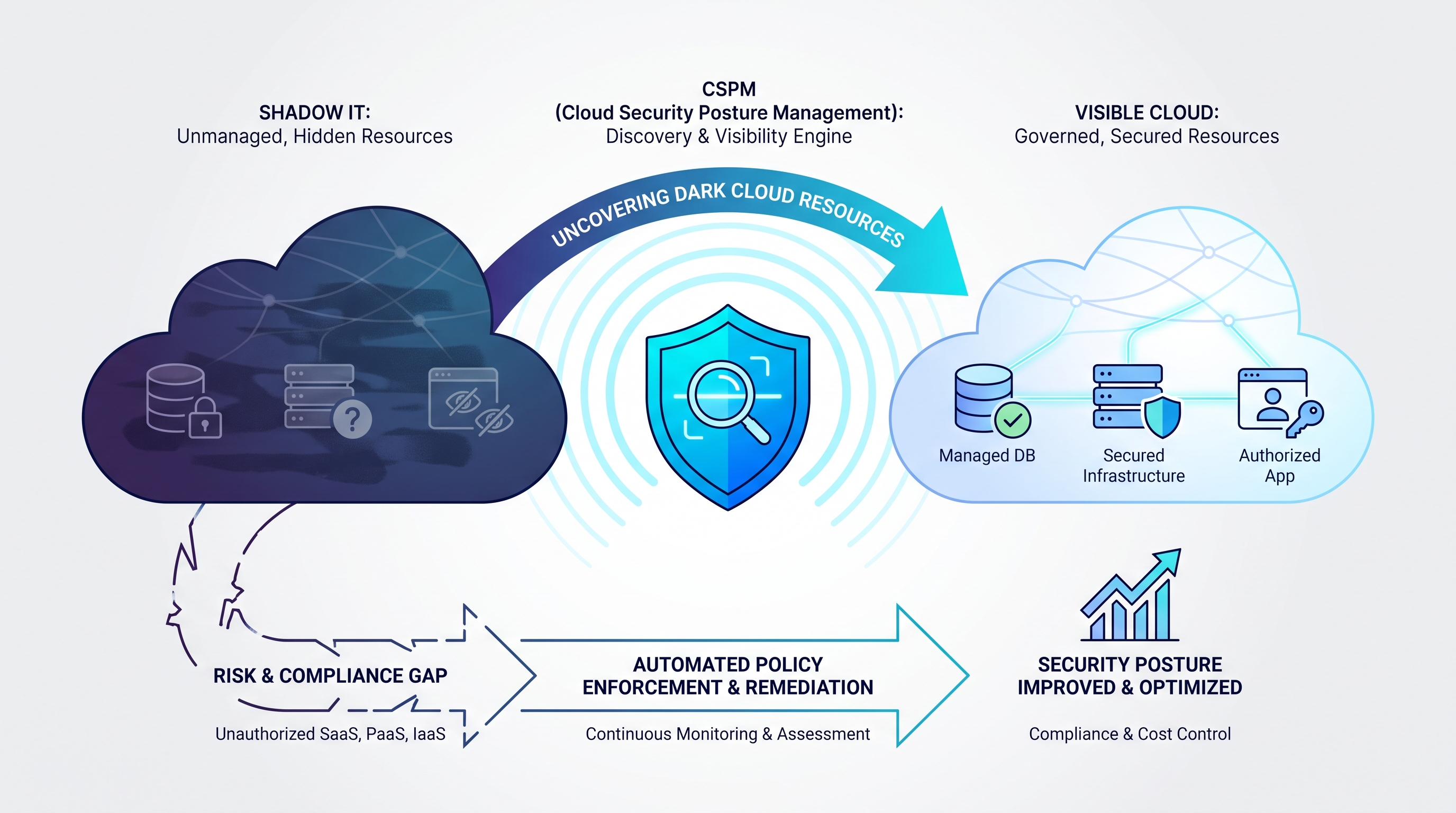
In the dynamic landscape of modern enterprise cloud operations, the allure of rapid innovation and decentralized resource provisioning often gives rise to a formidable adversary: Shadow IT. While the term "Shadow IT" might evoke images of unsanctioned software installations on corporate desktops, its manifestation in the cloud is far more insidious and pervasive. It encompasses any cloud resource – from compute instances and storage buckets to serverless functions and networking components – deployed outside the purview of central IT, security, or FinOps governance. These "dark cloud resources" are not merely inconvenient; they represent significant vectors for security breaches, compliance failures, and unbudgeted expenditures that can severely impact an organization's financial health and operational integrity.
The scale of multi-cloud adoption across platforms like AWS, Azure, GCP, and Oracle has only exacerbated this challenge. The ease with which developers or business units can spin up resources, often leveraging personal accounts or bypassing established procurement processes, creates a vast, unmapped digital terrain. Without comprehensive visibility and automated control, enterprises are effectively operating blind in critical areas of their cloud infrastructure. This is where Cloud Security Posture Management (CSPM) emerges as an indispensable tool, acting as the lighthouse that illuminates these dark corners, transforming an unknown threat landscape into a managed, secure, and financially optimized environment.
The Elusive Nature of Shadow IT in the Cloud
Understanding why Shadow IT is so prevalent in cloud environments is the first step toward combating it. The very attributes that make cloud computing attractive – agility, elasticity, and ease of access – also contribute to its proliferation:
Decentralized Provisioning: With self-service portals and Infrastructure-as-Code (IaC) tools, anyone with appropriate cloud credentials can provision resources. This democratizes access but decentralizes control, making it challenging for central teams to track every deployment.
Ephemeral and Serverless Workloads: Modern cloud architectures often involve short-lived instances, containerized applications, and serverless functions (e.g., AWS Lambda, Azure Functions, GCP Cloud Functions). These resources can be spun up and torn down rapidly, making traditional inventory management inadequate. A function deployed for a temporary data processing task, if misconfigured, can expose sensitive data even after its primary execution.
Multi-Cloud Complexity: Enterprises rarely operate on a single cloud provider. Managing resources across AWS, Azure, GCP, and Oracle Cloud requires a unified approach. Each cloud provider has its own APIs, security models, and nomenclature, creating a fragmentation that a siloed operational model cannot effectively bridge. The sheer volume and diversity of services make manual tracking impossible.
Developer Autonomy vs. Governance: There's a perpetual tension between empowering development teams with autonomy and enforcing necessary governance. Developers often prioritize speed and functionality, sometimes inadvertently circumventing security and cost controls in their pursuit of rapid deployment.
Lack of Centralized Visibility: Without a consolidated view across all cloud accounts and subscriptions, IT and security teams often rely on disparate tools or manual audits, which are inherently prone to gaps. This lack of a single source of truth means that resources can easily exist without being accounted for in security policies, compliance frameworks, or financial budgets.
The real-world impact of these factors is severe. Unmanaged cloud resources are often untagged, unpatched, and misconfigured. They can harbor critical vulnerabilities, become entry points for attackers, incur unexpected costs, and lead to non-compliance with regulatory mandates like GDPR, HIPAA, or PCI-DSS. For instance, an S3 bucket or Azure Blob storage provisioned by a rogue developer, left publicly accessible without proper access policies, can lead to massive data exfiltration and reputational damage.
CSPM: The Lighthouse in the Dark Cloud
Cloud Security Posture Management (CSPM) is a category of security tools designed to continuously monitor cloud environments for misconfigurations, compliance violations, and security risks. However, its role extends significantly beyond basic security checks. For enterprises grappling with Shadow IT, a robust CSPM solution is the foundational technology for achieving comprehensive visibility and control.
A CSPM solution doesn't just scan for known vulnerabilities; it actively discovers all provisioned resources across an organization's multi-cloud footprint. It then assesses their configuration against a defined set of security benchmarks, compliance standards, and organizational policies. This continuous, automated process is critical for identifying resources that fall outside the corporate governance framework – the very definition of Shadow IT.
Key Pillars of a Robust CSPM for Shadow IT Discovery:
Continuous Asset Discovery: This is the cornerstone. A sophisticated CSPM integrates directly with the APIs of cloud providers (AWS, Azure, GCP, Oracle) to continuously query and catalog every single resource. This isn't a one-time scan; it's an ongoing process that captures ephemeral resources and changes in real-time. It identifies instances, databases, storage, network components, serverless functions, and even less obvious assets like IAM roles and policies.
Security Posture Assessment: Once discovered, resources are evaluated against industry best practices (e.g., CIS Benchmarks, NIST Framework), internal security policies, and custom rules. This assessment immediately flags misconfigurations that indicate a security risk, such as open security groups, unencrypted storage, or overly permissive IAM policies.
Compliance Monitoring: CSPM maps discovered resources and their configurations to specific regulatory compliance standards (e.g., PCI DSS, HIPAA, SOC 2, ISO 27001). This helps identify Shadow IT resources that are not only insecure but also non-compliant, posing significant legal and financial risks.
Vulnerability Management Integration: While CSPM primarily focuses on configuration, advanced solutions integrate with vulnerability management tools to ensure that discovered compute resources are also free from software vulnerabilities, linking posture to patch status.
Anomaly Detection: By establishing a baseline of normal cloud behavior, CSPM can leverage machine learning to detect anomalous activities or resource deployments that deviate from established patterns, often a strong indicator of Shadow IT.
Architectural Deep Dive: How CSPM Uncovers Dark Resources
The technical mechanisms by which a CSPM operates are crucial to its effectiveness in combating Shadow IT. It's not magic, but a sophisticated aggregation and analysis of cloud metadata and operational telemetry.
API-Driven Discovery Across Multi-Cloud Environments
The primary method for a CSPM to achieve comprehensive visibility is through API integration with each cloud provider. This agentless approach allows for non-invasive, continuous monitoring:
AWS: A CSPM solution would typically leverage IAM roles with read-only permissions to services like AWS Config (for resource inventory and configuration history), CloudTrail (for API activity logs), EC2, S3, RDS, Lambda, VPC, and more. By aggregating data from these services, the CSPM can construct a complete inventory of all resources across all linked accounts and regions, including those not explicitly tagged or documented by internal teams.
Azure: In Azure, the CSPM would use Azure Active Directory (AAD) service principals with appropriate roles to query the Azure Resource Graph (for comprehensive resource inventory), Azure Security Center (for security recommendations), Azure Monitor, and specific service APIs for Virtual Machines, Storage Accounts, Azure SQL Databases, Azure Functions, and Virtual Networks.
GCP: For Google Cloud Platform, the CSPM would integrate via service accounts to access the Cloud Asset Inventory (a centralized inventory of all Google Cloud assets), Security Command Center, Cloud Logging, and APIs for Compute Engine, Cloud Storage, Cloud SQL, and Cloud Functions.
Oracle Cloud Infrastructure (OCI): OCI's API gateway and services like Cloud Guard and Audit are key for CSPM integration. It would query compartments, VCNs, compute instances, Autonomous Databases, and Object Storage buckets to identify all deployed assets.
By normalizing and correlating this metadata from disparate cloud APIs, a CSPM like CloudAtler's unified dashboard creates a single, consolidated view of all cloud assets, regardless of their origin or whether they adhere to internal naming conventions. This is the first critical step in making Shadow IT visible.
Network Flow Analysis for Unsanctioned Connections
Beyond resource inventory, CSPM solutions can analyze network flow logs to detect suspicious communication patterns that might indicate Shadow IT or compromised resources:
VPC Flow Logs (AWS), NSG Flow Logs (Azure), VPC Flow Logs (GCP), VCN Flow Logs (OCI): These logs capture metadata about IP traffic going to and from network interfaces in your cloud. A CSPM can ingest and analyze these logs to identify communication between known and unknown resources, unusual egress to public IP addresses, or ingress from suspicious external sources. For example, if a newly discovered, untagged EC2 instance starts communicating with an IP address associated with known command-and-control servers, it's a clear indicator of a security incident or a rogue workload.
Packet Mirroring (GCP): More advanced capabilities can even leverage features like GCP's Packet Mirroring to capture and inspect network traffic, offering deeper insights into the nature of communications from potentially dark resources.
Identity and Access Management (IAM) Scrutiny
Misconfigured IAM is a prime vector for Shadow IT. Developers might provision resources with overly permissive roles to simplify deployment, or create service accounts that are never properly revoked. CSPM continuously audits IAM configurations:
Overly Permissive Roles: Detecting roles that grant more permissions than necessary (e.g.,
s3:*on a public bucket, orec2:*on a non-admin role).Dormant Accounts and Unassigned Keys: Identifying IAM users, roles, or service accounts that are inactive but still possess privileges, which could be exploited.
Root Account Activity: Alerting on any activity related to cloud root accounts, which should be severely restricted.
Role-Based Access Control (RBAC) Misconfigurations: Ensuring that access policies for all discovered resources align with the principle of least privilege.
Storage Bucket Analysis
Publicly exposed storage buckets are a notorious source of data breaches. CSPM specifically targets these:
Publicly Accessible Buckets: Identifying S3 buckets, Azure Blob containers, GCP Cloud Storage buckets, or OCI Object Storage buckets configured for public access.
Unencrypted Data at Rest: Flagging storage resources that lack server-side encryption, increasing the risk if the bucket is compromised.
Lifecycle Policy Gaps: Detecting buckets without proper lifecycle policies, leading to data sprawl and potential cost overruns.
Serverless Function Auditing
Serverless functions are often deployed rapidly and can easily become "dark" if not properly managed:
Excessive Permissions: Auditing the IAM roles attached to Lambda functions, Azure Functions, or GCP Cloud Functions to ensure they adhere to least privilege.
Outdated Runtimes: Identifying functions running on deprecated runtimes with known vulnerabilities.
Unusual Invocation Patterns: Detecting functions invoked from unexpected sources or at unusual times.
FinOps Optimization through CSPM
The financial implications of Shadow IT are often as significant as the security risks. Unmanaged resources lead to wasted spend, inefficient resource utilization, and unpredictable cloud bills. A robust CSPM, especially one integrated into a FinOps platform, provides direct avenues for cost optimization:
Cost Visibility of Unmanaged Resources: By discovering all resources, CSPM brings previously hidden costs to light. This includes forgotten instances, unattached volumes (e.g., EBS volumes, Azure Disks), idle databases, and over-provisioned services that are still incurring charges. Without discovery, these "zombie resources" would continue to drain budgets unnoticed.
Resource Right-Sizing Recommendations: For discovered compute resources (VMs, containers, serverless), CSPM can analyze utilization metrics and provide recommendations for right-sizing – downgrading to smaller, more cost-effective instances or optimizing serverless memory configurations. This directly translates to savings.
Automated Tagging for Cost Allocation: A common characteristic of Shadow IT is the absence of proper tagging. Tags are essential for accurate cost allocation and chargeback. An advanced CSPM can integrate with automated tagging capabilities, applying predefined tags to newly discovered or untagged resources based on contextual information (e.g., owner, project, environment), thereby enabling precise cost reporting and accountability.
Budget Guardrails and Alerts: Once dark resources are identified and brought into the management fold, they can be integrated into existing FinOps processes. This allows for the establishment of budget control alerts and guardrails, ensuring that even newly discovered resources are monitored against defined spending limits. Anomalous spend patterns on these resources can trigger immediate notifications.
Commitment Intelligence: For long-running, stable workloads identified as Shadow IT, a CSPM integrated with FinOps capabilities can analyze usage patterns and recommend coverage through Reserved Instances (RIs) or Savings Plans. This ensures that even previously unmanaged resources can contribute to overall cost savings through commitment-based discounts.
Security Best Practices with an Advanced CSPM (CloudAtler's Approach)
Addressing Shadow IT requires more than just detection; it demands an integrated platform that can unify security, FinOps, and operations. CloudAtler, as an AI-powered platform, offers a comprehensive solution to not only uncover but also manage and remediate dark cloud resources across AWS, Azure, GCP, and Oracle environments.
Unified Dashboard for Multi-Cloud Visibility: CloudAtler provides a single pane of glass, consolidating all discovered assets, security posture assessments, and cost insights from your diverse cloud environments. This unified dashboard eliminates the fragmentation inherent in multi-cloud operations, giving IT, security, and FinOps teams a complete, real-time view of their entire cloud estate, including previously hidden Shadow IT.
AI-Powered Anomaly Detection: Leveraging sophisticated machine learning algorithms, Atler AI continuously analyzes cloud activity and resource configurations. It establishes baselines of normal behavior and proactively identifies deviations – whether it's an unusual resource deployment, an unexpected network flow, or a sudden spike in cost from an untagged resource. This predictive capability is crucial for catching subtle indicators of Shadow IT or potential breaches before they escalate.
Automated Remediation Workflows: Detection is only half the battle. CloudAtler goes further by enabling automated security management and remediation. Once a misconfiguration or compliance violation is detected on a dark resource, predefined playbooks can automatically trigger corrective actions, such as isolating a compromised instance, revoking overly permissive IAM policies, encrypting an unencrypted storage bucket, or applying necessary tags. This reduces manual effort and accelerates the time to remediation.
Patch Intelligence and Governance: Discovered compute resources, especially those outside central management, are often unpatched. CloudAtler's patch intelligence capabilities extend to these newly found assets, identifying missing security updates and critical vulnerabilities. It integrates with patch governance workflows to ensure that even Shadow IT resources are brought into compliance with patching policies, minimizing attack surface.
Cost Impact Calculation of Security Gaps: CloudAtler provides FinOps teams with the ability to quantify the financial risk associated with security misconfigurations on discovered resources. By correlating security vulnerabilities with potential breach costs and compliance fines, organizations can make data-driven decisions on where to prioritize remediation efforts, understanding the true "cost of insecurity."
Continuous Compliance Enforcement: Beyond initial discovery, CloudAtler ensures ongoing compliance. It continuously monitors all cloud resources against a vast library of industry standards and custom policies, immediately flagging any drift or new non-compliant deployments, effectively preventing new instances of Shadow IT from becoming long-term problems.
Implementing CloudAtler for Comprehensive Dark Cloud Discovery
Integrating CloudAtler into your enterprise environment is designed to be streamlined, providing immediate value in uncovering Shadow IT and optimizing your cloud posture:
Secure Integration: CloudAtler connects to your AWS, Azure, GCP, and Oracle environments via secure, read-only API access (e.g., IAM roles, service principals). This ensures data privacy and minimal operational overhead.
Initial Scan and Baseline Establishment: Upon integration, CloudAtler performs an initial comprehensive scan to discover all existing cloud resources across all connected accounts and subscriptions. This scan forms the baseline, immediately highlighting misconfigurations, compliance violations, and untagged resources that constitute your current Shadow IT footprint.
Defining Custom Policies: While CloudAtler comes with a rich set of pre-built security and FinOps policies, you can define custom rules tailored to your organization's unique requirements, ensuring that all discovered resources adhere to your internal governance standards.
Operationalizing Insights: The insights generated by CloudAtler are actionable. Integrate alerts and reports into your existing SecOps, FinOps, and IT Ops workflows. Use the platform's automation capabilities to remediate issues, enforce tagging policies, and right-size resources, bringing all dark cloud resources under centralized management.
Conclusion
The proliferation of Shadow IT in multi-cloud environments is a persistent and evolving challenge for enterprises. It presents a dual threat: significantly escalating security risks and silently eroding financial efficiency. Relying on manual processes or fragmented tools is no longer a viable strategy in the face of dynamic cloud landscapes and sophisticated threats. To truly gain control, achieve robust security, and optimize cloud spend, organizations must adopt a unified, intelligent approach.
Cloud Security Posture Management (CSPM) is the indispensable technology that empowers organizations to shed light on their dark cloud resources. By providing continuous, automated discovery, comprehensive security posture assessment, and deep FinOps insights across AWS, Azure, GCP, and Oracle, CSPM transforms the unknown into the governable. It moves organizations from a state of reactive firefighting to proactive, intelligent cloud management.
Don't let Shadow IT cast a long, costly shadow over your cloud operations. It's time to unify your FinOps, cloud security, and automated operations with a platform built for the complexities of modern cloud. Discover how CloudAtler's AI-powered platform can help you uncover every dark resource, enforce consistent governance, and drive significant cost savings, ensuring your cloud environment is secure, compliant, and financially optimized. Take control of your entire cloud footprint today.
All in One Place
Atler Pilot decodes your cloud spend story by bringing monitoring, automation, and intelligent insights together for faster and better cloud operations.