
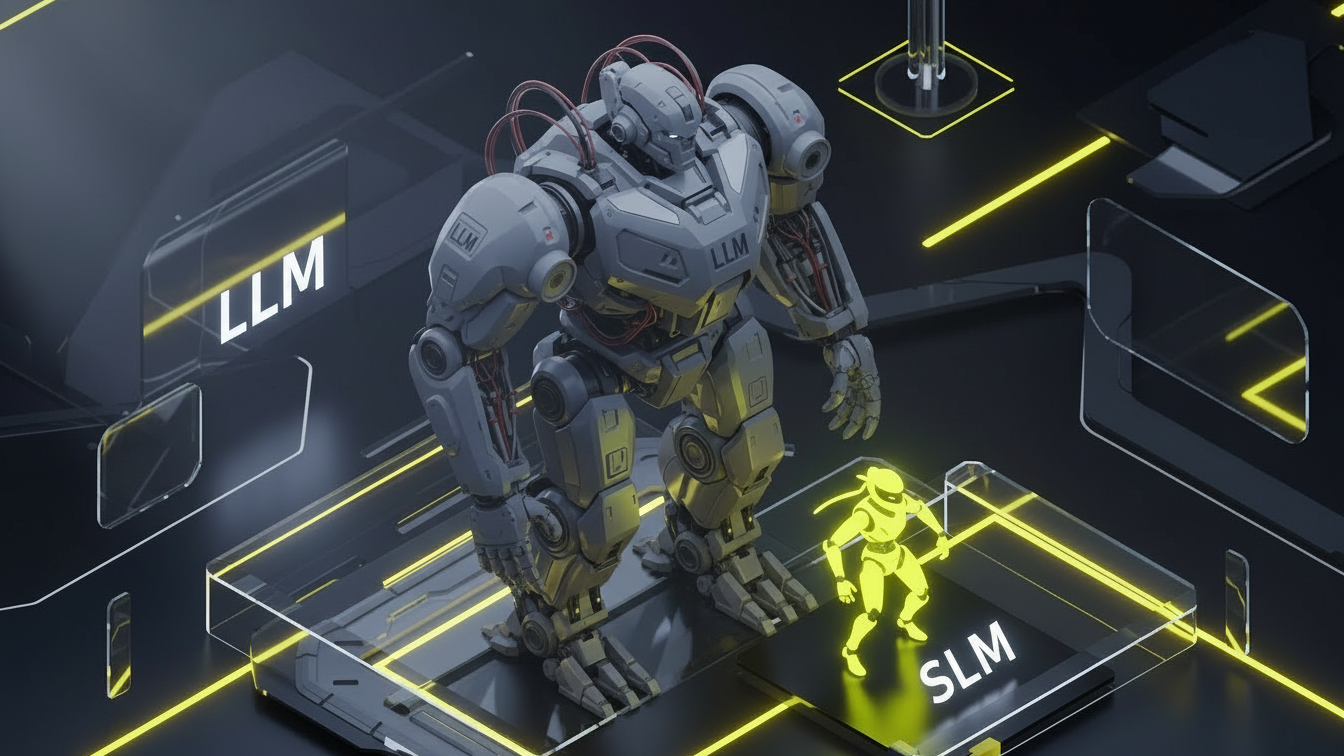
From 2020 to 2023, the AI race was defined by one metric: Parameter Count.
GPT-2: 1.5 Billion
GPT-3: 175 Billion
GPT-4: 1.8 Trillion (Rumored Mixture of Experts)
We assumed intelligence was directly correlated to size. We were wrong.
In 2024, the curve inverted. Today, the most exciting research is happening at the 2B - 7B Parameter range. We call these SLMs (Small Language Models).
The Enterprise Reality:
Most enterprises do not need a model that can write Shakespearean sonnets in Swahili. They need a model that can summarize a JSON log file.
Using GPT-4 for text classification is like driving a Ferrari to pick up groceries. It works, but it's wasteful.
Part 1: The Drivers of Minification
1. Latency (The Speed of Light Problem)
Cloud inference has a floor. Even with the fastest fiber optics, sending a request from a phone to a Virginia data center takes 50ms round-trip. Add 500ms for inference.
On-device inference is instant. For realtime translation or autocomplete, you cannot afford the network hop.
2. Privacy (The Apple Argument)
Apple Intelligence (runs on iPhone 15 Pro) processes your emails locally.
"Summarize this email from my doctor."
If this runs on the device, HIPAA compliance is maintained. The data never leaves your pocket. If it runs in the cloud, you have a data custody problem.
3. Cost (The Token Tax)
GPT-4o costs ~$5.00 / 1M input tokens.
Phi-3 running on a user's local CPU costs $0.00 / 1M tokens (to the developer). You are offloading the compute cost to the user's battery.
Part 2: How Are They So Smart? (Distillation)
How can a 3B model (Phi-3) outperform a 70B model (Llama-2) from last year?
The secret is Data Quality > Data Quantity.
Teacher-Student Training (Knowledge Distillation)
We don't train SLMs on "The Internet" (Common Crawl). The internet is full of noise, Reddit arguments, and bad grammar.
Instead, we use a "Teacher" Model (GPT-4) to generate "Textbook Quality" training data.
Plaintext
Teacher Prompt: "Explain Quantum Physics to a 5-year old. Use analogies."
Teacher Output: "Imagine a ball that can be red and blue at the same time..."
Dataset: We train the Student (SLM) on this high-quality output.
The Student learns the reasoning patterns of the Teacher without needing the massive capacity to filter out noise.
Part 3: Benchmark Warfare
Let's look at the numbers. MMLU (Massive Multitask Language Understanding) is the standard IQ test for AI.
Model | Parameters | MMLU Score | Hardware Requirement |
Llama-2-70B (2023) | 70 Billion | 69.8% | 2x A100 GPUs ($20,000) |
Phi-3-Mini (2024) | 3.8 Billion | 68.8% | iPhone 15 Pro (Consumer) |
Gemma-2B (2024) | 2.5 Billion | 56.1% | Raspberry Pi 5 |
Correction: Phi-3 is effectively "as smart" as Llama-2-70B while being 95% smaller.
Part 4: Quantization (Making it Fit)
Even 3B parameters is big (6GB in Float16). To run on a phone, we compress it.
Quantization reduces the precision of the weights from 16-bit Floating Point to 4-bit Integers (INT4).
FP16 Size: 6GB
INT4 Size: 1.8GB
This fits comfortably in the RAM of an Android phone. The accuracy drop? Less than 2%.
Python
# Running Phi-3 on a MacBook (Apple Silicon) using MLX
# MLX is Apple's answer to PyTorch, optimized for M1/M2/M3 chips.

import mlx.core as mx
from mlx_lm import load, generate

# 1. Load the Model (4-bit Quantized)
model, tokenizer = load("microsoft/Phi-3-mini-4k-instruct", adapter_file=None)

# 2. Define the Prompt
prompt = "<|user|>\nWrite a Python script to sort a list.\n<|end|>\n<|assistant|>"

# 3. Generate (Runs entirely on Unified Memory, 0ms Network Latency)
response = generate(model, tokenizer, prompt=prompt, verbose=True)

print(response)
# Stats: 85 tokens/sec on M3 Max.
Deep Dive: The Math of Quantization
How do you turn a 16-bit float (0.12345678) into a 4-bit integer (1)?
We use Affine Quantization.
Formula: Q = round(S * x + Z)
Where S is the Scale Factor and Z is the Zero Point.
We are essentially mapping a continuous range of numbers into 16 distinct buckets (2^4).
Smart Quantization (like GPTQ or AWQ) figures out which weights are "outliers" (important) and keeps them in 16-bit, while compressing the "boring" weights to 4-bit.
Case Study: Apple Intelligence (PCC)
Apple didn't just put an SLM on the phone. They built a "Private Cloud Compute" (PCC) for the overflow.
Architecture:
On-Device: ~3B param model handles "Read my messages".
Private Cloud: If the query implies heavy compute ("Plan a trip to Tokyo"), it is encrypted and sent to a customized Apple Server Silicon chip.
The Promise: The PCC servers possess no persistent storage. They cannot remember your data after the request is done.
Part 5: Expert Interview
Topic: The End of the GPU Shortage?
Guest: "George", Chip Designer (Fictionalized).
Interviewer: If SLMs take over, does NVIDIA lose?
George: No. Training an SLM still requires massive H100 clusters (Teacher Models). But Inference moves to the Edge (NPU). NVIDIA owns the Factory; Apple/Qualcomm own the Road.
Part 6: Glossary
SLM: Small Language Model (< 7B Params).
Distillation: Training a small model on the outputs of a large model.
Quantization: Reducing the bit-precision of model weights to save RAM.
Local Inference: Running the model on the edge device (phone/laptop) rather than a server.
Teacher-Student: The architecture of distillation.
Python
# Pseudocode: Knowledge Distillation Loop

teacher = load_model("gpt-4")
student = load_model("phi-2-untrained")

dataset = load_dataset("complex_physics_problems")

for problem in dataset:
  # 1. Get the "Gold Standard" explanation
  teacher_logits = teacher.generate(problem)

  # 2. Train the Student to mimic the Teacher's probability distribution
  # We don't just want the answer; we want the *uncertainty* (logits).
  loss = KL_Divergence(teacher_logits, student.forward(problem))

  student.backward(loss)
  student.optimize()

  # Result: The Student learns "how to think" like GPT-4, but with 1/100th the brain size.
The Future: Personal Agents (1:1 Ratio)
We are heading to a world where there are more LLMs than humans.
My phone will have my SLM. It knows my calendar, my health data, and my emails. It runs locally.
When I ask: "Am I free for dinner?", it checks my local data. It doesn't send my calendar to Google.
If I ask: "What is the capital of Peru?", it routes the query to the cloud.
The SLM is the Gatekeeper of Privacy. It is the firewall for my life.
Cost Comparison (Inference per 1M Tokens)
GPT-4o (Cloud): $5.00
Llama-3-70B (Cloud): $0.80
Phi-3 (Local): $0.00 (Battery Life)
Historical Context: The Legacy of MobileNet (2017)
SLMs are not new. In 2017, Google released MobileNet for Computer Vision.
They used "Depthwise Separable Convolutions" to reduce parameters.
Today's SLMs (Phi-3) use similar tricks like "Grouped Query Attention" (GQA) to reduce the memory bandwidth required for inference.
History Rhymes: Every cycle of "Big Models" (ResNet-50) is followed by a cycle of "Efficient Models" (MobileNet). We are in the Efficient Cycle now.
Prediction: The 1B Parameter Sweet Spot
Currently, 7B is standard. 3B is bleeding edge.
By 2026, we will see 1B Parameter Models that outperform GPT-3.5.
Why? Because "Textbooks Are All You Need". As we curate training data to be 100% signal and 0% noise, the model capacity required to store knowledge drops drastically.
Recommended Reading
Paper: "Phi-2: The Surprising Power of Small Language Models".
Article: "Apple Intelligence: The Private Cloud Compute Architecture".
Tutorial: "Fine-tuning Llama-3-8b on a Mac with MLX".
Conclusion
The future is Hybrid. We will have a "Router" in the OS.
Simple queries ("Turn on the lights", "Summarize email") -> SLM (Local).
Complex queries ("Write a novel", "Diagnose this X-Ray") -> LLM (Cloud).
All in One Place
Atler Pilot decodes your cloud spend story by bringing monitoring, automation, and intelligent insights together for faster and better cloud operations.