
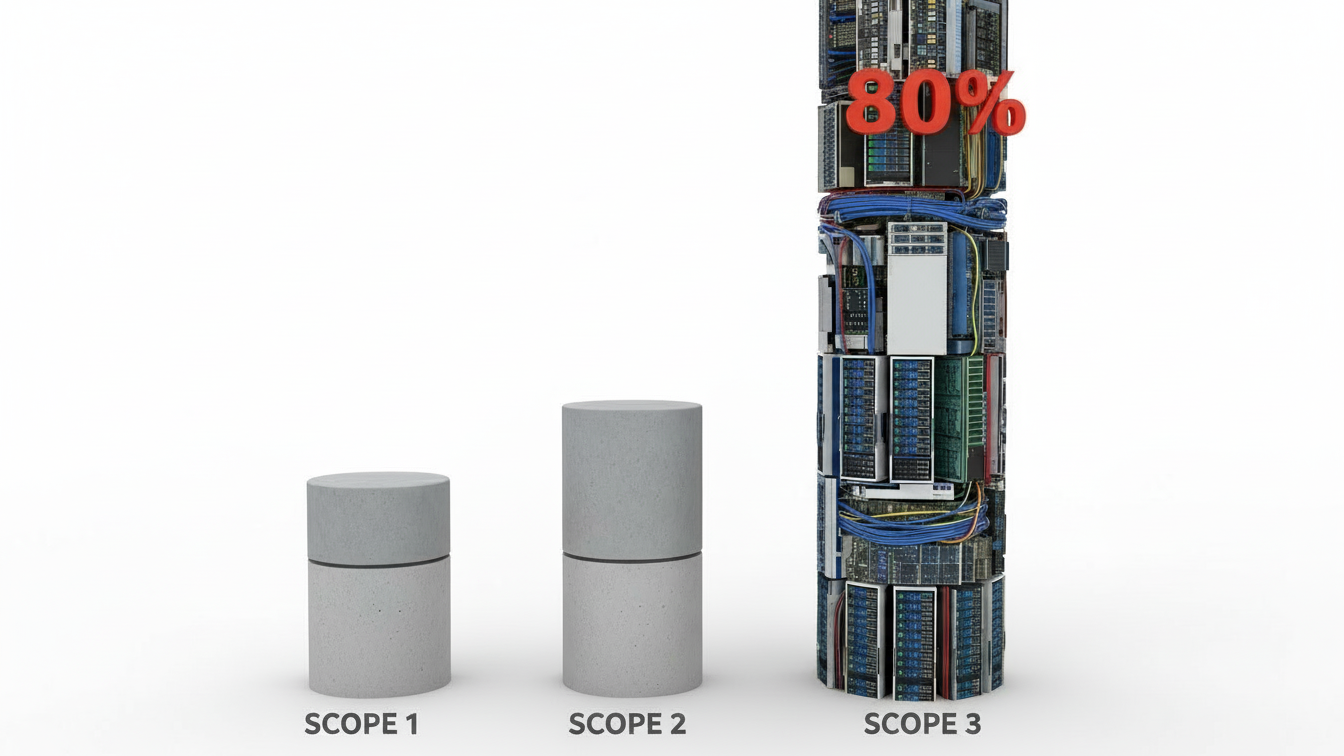
For most SaaS companies, Scope 3 emissions (supply chain) make up over 80% of their total carbon footprint. In the cloud, Scope 3 represents the embodied carbon of the servers, racks, and chips you rent.
The manufacturing of a GPU requires massive energy (mining silicon, fabrication). If you rent that GPU for an hour, you are responsible for a fraction of that manufacturing footprint. The problem? AWS, Azure, and GCP opaque reporting. Here is how to solve the Scope 3 puzzle using open tooling.
The Open Source Standard: Cloud Carbon Footprint (CCF)
Cloud Carbon Footprint (CCF) is the industry-standard open-source tool. It bridges the gap between your billing bill and carbon reality.
How CCF Calculates Scope 3:
Lookup: It scans your billing usage for instance types (e.g.,
m5.large).Coefficient: It checks a database of manufacturing emissions for the underlying CPU (e.g., Intel Skylake).
Amortization: It divides the manufacturing emissions by the expected lifespan of the server (typically 4 years).
Formula: $(\text{Manufacturing Emissions} / \text{Lifespan Hours}) \times \text{Your Usage Hours}$.
FOCUS 1.2 and Carbon Data
The FOCUS 1.2 billing standard now includes reserved columns for carbon. This allows you to ingest carbon data directly into your FinOps datasets.
SQL Query for Carbon Intensity (BigQuery):
SQL
SELECT
  Provider,
  Service,
  SUM(BilledCost) as Cost,
  SUM(x_CarbonEmissions_Scope3) as EmbodiedCarbon,
  (SUM(x_CarbonEmissions_Scope3) / SUM(BilledCost)) as CarbonIntensity
FROM focus_billing_export
GROUP BY 1, 2
ORDER BY CarbonIntensity DESC
Insight: You might find that "Storage" has a much higher carbon-to-dollar ratio than "Compute" because hard drives have high embodied carbon but low rental costs.
Actionable Strategy: Extend and Reuse
How do you reduce Scope 3? You can't change the manufacturing process. But you can:
Use Older Generations: AWS/Azure keep older instances (e.g.,
m4vsm7) active. These servers have often fully amortized their carbon debt. If your workload isn't performance-sensitive, using older hardware is "carbon free" from a Scope 3 perspective.ARM Processors (Graviton/Ampere): ARM chips have a significantly lower manufacturing footprint per unit of compute compared to x86 chips due to simpler die architectures.
Conclusion: Scope 3 is invisible in the standard console, but it is real in your ESG report. Using tools like CCF gives you the data to make architectural decisions that lower your true environmental impact.
All in One Place
Atler Pilot decodes your cloud spend story by bringing monitoring, automation, and intelligent insights together for faster and better cloud operations.