
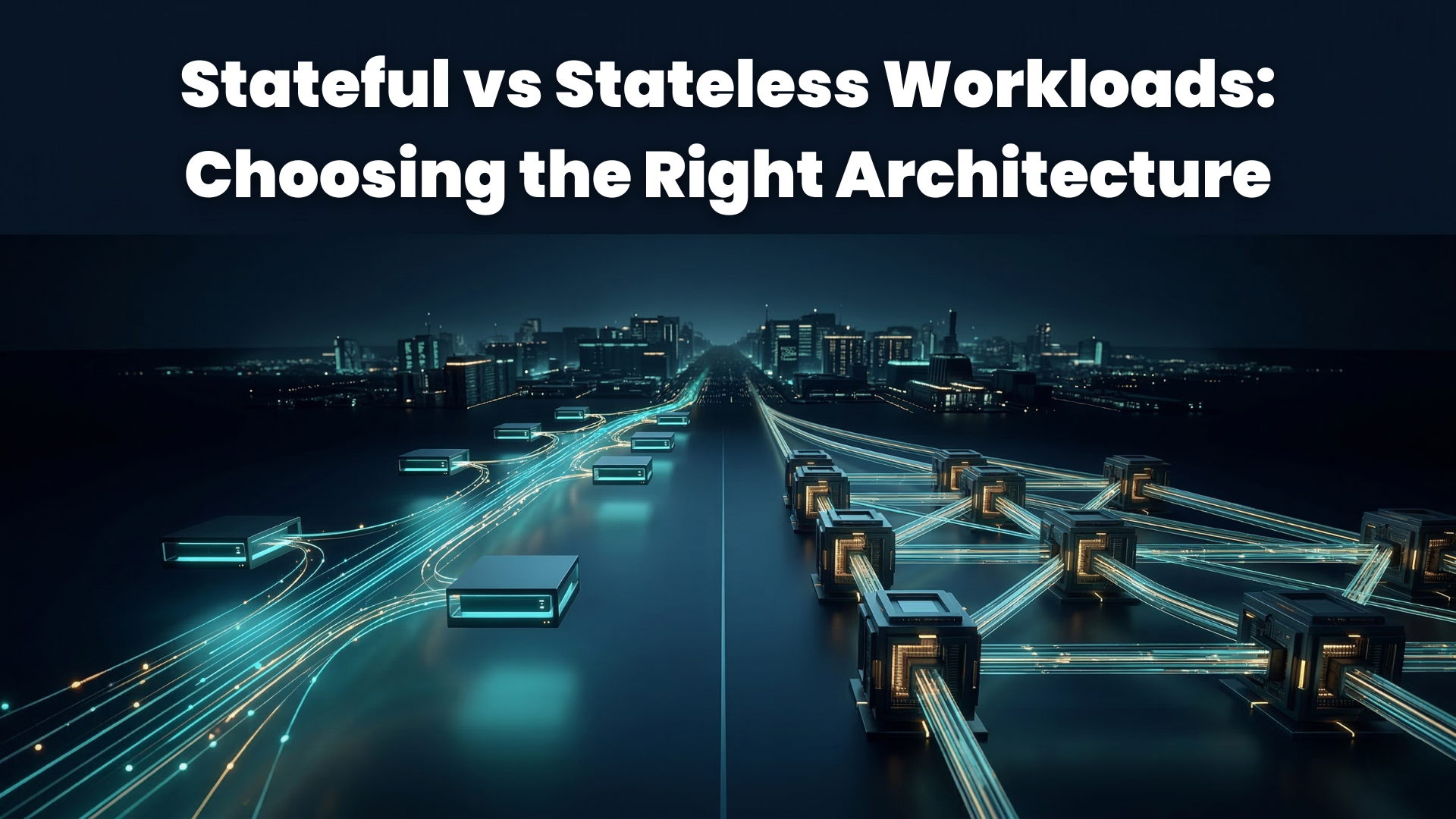
Modern applications are more distributed, scalable, and cloud-native than ever before. Whether you’re building APIs, microservices, streaming platforms, or enterprise SaaS applications, one architectural decision plays a critical role in how your system performs and scales, and that is choosing between stateful and stateless workloads.
At first glance, the difference may seem simple. Stateless systems do not store session information between requests, while stateful systems do. However, the implications of this choice go far beyond technical definitions. It affects scalability, fault tolerance, infrastructure complexity, cost efficiency, and overall system design.
With the rise of cloud-native platforms, Kubernetes, and distributed architectures, understanding when to use stateful vs stateless workloads has become essential for developers, DevOps teams, and cloud architects.
In this guide, we’ll explore what stateful and stateless workloads are, how they differ, and how to decide which architecture works best for your application.
What Are Stateless Workloads?
Stateless workloads refer to applications or services that do not retain information about previous interactions. Each request is processed independently, meaning the system does not rely on stored session data to function. In a stateless system, every request contains all the information needed to process it.
How Stateless Systems Work?
When a client sends a request to a stateless service, the system processes the request and returns a response without storing any session data. Once the response is sent, the server does not retain any information about that interaction.
Because the server does not maintain state, the next request could be handled by any server in the infrastructure.
This architecture makes stateless systems highly flexible and scalable.
Examples of Stateless Applications
Stateless architectures are commonly used in:
REST APIs
Microservices architectures
Content delivery systems
Serverless applications
Web front-end services
For example, when a user requests a web page through an API, the API processes the request and returns the data. The system does not need to remember previous requests to function correctly. This design allows stateless applications to distribute traffic easily across multiple servers.
What Are Stateful Workloads?
Stateful workloads, on the other hand, store information about previous interactions. This stored information, or “state,” allows the system to track ongoing sessions, transactions, or workflows. Stateful systems rely on stored data to process requests correctly.
How Stateful Systems Work?
In a stateful architecture, servers maintain session information or application data across multiple interactions. For example, when a user logs into an application, the system stores session information such as authentication tokens or user activity. This state is then used to manage subsequent interactions.
Because stateful systems rely on stored data, they often require dedicated infrastructure or persistent storage to maintain consistency.
Examples of Stateful Applications
Stateful workloads are common in systems that require persistent data or ongoing sessions, such as:
Databases
Payment processing systems
Online gaming platforms
Banking applications
User session management systems
For instance, a database must remember stored records, transactions, and queries. Without maintaining state, it would not be able to manage data reliably.
Key Differences Between Stateful and Stateless Workloads
Understanding the differences between these architectures helps determine which approach is best suited for a specific application.
Data Storage
Stateless systems do not store session data between requests. Each request contains the information required for processing. Stateful systems rely on stored data to maintain context across interactions.
Scalability
Stateless systems are generally easier to scale because requests can be distributed across multiple servers without concern for stored state.
Stateful systems are more complex to scale because data consistency and session management must be maintained.
Infrastructure Complexity
Stateless workloads simplify infrastructure management because servers can be replaced or scaled without affecting application state. These systems require additional components such as databases, storage layers, or session management tools.
Fault Tolerance
Stateless systems are typically more resilient to failures because requests can be rerouted to another server without losing context. They must ensure data persistence and consistency, which can introduce additional complexity in recovery and replication strategies.
Why are Stateless Architectures Popular in Cloud-Native Systems?
Cloud-native systems often favor stateless architectures because they align well with modern infrastructure patterns.
Elastic Scalability
Stateless workloads can scale horizontally with ease. If traffic increases, additional instances can be deployed to handle demand without needing to transfer session data between servers. This scalability makes stateless architectures ideal for high-traffic applications.
Simplified Infrastructure Management
Stateless services simplify infrastructure operations because instances can be created or destroyed without affecting application behavior. This flexibility works particularly well with container orchestration platforms such as Kubernetes.
Resilience and Reliability
Because stateless systems do not rely on stored session data, they are less susceptible to failures caused by server outages. Requests can simply be redirected to other healthy instances.
When are Stateful Architectures Necessary?
Despite the advantages of stateless systems, many applications require stateful workloads.
Data Persistence
Applications that rely on stored data must maintain state. Databases, messaging systems, and analytics platforms depend on persistent storage to function.
Transaction Management
Systems that handle financial transactions or sensitive data must maintain state to ensure accuracy and reliability. For example, payment processing systems must track transaction status across multiple steps.
User Session Management
Applications that manage user sessions, preferences, or personalized data often rely on stateful infrastructure. Although some systems externalize session data to databases or caching layers, the application itself may still rely on stateful components.
Hybrid Architectures: Combining Stateful and Stateless Workloads
In modern cloud systems, the most common approach is not purely stateful or stateless. Instead, many architectures combine both models.
Stateless Application Layers
Application layers are often designed to be stateless so they can scale easily and handle large volumes of traffic.
Stateful Data Layers
Persistent data is typically stored in dedicated stateful components such as databases or storage services. This separation allows organizations to benefit from the scalability of stateless services while maintaining reliable data storage.
For example, a typical cloud application might use stateless microservices that communicate with a stateful database layer.
Infrastructure Challenges in Stateful Systems
Running stateful workloads in distributed environments introduces several operational challenges.
Data Consistency
Stateful systems must ensure that data remains consistent across multiple nodes and regions. Replication strategies, distributed storage systems, and synchronization mechanisms are required to maintain data integrity.
Infrastructure Management
Managing stateful infrastructure often requires specialized orchestration tools that can handle persistent storage and workload scheduling. Platforms like Kubernetes now provide mechanisms such as StatefulSets to support stateful workloads.
Resource Efficiency
Stateful systems often require more infrastructure resources because data must be stored, replicated, and maintained. Without proper monitoring and optimization, these workloads can lead to inefficient infrastructure utilization.
Our cloud intelligence platform, Atler Pilot, helps teams analyze infrastructure usage patterns, detect inefficiencies, and identify opportunities to optimize both stateful and stateless workloads. By providing visibility into resource consumption and performance metrics, Atler Pilot helps organizations ensure their cloud infrastructure remains efficient and cost-effective.
Choosing the Right Architecture
Selecting between stateful and stateless workloads depends on several factors.
Application Requirements
If your application requires persistent data, session management, or transaction tracking, a stateful architecture may be necessary. For lightweight services, APIs, and scalable front-end applications, stateless systems are often the better choice.
Scalability Needs
Applications that expect large traffic spikes benefit from stateless architectures because they can scale horizontally with minimal complexity.
Operational Complexity
Stateless systems typically require less operational management, making them easier to maintain in distributed environments. Stateful systems require additional planning around storage, replication, and reliability.
The Future of Cloud Architectures
As cloud infrastructure continues to evolve, modern architectures are increasingly designed around stateless compute layers combined with stateful data services. Technologies such as container orchestration, serverless computing, and distributed databases are making it easier to manage both workload types effectively.
At the same time, improved monitoring and cost intelligence tools are helping organizations optimize infrastructure efficiency across these environments. Platforms like Atler Pilot enable teams to gain deeper insights into cloud resource usage, detect inefficiencies, and optimize workloads across complex cloud environments.
Conclusion
The choice between stateful vs stateless workloads is one of the most important architectural decisions in modern cloud systems. Stateless architectures offer scalability, flexibility, and simplified infrastructure management, making them ideal for APIs, microservices, and web applications.
Stateful architectures, however, remain essential for applications that require persistent data, session tracking, and transactional integrity. In most modern systems, the best solution is a hybrid approach that combines stateless application layers with stateful data services. By understanding the strengths and limitations of each architecture, engineering teams can design systems that are not only scalable and resilient but also efficient and cost-effective.
As cloud environments continue to grow in complexity, having the right visibility into infrastructure performance, through platforms like Atler Pilot, can help organizations ensure their workloads are optimized for both performance and cost.
All in One Place
Atler Pilot decodes your cloud spend story by bringing monitoring, automation, and intelligent insights together for faster and better cloud operations.