
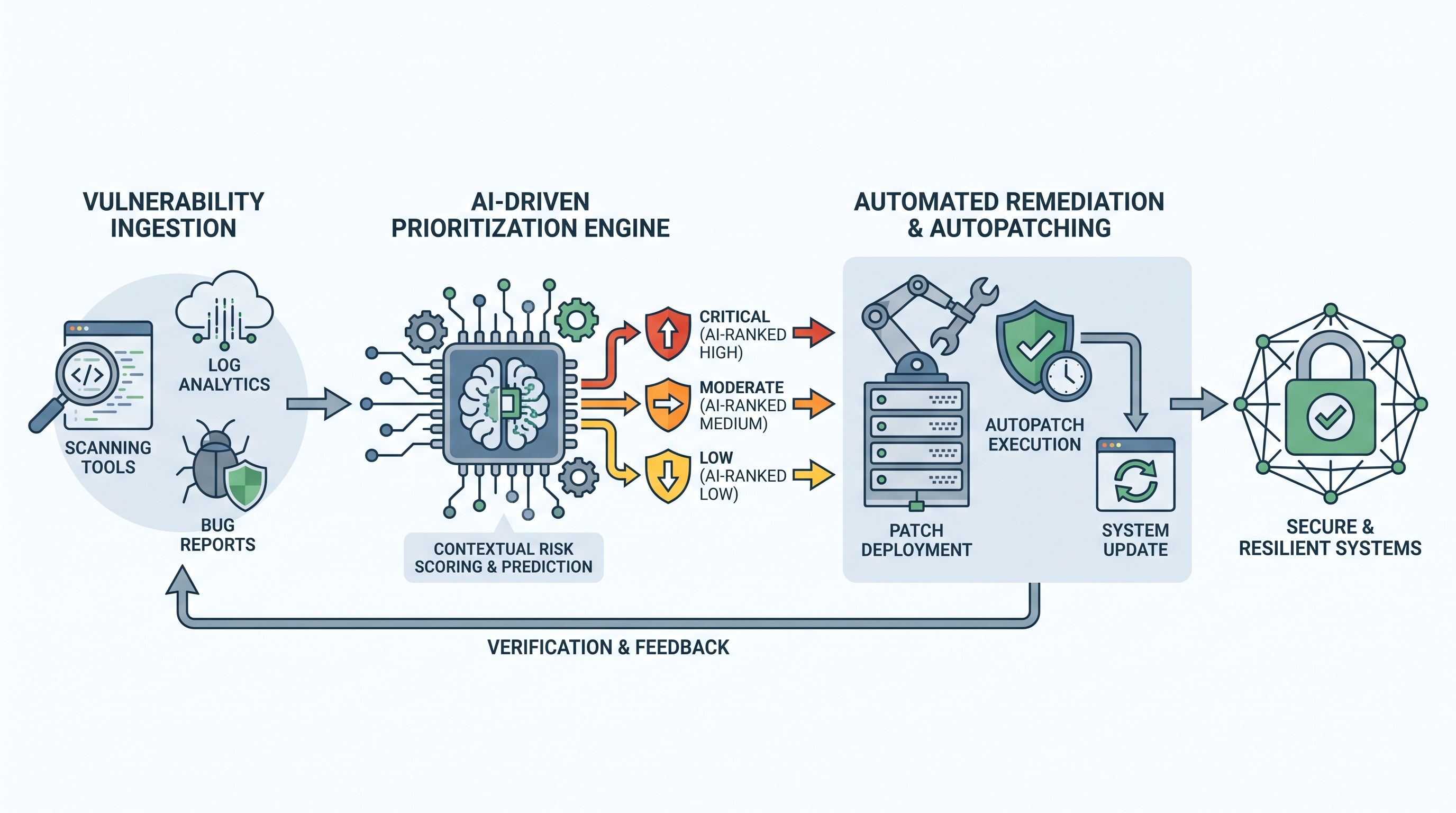
The Modern Vulnerability Deluge in Multi-Cloud Environments
Enterprise cloud footprints spanning AWS, Azure, GCP, and Oracle Cloud Infrastructure (OCI) have created an unprecedented scale of operational complexity. As organizations shift to microservices architectures, containerized workloads, and infrastructure-as-code (IaC), the sheer volume of software packages, dependencies, and OS-level libraries has exploded. Consequently, security teams are inundated with thousands of vulnerability alerts daily.
Traditional vulnerability management relies heavily on the Common Vulnerability Scoring System (CVSS). While CVSS provides a standardized framework for rating the severity of a security flaw, it is fundamentally flawed when used in isolation for prioritization. CVSS measures severity, not risk. A vulnerability rated CVSS 9.8 (Critical) residing on an isolated back-end database with no public internet ingress, strict Network Security Group (NSG) rules, and no active exploit in the wild poses a lower real-world risk than a CVSS 6.8 (Medium) vulnerability on a public-facing web server that is actively being exploited by threat actors.
This lack of context leads to "vulnerability fatigue." Security teams hand over massive spreadsheets of "Critical" and "High" vulnerabilities to Site Reliability Engineers (SREs) and system administrators, demanding immediate remediation. The result is operational friction, delayed product releases, and high developer burnout. Furthermore, patching is not a free operation. It consumes compute resources, requires regression testing, risks application downtime, and demands expensive engineering hours. To solve this, enterprises must transition to context-aware vulnerability prioritization and automated remediation workflows that balance security posture with operational efficiency.
The Failure of CVSS-Only Prioritization
To understand why a new paradigm is required, we must analyze the data points that CVSS ignores:
Runtime Reachability: Is the vulnerable code path actually loaded into memory and executed? Static Application Security Testing (SAST) and Software Composition Analysis (SCA) often flag vulnerable libraries that are packaged in a container but never imported or called by the running application.
Environmental Controls: Are there compensating controls, such as Web Application Firewalls (WAFs), IAM policies, or network security groups, that mitigate the threat?
Exploit Intelligence: Is there a known exploit payload available on public repositories like GitHub or Metasploit? What is the Exploit Prediction Scoring System (EPSS) score?
Asset Criticality: Does the host store or process personally identifiable information (PII), financial data, or critical business logic?
Without integrating these signals, organizations waste up to 70% of their remediation efforts on vulnerabilities that pose zero actual threat. By implementing an AI-driven triage layer, we can correlate these disparate data streams to calculate an actionable "Real-World Risk Score." This is where a unified platform like CloudAtler's cloud security management engine becomes invaluable, bridging the gap between raw threat intelligence and actual cloud architecture context.
Architecting an AI-Driven Prioritization Pipeline
An intelligent vulnerability management pipeline must continuously ingest, correlate, and analyze data from multiple cloud environments. Below is a high-level architectural blueprint of how an AI-driven triage and prioritization engine operates:
+---------------------------------------------------------------------------------------+
|                                    INGESTION LAYER                                    |
|  +------------------+  +------------------+  +------------------+  +---------------+  |
|  |   SCA/Container  |  |  Cloud Provider  |  |  Threat Intel &  |  | Runtime Agent |  |
|  |   Scanners (Snyk,|  |  Config (AWS     |  |  EPSS Feeds      |  | Telemetry     |  |
|  |   Trivy, Prisma) |  |  Config, Azure)  |  |  (CISA KEV, etc) |  | (eBPF, OS)    |  |
|  +--------+---------+  +--------+---------+  +--------+---------+  +-------+-------+  |
+-----------|---------------------|---------------------|--------------------|----------+
            |                     |                     |                    |
            +---------------------+----------+----------+--------------------+
                                             |
                                             v
+---------------------------------------------------------------------------------------+
|                                 CONTEXTUAL AI ENGINE                                  |
|  1. Graph Database Mapping (Assets, IAM, Network Paths, Data Classification)          |
|  2. Runtime Execution Verification (Is the vulnerable library loaded in memory?)       |
|  3. EPSS & Threat Intelligence Analysis (Is there an active exploit in the wild?)       |
|  4. Risk Score Calculation & De-duplication                                           |
+---------------------------------------------------------------------------------------+
                                             |
                                             v
+---------------------------------------------------------------------------------------+
|                                  DECISION & ACTION                                    |
|       +------------------------------------+-----------------------------------+      |
|       |                                    |                                   |      |
|       v                                    v                                   v      |
|  [Auto-Patch Pipeline]            [Ticket Generation]                [Suppression]    |
|  - Immutable Image Bake           - JIRA / ServiceNow                - Low risk,      |
|  - Blue-Green Deploy              - Enriched with context            no active path   |
+---------------------------------------------------------------------------------------+
Data Ingestion and Contextualization
The pipeline begins by aggregating vulnerability reports from container registries, host scanners, and code repositories. Simultaneously, it queries cloud provider APIs to map the infrastructure topology. This step answers critical questions: Is the host running the vulnerable package exposed to the internet? Does it have an attached IAM role with administrative privileges?
For example, consider an AWS EC2 instance running an outdated version of libxml2 containing a heap buffer overflow vulnerability. The AI engine cross-references AWS CloudTrail logs, VPC flow logs, and IAM policies. It discovers that the instance is inside a private subnet, accessible only via a bastion host, and has an IAM role restricted to writing to a specific S3 bucket. The engine automatically downgrades the priority of this alert.
Using Graph Neural Networks (GNNs) for Attack Path Analysis
Advanced AI-driven security platforms utilize Graph Neural Networks (GNNs) to represent cloud infrastructure as a directed graph. Nodes represent assets (EC2 instances, S3 buckets, Lambda functions, IAM users), and edges represent relationships or access paths (network routes, IAM assume-role permissions, security group rules).
By running pathfinding algorithms on this graph, the AI can detect complex attack paths that human operators would miss. For instance, an attacker could exploit a medium-severity vulnerability on an external web server, assume its instance profile, leverage a privilege escalation misconfiguration to become a cluster administrator, and ultimately exfiltrate data from a database. By identifying this chain, the AI elevates the priority of the initial "medium" vulnerability because it serves as the entry point for a critical attack path.
The FinOps of Patching: Calculating the Financial Impact
Security decisions cannot be made in a vacuum. Every action taken by security and engineering teams has a financial footprint. In a multi-cloud environment, spinning up staging environments for regression testing, rebuilding container images, updating base AMIs, and redeploying virtual machines incurs direct cloud compute costs.
Furthermore, unplanned downtime or performance degradation caused by a bad patch can lead to SLA penalties and loss of customer trust. Therefore, a mature enterprise security program must calculate the financial impact of patching before executing any remediation script.
The Cost-of-Remediation Equation
To quantify this, we can model the Total Cost of Remediation (TCR) against the Cost of Exposure (CoE):
TCR = (Eng_Hours × Eng_Rate) + Compute_Overhead + Testing_Infrastructure_Cost + Potential_Downtime_Cost
CoE = Probability_of_Exploit × (Regulatory_Fines + Brand_Damage_Valuation + Incident_Response_Cost)
If the TCR is significantly higher than the CoE for a minor vulnerability, the rational business decision is to defer patching and implement a compensating control (such as a WAF rule) instead. Conversely, for a highly exploitable zero-day vulnerability on a billing database, the CoE is astronomical, justifying immediate, automated, and potentially disruptive patching. Our platform helps organizations analyze these tradeoffs natively, aligning security objectives with enterprise FinOps budgets.
Designing a Zero-Touch Autopatch Pipeline
Once a vulnerability is prioritized and approved for remediation, the next step is execution. Manual patching is slow, error-prone, and cannot scale. Organizations must build an automated patch pipeline that can apply security updates safely without human intervention.
However, "autopatching" strikes fear into the hearts of SREs. A bad package update can cause dependency conflicts, kernel panics, or application crashes. To build trust, the autopatch pipeline must incorporate rigorous pre-patch validation, canary deployments, and safe rollbacks.
Step 1: Immutable Infrastructure vs. Live Patching
There are two primary approaches to cloud patching:
Mutable (Live Patching): Applying updates directly to running instances using tools like AWS Systems Manager (SSM) Patch Manager, Ansible, or Azure Update Manager. This is suitable for legacy workloads but introduces configuration drift.
Immutable (Re-baking): Modifying the base Golden Image (AMI, VM template, or Dockerfile), rebuilding the image via a CI/CD pipeline, and redeploying the infrastructure. This is the gold standard for cloud-native environments as it eliminates drift and ensures consistency.
Below is an example of an automated GitLab CI/CD pipeline stage that uses HashiCorp Packer to re-bake an AWS AMI when a critical OS vulnerability is detected:
stages:
  - scan
  - bake
  - deploy

bake_ami:
  stage: bake
  image: hashicorp/packer:latest
  script:
    - packer init templates/aws-ubuntu.pkr.hcl
    - packer build -var "patch_update=true" templates/aws-ubuntu.pkr.hcl
  rules:
    - if: '$TRIGGER_PATCH_BUILD == "true"'
In this pipeline, the patch_update=true variable triggers an internal script within the Packer template to run apt-get update && apt-get upgrade -y, ensuring that the newly baked AMI contains all the latest security patches.
Step 2: Safe Rollback Mechanisms and Canary Deployments
To deploy the newly patched image safely, the pipeline should leverage a Blue-Green or Canary deployment strategy. Rather than updating all production instances simultaneously, the deployment engine provisions a small subset of instances (e.g., 10%) running the new image.
The system then monitors real-world performance and error metrics for a defined soak period (e.g., 30 minutes). If the error rate spikes, latency increases, or synthetic tests fail, the pipeline automatically aborts the deployment and routes traffic away from the patched instances.
Here is an example of a Prometheus Query (PromQL) used by an automated rollback system to monitor HTTP 5xx error rates during a canary patch deployment:
sum(rate(http_requests_total{status=~"5.."}[5m]))
/
sum(rate(http_requests_total[5m])) * 100 > 1.0
If this query returns true (meaning the HTTP 5xx error rate exceeds 1% of total traffic over a 5-minute window), the rollback trigger is pulled, terminating the new instances and restoring the previous stable state. This level of automation is core to CloudAtler's automated patch remediation capabilities, providing teams with the confidence to enable self-healing infrastructure.
Multi-Cloud Governance and Compliance at Scale
Managing security patches across a single cloud provider is challenging enough; doing so across a heterogeneous multi-cloud environment requires a unified control plane. AWS, Azure, and GCP each have their own native patch management tools, metadata schemas, and logging formats. Trying to manage these in silos results in visibility gaps and compliance failures.
Abstraction of Cloud APIs
An enterprise-grade vulnerability management platform abstracts the underlying cloud APIs. Whether an operator is patching an EC2 instance in AWS, a Virtual Machine in Azure, or a Compute Engine instance in GCP, they should interact with a single, unified interface. This interface translates high-level business intents (e.g., "Patch all critical OS vulnerabilities on PCI-compliant hosts") into cloud-specific actions:
In AWS, it invokes SSM Run Command or SSM Association APIs.
In Azure, it triggers Azure Update Manager API calls.
In GCP, it schedules OS Patch Deployments via GCP OS Config APIs.
This abstraction ensures that security policies are applied consistently, regardless of where the workload resides. It also simplifies compliance reporting. During an audit, instead of pulling reports from three different cloud consoles, compliance officers can extract a single, unified ledger of patch compliance, proving that vulnerabilities were remediated within the required SLA windows.
Overcoming Cultural and Operational Barriers
The technology to automate vulnerability prioritization and patching exists today. The biggest hurdle to adoption is cultural. SRE and DevOps teams are often hesitant to hand over control of production environments to automated security tools. To overcome this resistance, organizations should adopt a phased crawl-walk-run approach:
Phase | Automation Level | Human Involvement | Target Workloads |
|---|---|---|---|
Crawl | AI Prioritization & Ticket Enrichment | Manual approval and manual execution | Production & Non-Production |
Walk | Automated Patching in Staging | Manual promotion to Production | Development, Testing, and Staging |
Run | Full Zero-Touch Autopatching | No human intervention (unless rollback triggers) | Non-critical Production & Stateless Services |
By starting with automated prioritization and manual execution, teams can build confidence in the AI's recommendations. As they verify that the AI consistently identifies the correct risks without false positives, they can gradually enable auto-patching in development and staging environments, eventually progressing to fully automated production deployments for stateless, auto-scaled workloads.
Unifying Cloud Operations with CloudAtler
The traditional, siloed approach to cloud security, operations, and finance is no longer viable. To secure modern multi-cloud environments without crippling engineering velocity or blowing past operational budgets, enterprises must unify their workflows.
CloudAtler is designed from the ground up to solve these exact challenges. By unifying FinOps, cloud security, and automated operations into a single, cohesive platform, CloudAtler empowers organizations to prioritize vulnerabilities with deep architectural context, calculate the true financial impact of remediation, and execute automated, safe patch pipelines across AWS, Azure, GCP, and Oracle Cloud.
Stop drowning in alert noise and wasting critical engineering resources on manual, low-risk patches. Unify your cloud operations with CloudAtler today and experience the power of intelligent, automated, and cost-aware cloud security.
All in One Place
Atler Pilot decodes your cloud spend story by bringing monitoring, automation, and intelligent insights together for faster and better cloud operations.