
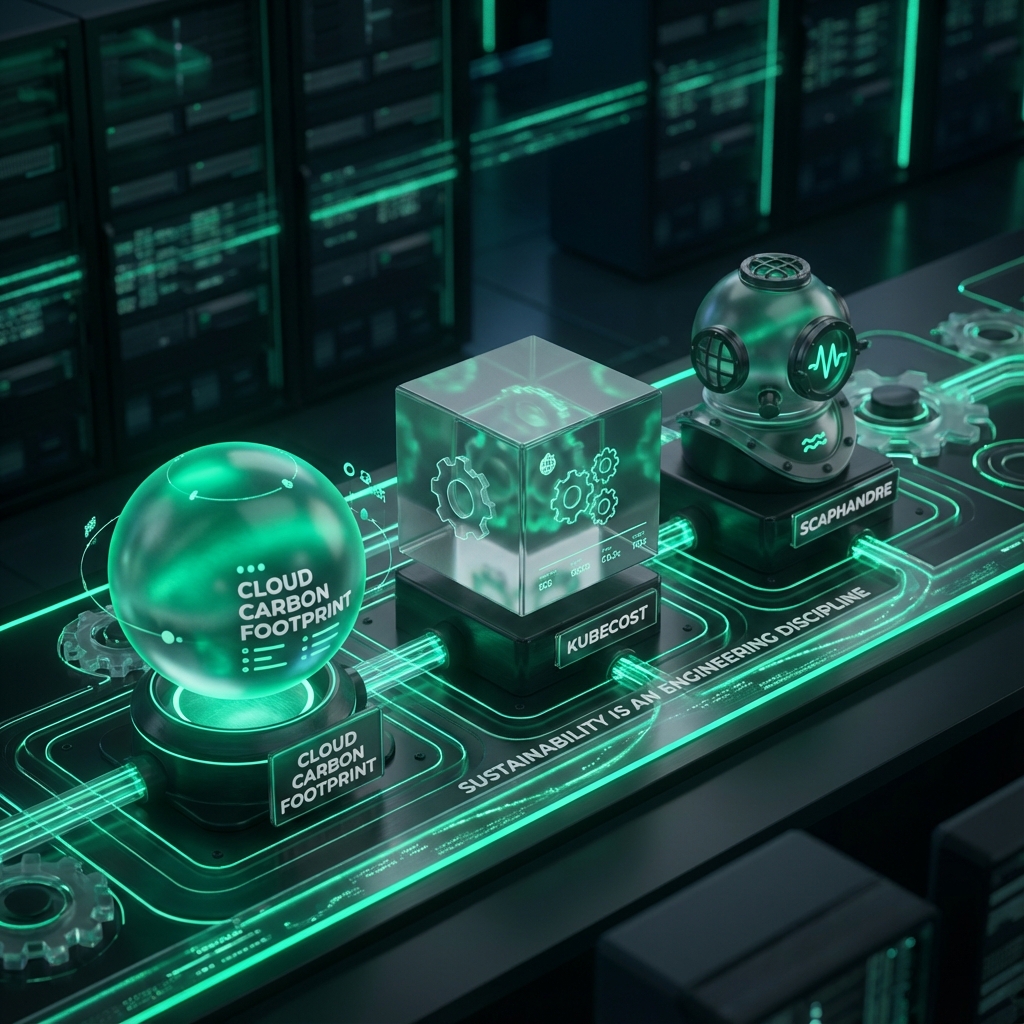
Sustainability as Code. GreenOps isn't about buying offsets or planting trees; it's about engineering efficiency. To do that, you need visibility. You can't optimize what you can't see.
In 2026, the "Green Stack" has matured. It is no longer a collection of hacky scripts but a cohesive set of enterprise-ready tools that integrate with your existing observability pipeline (Prometheus, Grafana, Datadog). Here are the three essential tools for the modern AI Platform Engineer.
1. Cloud Carbon Footprint (CCF) Strategy Layer | Multi-Cloud | Reporting
The Executive Dashboard. CCF is an open-source tool that acts as the source of truth for your overall organizational footprint.
How It Works It connects directly to your AWS Cost and Usage Reports (CUR), Google Cloud Billing, and Azure Consumption APIs. It takes your usage data (e.g., "100 hours of p4d.24xlarge in us-east-1") and applies coefficients to estimate CO2e (Carbon Dioxide Equivalent). It handles the messy work of looking up grid intensity factors for different regions and embodied carbon coefficients for hardware types.
Why You Need It
Multi-Cloud Aggregation: If you use AWS for training and Azure for inference, CCF unifies the data into one view.
Trend Analysis: It is perfect for QBRs (Quarterly Business Reviews) to show the C-Suite: "We increased usage by 50% but only increased carbon by 10%."
Recommendations: It proactively suggests rightsizing opportunities, like shutting down zombie instances or switching regions.
2. Kubecost (Green Edition) Orchestration Layer | Kubernetes | Chargeback
The Accountant. Kubecost is famous for FinOps (cost management), but its newer versions integrate carbon metrics. It brings visibility down from the "Cloud Account" level to the "Pod" level.
How It Works It sits inside your Kubernetes cluster. It maps emissions to Kubernetes concepts like Namespaces, Deployments, and Labels. It calculates the "Carbon Efficiency" of your workloads by correlating resource allocation with resource utilization.
Why You Need It
Attribution: It allows you to say, "The Data Science team (Namespace:
ds-training) is responsible for 40% of our emissions," rather than just blaming "The Platform."Unified Metric: It allows you to view Cost ($) and Carbon (CO2e) side-by-side. Often, these metrics align (waste is expensive), but sometimes they diverge (e.g., running in a cheaper but dirtier region). Kubecost makes this trade-off visible.
3. Scaphandre Node Layer | Bare Metal | Process-Level
The Sensor. Scaphandre (French for "Diving Suit") is a bare-metal agent written in Rust that deep-dives into power consumption at the process level.
How It Works Unlike Kepler (which focuses on K8s), Scaphandre is excellent for capturing data on bare-metal servers, developer workstations, or edge devices. It reads RAPL sensors directly and exports metrics to Prometheus.
Why You Need It
Performance Tuning: It helps you identify "Energy Leaks." For example, spotting a Python script that is spinning in a busy loop and keeping the CPU C-states from sleeping, burning 50W for no reason.
Granularity: It can tell you the power consumption of
PID 1234(e.g., your specific Postgres database process) rather than just the whole server.
Integration Strategy: Gate the Build
Having tools is one thing; using them to stop bad code is another. The ultimate maturity level in GreenOps is Gating the Build.
Imagine a CI/CD pipeline rule: "If a Pull Request increases the estimated energy consumption per inference by >10%, fail the build."
To implement this:
Run a benchmark during CI (using Scaphandre or Kepler to measure).
Compare the Joules/Token against the
mainbranch baseline.Block the merge if the regression is too high.
This treats carbon regression exactly like a performance regression or a security vulnerability. It stops the bleeding before it reaches production.
All in One Place
Atler Pilot decodes your cloud spend story by bringing monitoring, automation, and intelligent insights together for faster and better cloud operations.