
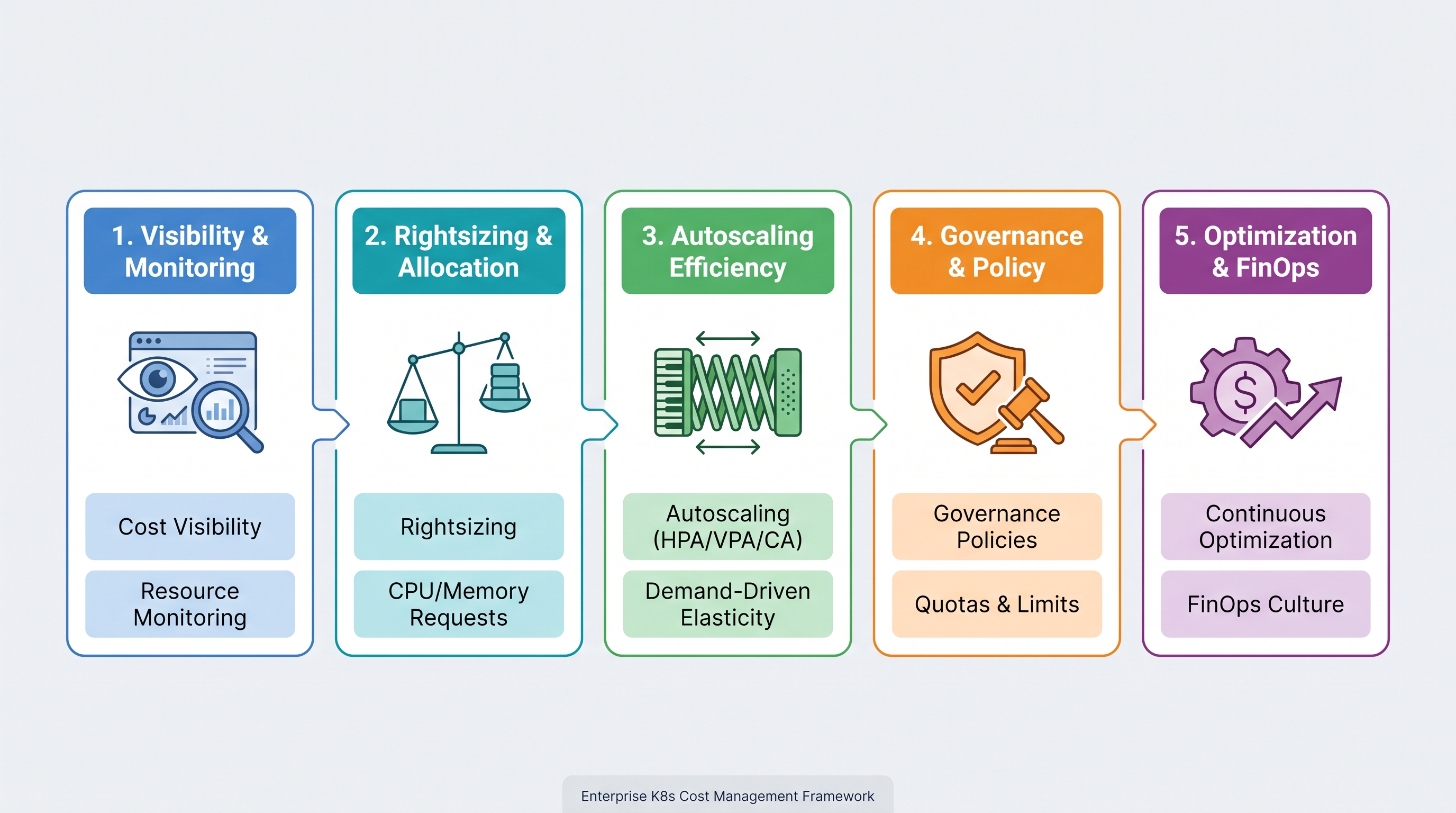
Navigating the Kubernetes Cost Labyrinth: A FinOps Imperative
Kubernetes has become the de facto standard for orchestrating containerized applications, powering the most demanding enterprise workloads across hybrid and multi-cloud environments. Its declarative nature, scalability, and resilience offer unparalleled agility for development and operations teams. However, this power and flexibility come with a significant caveat: unmanaged Kubernetes deployments can quickly lead to spiraling cloud costs, transforming innovation into an unexpected financial burden. For enterprises, mastering Kubernetes cost management isn't merely an operational task; it's a strategic FinOps imperative, demanding a sophisticated blend of technical expertise, financial accountability, and robust security practices.
The complexity of Kubernetes—with its myriad of resources, dynamic scaling capabilities, and intricate networking—often obscures true resource consumption. Unlike traditional virtual machine environments where a single VM corresponds to a clear cost unit, Kubernetes abstracts away the underlying infrastructure, making it challenging to attribute costs accurately to specific applications, teams, or business units. This lack of granular visibility, coupled with engineers' natural tendency to over-provision out of fear of performance bottlenecks, creates fertile ground for financial inefficiencies.
In this comprehensive guide, we will dissect the core challenges of Kubernetes cost management and present five golden rules that every enterprise must adopt. These rules are not theoretical concepts but actionable strategies, backed by architectural examples and FinOps principles, designed to bring clarity, control, and significant savings to your Kubernetes investments. We'll explore how to right-size resources with precision, leverage cost-effective infrastructure, establish transparent cost allocation, optimize storage and networking, and embed a continuous FinOps culture into your cloud-native operations. By the end, you'll have a clear roadmap to transform your Kubernetes cost landscape from a black box into a transparent, optimized, and financially sound ecosystem.
Golden Rule 1: Precision Right-Sizing and Granular Resource Governance
The most common culprit behind excessive Kubernetes costs is over-provisioning. Developers and operations teams, often under pressure to guarantee performance and stability, tend to request more CPU and memory than their applications genuinely require. This "safety buffer" approach, while well-intentioned, directly translates to underutilized infrastructure and inflated cloud bills. Precision right-sizing is not about starving applications; it's about aligning resource allocations with actual workload demands, ensuring optimal performance without wasteful expenditure.
Understanding Requests and Limits
At the heart of Kubernetes resource governance are requests and limits defined in pod specifications. These parameters are fundamental to how the Kubernetes scheduler places pods on nodes and how the Kubelet manages resources for containers:
requests(CPU/Memory): These specify the minimum amount of CPU and memory a container needs. The Kubernetes scheduler uses these values to decide which node can accommodate a pod. If a node doesn't have enough allocatable resources to satisfy a pod's requests, the pod won't be scheduled on that node. This is a critical FinOps lever; setting requests too high means nodes are perceived as full even if physical resources are available, leading to unnecessary cluster scaling.limits(CPU/Memory): These define the maximum amount of CPU and memory a container is allowed to use. If a container exceeds its CPU limit, it will be throttled. If it exceeds its memory limit, it will be terminated by the kernel with an Out-Of-Memory (OOM) error and potentially restarted. While limits prevent a single misbehaving pod from consuming all node resources, setting them too generously can mask inefficiencies.
The optimal strategy involves continuous monitoring of actual resource usage to fine-tune these values. Tools that provide granular insights into pod-level CPU and memory consumption are invaluable here. CloudAtler’s performance management features, for instance, can analyze historical usage patterns across your Kubernetes clusters, identifying workloads with consistently low utilization relative to their requests. This intelligence allows for data-driven adjustments, ensuring that your requests are accurately reflecting baseline needs, and limits are set to prevent runaway processes without being overly restrictive.
Leveraging Autoscaling Mechanisms
Kubernetes offers powerful native autoscaling capabilities that are crucial for dynamic cost management:
Horizontal Pod Autoscaler (HPA): The HPA automatically scales the number of pod replicas based on observed CPU utilization, memory utilization, or custom metrics (e.g., Kafka queue length, HTTP request rate). For stateless applications, HPA is highly effective in matching compute capacity to demand fluctuations. Configuring HPA requires careful consideration of target metrics, stabilization windows, and minimum/maximum replica counts to avoid "thrashing" (rapid, unnecessary scaling).
Vertical Pod Autoscaler (VPA): The VPA automatically adjusts the CPU and memory requests and limits for individual pods based on their historical and real-time usage. VPA operates in different modes:
Off,Initial(sets requests/limits only on pod creation),Recommender(provides recommendations without applying them), andAuto(automatically updates requests/limits). While VPA can significantly reduce over-provisioning, itsAutomode can sometimes lead to pod evictions for resource adjustments, which needs to be carefully managed for stateful or critical workloads.Cluster Autoscaler (CA): The CA dynamically adjusts the number of nodes in your Kubernetes cluster based on pending pods and node utilization. If pods cannot be scheduled due to insufficient resources, the CA provisions new nodes. If nodes are underutilized for a configurable period and all pods can be rescheduled elsewhere, the CA de-provisions nodes. This ensures your infrastructure scales with your application's needs, preventing unnecessary node costs.
An advanced FinOps strategy combines these autoscalers. HPA handles application-level scaling, VPA optimizes individual pod resources, and CA manages the underlying infrastructure. This layered approach ensures that resources are optimized at every level, from container to cluster. CloudAtler’s compute lifecycle analysis provides comprehensive insights into how these autoscalers are performing, identifying opportunities for further tuning and ensuring that your cluster's scaling behavior aligns with your cost objectives.
Enforcing Governance with Resource Quotas and Limit Ranges
Beyond individual pod configurations, enterprise-grade cost management requires enforcing resource governance at the namespace or project level. This is where Kubernetes' Resource Quotas and Limit Ranges become indispensable:
Resource Quotas: These define constraints on the aggregate resource consumption per namespace. You can limit the total CPU requests, memory requests, CPU limits, memory limits, and even the number of objects (pods, services, PVCs) allowed within a namespace. This is a powerful FinOps tool for chargeback models, enabling teams to operate within a defined budget for their allocated resources.
Limit Ranges: These provide default resource requests/limits for pods and containers if they are not explicitly specified. They can also enforce minimum and maximum values for CPU and memory requests/limits within a namespace. Limit Ranges prevent developers from deploying pods without any resource definitions, which can lead to "noisy neighbor" issues and make right-sizing efforts challenging.
Implementing a robust policy-as-code strategy, potentially using tools like OPA Gatekeeper or Kyverno, can automate the enforcement of these quotas and ranges across all namespaces, ensuring compliance and preventing resource sprawl from the outset. This proactive approach is critical for maintaining cost control in large, multi-team Kubernetes environments.
Golden Rule 2: Harnessing Spot Instances and Optimized Node Management
While right-sizing addresses internal resource consumption, optimizing the underlying compute infrastructure is equally vital for cost savings. Cloud providers offer significant discounts for leveraging their excess capacity, typically through "Spot Instances" (AWS), "Preemptible VMs" (GCP), or "Spot Virtual Machines" (Azure). Integrating these volatile but cost-effective resources into your Kubernetes strategy can yield substantial savings, often 70-90% off on-demand prices.
Strategically Employing Spot Instances
The key to successful Spot Instance utilization lies in understanding their ephemeral nature. Cloud providers can reclaim these instances with short notice (typically 30 seconds to 2 minutes). Therefore, they are best suited for fault-tolerant, stateless, or batch workloads that can gracefully handle interruptions and restarts. Examples include:
Stateless Microservices: Web servers, API gateways, worker services that process independent requests and store no persistent state locally.
Batch Processing: Data transformation jobs, rendering tasks, machine learning inference jobs where progress can be checkpointed or retried.
Development/Testing Environments: Non-production environments where occasional interruptions are acceptable.
To integrate Spot Instances effectively, your Kubernetes deployment strategy must:
Isolate Workloads: Use node selectors, taints and tolerations, or affinity rules to schedule appropriate workloads onto Spot Instance node pools. For example, a dedicated node pool labeled
lifecycle=spotcould be tainted to only accept pods with a corresponding toleration.Design for Resilience: Ensure your applications are designed to be highly available and fault-tolerant. This means having multiple replicas, fast startup times, and mechanisms for graceful shutdown (e.g., pre-stop hooks, readiness/liveness probes). The Cluster Autoscaler can be configured to provision new Spot Instances quickly if existing ones are reclaimed.
Leverage Managed Services: Cloud providers offer managed Kubernetes services (EKS, GKE, AKS) that integrate seamlessly with their Spot offerings. GKE Autopilot, for instance, abstracts away node management entirely, often using Spot instances for burstable workloads automatically. AWS's Karpenter can intelligently provision nodes of the right type and size, including Spot instances, in response to unschedulable pods, often outperforming the traditional Cluster Autoscaler.
While Spot Instances offer compelling cost savings, they also introduce a layer of operational complexity. Monitoring their availability and eviction rates is crucial. A robust FinOps strategy will meticulously track the cost savings achieved through Spot instances against any operational overhead or potential service interruptions, ensuring a net positive impact.
Optimized Node Pool Management
Beyond Spot Instances, intelligent node pool design is crucial for cost optimization:
Heterogeneous Node Pools: Don't use a single, monolithic node pool. Create distinct node pools for different workload types, instance families (compute-optimized, memory-optimized), and pricing models (on-demand, reserved, spot). For example, critical stateful services might run on dedicated on-demand or reserved instance nodes, while batch jobs run on Spot instances.
Right-Sizing Nodes: Just as you right-size pods, right-size your nodes. Larger nodes might offer better resource packing efficiency but can lead to larger blast radii during failures. Smaller nodes might be more flexible but incur higher operational overhead. Monitor node utilization to identify oversized or undersized nodes.
Consider Serverless Kubernetes Options: Solutions like AWS Fargate for EKS or Azure Container Instances for AKS abstract away node management entirely, allowing you to pay only for the resources your pods consume, without needing to provision or manage underlying VMs. This can simplify operations and align costs more directly with application usage, though it may come with a slight premium compared to meticulously optimized self-managed nodes.
Effective node management requires continuous analysis of your cluster's resource demands and a deep understanding of cloud provider pricing models. This analysis should be a core component of your FinOps practice, allowing for proactive adjustments to your node provisioning strategy. CloudAtler helps identify inefficiencies in node utilization, guiding decisions on optimal instance types and scaling configurations to maximize savings without compromising performance or reliability.
Golden Rule 3: Proactive Cost Visibility, Allocation, and Chargeback
You cannot manage what you cannot measure. In the dynamic world of Kubernetes, a lack of clear cost visibility is a primary impediment to effective FinOps. Without knowing which teams, applications, or services are consuming what resources, it's impossible to attribute costs accurately, foster accountability, or identify areas for optimization. Proactive cost visibility, coupled with robust allocation and chargeback mechanisms, transforms amorphous cloud spend into actionable financial intelligence.
Implementing a Mandatory and Consistent Labeling Strategy
The foundation of Kubernetes cost visibility is a meticulously planned and rigorously enforced labeling and tagging strategy. Labels are key-value pairs that are attached to Kubernetes objects (pods, deployments, services, namespaces, nodes, persistent volumes). They are crucial for organizing and selecting subsets of objects, and critically, for cost attribution. Cloud providers also use tags for resource billing, so a consistent strategy that bridges both Kubernetes labels and cloud provider tags is essential.
Mandatory labels should include:
apporservice: Identifies the application or microservice.environment: e.g.,dev,staging,production.teamorowner: The engineering team responsible for the workload.cost-centerorbusiness-unit: For financial chargeback.project: The specific project the workload belongs to.
Enforcement of these labels should be automated and integrated into your CI/CD pipelines using admission controllers like OPA Gatekeeper or Kyverno. These tools can prevent deployments of objects that lack required labels, ensuring compliance from the outset. CloudAtler's automated tagging capabilities can further streamline this process, ensuring consistency across diverse cloud resources and Kubernetes objects, which is paramount for unified cost reporting.
Kubernetes Cost Allocation and Reporting
Once resources are properly labeled, the next step is to accurately allocate and report costs. This involves:
Resource Mapping: Translating Kubernetes resource consumption (CPU/memory requests, storage) into monetary costs based on the underlying cloud provider pricing for nodes, storage, and network. This is complex because multiple pods share a single node, and different instance types have varying costs.
Shared Resource Allocation: Determining how to fairly distribute the cost of shared cluster components (e.g., control plane, Ingress controllers, monitoring stacks) among different teams or namespaces. Common approaches include proportional allocation based on resource requests, or fixed overhead charges.
Integration with Cloud Billing APIs: Pulling raw billing data from AWS Cost Explorer, Azure Cost Management, or Google Cloud Billing to correlate with Kubernetes resource usage data.
Specialized Kubernetes cost management tools (like OpenCost or Kubecost) are invaluable here. They integrate with Kubernetes APIs and cloud billing APIs to provide granular cost breakdowns by namespace, deployment, label, and even individual pod. These tools can help visualize spend, identify cost anomalies, and generate chargeback reports.
CloudAtler’s financial operations platform unifies this data, offering a comprehensive dashboard that correlates Kubernetes resource consumption with actual cloud spend across AWS, Azure, GCP, and Oracle. This provides a single pane of glass for FinOps teams, enabling them to understand cost drivers, allocate costs accurately, and derive actionable insights for optimization.
Implementing Showback and Chargeback Models
Beyond simple reporting, FinOps thrives on accountability. Implementing showback (showing teams their costs) or chargeback (billing teams for their costs) models can dramatically shift behavior and encourage cost-conscious development practices:
Showback: Provides teams with regular reports or dashboard access detailing their cloud spend. This fosters awareness and encourages self-correction without direct financial penalties.
Chargeback: Directly allocates cloud costs to specific cost centers or business units. This requires robust, auditable cost allocation mechanisms and clear internal service level agreements (SLAs) regarding resource pricing.
Both models require a transparent and consistent methodology for cost calculation. Regular FinOps reviews, where engineering and finance teams discuss cost trends and optimization opportunities, are crucial for embedding this culture. CloudAtler’s budget forecasting features, combined with its real-time cost visibility, empower organizations to set realistic budgets, track against them, and provide teams with the necessary data to manage their spend effectively.
Golden Rule 4: Strategic Storage and Network Optimization
While compute costs often dominate the conversation, storage and network egress can silently inflate your Kubernetes bill. Neglecting these areas means leaving significant optimization opportunities on the table. A holistic FinOps approach must extend to every component of your cloud-native infrastructure.
Right-Sizing and Tiering Persistent Storage
Kubernetes Persistent Volumes (PVs) and Persistent Volume Claims (PVCs) abstract away the underlying storage infrastructure. However, the choice of StorageClass and the requested volume size have direct cost implications:
StorageClass Selection: Cloud providers offer various storage types, each with different performance characteristics (IOPS, throughput) and pricing. For example, AWS offers GP2/GP3 (general purpose), IO1/IO2 (provisioned IOPS), and Cold HDD. Google Cloud has Standard Persistent Disks, SSD Persistent Disks, and Extreme Persistent Disks. Using an expensive, high-performance storage class (e.g., provisioned IOPS SSD) for a workload that only requires standard performance is a common source of waste. Define multiple StorageClasses in your cluster, each mapping to an appropriate cloud storage type, and ensure developers select the correct class for their application's needs.
Volume Size and Performance: Many cloud storage types tie performance directly to volume size (e.g., AWS GP2 EBS volumes provide 3 IOPS per GB). Over-provisioning storage size to meet IOPS requirements, even if the actual data stored is small, leads to unnecessary costs. Monitor actual storage utilization and IOPS/throughput demands to right-size volumes.
Lifecycle Management: Implement policies for snapshotting, archiving, and deleting old or unused Persistent Volumes. Orphaned PVCs or PVs that are no longer bound to any application can accumulate significant costs over time. Automated cleanup routines and regular audits are essential.
For stateful applications, carefully consider solutions like Rook/Ceph or Portworx if you require advanced storage features, but be mindful of their operational overhead and potential costs. For most use cases, leveraging the cloud provider's managed storage services via CSI drivers is the most cost-effective approach.
Minimizing Network Egress Costs
Network data transfer, particularly egress (data leaving the cloud provider's network or crossing regions), can be surprisingly expensive. Kubernetes deployments, with their distributed microservices architecture, can generate substantial inter-service traffic. Key strategies for network cost optimization include:
In-Region Traffic Optimization: Keep traffic within the same availability zone or region whenever possible. Cross-AZ traffic within the same region typically incurs lower costs than cross-region traffic. Ensure your Kubernetes cluster is configured to prefer scheduling pods in the same AZ as their data sources.
Private Endpoints and VPC Peering: For communication with other cloud services (databases, object storage), use private endpoints (e.g., AWS VPC Endpoints, Azure Private Link, GCP Private Service Connect) or VPC peering. This keeps traffic within the cloud provider's private network, avoiding expensive public internet egress charges and enhancing security.
Efficient Ingress/Egress Controllers: Optimize your Ingress controllers (e.g., NGINX Ingress, AWS ALB Ingress, GCP GKE Ingress) to efficiently route external traffic to your services. Consider traffic compression (e.g., GZIP) where appropriate to reduce data transfer volumes.
Service Mesh Considerations: While a service mesh (e.g., Istio, Linkerd) provides powerful traffic management, observability, and security features, it also adds overhead. Evaluate whether the benefits outweigh the additional resource consumption and complexity, which can indirectly increase network and compute costs.
Content Delivery Networks (CDNs): For serving static assets or public-facing content, leverage CDNs (e.g., CloudFront, Cloudflare, Azure CDN) to cache content closer to users. This reduces direct egress from your Kubernetes services and improves user experience.
Network architecture review should be a regular part of your FinOps and security audits. Identifying chatty services, inefficient data transfer patterns, and unnecessary public egress routes can uncover significant cost savings. Furthermore, secure network configurations, such as implementing strict network policies (e.g., using Calico or Cilium) and private connectivity, inherently align with cost-saving by reducing exposure to public internet transit costs and potential data exfiltration charges. CloudAtler's unified platform provides visibility into network traffic patterns and associated costs, helping identify optimization opportunities that might otherwise go unnoticed.
Golden Rule 5: Implementing a Continuous FinOps Culture and Automation
Kubernetes cost management is not a one-time project; it's an ongoing discipline. The dynamic nature of cloud-native environments, with constantly evolving applications, infrastructure, and pricing models, demands a continuous FinOps culture supported by robust automation. Without this, even the best initial optimizations will degrade over time, leading to cost creep.
Embedding FinOps into the Development Lifecycle with GitOps and Policy-as-Code
The most effective way to control costs is to prevent wasteful resource consumption before it even enters production. This requires shifting left, integrating FinOps principles directly into the development and deployment lifecycle:
GitOps for Infrastructure and Application Deployment: By managing all cluster configurations and application deployments through Git repositories (e.g., using Argo CD or Flux CD), you gain version control, auditability, and a single source of truth. This consistency reduces configuration drift, which can lead to unexpected costs, and facilitates automated changes.
Policy-as-Code (PaC): Tools like OPA Gatekeeper, Kyverno, or even custom Admission Controllers, allow you to define and enforce policies directly within your Kubernetes cluster. These policies can prevent deployments that violate FinOps best practices, such as:
Mandating
requestsandlimitsfor all containers.Enforcing minimum/maximum resource allocations.
Requiring specific labels (
team,cost-center) on all resources.Prohibiting the use of expensive storage classes for non-critical workloads.
Ensuring that sensitive data does not reside on non-compliant storage types.
By enforcing these policies at the admission control stage, you catch potential cost issues before they become live problems, reducing reactive firefighting and ensuring compliance with both FinOps and security mandates.
CI/CD Integration: Integrate cost validation checks into your CI/CD pipelines. Tools can estimate the cost impact of new deployments or configuration changes, providing developers with immediate feedback on the financial implications of their code. This fosters a cost-aware mindset throughout the engineering organization.
This proactive approach significantly reduces the "cost of correction" later in the cycle. It transforms FinOps from a reactive audit function into an integrated, preventative measure, aligning engineering velocity with financial responsibility.
Automated Cleanup and Anomaly Detection
Even with rigorous upfront controls, unused or orphaned resources can accumulate in dynamic Kubernetes environments. Automation is key to preventing this "dark debt":
Automated Cleanup Scripts: Implement scripts or operators that periodically scan for and delete unused resources, such as:
Unbound Persistent Volume Claims (PVCs) or Persistent Volumes (PVs).
Old or superseded ConfigMaps and Secrets.
Failed or completed Jobs that are no longer needed.
Idle namespaces or clusters (e.g., for ephemeral development environments).
Anomaly Detection: Leverage AI-powered platforms to continuously monitor resource consumption and spend patterns. Sudden spikes in resource usage, unexpected increases in cloud bills, or deviations from historical norms can indicate inefficient configurations, runaway processes, or even potential security breaches (e.g., cryptomining malware). CloudAtler’s Atler AI is specifically designed for this, providing predictive monitoring and anomaly detection across FinOps, security, and operational metrics. This intelligent layer allows teams to react swiftly to deviations, preventing minor issues from escalating into major cost or security incidents.
Fostering Cross-Functional Collaboration and Continuous Improvement
Ultimately, FinOps is a cultural transformation. It requires ongoing collaboration between finance, engineering, and operations teams. This continuous feedback loop ensures that cost optimization is not seen as a one-off project but an integral part of cloud operations:
Regular FinOps Reviews: Schedule recurring meetings where stakeholders review cost reports, discuss optimization opportunities, and track progress against budget goals. This ensures transparency and shared ownership.
Setting KPIs and Goals: Define clear Key Performance Indicators (KPIs) for cost efficiency (e.g., cost per transaction, resource utilization rates, savings from optimization initiatives). These KPIs should be visible and understood across teams.
Education and Training: Provide ongoing training for developers and operators on FinOps principles, cost-aware design patterns, and effective use of Kubernetes resource management features.
Centralized Intelligence: A unified platform that consolidates FinOps, security, and operational data is crucial. CloudAtler’s unified dashboard provides this holistic view, enabling teams to correlate cost data with performance metrics and security posture. This allows for informed decisions where cost savings do not inadvertently compromise performance or introduce security vulnerabilities. For example, understanding that a specific patch remediation might have a direct cost impact (cost-impact-calculation) allows for budget-aware planning.
By embedding these practices, enterprises can cultivate a sustainable FinOps culture where cost efficiency is a shared responsibility, continuously optimized through automation, intelligence, and collaboration.
Conclusion: Unifying FinOps, Security, and Operations for Kubernetes Excellence
The journey to mastering Kubernetes cost management is multifaceted, demanding more than just technical tweaks. It requires a strategic shift towards a FinOps-driven culture, where cost awareness, accountability, and continuous optimization are woven into the fabric of your cloud-native operations. By diligently applying these five golden rules—precision right-sizing, strategic use of ephemeral instances, proactive cost visibility, intelligent storage and network optimization, and a continuous FinOps culture with automation—enterprises can transform their Kubernetes environments from potential cost sinks into highly efficient, financially optimized, and secure platforms.
However, navigating this complexity across diverse cloud environments
All in One Place
Atler Pilot decodes your cloud spend story by bringing monitoring, automation, and intelligent insights together for faster and better cloud operations.