
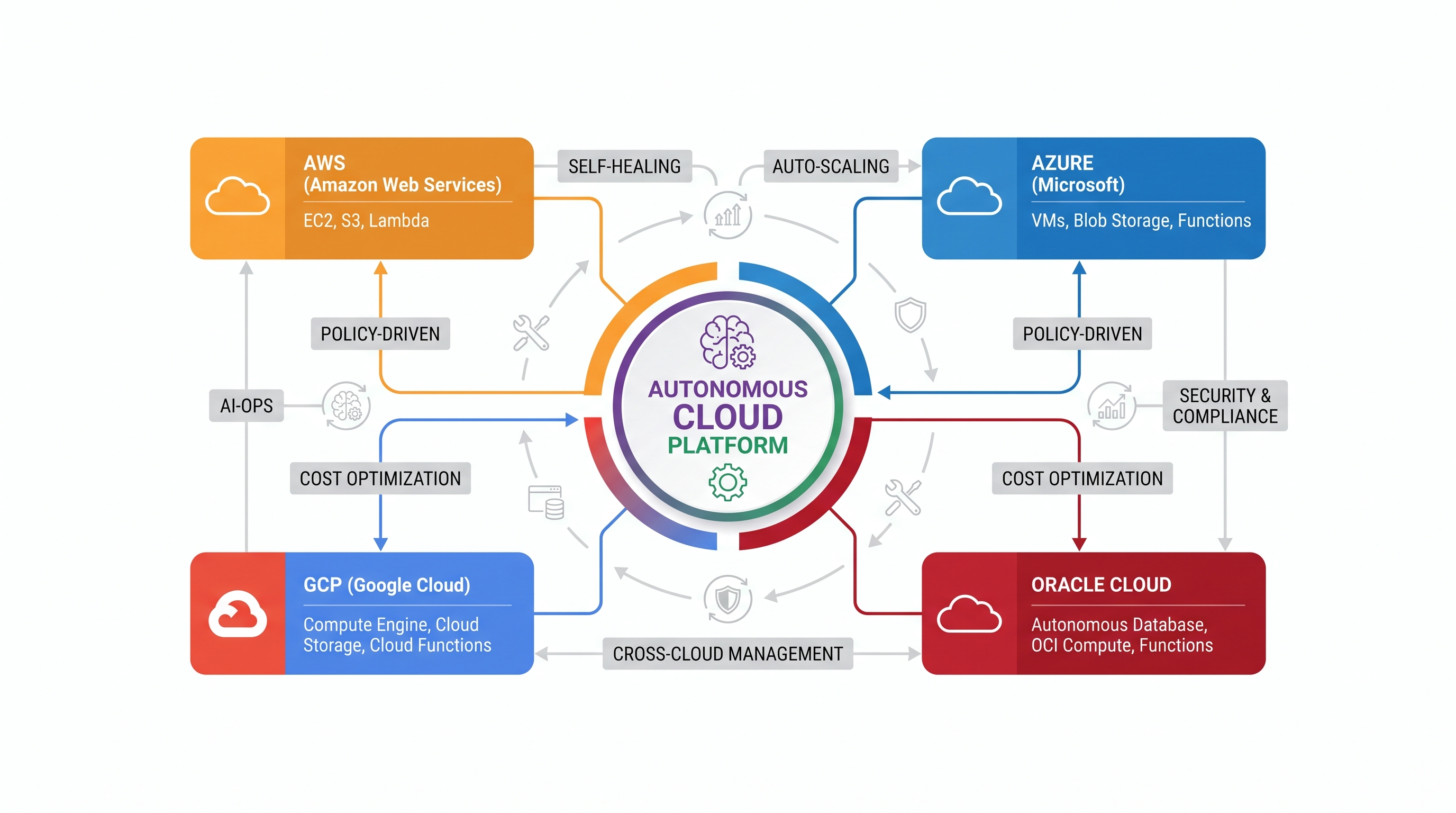
The Imperative for Autonomous Cloud Operations in the Enterprise
In the relentless pursuit of agility, cost efficiency, and robust security, enterprises have embraced multi-cloud strategies, leveraging the distinct advantages offered by hyperscalers like Amazon Web Services (AWS), Microsoft Azure, Google Cloud Platform (GCP), and Oracle Cloud Infrastructure (OCI). While this approach offers unparalleled flexibility and resilience, it also introduces a formidable challenge: managing disparate operational models, security frameworks, and cost structures across an ever-expanding fleet of resources.
The traditional approach to cloud operations—relying heavily on manual intervention, fragmented tooling, and reactive responses—is no longer sustainable. As cloud environments scale, the complexity grows exponentially, leading to increased operational overhead, heightened security risks, and spiraling costs. This is where the concept of the "Autonomous Cloud" emerges as a strategic imperative. An autonomous cloud environment is one where operations, from provisioning and scaling to security and cost management, are largely self-governing, self-optimizing, and self-healing, driven by advanced automation and artificial intelligence.
Achieving this level of autonomy across a multi-cloud landscape (AWS, Azure, GCP, Oracle) demands a unified, intelligent platform capable of abstracting away provider-specific complexities, normalizing data, and executing intelligent actions. The goal is to move beyond mere automation scripts to a system that can understand context, predict outcomes, and take proactive measures, fundamentally transforming how enterprises manage their digital infrastructure.
Deconstructing the Autonomous Cloud: Core Pillars of Multi-Cloud Automation
The journey to an autonomous cloud is built upon several foundational pillars, each critical for enabling intelligent, self-managing operations across diverse cloud providers.
1. Intelligent Observability and Unified Monitoring
True autonomy begins with comprehensive visibility. In a multi-cloud environment, this means moving beyond siloed monitoring solutions (e.g., AWS CloudWatch, Azure Monitor, GCP Operations Suite, OCI Monitoring) to a unified, centralized observability platform. This platform must:
Aggregate Telemetry Data: Ingest metrics, logs, traces, and events from all connected cloud accounts and services, normalizing data formats for consistent analysis. For instance, CPU utilization metrics from an AWS EC2 instance, an Azure VM, a GCP Compute Engine instance, and an OCI Compute instance should be presented and analyzed uniformly.
Contextual Correlation: Automatically correlate data across different cloud providers and services. An anomaly detected in network latency in AWS might be linked to increased database load in Azure, highlighting a cross-cloud application dependency.
AI/ML-Driven Anomaly Detection: Leverage machine learning algorithms to establish baselines, detect deviations from normal behavior, and identify anomalies that would be missed by static thresholds. This extends to predictive analytics, anticipating resource saturation or performance bottlenecks before they impact users.
Topology Mapping: Dynamically map multi-cloud resource dependencies and application architectures, providing a real-time, holistic view of the entire operational landscape.
The unification of this data feeds the intelligence layer, enabling the autonomous system to "understand" the current state and predict future states of the environment.
2. Proactive FinOps Automation and Cost Optimization
FinOps, the practice of bringing financial accountability to the variable spend model of cloud, is a prime candidate for autonomous operations. Manual cost management across multiple cloud bills is a monumental, error-prone task. An autonomous FinOps capability focuses on:
Real-time Cost Visibility and Allocation: Provide a single pane of glass for all cloud spend, breaking it down by department, project, application, and environment, irrespective of the underlying cloud provider. This requires robust, automated automated tagging and resource grouping across AWS, Azure, GCP, and OCI.
Automated Waste Detection and Remediation: Identify idle resources, oversized instances, unattached volumes, and forgotten snapshots across all clouds. The autonomous system can then automatically initiate actions like:
Right-sizing compute instances based on actual utilization patterns (e.g., downgrading an over-provisioned EC2 m5.xlarge to m5.large).
Deleting unused storage (e.g., Azure managed disks, GCP persistent disks, OCI block volumes).
Scheduling non-production environments to shut down during off-hours.
Commitment Management Optimization: Intelligently recommend and manage Reserved Instances (AWS), Savings Plans (AWS, Azure), Committed Use Discounts (GCP), and Universal Credits (Oracle) across the entire multi-cloud estate. The system continuously analyzes usage patterns and forecasts demand to optimize reserved savings optimization, ensuring maximum discount utilization and minimizing unused commitments.
Budget Enforcement and Forecasting: Implement automated budget guardrails that trigger alerts or even enforce policy-driven actions (e.g., preventing new resource deployments) when spend approaches predefined limits. Leveraging historical data and AI, the system provides accurate budget forecasting, allowing finance teams to plan with greater precision and understand the cost impact calculation of proposed changes.
This proactive approach ensures that cloud spend remains optimized and aligned with business value, without requiring constant manual oversight.
3. Continuous Security and Compliance Automation
Security in the multi-cloud era is a shared responsibility, but the sheer volume of configurations, policies, and potential vulnerabilities makes manual security management untenable. Autonomous security focuses on:
Automated Policy Enforcement: Continuously scan cloud configurations (S3 buckets, Azure Storage, GCP Cloud Storage, OCI Object Storage; Security Groups, NSGs, Firewall Rules) against predefined security baselines and compliance standards (NIST, ISO 27001, PCI DSS). Automatically remediate non-compliant configurations or flag them for review.
Vulnerability Management and Patching: Integrate with threat intelligence feeds and vulnerability databases to identify known CVEs affecting multi-cloud assets. CloudAtler's Patch Intelligence can pinpoint vulnerable instances across AWS EC2, Azure VMs, GCP Compute Engine, and OCI Compute, then orchestrate automated patching workflows, often leveraging native cloud tools (AWS Systems Manager Patch Manager, Azure Update Management, GCP OS Config, OCI OS Management) with intelligent pre-checks and safe rollbacks.
Identity and Access Management (IAM) Governance: Detect and remediate overly permissive IAM policies, orphaned accounts, and privilege escalation risks across all cloud providers. Ensure consistent role-based access control (RBAC) and least-privilege principles are enforced.
Threat Detection and Automated Response: Leverage AI/ML to detect anomalous access patterns, suspicious network traffic, or unusual API calls that indicate a potential breach. Automatically trigger response actions, such as isolating compromised resources, blocking malicious IPs, or initiating forensic snapshots. CloudAtler's security management capabilities provide unified oversight and response.
By embedding security automation into every layer, enterprises can achieve a proactive, "security-as-code" posture, significantly reducing their attack surface and improving compliance.
4. Self-Healing and Self-Optimizing Operations
Beyond cost and security, the autonomous cloud extends to the core operational aspects of application and infrastructure management:
Automated Incident Response: When an issue is detected (e.g., a service degradation, resource exhaustion, or application error), the autonomous system initiates predefined playbooks. This could involve restarting services, re-provisioning unhealthy instances, or failing over to a redundant region, all without human intervention.
Performance Optimization: Continuously monitor application performance and resource utilization. The system can dynamically adjust auto-scaling policies (e.g., AWS Auto Scaling Groups, Azure Virtual Machine Scale Sets, GCP Managed Instance Groups), optimize database performance settings, or reallocate network bandwidth to maintain optimal service levels. CloudAtler's performance management ensures your resources are always perfectly aligned with demand.
Change Management Automation: Automate the deployment of infrastructure as code (IaC) changes, application updates, and configuration modifications. Incorporate automated testing, canary deployments, and the ability to perform safe rollbacks in case of issues, minimizing downtime and risk.
Predictive Maintenance: Leveraging predictive monitoring operations, the system can anticipate potential failures (e.g., disk degradation, network congestion) based on trend analysis and proactively remediate them before they become critical incidents.
This enables a resilient, high-performing cloud environment that continuously adapts to changing conditions and demands.
Architectural Blueprint for Multi-Cloud Autonomous Operations
Building an autonomous cloud platform requires a sophisticated architectural approach that can seamlessly integrate with and orchestrate operations across disparate cloud providers. At its core, such a platform, like CloudAtler, typically comprises:
1. Centralized Control Plane and API Integration
The foundation of multi-cloud autonomy is a robust control plane that acts as the single source of truth and command for all cloud resources. This involves:
Cloud Provider Connectors: Secure, API-driven integrations with AWS, Azure, GCP, and Oracle Cloud APIs. These connectors are responsible for ingesting telemetry data (metrics, logs, events), inventorying resources, and executing commands (e.g., start/stop instances, modify security groups, update tags).
Data Ingestion and Normalization Pipeline: A critical component that takes raw, provider-specific data and transforms it into a standardized, unified format. This allows for consistent analysis and action across heterogeneous environments. For example, an "instance ID" might be presented differently by each cloud, but the normalization layer maps them to a common identifier.
Resource Graph Database: A dynamic inventory of all cloud resources, their configurations, relationships, and historical state. This graph is continuously updated and provides the context necessary for intelligent decision-making.
Unified Dashboard: A single, intuitive interface providing a holistic view of the entire multi-cloud estate, encompassing operational status, security posture, and financial performance. This is where CloudAtler's unified dashboard excels, offering comprehensive visibility across AWS, Azure, GCP, and Oracle.
2. AI/ML Intelligence Engine
This is the brain of the autonomous cloud, responsible for processing the normalized data and making intelligent decisions:
Anomaly Detection Models: Continuously analyze incoming data streams to identify unusual patterns in cost, security events, or operational metrics.
Predictive Analytics: Forecast future resource needs, potential performance bottlenecks, or cost trends based on historical data and observed patterns.
Recommendation Engine: Suggest optimal configurations, cost-saving opportunities, or security improvements based on analysis and best practices.
Policy Engine: Enforce predefined rules and guardrails for FinOps, security, and operations. This engine translates high-level policies (e.g., "no public S3 buckets," "all non-prod VMs must be off overnight") into executable actions. CloudAtler's Atler AI powers these intelligent capabilities.
3. Automation and Orchestration Layer
This layer executes the decisions made by the AI/ML engine, translating them into concrete actions across the multi-cloud environment:
Workflow Orchestrator: Manages complex, multi-step automation sequences. For example, a patching workflow might involve snapshotting an instance, applying patches, running health checks, and then either rolling back or completing the update.
Action Framework: A library of atomic actions that can be performed on cloud resources (e.g., resize instance, modify security group, create snapshot). These actions are provider-agnostic at the orchestration layer, with provider-specific implementations handled by the underlying connectors.
Serverless Functions/Runbooks: For reactive automation, serverless functions (AWS Lambda, Azure Functions, GCP Cloud Functions) or cloud-native runbook automation (AWS Systems Manager Automation, Azure Automation) can be triggered by events detected by the intelligence engine.
Infrastructure as Code (IaC) Integration: Work alongside tools like Terraform, CloudFormation, Azure Resource Manager, and GCP Deployment Manager to ensure that automated changes are consistent with desired state configurations and can be tracked.
4. Data Lake for Operational Intelligence
A centralized data lake (e.g., built on AWS S3, Azure Data Lake Storage, GCP Cloud Storage, OCI Object Storage) serves as the long-term repository for all collected telemetry, configuration data, and operational logs. This data lake is crucial for:
Historical Analysis: Understanding long-term trends, auditing past actions, and performing root cause analysis.
Machine Learning Model Training: Providing the vast datasets required to train and refine the AI/ML intelligence engine.
Compliance and Audit Trails: Maintaining immutable records of all changes and activities for regulatory compliance.
Real-World Scenarios and Technical Implementations
Let's illustrate the power of an autonomous cloud with concrete, technical scenarios.
Scenario 1: FinOps - Cross-Cloud Cost Anomaly Detection and Remediation
Problem: A sudden, unexplained spike in compute costs is observed across different regions and cloud providers, potentially indicating misconfigured auto-scaling, forgotten resources, or a crypto-mining attack.
Autonomous Solution with CloudAtler:
Unified Observability: CloudAtler's platform continuously ingests billing and usage data from AWS Cost Explorer, Azure Cost Management, GCP Billing Reports, and OCI Cost Analysis, normalizing it. It also collects granular metrics (CPU, memory, network I/O) from CloudWatch, Azure Monitor, GCP Operations Suite, and OCI Monitoring.
AI-Driven Anomaly Detection: CloudAtler's Atler AI applies machine learning models to this unified dataset. It detects an anomalous increase in compute hours and associated costs, correlating it with an unusual spike in CPU utilization on several newly provisioned, untagged instances across AWS EC2, Azure VMs, and GCP Compute Engine.
Root Cause Analysis: The AI identifies that these instances were provisioned outside of standard IaC pipelines, lack proper tags, and exhibit resource utilization patterns consistent with malicious activity or accidental over-provisioning. It also calculates the potential cost impact calculation of allowing these resources to continue running.
Automated Remediation: Based on predefined FinOps policies (e.g., "untagged instances with >90% CPU for >24 hours in non-prod environments must be terminated"), CloudAtler triggers an automated workflow:
Notification: Alerts the FinOps and Security teams with details of the anomaly, affected resources, and proposed action.
Snapshot & Isolate: For security incidents, it might first take snapshots of the instances (e.g., EBS snapshots, Azure VM snapshots, GCP disk snapshots) and isolate them from the network by modifying security groups or network ACLs.
Termination/Right-sizing: If identified as waste, CloudAtler makes API calls to AWS EC2, Azure Compute, GCP Compute Engine, and OCI Compute to either terminate the instances or right-size them based on a more appropriate configuration.
Policy Update: Updates the automated tagging policy to ensure future deployments are correctly tagged.
This entire process, from detection to remediation, can occur within minutes, significantly reducing financial exposure and operational overhead.
Scenario 2: Security - Automated Multi-Cloud Vulnerability Management and Patching
Problem: A critical zero-day vulnerability (CVE) is announced, affecting a specific operating system or software package installed on servers across your entire multi-cloud footprint.
Autonomous Solution with CloudAtler:
Threat Intelligence Integration: CloudAtler continuously ingests vulnerability feeds from multiple sources. Upon detection of a new critical CVE, it cross-references this with its unified asset inventory.
Automated Asset Identification: Using Patch Intelligence, CloudAtler quickly identifies all affected instances across AWS (EC2), Azure (VMs), GCP (Compute Engine), and Oracle (Compute instances) that are running the vulnerable OS or software version, regardless of region or account. It then prioritizes these assets based on their criticality, exposure, and business impact.
Automated Patch Remediation Workflow: CloudAtler initiates a pre-approved, automated patching workflow configured for each cloud provider:
Pre-Patch Health Checks: Runs automated checks on the instances (e.g., disk space, service status, network connectivity) to ensure they are healthy enough to receive patches.
Snapshot & Backup: Creates pre-patch snapshots or backups (e.g., AWS EBS snapshots, Azure VM backups, GCP disk snapshots, OCI boot volume backups) to enable safe rollbacks if issues arise.
Patch Application: Orchestrates the application of patches using native cloud mechanisms (e.g., AWS Systems Manager Patch Manager, Azure Update Management, GCP OS Config, OCI OS Management) or custom scripts, applying them in batches to minimize impact.
Post-Patch Validation: Performs automated health checks, service restarts, and application tests to verify successful patching and ensure application functionality.
Rollback Mechanism: If post-patch validation fails, CloudAtler automatically initiates a safe rollback to the pre-patch state using the created snapshots, ensuring minimal disruption.
Compliance Reporting: Generates real-time compliance reports demonstrating that the vulnerability has been addressed across the entire multi-cloud estate, fulfilling audit requirements.
This automated, intelligent approach drastically reduces the window of vulnerability, a critical component of enterprise security management.
Scenario 3: Operations - Proactive Multi-Cloud Performance Optimization
Problem: An upcoming marketing campaign is projected to cause a significant surge in user traffic, potentially leading to performance degradation or outages across a multi-cloud application architecture, where the web tier is in AWS, the API layer in Azure, and the database in GCP.
Autonomous Solution with CloudAtler:
Predictive Monitoring: CloudAtler's predictive monitoring operations analyzes historical traffic patterns, application performance metrics, and the projected campaign load. Its AI engine forecasts potential resource exhaustion (e.g., CPU, memory, network I/O, database connections) across the AWS web servers, Azure API instances, and GCP database instances.
Automated Scaling Recommendations: The AI determines the optimal scaling strategy, recommending pre-emptive scaling actions across all layers:
AWS: Adjust Auto Scaling Group desired capacity for web servers, potentially increasing instance types.
Azure: Scale out Virtual Machine Scale Sets for the API layer.
GCP: Increase database instance size or add read replicas for the Cloud SQL database.
OCI (if applicable): Adjust load balancer capacity or scale OCI Compute instances.
Automated Pre-emptive Scaling: Based on pre-approved policies for critical applications, CloudAtler automatically initiates these scaling actions hours or days before the projected surge. It interacts with the respective cloud provider APIs to provision new resources, update load balancer configurations, and adjust database settings.
Continuous Optimization: During the campaign, CloudAtler continues to monitor performance in real-time. If actual traffic exceeds projections, it can trigger further auto-scaling actions. If traffic is lower, it can scale down resources post-campaign, ensuring cost efficiency. This continuous performance management ensures optimal resource utilization.
This proactive, AI-driven approach prevents outages and ensures a seamless user experience, while simultaneously managing costs by only scaling up when necessary and scaling down promptly.
Challenges and Considerations for Autonomous Cloud Adoption
While the benefits of an autonomous cloud are profound, enterprises must navigate several challenges:
Data Gravity and Latency: Moving large datasets between clouds for centralized analysis can incur egress costs and introduce latency. Intelligent data placement and localized processing (edge computing) can mitigate this.
Security and Compliance Complexity: Automating security requires a robust "zero-trust" framework and careful definition of automation boundaries to prevent malicious automation or unintended side effects. Ensuring compliance across multiple regulatory landscapes with automated systems is paramount.
Organizational Culture Shift: Moving from manual operations to an autonomous model requires a significant cultural shift. Teams accustomed to hands-on management must adapt to an oversight and governance role, trusting the automation to perform routine tasks. This often involves upskilling in areas like MLOps, policy-as-code, and advanced troubleshooting.
Vendor Lock-in (Tooling): While the goal is to avoid cloud provider lock-in, enterprises must be mindful of potential lock-in to multi-cloud management platforms. A flexible platform with open APIs and extensibility is key.
Defining Human-in-the-Loop: Not all decisions should be fully automated. Establishing clear boundaries for human approval (e.g., for high-impact changes) and fallback mechanisms is crucial for maintaining control and accountability.
The CloudAtler Advantage: Unifying Autonomy Across Your Enterprise
Navigating the complexities of multi-cloud autonomy requires a specialized platform engineered for enterprise demands. CloudAtler is an AI-powered platform specifically designed to unify FinOps, cloud security, and automated operations across AWS, Azure, GCP, and Oracle environments.
Our platform provides the critical capabilities needed to achieve true autonomous cloud operations:
Unified Visibility and Control: A single, comprehensive unified dashboard and control plane abstract away cloud-specific complexities, giving you a holistic view of your entire multi-cloud estate.
AI-Powered Intelligence: Leveraging Atler AI, our platform delivers predictive analytics, intelligent anomaly detection, and actionable recommendations for cost optimization, security posture enhancement, and operational efficiency.
Automated FinOps: From budget forecasting and cost impact calculation to automated right-sizing and reserved savings optimization, CloudAtler ensures your cloud spend is always optimized.
Proactive Security & Compliance: Our security management features, including patch intelligence and automated policy enforcement, safeguard your multi-cloud environment against evolving threats and ensure continuous compliance.
Self-Healing Operations: With predictive monitoring operations and intelligent automation, CloudAtler enables self-healing infrastructure, reducing MTTR and enhancing application resilience.
By bringing together these critical functions under one intelligent platform, CloudAtler empowers enterprises to transform their cloud operations from reactive and manual to proactive, efficient, and truly autonomous.
Conclusion: Embracing the Future of Cloud Operations
The autonomous cloud is not a futuristic vision; it is an urgent requirement for enterprises striving for operational excellence, robust security, and unparalleled cost efficiency in their multi-cloud journey. The inherent complexity of managing diverse environments like AWS, Azure, GCP, and Oracle demands a paradigm shift from manual oversight to intelligent, AI-driven automation.
By meticulously implementing unified observability, proactive FinOps automation, continuous security, and self-optimizing operations, organizations can unlock unprecedented levels of agility and resilience. The benefits are clear: reduced operational costs, a stronger security posture, faster incident resolution, and the ability for engineering teams to focus on innovation rather than repetitive tasks.
Ready to transform your multi-cloud operations into a self-managing, cost-efficient, and secure powerhouse? Discover how CloudAtler's AI-powered platform can unify your FinOps, security, and automated operations across AWS, Azure, GCP, and Oracle. Visit CloudAtler.com today for a personalized demonstration
All in One Place
Atler Pilot decodes your cloud spend story by bringing monitoring, automation, and intelligent insights together for faster and better cloud operations.