
Introduction: The Cognitive Limit of Human Cloud Operations
Modern enterprise cloud environments have expanded far beyond human cognitive capacity. A typical Fortune 500 deployment spans multiple cloud providers—AWS, Azure, GCP, and Oracle Cloud Infrastructure (OCI)—encompassing tens of thousands of microservices, ephemeral containerized workloads, serverless functions, and complex software-defined networks. In this hyper-distributed landscape, traditional manual operations (frequently referred to as "Click-ops") and even static, human-triggered Infrastructure as Code (IaC) pipelines are failing to keep pace.
When an application experiences a sudden traffic spike, or when a newly disclosed zero-day vulnerability threatens production databases, waiting for an operator to log into a console, analyze telemetry, write a terraform patch, and push it through a continuous integration/continuous deployment (CI/CD) pipeline is an operational liability. It introduces latency, human error, and substantial financial waste. This realization is driving the industry toward a new paradigm: the Autonomous Cloud.
The autonomous cloud represents a state where infrastructure is not merely automated, but self-configuring, self-optimizing, self-healing, and self-securing. It continuously monitors its own state, reasons about performance, cost, and security postures, and executes closed-loop remediation actions without requiring human intervention. But how close are we to this reality? What are the architectural building blocks required to achieve it, and what are the engineering hurdles holding us back?
The Spectrum of Cloud Autonomy: From IaC to Closed-Loop Systems
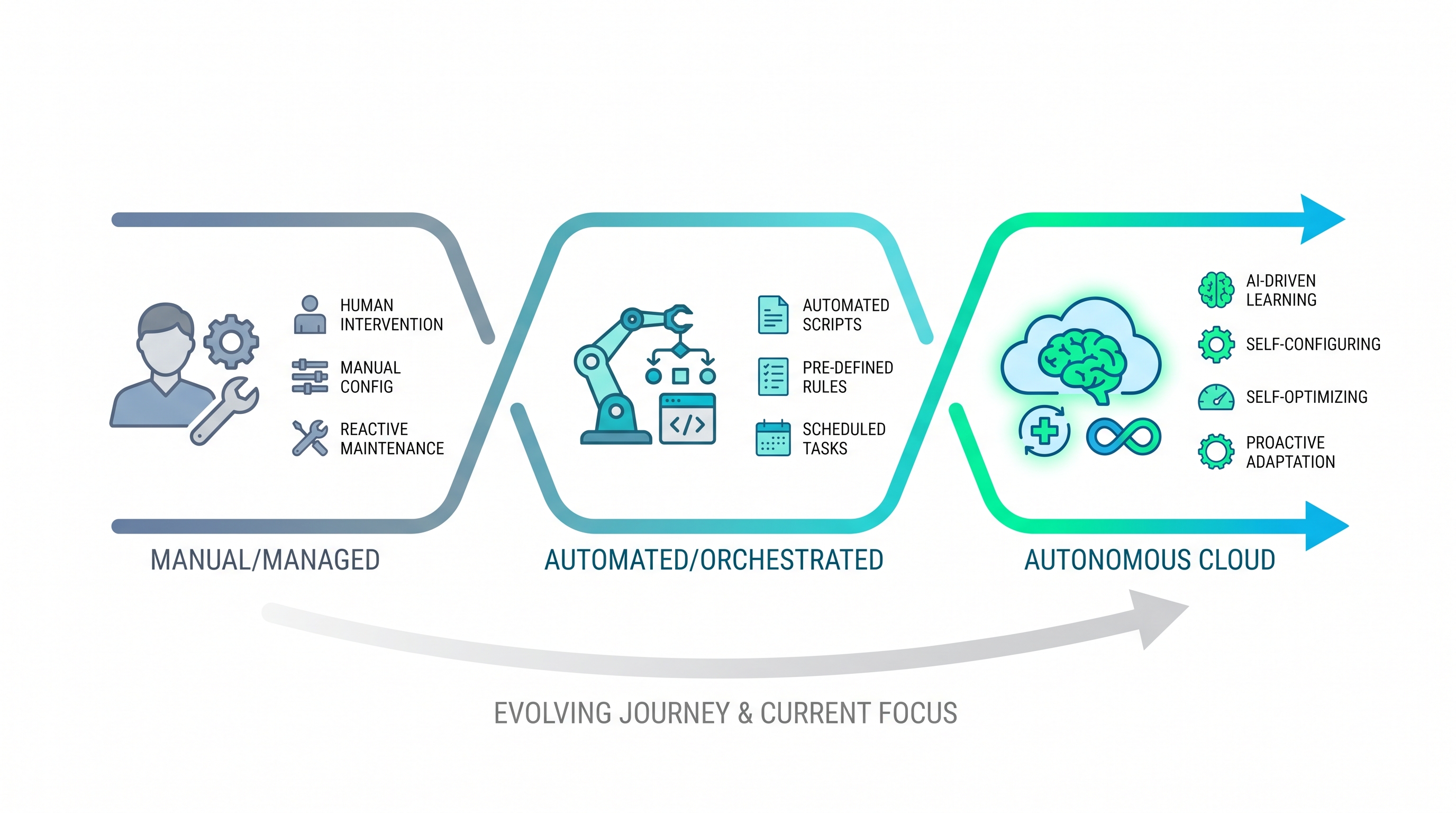
To understand where we are, we must define the levels of cloud autonomy. Much like the automotive industry's levels of self-driving capability, cloud infrastructure automation can be classified into five distinct phases:
Level 0: Manual Operations (No Autonomy). Operators provision, configure, and scale resources manually via cloud provider consoles or command-line interfaces (CLIs). System state is tracked informally, and drift is common.
Level 1: Imperative & Declarative Automation. Infrastructure is defined as code (IaC) using tools like Terraform, Ansible, or CloudFormation. While configurations are version-controlled and reproducible, execution still requires human triggers (e.g., pulling a git branch or running a pipeline).
Level 2: Reactive Orchestration. Systems respond to predefined thresholds using basic rules-based automation. Examples include Auto Scaling Groups (ASGs) triggered by high CPU utilization or simple alert-manager scripts that restart failed services.
Level 3: Proactive, Policy-Driven Automation. Infrastructure platforms analyze streaming telemetry and apply predictive models to anticipate resource needs, identify security anomalies, and detect cost inefficiencies. Remediation is suggested to human operators or executed automatically within strict, pre-approved boundaries.
Level 4: Fully Autonomous Infrastructure. The cloud operates as a self-reconciling system. It continuously balances performance, cost, and security targets across multi-cloud environments. The system dynamically negotiates resource allocations, patches vulnerabilities, refactors network topologies, and manages financial commitments with zero human overhead.
Currently, the vast majority of enterprise organizations find themselves transitioning between Level 2 and Level 3. They have robust IaC pipelines and reactive autoscaling, but they struggle to implement proactive, closed-loop systems. To move fully into Level 3 and eventually Level 4, organizations must shift from static configuration management to dynamic, event-driven state reconciliation loops.
The Architectural Foundations of Self-Configuring Infrastructure
At the core of any autonomous system is the control theory concept of the "reconciliation loop" (also known as the MAPE-K loop: Monitor, Analyze, Plan, Execute, Knowledge). This is the same architectural pattern that powers Kubernetes controllers. The system continually compares the "actual state" of the infrastructure against the "desired state" and executes actions to eliminate any delta.
To scale this pattern across complex multi-cloud environments, cloud architects must implement a decoupled, event-driven architecture consisting of three primary layers:
1. High-Fidelity Telemetry and Observability Pipelines
An autonomous cloud cannot make decisions without accurate, real-time data. This requires ingest pipelines capable of processing metrics, logs, traces, and security events from diverse sources—such as eBPF agents, cloud provider APIs (AWS CloudTrail, Azure Activity Logs), and network flow logs. This telemetry must be aggregated, normalized, and analyzed with sub-second latency to detect performance degradation, configuration drift, or security threats.
2. Distributed Policy Engines
The "Plan" phase of the reconciliation loop requires a centralized brain that evaluates telemetry against operational policies. This is achieved using Policy-as-Code (PaC) frameworks like Open Policy Agent (OPA) or Kyverno. These engines evaluate whether a proposed state change complies with security baselines, compliance standards, and budgetary constraints. To prevent run-away automation, organizations must enforce strict policy-based guardrails that define the boundaries within which the autonomous system can make changes.
3. Multi-Cloud Provisioning and Execution Providers
Once a plan is formulated and validated, the system must execute the required changes. This is where traditional IaC tools fall short, as they are designed for static, point-in-time deployment. Autonomous execution requires dynamic APIs capable of modifying running resources without disrupting service. This involves interacting directly with cloud provider control planes to adjust instance sizes, modify security group rules, re-route traffic via global load balancers, or spin down redundant clusters.
Architectural Example: The Closed-Loop Auto-Remediation Loop
Consider a scenario where an enterprise application experiences a sudden increase in database query latency. In a manual setup, an engineer would receive an alert, log into the database, analyze slow query logs, and manually scale up the database instance or add a read replica. In an autonomous architecture, the process is entirely hands-off:
Detection: APM sensors detect that the 99th percentile response time has exceeded the SLA threshold of 200ms.
Analysis: The telemetry pipeline correlates the latency spike with high CPU utilization on the primary database instance and determines that read-heavy traffic is the root cause.
Planning: The autonomous engine consults the system metadata and policy engine. It determines that the application supports read-write splitting and that the budget allows for an additional read replica.
Execution: The engine invokes the cloud provider API to provision a new read replica, configures the database connection pool in the application pods to route read traffic to the new replica, and updates the local DNS configuration.
Verification: The system monitors telemetry to ensure latency drops below 200ms. If the action fails to resolve the issue, it triggers a safe rollback.
Self-Optimizing FinOps: Beyond Static Rightsizing
One of the most immediate and tangible benefits of cloud autonomy is in the domain of Financial Operations (FinOps). Traditional FinOps practices are highly reactive. Teams typically download monthly billing reports, run heuristic analysis, and generate static "rightsizing" recommendations that are handed off to engineering teams. By the time engineers review these recommendations (often weeks later), the application workload patterns have changed, making the recommendations obsolete or risky to implement.
An autonomous FinOps approach replaces this manual cycle with real-time, programmatic cost optimization. Instead of treating resource allocation as a static configuration, the autonomous cloud treats it as a dynamic scheduling problem. This requires a unified financial command center that continuously evaluates the cost-to-performance ratio of every running resource.
Dynamic Compute Lifecycle Management
Enterprise workloads have highly variable resource utilization patterns. A batch processing job might require massive compute power for three hours a day, while a development environment might sit idle for sixteen hours a day. An autonomous cloud optimizes these patterns by dynamically shifting workloads across different compute lifecycles:
Spot Instance Harvesting: The system automatically migrates fault-tolerant workloads (such as CI/CD runners, stateless microservices, and big data processing nodes) to Spot/Interruptible instances, reducing compute costs by up to 90%. If the cloud provider issues a spot termination warning, the autonomous controller automatically provisions replacement capacity on on-demand instances and drains the terminating nodes without downtime.
Predictive Scheduling: Rather than relying on rigid, time-based cron jobs to shut down non-production environments, the system analyzes historical usage patterns to predict when developer environments are active. It dynamically scales resources to zero when they are not in use and pre-warms them before the team starts work in the morning.
Continuous Micro-Rightsizing: Instead of waiting for major maintenance windows to resize virtual machines, the autonomous system leverages container orchestration platforms (like Kubernetes) to perform continuous vertical and horizontal pod autoscaling. It dynamically tunes CPU and memory limits based on real-time application behavior, eliminating "slack" resource capacity.
Real-Time Commitment Portfolio Optimization
Cloud providers offer steep discounts in exchange for long-term spend commitments (e.g., AWS Savings Plans, Azure Reservation Exchanges). However, managing these commitment portfolios manually is incredibly complex, requiring financial analysts to predict usage up to three years in advance. Under-committing results in missed savings, while over-committing leads to paying for unused capacity.
An autonomous FinOps engine solves this by continuously modeling future resource consumption and programmatically buying, selling, or exchanging commitments. By analyzing workload telemetry, the system can determine whether a sudden drop in compute usage is a temporary fluctuation or a permanent architectural shift, adjusting the commitment coverage ratio in real-time to maximize ROI.
Autonomous Cloud Security: Continuous Compliance and Intelligent Patching
While cost optimization is critical, an autonomous cloud must also be intrinsically secure. The speed at which new vulnerabilities are discovered and exploited means that human-led security operations are no longer sufficient. If a critical vulnerability like Log4j is disclosed, hackers begin scanning the internet for vulnerable endpoints within hours. A manual patching cycle that takes weeks leaves the enterprise highly exposed.
Achieving autonomous cloud security requires moving away from periodic vulnerability scanning toward continuous, event-driven security posture management. This involves integrating vulnerability detection directly with automated remediation loops.
Automated Vulnerability Remediation and Patching
When a new vulnerability is identified, the autonomous security engine must assess the risk and execute the appropriate remediation strategy. However, applying updates blindly can introduce operational risk, as software patches can occasionally break application compatibility or degrade performance.
To mitigate this risk, advanced platforms leverage automated patch remediation workflows that operate with patch-aware intelligence. The system does not simply apply the patch to the entire production fleet at once. Instead, it follows a structured, risk-mitigated deployment pattern:
Phase | Action | Validation Metric |
|---|---|---|
1. Sandbox Testing | Clone the production environment into an isolated sandbox and apply the security patch. | Automated integration and smoke tests must pass 100%. |
2. Canary Deployment | Deploy the patched image to a single instance or pod (e.g., 5% of traffic) in production. | Monitor error rates, CPU/Memory utilization, and latency for anomalies. |
3. Progressive Rollout | Gradually increase traffic to the patched instances (25%, 50%, 100%) over a predefined window. | Continuous evaluation of system health and performance baselines. |
4. Automated Rollback | If any metric deviates from the baseline during rollout, immediately revert to the previous state. | Rapid restoration of service availability to prevent user-facing downtime. |
By implementing robust safe rollbacks, the autonomous cloud can confidently apply critical security patches at scale, minimizing the window of vulnerability while maintaining strict system uptime and reliability.
Dynamic Security Group and IAM Policy Hardening
Another key aspect of autonomous security is the principle of least privilege. In many enterprise environments, Identity and Access Management (IAM) policies and security group rules are overly permissive, designed during the development phase and never tightened for production. This creates a massive attack surface.
An autonomous security system continuously analyzes actual network flow logs and IAM credential usage. If a service has not communicated over port 22 (SSH) for 30 days, or if an IAM role has not utilized a specific API permission, the system dynamically adjusts the security group rules and IAM policies to revoke the unused access. This process of continuous micro-segmentation and privilege reduction ensures that even if a resource is compromised, the blast radius is strictly contained.
The "Human-in-the-Loop" Paradox and Guardrail Engineering
If the technology to build self-configuring, self-optimizing, and self-healing infrastructure exists, why are more enterprises not running fully autonomous clouds? The answer lies in trust. This is known as the "Human-in-the-Loop" paradox: as systems become more automated, the impact of a single automated error increases, making humans hesitant to relinquish control.
For example, if an autonomous engine misinterprets a network anomaly and mistakenly shuts down a core database cluster, the resulting outage could cost millions of dollars. To build trust, organizations must transition from manual operators to "guardrail engineers."
In an autonomous cloud paradigm, Infrastructure and SRE teams do not manage individual servers or write manual scaling rules. Instead, they design and maintain the guardrails that govern the autonomous engine. These guardrails act as safety limits, defining the boundaries within which the system can operate independently. Examples of guardrails include:
Budgetary Ceilings: The autonomous system can scale resources to meet demand, but it cannot exceed a maximum daily budget limit without explicit human approval.
Geographic Restrictions: To comply with data sovereignty laws (e.g., GDPR), the system is strictly prohibited from moving workloads or data storage outside of designated geographic regions.
Maintenance Windows: Non-critical patches and optimization tasks can only be executed during specified low-traffic windows to minimize potential user disruption.
Confidence Thresholds: The system must calculate a confidence score for any proposed action. If the confidence score is below 95%, the system must present the recommendation to a human operator for validation rather than executing it autonomously.
By defining these boundaries programmatically, organizations can enjoy the speed and efficiency of autonomous operations while maintaining complete control over risk and compliance.
The Path Forward: Unifying FinOps, Security, and Operations
The journey to the autonomous cloud is not a single leap, but a progressive evolution. To achieve true Level 4 autonomy, enterprises must break down the traditional silos between FinOps, security, and platform engineering. In many organizations, these teams operate with separate tools, separate datasets, and competing incentives:
Platform Engineers prioritize speed and uptime, often over-provisioning resources to guarantee performance.
FinOps Teams prioritize cost reduction, sometimes pushing for rightsizing changes that could impact system reliability.
Security Teams prioritize risk mitigation, occasionally slowing down deployments with manual compliance checks and patching schedules.
These competing priorities create friction and prevent the implementation of cohesive automation loops. An autonomous cloud requires a unified platform that can balance these trade-offs in real-time. The system must understand that a cost-saving action cannot violate a security policy, and a security patch must be applied in a way that minimizes performance degradation and cost overhead.
This is where the Atler AI engine comes into play. By unifying telemetry, financial data, and security postures into a single, cohesive intelligence layer, it enables organizations to transition from fragmented, reactive automation to unified, autonomous cloud operations.
Conclusion: Unify Your Cloud Operations with CloudAtler
The autonomous cloud is no longer a distant theoretical concept; it is an operational necessity. As multi-cloud environments grow in complexity, the organizations that rely on manual intervention and static workflows will find themselves falling behind in agility, security, and cost efficiency. The future belongs to self-configuring, self-optimizing, and self-healing infrastructure.
By implementing real-time reconciliation loops, continuous FinOps optimization, and automated, risk-mitigated security patching, enterprises can unlock unprecedented levels of efficiency and resilience. But you do not have to build these complex autonomous systems from scratch.
The CloudAtler unified platform is designed to bridge the gap between human intent and autonomous execution. By integrating FinOps, cloud security, and automated operations into a single, intuitive control plane across AWS, Azure, GCP, and Oracle, CloudAtler empowers your teams to define the guardrails while our intelligent engine manages the complexity.
Ready to take the first step toward the autonomous cloud? Schedule a demo with CloudAtler today and discover how to transform your cloud operations from manual to self-optimizing.
All in One Place
Atler Pilot decodes your cloud spend story by bringing monitoring, automation, and intelligent insights together for faster and better cloud operations.