
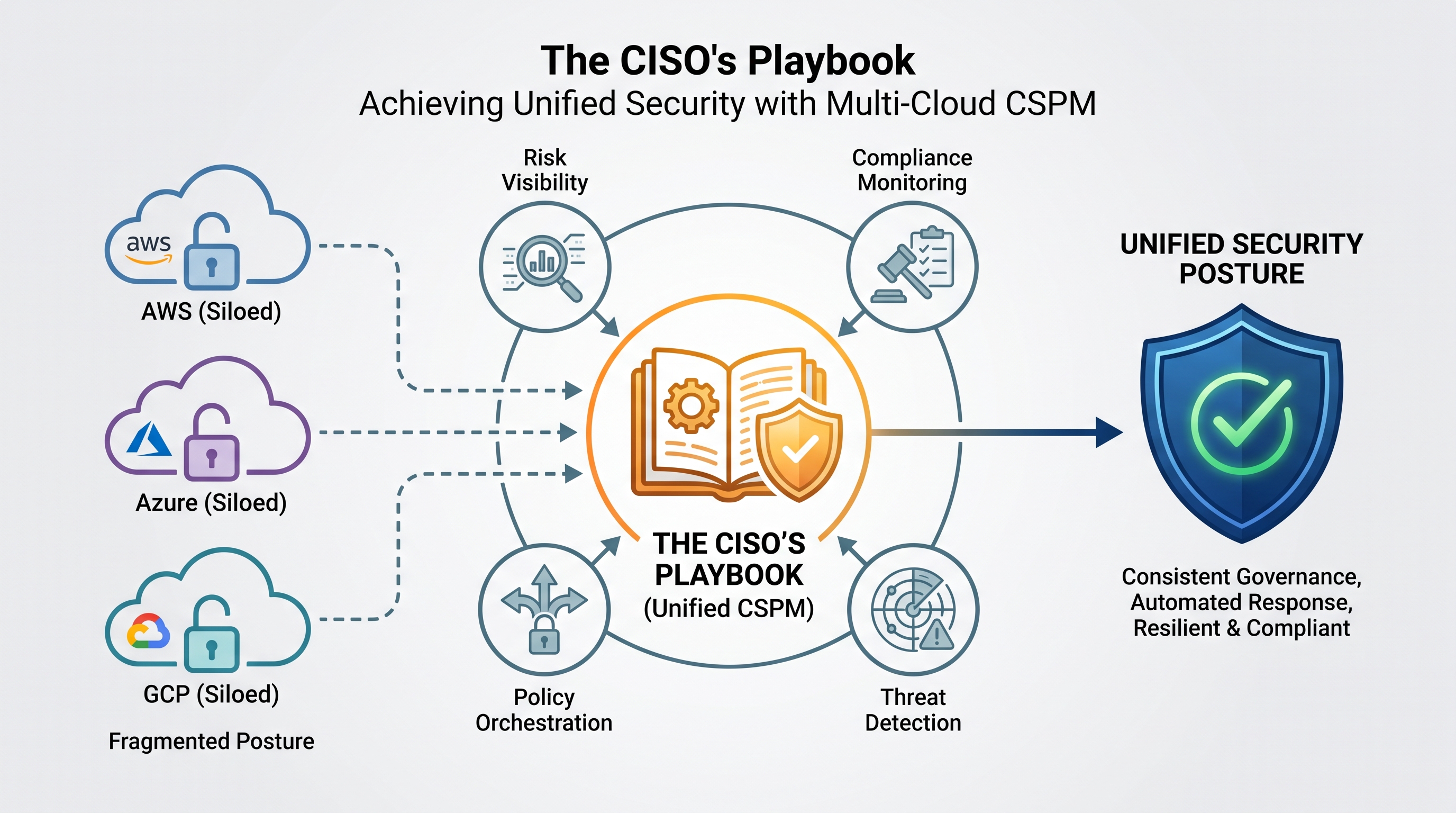
In today's enterprise landscape, multi-cloud adoption is no longer an aspiration but a strategic imperative. Organizations are leveraging the unique strengths of AWS, Azure, Google Cloud Platform (GCP), and Oracle Cloud Infrastructure (OCI) to drive innovation, enhance resilience, and optimize costs. However, this distributed infrastructure introduces a formidable challenge for the Chief Information Security Officer (CISO): maintaining a consistent, robust security posture across disparate environments, each with its own services, APIs, and security models. The traditional approach of managing security in silos for each cloud provider is unsustainable, leading to fragmented visibility, increased operational overhead, and an elevated risk profile. This is where a unified Multi-Cloud Cloud Security Posture Management (CSPM) strategy becomes indispensable, serving as the cornerstone of the modern CISO's playbook for holistic cloud security and integrated FinOps.
The Multi-Cloud Conundrum: A CISO's Challenge
The allure of multi-cloud environments—from avoiding vendor lock-in to leveraging specialized services—is undeniable. Yet, for the CISO, this distributed architecture often translates into a complex web of security challenges. Each cloud provider operates under a shared responsibility model, but the specifics of what the customer is responsible for can vary significantly. This creates a labyrinth of configurations, permissions, and compliance requirements that demand meticulous attention.
One of the primary hurdles is the sheer complexity of managing disparate security models. An AWS security group operates differently from an Azure Network Security Group (NSG) or a GCP firewall rule. IAM policies in AWS have different syntax and constructs than Azure RBAC roles or GCP IAM policies. This heterogeneity makes it incredibly difficult to establish and enforce consistent security policies across the entire cloud estate. Security teams often find themselves context-switching between provider-specific consoles, leading to:
Visibility Gaps: A lack of a unified view across all cloud assets means blind spots are inevitable. A misconfigured storage bucket in one cloud might go unnoticed while a similar issue in another cloud is flagged, simply due to inconsistent tooling or monitoring.
Alert Fatigue: Each cloud provider offers its own security services and generates a deluge of alerts. Without consolidation and intelligent correlation, security analysts are overwhelmed, leading to missed critical incidents and inefficient response times.
Compliance Drift: Maintaining continuous compliance with regulatory frameworks (e.g., PCI DSS, HIPAA, GDPR, ISO 27001) is a monumental task. The dynamic nature of cloud environments means configurations can drift from their compliant state rapidly, making manual audits impractical and prone to error.
Operational Overhead: Managing multiple security tools, each tailored to a specific cloud, leads to increased operational costs, skill gaps within teams, and slower incident response.
Furthermore, these security challenges have a direct and often understated impact on FinOps objectives. Security misconfigurations can lead to significant cost inefficiencies. For instance, an overly permissive firewall rule might expose an internal API endpoint, necessitating rapid, expensive remediation efforts. Unencrypted data stored in a public bucket could incur not only compliance fines but also unexpected egress costs if exploited. Conversely, overly restrictive security policies can hinder developer agility and force the procurement of additional, unnecessary services, driving up cloud spend. The CISO, therefore, must not only secure the cloud but also understand the financial implications of security decisions and misconfigurations, making the convergence of security and FinOps critical.
Defining Multi-Cloud CSPM: Beyond Basic Compliance Checks
In response to these complexities, Cloud Security Posture Management (CSPM) emerged as a critical capability. However, in a multi-cloud context, CSPM transcends basic compliance checks. It is a comprehensive, continuous process for identifying, evaluating, and improving the security posture of cloud environments. A robust multi-cloud CSPM solution provides a unified control plane to manage the entire cloud security lifecycle across AWS, Azure, GCP, and Oracle clouds.
At its core, multi-cloud CSPM entails:
Continuous Monitoring: Real-time assessment of cloud configurations against predefined security policies and compliance benchmarks.
Policy Enforcement: The ability to define and automatically enforce security policies across all connected cloud accounts and subscriptions.
Drift Detection: Identifying any deviation from the desired secure state, whether due to human error, malicious activity, or unauthorized changes.
Risk Prioritization: Not all security findings are equal. A sophisticated CSPM solution prioritizes risks based on asset criticality, potential impact, and exploitability.
Automated Remediation: Beyond detection, the capability to automate corrective actions, either fully or with human approval, to bring configurations back into compliance.
It's crucial to differentiate CSPM from other cloud security solutions while recognizing their symbiotic relationship. Cloud Workload Protection Platforms (CWPP) focus on securing workloads (VMs, containers, serverless functions) themselves, whereas Cloud Infrastructure Entitlement Management (CIEM) specializes in managing and optimizing identities and access. CSPM, on the other hand, focuses on the configuration of the underlying cloud infrastructure and services. A truly unified security strategy integrates these capabilities, with CSPM acting as the overarching governance layer, ensuring the foundational infrastructure is secure before workloads are deployed and identities are provisioned. The key differentiator for multi-cloud CSPM is its ability to normalize data and policy enforcement across heterogeneous cloud APIs and services, presenting a single, coherent view for the CISO.
Pillar 1: Centralized Visibility and Asset Inventory
The foundational requirement for any effective multi-cloud security strategy is a single, authoritative source of truth for all cloud assets. Without centralized visibility, the CISO is operating in the dark, unable to accurately assess the attack surface or identify misconfigurations. A multi-cloud CSPM solution must provide an automated, continuous discovery and classification mechanism for every resource across all connected cloud environments.
This includes, but is not limited to:
Compute Instances: EC2, Azure VMs, GCP Compute Engine, OCI Compute.
Storage Services: S3 buckets, Azure Blob Storage, GCP Cloud Storage, OCI Object Storage.
Networking Components: VPCs/VNets, subnets, route tables, security groups/NSGs, load balancers, API gateways.
Identity and Access Management (IAM): Users, roles, policies, groups, service accounts.
Database Services: RDS, Azure SQL Database, GCP Cloud SQL, OCI Autonomous Database.
Container Services: EKS, AKS, GKE, OKE.
Serverless Functions: Lambda, Azure Functions, GCP Cloud Functions.
Beyond simple discovery, the CSPM must intelligently map relationships and dependencies between these resources, irrespective of the cloud provider. For instance, understanding that an EC2 instance in AWS hosts a critical application, is part of a specific FinOps cost center (via tagging), and communicates with an Azure SQL Database, is vital for contextualizing risk. This deep understanding of the cloud topology allows CISOs to assess the blast radius of a potential compromise and prioritize remediation efforts effectively. CloudAtler, for example, achieves this by ingesting configuration data from all major cloud providers, normalizing it, and presenting it within a unified dashboard, providing an unparalleled single pane of glass for all cloud operations.
A critical aspect of asset inventory for both security and FinOps is a consistent tagging strategy. Tags are metadata labels applied to cloud resources (e.g., "environment:production", "owner:devteam", "project:billingapp", "compliance:PCI"). A robust CSPM solution can leverage these tags to filter, categorize, and prioritize security findings, ensuring that alerts for production resources are treated with higher urgency than those for development environments. From a FinOps perspective, consistent tagging is the bedrock of accurate cost allocation and chargeback, enabling organizations to attribute cloud spend to specific teams, projects, or business units. The integration of automated tagging capabilities within the CSPM framework ensures that new resources are correctly classified from inception, preventing shadow IT and improving both security governance and cost visibility.
Pillar 2: Continuous Security Posture Monitoring and Compliance Enforcement
Once a comprehensive asset inventory is established, the next crucial step is continuous monitoring of the security posture against established benchmarks and internal policies. This pillar moves beyond point-in-time audits to a dynamic, real-time assessment of cloud configurations.
A multi-cloud CSPM must support:
Industry Benchmarks: Automatically assess configurations against well-known security frameworks such as CIS Benchmarks (for AWS, Azure, GCP, OCI), NIST CSF, PCI DSS, HIPAA, GDPR, and ISO 27001. This ensures a baseline of security hygiene is maintained across all environments.
Custom Policy Definition: Organizations often have unique security requirements that go beyond standard benchmarks. A powerful CSPM allows CISOs to define custom policies using a declarative language (e.g., "All S3 buckets in production accounts must have server-side encryption enabled and block public access," "All compute instances must have a specific endpoint detection and response (EDR) agent installed"). These policies should be enforceable across all cloud providers, translating high-level requirements into cloud-specific checks.
Drift Detection: Cloud environments are inherently dynamic. Developers deploy new resources, modify existing ones, and decommission others. This constant change can lead to configuration drift, where a resource deviates from its desired secure state. A sophisticated CSPM continuously monitors for these changes, alerting security teams to unauthorized or non-compliant modifications in real-time. For example, if a security group that was previously locked down is suddenly opened to the internet, the CSPM should immediately flag this drift.
Architecturally, this requires the CSPM to integrate deeply with each cloud provider's API to pull configuration metadata. It then applies a set of rules and logic to this data, comparing it against the defined policies and benchmarks. For instance, in AWS, a CSPM would analyze Service Control Policies (SCPs) at the Organizational Unit (OU) level, IAM policies, and individual resource configurations. In Azure, it would evaluate Azure Policies, RBAC assignments, and NSG rules. For GCP, Organization Policies, IAM policies, and firewall rules are examined. OCI's Identity and Access Management (IAM) policies and security lists would be scrutinized. The CSPM's value proposition lies in its ability to normalize these disparate inputs into a single, unified policy engine, allowing CISOs to define a policy once and apply it everywhere. CloudAtler’s security management capabilities are engineered precisely for this, providing comprehensive enforcement and monitoring across the entire multi-cloud estate.
Pillar 3: Risk Prioritization and Intelligent Remediation
Detecting misconfigurations is only half the battle; the true value of CSPM lies in its ability to facilitate effective remediation. However, in large multi-cloud environments, the sheer volume of security findings can be overwhelming. This necessitates intelligent risk prioritization.
Moving beyond a simple "red/green" status, a mature CSPM solution contextualizes risks by considering factors such as:
Asset Criticality: Is the affected resource hosting a mission-critical application, sensitive customer data, or a development sandbox?
Exploitability: How easily can this vulnerability be exploited? Is it exposed to the public internet?
Blast Radius: What is the potential impact if this vulnerability is exploited? Does it provide access to other critical systems or data?
Compliance Impact: Does the finding violate a critical compliance requirement (e.g., PCI DSS)?
Leveraging AI and Machine Learning (ML) becomes paramount here. AI can integrate threat intelligence feeds, analyze historical incident data, and detect anomalous patterns that might indicate an active threat or a highly exploitable vulnerability. For instance, if a public S3 bucket is detected, AI can cross-reference this with known scanning activities targeting S3, or if the bucket contains sensitive data based on its naming convention or content metadata, elevating its priority.
Once risks are prioritized, the next step is intelligent remediation. This is where the CSPM transitions from a detection tool to an active security enforcer. Automated remediation workflows are crucial for "shift-left" security, integrating security checks and fixes directly into the CI/CD pipeline. Examples include:
Automated Configuration Enforcement: If a non-compliant security group is detected, the CSPM can trigger an automated workflow to revert it to a compliant state (e.g., closing unnecessary ports).
Automated Patching: For vulnerabilities detected in OS or application layers of compute instances, the CSPM can integrate with patch management systems to initiate automated patching processes. CloudAtler's patch remediation features exemplify this, providing intelligent, automated patching across diverse cloud environments, ensuring systems are always up-to-date and secure without manual intervention.
Policy as Code: Integrating CSPM with infrastructure-as-code (IaC) tools (Terraform, CloudFormation, ARM templates) allows security policies to be baked into the infrastructure definitions from the outset, preventing misconfigurations before they are deployed.
The goal is to move towards a "self-healing" cloud environment where common misconfigurations are automatically detected and corrected, freeing security teams to focus on more complex threats and strategic initiatives. This proactive approach significantly reduces the mean time to detect (MTTD) and mean time to respond (MTTR) to security incidents.
Pillar 4: Integrating Security with FinOps for Cost-Aware Security
The convergence of security and FinOps is no longer optional; it's a strategic necessity for CISOs. Security is often perceived as a cost center, but a well-implemented multi-cloud CSPM can demonstrate tangible cost savings and optimize cloud spend. This requires understanding how security misconfigurations impact financial efficiency and how security remediation can be cost-aware.
Here’s how security intertwines with FinOps:
Identifying Cost Inefficiencies from Misconfigurations:
Over-provisioned Resources: Poor access controls or network segmentation might lead to teams over-provisioning resources "just in case" to compensate for perceived security gaps, leading to unnecessary compute or storage costs.
Unencrypted Data and Data Egress: Publicly exposed data, if accessed maliciously, can incur significant data egress charges from unauthorized downloads. Furthermore, the reputational damage and regulatory fines from a data breach far outweigh the cost of encryption.
Compliance Fines: Non-compliance with regulations due to security misconfigurations can result in hefty fines, directly impacting the organization's bottom line.
Inefficient Security Tooling: Managing multiple, disparate security tools for each cloud provider incurs licensing costs, operational overhead, and requires specialized skills, leading to higher FTE costs.
Cost Impact Analysis of Remediation Actions: Before executing a remediation, it's crucial to understand its potential cost implications. For example, encrypting an existing large S3 bucket might incur temporary compute costs for data re-encryption. Shutting down an unpatched server might disrupt a business-critical application, leading to revenue loss. A sophisticated CSPM, integrated with FinOps capabilities, can provide this context. CloudAtler, for instance, offers a comprehensive cost impact calculation feature, which allows CISOs and FinOps teams to understand the financial ramifications of security findings and proposed remediation strategies before implementation. This enables informed decision-making, balancing security posture with financial prudence.
Budget-Aware Security Guardrails: Implementing security policies that also consider cost. For example, a policy might dictate that high-risk data should only reside in specific, highly secure (and potentially more expensive) storage tiers, while less sensitive data can reside in standard, cost-optimized tiers. CSPM can enforce these guardrails by flagging deviations and providing cost-aware recommendations. This proactive approach prevents costly security mistakes and ensures that security investments are aligned with business value.
By unifying security and FinOps insights, CISOs can transform security from a pure cost center into a value driver, demonstrating how a secure cloud posture leads to operational efficiency, reduced risk, and ultimately, optimized cloud spend. This integrated approach is a hallmark of CloudAtler's platform, designed to give CISOs and FinOps leaders full visibility and control over their multi-cloud environments.
Pillar 5: Operationalizing Multi-Cloud CSPM: The CloudAtler Approach
Operationalizing a multi-cloud CSPM requires a platform that can abstract away the underlying cloud complexities while providing deep, actionable insights. This is where CloudAtler’s AI-powered platform excels, unifying FinOps, cloud security, and automated operations across AWS, Azure, GCP, and Oracle environments.
CloudAtler addresses the core challenges of multi-cloud security by providing:
AI-Powered Capabilities: At the heart of CloudAtler is Atler AI, which provides predictive analytics, identifies anomalous behavior, and offers intelligent, context-aware recommendations. For security, this translates to proactive threat detection and prioritized remediation based on real-time risk assessment, not just static rule matching. The AI learns from historical data and environmental changes, constantly refining its ability to detect subtle security drifts and potential exploits.
Unified Dashboard for Cross-Cloud Visibility: As discussed, a single pane of glass is non-negotiable. CloudAtler’s unified dashboard aggregates all security findings, compliance status, and operational metrics from AWS, Azure, GCP, and Oracle into a single, intuitive interface. CISOs gain immediate insights into their overall security posture, identify top risks across all clouds, and drill down into specific alerts without switching contexts or tools. This dramatically reduces alert fatigue and improves incident response times.
Automated Governance and Guardrails: CloudAtler enables CISOs to define and enforce security policies as code across their entire multi-cloud estate. These policies act as guardrails, automatically preventing non-compliant deployments or flagging existing misconfigurations for remediation. For example, a guardrail can prevent the creation of public S3 buckets in production accounts, or ensure that all newly deployed VMs meet specific hardening standards. This proactive governance ensures that security is baked into the cloud environment from inception, rather than being an afterthought.
Integrated Security Management: Beyond posture, CloudAtler provides comprehensive security management features. This includes vulnerability management, identity and access management (IAM) posture analysis, network security monitoring, and data security governance. By consolidating these capabilities, CloudAtler eliminates the need for multiple point solutions, streamlining security operations and reducing tool sprawl.
Real-World Scenario: Proactive Risk Mitigation: Consider a scenario where an engineer accidentally misconfigures an Azure Blob Storage container, making it publicly accessible.
Detection: CloudAtler's CSPM immediately detects this misconfiguration across the Azure environment.
Contextualization via AI: Atler AI analyzes the content (if metadata indicates sensitive data), its exposure (public internet), and potential blast radius (if linked to critical applications). It also cross-references with FinOps data to calculate potential data egress costs if exploited.
Prioritization: Based on the AI's analysis, the incident is flagged as a high-priority critical alert, visible in the unified dashboard.
Automated Remediation: CloudAtler's automated operations engine can be configured to automatically apply a policy to restrict public access to the Blob Storage or initiate a pre-approved workflow for the security team to review and approve the fix.
FinOps Impact: The cost impact calculation feature shows the CISO and FinOps team the financial risk mitigated by this rapid detection and remediation, demonstrating tangible ROI.
This integrated approach transforms security operations from reactive firefighting to proactive, intelligent risk management, empowering CISOs to maintain a robust security posture while also contributing to the organization's financial health.
Building Your CISO's Playbook: Step-by-Step Implementation
Implementing a unified multi-cloud CSPM strategy requires a structured approach. Here's a playbook for CISOs to guide their journey:
Phase 1: Assessment and Discovery (Baseline)
Inventory All Cloud Assets: Begin by connecting your CSPM platform (like CloudAtler) to all your AWS, Azure, GCP, and OCI accounts. Allow it to perform a comprehensive discovery of all existing resources.
Establish a Security Baseline: Run an initial assessment against industry benchmarks (CIS, NIST) and any existing internal security policies. This will provide a baseline understanding of your current security posture and highlight immediate areas of concern.
Identify Critical Assets: Work with business units to identify and tag mission-critical applications, data stores, and infrastructure components. This is crucial for subsequent risk prioritization.
Define FinOps Alignment: Ensure your tagging strategy aligns with FinOps requirements for cost allocation and chargeback. This integration from day one makes future FinOps optimization much smoother.
Phase 2: Policy Definition and Customization
Translate Organizational Policies: Convert your organization's security requirements into cloud-agnostic and cloud-specific policies within the CSPM. This includes access control, data encryption, network segmentation, and logging standards.
Implement Guardrails: Configure automated guardrails to prevent common misconfigurations (e.g., preventing public S3 buckets in production, enforcing MFA for privileged roles).
Customize Compliance Profiles: Tailor compliance reporting to specific regulatory frameworks relevant to your industry (e.g., PCI DSS for financial services, HIPAA for healthcare).
Review and Refine: Regularly review and refine policies based on new threats, evolving compliance requirements, and operational feedback.
Phase 3: Automation and Integration
Automate Remediation Workflows: For low-risk, high-frequency findings, configure automated remediation. For higher-risk items, establish approval workflows that integrate with your ITSM or security operations platform. CloudAtler's robust operational intelligence and automation capabilities are designed for this.
Integrate with CI/CD: "Shift left" security by integrating CSPM checks into your CI/CD pipelines. This ensures that infrastructure-as-code templates are scanned for misconfigurations before deployment, preventing issues from reaching production.
API Integration: Leverage the CSPM's APIs to integrate with existing SIEM, SOAR, and incident response platforms for a holistic security ecosystem.
Patch Management Integration: Link CSPM findings regarding OS or application vulnerabilities with automated patch remediation systems to ensure timely updates.
Phase 4: Continuous Monitoring and Optimization
Establish Reporting and Dashboards: Utilize the unified dashboard to monitor your security posture, compliance status, and FinOps metrics continuously. Generate regular reports for executive leadership and compliance auditors.
Regular Audits and Reviews: Periodically conduct internal and external audits to validate the effectiveness of your CSPM implementation and policies.
Leverage AI for Continuous Improvement: Utilize the AI capabilities of your CSPM to identify trends, predict potential risks, and optimize your security posture proactively. Atler AI continuously learns and suggests improvements.
Foster Collaboration: Encourage collaboration between CISO, Cloud Architects, DevOps, and FinOps teams. Security is a shared responsibility, and a unified platform like CloudAtler facilitates this by providing a common language and shared data points. For CISOs specifically looking for robust solutions, CloudAtler offers dedicated CISO security solutions designed to meet these complex demands.
By following this structured approach, CISOs can transform their multi-cloud security strategy from a reactive, fragmented effort into a proactive, unified, and financially optimized operation. The journey to unified security is continuous, but with the right playbook and the right platform, it is an achievable and highly rewarding endeavor.
Conclusion
The multi-cloud era presents unprecedented opportunities for innovation and efficiency, but it also introduces significant security and operational complexities for the CISO. Fragmented visibility, inconsistent policy enforcement, and the sheer volume of security alerts can quickly overwhelm even the most sophisticated security teams. A unified multi-cloud CSPM is no longer a luxury but a fundamental requirement for maintaining a robust and compliant security posture across AWS, Azure, GCP, and Oracle environments. By centralizing visibility, automating policy enforcement, leveraging AI for intelligent risk prioritization and remediation, and integrating seamlessly with FinOps objectives, CISOs can transform their security operations from a reactive cost center into a proactive business enabler.
CloudAtler provides the comprehensive, AI-powered platform designed to address these challenges head-on. By unifying FinOps, cloud security, and automated operations, CloudAtler empowers CISOs to gain unparalleled control, optimize cloud spend, and ensure continuous compliance across their entire multi-cloud estate. Don't let the complexities of multi-cloud hinder your organization's growth or expose it to unnecessary risk. Take control of your cloud security and financial operations today.
Ready to unify your cloud operations, enhance your security posture, and drive FinOps efficiency across AWS, Azure, GCP, and Oracle? Discover how CloudAtler can transform your enterprise.
All in One Place
Atler Pilot decodes your cloud spend story by bringing monitoring, automation, and intelligent insights together for faster and better cloud operations.