
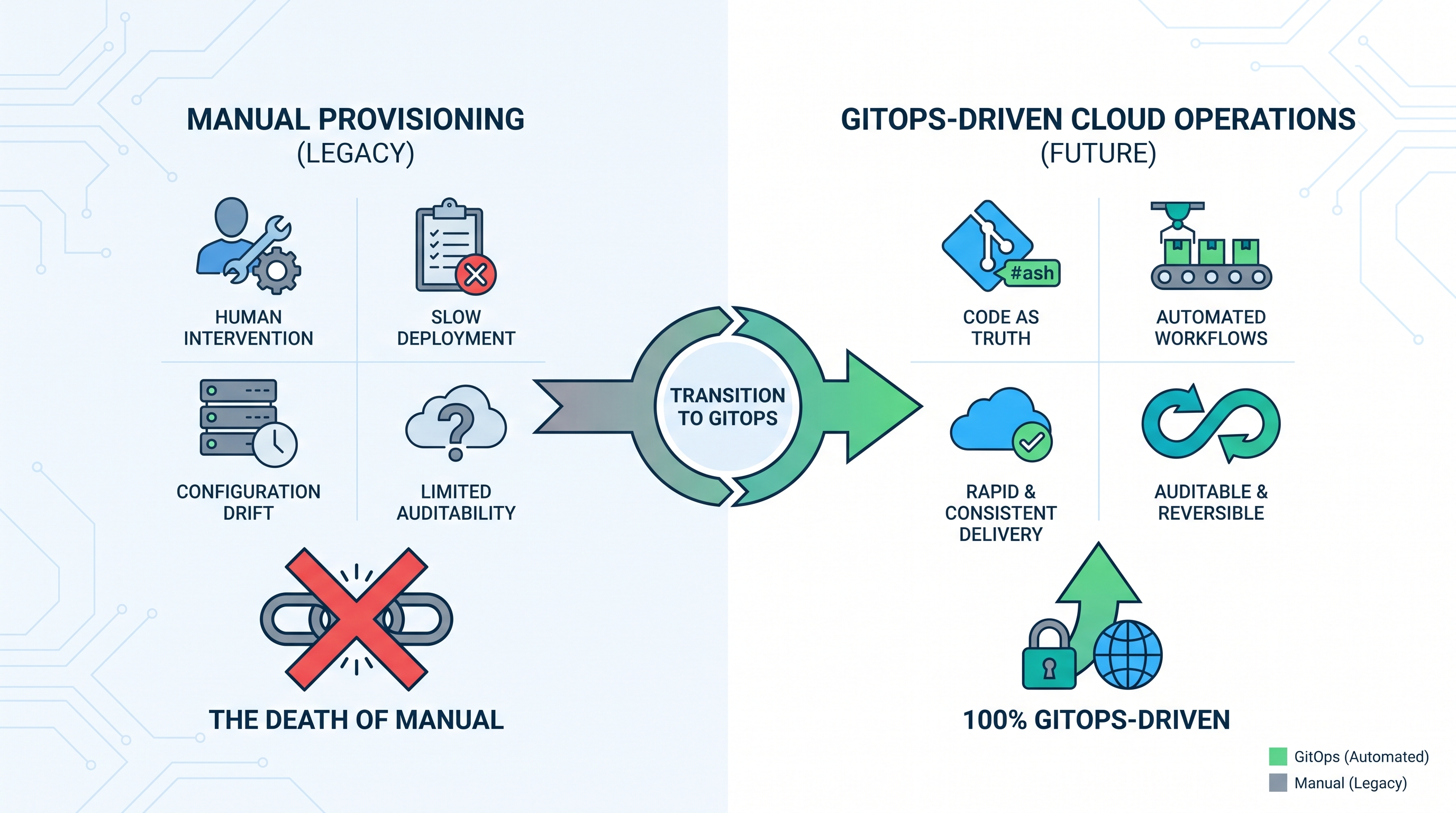
Introduction: The Fragility of the Click-Ops Era
For years, enterprise IT operations relied on a mixture of manual provisioning, semi-automated scripts, and golden-image templates. System administrators and cloud engineers logged into cloud consoles—whether AWS, Azure, GCP, or Oracle Cloud Infrastructure (OCI)—to manually configure security groups, provision virtual machines, and spin up managed databases. This operational pattern, colloquially known as "Click-Ops," is highly fragile, error-prone, and fundamentally incompatible with modern enterprise scale.
The consequences of Click-Ops are severe. Configuration drift occurs almost immediately after deployment as engineers make manual modifications to troubleshoot live incidents. Security configurations erode over time, exposing open ports or unencrypted storage volumes to the public internet. Furthermore, tracking down the owner of an orphaned resource or understanding why a cloud bill suddenly spiked becomes an archaeological exercise rather than an engineering task. To achieve true agility, security, and cost efficiency, enterprises must declare manual provisioning dead. The path forward requires a transition to a 100% GitOps-driven cloud operations model.
What is 100% GitOps-Driven Cloud Operations?
GitOps is an operational framework that takes DevOps best practices—such as version control, collaboration, compliance, and CI/CD—and applies them to infrastructure automation. In a 100% GitOps-driven model, Git is the absolute, single source of truth for the entire system state. If a resource is not defined in Git, it does not exist in the cloud environment. Conversely, if a resource is defined in Git, the actual running infrastructure must match that definition exactly.
While GitOps originated in the Kubernetes ecosystem with tools like ArgoCD and Flux, modern enterprise GitOps extends far beyond container orchestration. It encompasses the entire cloud fabric, utilizing declarative Infrastructure-as-Code (IaC) tools such as Terraform, OpenTofu, Pulumi, and Crossplane to manage global networks, serverless runtimes, IAM policies, and cloud-native databases across multi-cloud environments.
The GitOps model operates on four core pillars:
Declarative System Descriptions: The entire system configuration is defined declaratively using code, specifying the desired end-state rather than the steps to achieve it.
Version-Controlled State: The desired state is stored in Git, creating an immutable, versioned audit log of every change, who made it, and why.
Automated Software Agents: Continuous reconciliation loops constantly compare the desired state in Git with the actual state in the cloud.
Self-Healing and Automatic Drift Correction: When the reconciliation loop detects a mismatch between the desired and actual state, it automatically applies the necessary changes to correct the drift, or alerts operations teams to the variance.
Architectural Blueprint for Multi-Cloud GitOps
Implementing GitOps across a complex multi-cloud topology requires a highly structured, scalable directory layout and a robust CI/CD pipeline. Below is an architectural blueprint for an enterprise GitOps repository structure designed to handle multi-environment, multi-cloud deployments:
├── .github/
│   └── workflows/
│       ├── gitops-plan.yml
│       └── gitops-apply.yml
├── policies/
│   ├── security/
│   │   ├── enforce-encryption.rego
│   │   └── restrict-ssh.rego
│   └── financial/
│       └── budget-guardrails.rego
├── infrastructure/
│   ├── global/
│   │   ├── iam/
│   │   └── dns/
│   └── regional/
│       ├── aws-production-us-east-1/
│       │   ├── main.tf
│       │   ├── variables.tf
│       │   └── terraform.tfvars
│       ├── azure-production-eastus/
│       │   ├── main.tf
│       │   └── providers.tf
│       └── gcp-staging-us-central1/
│           ├── main.tf
│           └── backend.tf
└── modules/
    └── secure-app-node/
        ├── main.tf
        ├── outputs.tf
        └── variables.tf
In this architecture, the repository is split into distinct logical boundaries. Global configurations, such as IAM roles and root DNS zones, are isolated from regional, environment-specific directories. This separation minimizes the blast radius of any single configuration change. State files are stored in secure, remote backends (e.g., AWS S3 with DynamoDB state locking, or Azure Blob Storage) to prevent concurrent executions and state file corruption.
To execute changes without static cloud credentials, the CI/CD pipeline utilizes OpenID Connect (OIDC) federation. When a developer submits a Pull Request (PR), the CI pipeline authenticates directly with the cloud providers (AWS, Azure, GCP, OCI) using short-lived, ephemeral tokens. This eliminates the risk of compromised static credentials in your version control platform.
Integrating FinOps into the GitOps Pipeline: Shift-Left Cost Control
One of the greatest challenges of cloud adoption is uncontrolled spend. In a traditional operating model, FinOps is reactive—teams analyze the cloud bill at the end of the month, identify cost spikes, and spend weeks tracking down the responsible teams. GitOps allows enterprises to shift FinOps to the left, integrating cost controls directly into the developer workflow before any infrastructure is provisioned.
By leveraging tools such as Infracost or custom Open Policy Agent (OPA) policies within the GitOps pipeline, organizations can calculate the financial impact of a pull request automatically. When a developer proposes a change—such as upgrading an EC2 instance type or provisioning a new managed database—the CI pipeline runs a cost-impact calculation and posts the exact monthly cost delta as a comment on the PR.
To scale this across the enterprise, organizations must implement a unified financial operations platform that provides global visibility and sets automated guardrails. For example, the GitOps pipeline can enforce the following policy logic:
If the projected cost increase of a PR is less than $100/month, auto-approve the financial check.
If the projected cost increase is between $100 and $1,000/month, require approval from the engineering lead.
If the projected cost increase exceeds $1,000/month, or if it violates a pre-allocated environment budget, block the PR automatically and route it to the finance team for explicit authorization.
This proactive enforcement ensures that cloud budgets are respected at the commit level, preventing expensive provisioning mistakes from ever reaching production.
Securing the GitOps Pipeline: Policy-as-Code and Drift Detection
Security in a 100% GitOps model is governed by Policy-as-Code (PaC). Rather than relying on post-deployment security scans or manual compliance audits, security policies are codified and evaluated continuously during the pull request phase. This guarantees that every piece of infrastructure deployed is compliant with corporate and regulatory standards (such as SOC2, ISO 27001, or HIPAA) by design.
Using Rego (the policy language of Open Policy Agent), security teams can write policies that block non-compliant code. For example, a policy can mandate that all S3 buckets must have public access blocked and server-side encryption enabled. If a developer attempts to merge a configuration that violates these rules, the CI pipeline fails, preventing the deployment.
However, securing the pipeline is only half the battle; you must also secure the runtime. Inevitably, emergency situations will arise where an engineer bypasses the GitOps pipeline to make a direct modification in the cloud console to resolve an active outage. This introduces configuration drift, which is the silent killer of cloud security and operational stability. To solve this, GitOps engines run continuous drift detection loops. When a deviation is detected, the engine can execute automated safe rollbacks to revert the unauthorized changes, restoring the environment to its validated, secure state defined in Git.
For organizations requiring advanced compliance monitoring, integrating enterprise cloud security management directly with the GitOps workflow provides a centralized view of security posture, active policy violations, and remediation status across multi-cloud environments.
Implementation Deep-Dive: Declarative Infrastructure and Automated Reconciliation
Let us examine a concrete, technical implementation of a GitOps pipeline that enforces security policies, evaluates cost deltas, and handles automated deployment.
1. The Declarative Infrastructure Definition
Below is a Terraform configuration defining a secure, high-availability AWS VPC and an EC2 instance. This represents our desired state stored in the Git repository.
# main.tf
terraform {
  required_version = ">= 1.5.0"
  required_providers {
    aws = {
      source  = "hashicorp/aws"
      version = "~> 5.0"
    }
  }
  backend "s3" {
    bucket         = "enterprise-gitops-state"
    key            = "production/us-east-1/network/terraform.tfstate"
    region         = "us-east-1"
    dynamodb_table = "enterprise-gitops-locks"
  }
}

provider "aws" {
  region = var.aws_region
}

variable "aws_region" {
  type    = string
  default = "us-east-1"
}

resource "aws_vpc" "production_vpc" {
  cidr_block           = "10.0.0.0/16"
  enable_dns_hostnames = true
  enable_dns_support   = true

  tags = {
    Name        = "production-vpc"
    Environment = "production"
    ManagedBy   = "GitOps"
  }
}

resource "aws_security_group" "app_sg" {
  name        = "app-security-group"
  description = "Restrict access to application instances"
  vpc_id      = aws_vpc.production_vpc.id

  # Ingress restricted to internal corporate CIDR
  ingress {
    from_port   = 443
    to_port     = 443
    protocol    = "tcp"
    cidr_blocks = ["192.168.0.0/16"]
  }

  # Egress completely open
  egress {
    from_port   = 0
    to_port     = 0
    protocol    = "-1"
    cidr_blocks = ["0.0.0.0/0"]
  }
}

resource "aws_instance" "app_server" {
  ami           = "ami-0c7217cdde317cfec" # Amazon Linux 2023
  instance_type = "m5.large"
  subnet_id     = "subnet-0123456789abcdef0" # Pre-existing secure subnet

  vpc_security_group_ids = [aws_security_group.app_sg.id]

  root_block_device {
    volume_size           = 50
    volume_type           = "gp3"
    encrypted             = true
    kms_key_id            = "alias/aws/ebs"
    delete_on_termination = true
  }

  metadata_options {
    http_endpoint               = "enabled"
    http_tokens                 = "required" # Enforce IMDSv2
    http_put_response_hop_limit = 1
  }

  tags = {
    Name        = "app-server-prod"
    Environment = "production"
    CostCenter  = "CorePlatform"
  }
}
2. The Policy-as-Code (OPA/Rego) Verification
To ensure that no engineer accidentally exposes our application server or provisions unencrypted storage, we define an OPA policy file. This policy checks the planned Terraform execution plan before it is applied.
# policies/security/enforce-encryption.rego
package terraform.security

default allow = false

# Allow execution only if all resources pass validation
allow {
    count(violation) == 0
}

# Rule: Enforce EBS encryption
violation[msg] {
    resource := input.resource_changes[_]
    resource.type == "aws_instance"
    root_block := resource.change.after.root_block_device[_]
    root_block.encrypted != true
    msg := sprintf("Security Violation: Root block device on instance '%v' must be encrypted.", [resource.name])
}

# Rule: Prevent open SSH (port 22) to the public internet
violation[msg] {
    resource := input.resource_changes[_]
    resource.type == "aws_security_group"
    ingress := resource.change.after.ingress[_]
    ingress.from_port <= 22
    ingress.to_port >= 22
    ingress.cidr_blocks[_] == "0.0.0.0/0"
    msg := sprintf("Security Violation: Security group '%v' allows unrestricted SSH access (port 22).", [resource.name])
}
3. The GitHub Actions GitOps Pipeline
This workflow file automates the execution of our GitOps pipeline, running on every pull request and subsequent merge to the main branch.
# .github/workflows/gitops-pipeline.yml
name: "GitOps Infrastructure Pipeline"

on:
  pull_request:
    branches:
      - main
  push:
    branches:
      - main

permissions:
  id-token: write # Required for OIDC federation
  contents: read

jobs:
  validate:
    name: "Validate, Scan, and Plan"
    runs-on: ubuntu-latest
    steps:
      - name: Checkout Code
        uses: actions/checkout@v3

      - name: Setup Terraform
        uses: hashicorp/setup-terraform@v2
        with:
          terraform_version: 1.5.5

      - name: Configure AWS Credentials (OIDC)
        uses: aws-actions/configure-aws-credentials@v2
        with:
          role-to-assume: arn:aws:iam::123456789012:role/github-actions-gitops-role
          aws-region: us-east-1

      - name: Terraform Init
        run: terraform init

      - name: Terraform Validate
        run: terraform validate

      - name: Generate Plan File
        run: terraform plan -out=tfplan

      - name: Convert Plan to JSON for OPA
        run: terraform show -json tfplan > tfplan.json

      - name: Install Open Policy Agent (OPA)
        run: |
          curl -L -o opa https://openpolicyagent.org/downloads/v0.55.0/opa_linux_amd64_static
          chmod +x opa
          sudo mv opa /usr/local/bin/

      - name: Run Policy-as-Code Checks
        run: |
          opa eval --data policies/security/enforce-encryption.rego --input tfplan.json "data.terraform.security.violation" > opa-results.json
          cat opa-results.json
          # If violations exist, exit with code 1 to block the pipeline
          if grep -q "Security Violation" opa-results.json; then
            echo "Policy-as-Code checks failed. Blocking deployment."
            exit 1
          fi

  deploy:
    name: "Apply Infrastructure Changes"
    needs: validate
    if: github.ref == 'refs/heads/main' && github.event_name == 'push'
    runs-on: ubuntu-latest
    steps:
      - name: Checkout Code
        uses: actions/checkout@v3

      - name: Setup Terraform
        uses: hashicorp/setup-terraform@v2
        with:
          terraform_version: 1.5.5

      - name: Configure AWS Credentials (OIDC)
        uses: aws-actions/configure-aws-credentials@v2
        with:
          role-to-assume: arn:aws:iam::123456789012:role/github-actions-gitops-role
          aws-region: us-east-1

      - name: Terraform Init
        run: terraform init

      - name: Terraform Apply
        run: terraform apply -auto-approve
The Role of CloudAtler in Unifying GitOps, FinOps, and Security
While establishing a GitOps pipeline represents a monumental leap forward, managing this model at enterprise scale introduces new challenges. Large enterprises operate hundreds of repositories, thousands of cloud resources, and multiple cloud environments simultaneously. Maintaining visibility across all these components, managing state files, and understanding the financial and security impact of every commit can quickly overwhelm platform engineering teams.
This is where CloudAtler steps in. CloudAtler acts as an intelligent, unified control plane that bridges the gap between raw GitOps configurations and actual enterprise cloud operations. By integrating directly with your version control systems (GitHub, GitLab, Bitbucket) and your cloud providers (AWS, Azure, GCP, and OCI), it ensures a seamless, secure, and cost-optimized infrastructure deployment.
Discover more about our unified solutions and how we can transform your multi-cloud architecture at CloudAtler.
All in One Place
Atler Pilot decodes your cloud spend story by bringing monitoring, automation, and intelligent insights together for faster and better cloud operations.