
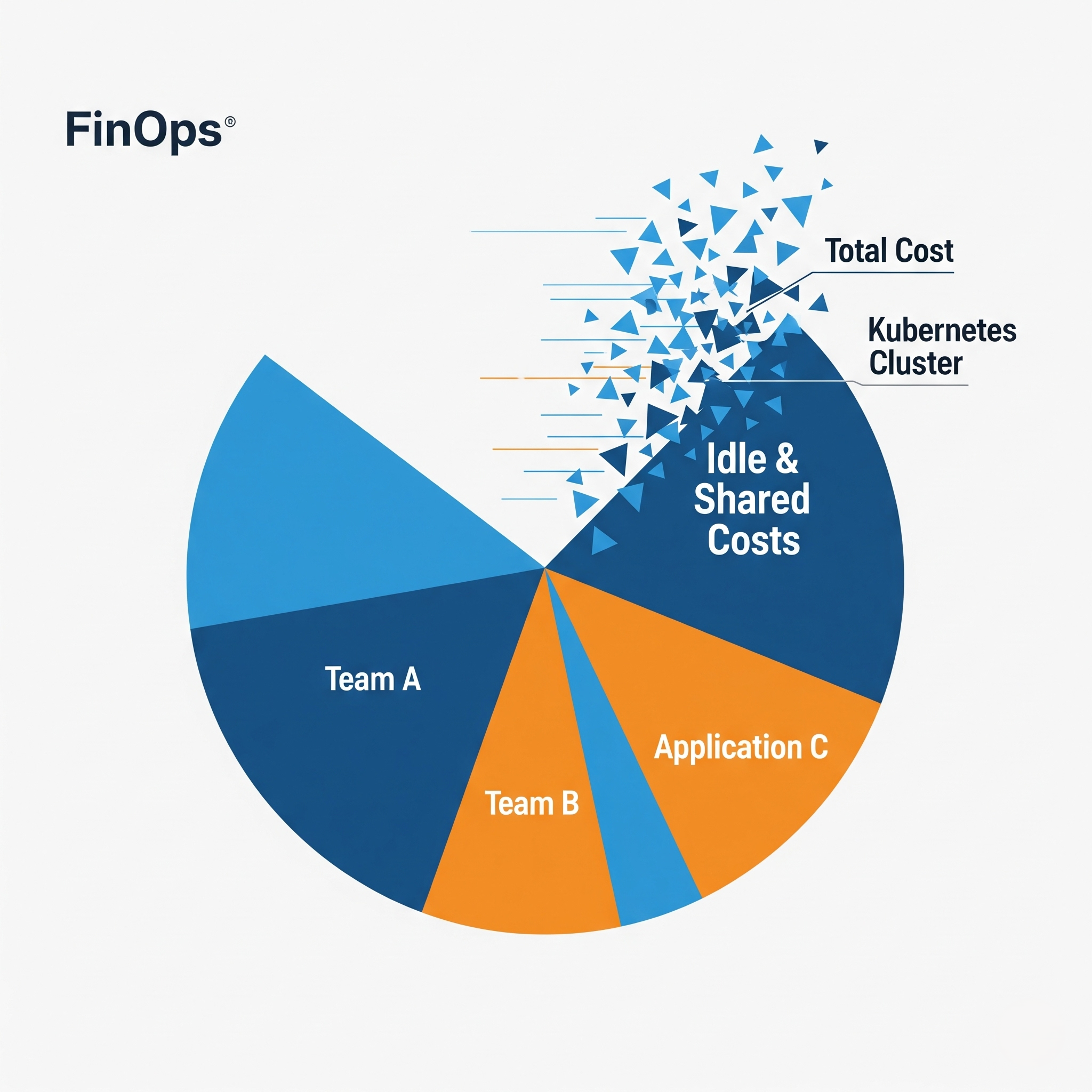
Kubernetes has revolutionized application deployment, but it has also created a massive challenge for financial accountability. Your cloud bill shows the cost of your worker nodes, but provides zero insight into which teams or applications are consuming those resources. Achieving accurate Kubernetes cost visibility is the foundation of any successful FinOps practice. This guide outlines the essential best practices to transform your cluster spend from a black box into a transparent expense.
The Core Challenge: Shared Resources
The central problem is that Kubernetes is an inherently shared platform. A single EC2 instance might run pods from multiple namespaces belonging to different teams. A robust allocation model must be based on actual consumption, not simple division.
Foundational Best Practices: Getting the Basics Right
1. Establish a Granular and Enforced Labelling Strategy
Why it Matters: Labels are the primary mechanism for attaching business context to Kubernetes objects.
Best Practices:
Define a Standard Taxonomy: Create a mandatory set of labels that must be applied to every workload (e.g., team, application, environment, cost-center).
Automate Enforcement: Use a policy-as-code engine like Open Policy Agent (OPA) or Kyverno to automatically reject any workload submitted without the required labels.
2. Organize Workloads with Namespaces
Why it Matters: Namespaces provide a logical boundary for grouping resources belonging to a single team or application. They are the primary unit for cost aggregation.
Best Practice: Assign each team or application its own dedicated namespace. This simplifies both cost allocation and security.
Advanced Allocation: A Consumption-Based Model
This requires a Kubernetes-native cost monitoring tool (like OpenCost or Kubecost).
3. Allocate Costs Based on Resource Requests
How it Works: This is the most common approach. The cost of a node is allocated to the pods running on it proportionally based on their CPU and memory requests. If a pod requests 2 vCPU on an 8 vCPU node, it is allocated 25% of that node's hourly cost.
Pros: Simple to implement and aligns with the capacity Kubernetes has reserved for the workload.
Cons: It doesn't account for actual usage. A pod that requests 2 vCPU but only uses 0.1 vCPU is still allocated the cost of the full 2 vCPU.
4. Distribute the Cost of Idle and Shared Resources
The Challenge: What do you do with the cost of a node's unallocated capacity (idle cost) or shared services like monitoring agents?
Best Practice: These costs should not be ignored. A fair model distributes these shared costs proportionally. If Team A consumes 30% of the cluster's allocated resources, they should be allocated 30% of the idle and shared costs. This ensures 100% of the cluster's cost is allocated.
5. Account for Out-of-Cluster Costs
Why it Matters: A Kubernetes application often relies on external services like an Amazon RDS database or an S3 bucket.
Best Practice: Your cost allocation strategy must extend beyond the cluster. Use a FinOps platform that can automatically associate the cost of an external database with the Kubernetes service that uses it, based on a consistent labeling strategy.
6. Implement Showback or Chargeback
The Goal: The ultimate purpose of cost allocation is to drive accountability.
Showback: The informational phase. You provide each team with a regular report "showing" their allocated costs without financial penalty to build awareness.
Chargeback: The enforcement phase. The allocated costs are formally transferred to each team's budget, creating a powerful incentive to optimize.
Conclusion
Accurate Kubernetes cost allocation starts with the foundational discipline of labeling and evolves into a sophisticated, consumption-based model. By implementing these best practices, you can demystify your Kubernetes spend, empower engineering teams with trusted data, and foster a culture where cost efficiency is a shared responsibility.
All in One Place
Atler Pilot decodes your cloud spend story by bringing monitoring, automation, and intelligent insights together for faster and better cloud operations.